Decoding the Panji of Mithila · Volume IV · Chapter 68
Bhakhrauli-Kujouli: Chikni- Purnia, Porbarauni and Haripur, Entries (565)-(572) This chapter opens the Bhakhrauli-Kujouli gramarambh
Chapter 68. Bhakhrauli-Kujouli: Chikni-
Purnia, Porbarauni and Haripur, Entries
(565)-(572)
   This chapter opens the Bhakhrauli-Kujouli gramarambh
after the Kapileshwarnath pause. The register first names the
Chikni-Purnia, Danga and Dhagjari direction, then turns to
Porbarauni, Biroti, Harinagar and finally the Haripur
continuations. The whole unit is best read as one Bhakhrauli
block because entries (565)-(572) repeatedly return to the
same Bhakhrauli stem while changing destination-villages,
marriage-routes, and branch labels. The chapter stops before
the Malangiya-Kujouli gramarambh of entry (573).

Entry (565): Bhakhrauli-Kujouli gramarambh toward
Chikni-Purnia, Danga and Dhagjari
  Entry (565) begins with the heading Bhakhrauli to Chikni-
Purnia, Danga and Dhagjari, and then explicitly says that the
Bhakhrauli-Kujouli gramarambh begins. Shubhankar is the
point of opening. His sons are Pradyumna and Abhiram, with
the first marriage-route tied through Digho-Umapati-Shyam.
Pradyumna gives Bhavesh, who is connected through
Budhwal-Krishnadev-Shivdev and Sarisab-Ramdev. Bhavesh
then gives Rudra and Nika through Soderpur-Chintamani-
Mahinath and Karmah-Devidas.
  Rudra is expanded through both principal and apara routes.
He gives Deonath and Umanath through Ekhara-Rameshwar-
Durgadatt and Pali-Bhikhari. An apara Rudra line gives
Shivnath through Pali-Hiradhi-Bodhi and Soderpur-Bachai.
Another Rudra route is tied through Karmah-Chudamani-
Ramdatt and Soderpur-Yogi. Umanath gives Lalit, Kishori,
Bhulai and Bhaiji through Pali-Karu-Saburdatt and Soderpur-
Ramkrishna. Kishori gives Nityanand, Bande and Sundar
through    Karmah-Yar-Shyamlal      and    Kujouli-Baburam.

Shivnath gives Kamaladatt through           Khaual-Jagyapati-
Lakshminath and Soderpur-Umai.
   Nika gives Amritnath through Soderpur-Bachharu-Juraun
and Sakararhi-Bhagirath. An apara Nika line gives
Vishwanath through Hariamb-Ghoghan-Toti and Belaunch-
Yadav. Amritnath is then tied through Soderpur-Gokulnath-
Jyotishi Shambhudatt and Belaunch-Chaudhary Prabhakar,
and by an apara line through Budhwal-Gonod-Harinath and
Satlakha-Lochan. Vishwanath is important because the text
gives several exits from him: through Pandua-Biku-
Shambhunath and Soderpur-Chanan; through Pandua-Rohan-
Rudramani and Soderpur-Nandishwar; through Bachchelal
with Pandua-Yogi-Dina and Ghusaut-Dhan; and through
Mohan      by     way     of    Kodariya-Parmeshwaridatt-
Bhuvaneshwaridatt and Balias-Vacha.
   The Mohan and Batahuk branches complete the entry.
Mohan is connected through Satlakha-Arjun-Lala and Pali-
Yadurai. Batahuk is an apara son of Mohan and is tied through
Khaual-Motiram-Radhavallabh and Baheradhi-Sansardhar.
Batahuk then gives a route through Balias-Hanumandatt-
Babulal, with a B-reference to Hariamb-Govardhan. The entry
also preserves Gonu through Bhadual-Mandar-Jivan-Dukhiya
and Karmah-Chan, and a Vishwanath-Bachchelal continuation
through Pali-Amritnath-Chintamani and Belaunch-Nenan.
These densely repeated routes show that the gramarambh is
not a single-line descent but a multi-route Bhakhrauli-Kujouli
matrix.

Entries (566)-(568): Porbarauni, Biroti and Harinagar
branches
  Entry (566) moves from Bhakhrauli to Porbarauni, with
Biroti also named. Abhiram gives Mahamahopadhyaya
Vagish, Madhurapati and Mahamahopadhyaya Janakinath
through    Jajival-Kaviraj-Saday and    Satlakha-Padum.

Mahamahopadhyaya Vagish gives Bachhu, Hemnath, Gani,
Jaynath and Hridaynath through Soderpur-Manhar-Gonu and
Uchati-Purushottam. Bachhu is tied through Ghusaut-Theghu-
Chhatrapati and Balias-Kashinath. Gani gives Jhingur through
Ghusaut-Chhatrapati-Bhond and Pandua-Bodh, and Jhingur
gives Baldev and Haridev through Soderpur-Bhavanidatt-
Maheshdatt and the Karmah-Bhairaveshwaridatt-Chakradhari
route, with Budhwal-Babujan added as the ddau-side.
   The same Porbarauni entry then preserves the Satyadev,
Ramdev and Krishnadev groups. Satyadev gives Suryadev and
Indradev through Digho-Ayodhyanath-Bala and Khaual-
Chaudhary Kalar. Suryadev gives Murari and Nandu through
Sakararhi-Harinandan-Shrikrishna and Alay-Chaudhary Lalji,
while Indradev is connected through Narsam-Balias-Madhav-
Achyutanand and Alay-Chaudhary Ratikant. Ramdev gives
Mahadev, Kamdev and Vishwadev through Jajival-Fuddhi-
Harikant and Budhwal-Halli. Mahadev gives Shridev, Rajdev
and Brahmdev through Hariamb-Chiranjeev-Kalikanand and
Balias-Buchan or Jaybhadra. Kamdev gives Vivekanand
through    Ghusaut-Banmali-Krishnakant     and     Khaual-
Chaudhary Devkinand. Vishwadev gives Raghudev, Ugradev
and Naval through the Gajhara-Raiyak/Soderpur-Bhavanand-
Kulanand-Gopal route and Ghusaut-Balmukund. Basudev
gives Arun Kumar and Lalit Kumar through Ghusaut-Damni-
Banmali and Narun-Anant, and Krishnadev gives Baidyanath
and Vibhutinath through Sarisab-Bhola-Shivshankar, with
Baidyanath connected through Satlakha-Hemnath-Maheshwar
and Pabouli-Raghunath.
  Entry (567) narrows the same Bhakhrauli-Porbarauni block
toward Harinagar. Hridaynath gives Khagnath and Vaiya
Krishnalal through Balias-Vidyanath-Brajnath and Ghusaut-
Umapati. Khagnath gives Radhakant and Gopikant through
Soderpur-Parmeshwar-Tufani and Babhaniam-Ranjan, while
an apara Khagnath line gives Raghunandan, Shrinandan and

Ramanandan through Darihara-Shivdatt-Khadagpani and
Budhwal-Ghananand. Radhakant gives Jagannath through
Balias-Girdhari-Bhaiyen and Hariamb-Dina; Jagannath gives
Pashupati through Bisfi-Thakur Manu-Vishweshwar and
Hariamb-Babumani. Apara Radhakant is tied through Jajival-
Parmeshwaridatt-Ramchandra and Balias-Lakshman, and
Pashupati continues through Pali-Madhav-Vishweshwar and
Soderpur-Indranand.
   Gopikant gives Komalkant through Alay-Jaylal-Chaudhary
Chumman and Pandua-Pa Thadu. An apara Gopikant line
gives Umakant through the same Jajival-Parmeshwaridatt-
Ramchandra and Balias-Lakshman route. Raghunandan gives
Kalidatt through Pali-Chandradatt-Vaiya Halli and Sarisab-
Ramkrishna. Shrinandan gives Jagdish and Parmanand
through Ghusaut-Keshavnarayan-Jagli and Pandua-Ramsevak.
Ramanandan gives Gadadhar and Baidyanath through the
Hariamb-Balias-Girdhari-M.M. Rajje and Hariamb-Dina route.
Gadadhar gives Chakradhar, Gangadhar, Shashidhar and
Mahidhar through Digaudh-Soderpur-Vidyanand-Durganand
and Balias-Hariamb-Kunjan. Gangadhar is further connected
through Analpur-Karmah-Mushan-Ramkrishna and Sanha-
Mal-Kujouli-Dwarikanath.
   Entry (568) is another Bhakhrauli-Porbarauni continuation.
Vaiya Krishnalal is tied through Belaunch-Chhaban-Nehnath
and Dighoy-Thakur Hira. Kavi Madhurapati gives Pa
Buddhijath and Dayanath through Pali-Jyotishi Gunanand-
Durgadatt and Gangoli-Lakshmikant. Pa Buddhijath gives
Babunandan through Pali-Yaduram-Mansukh and Balias-
Khagapati; Babunandan then moves through Narun-Pakhiya-
Babunath and Hariamb-Kishornath. Dayanath is tied through
Ghusaut-Chhatrapati-Dullah and Sarisab-Bhikhi, with an
apara route through Khaual-Medhakar-Brahmadatt and
Jajival-Gonan.

   Janakinath gives Eknath, Mohan or Bhaiya, Harinath and
Bhavnath through Balias-Pashupati-Durganath and Pali-
Hemashankar. Eknath gives Shrinath through Pandua-Pa
Nandishwar-Pa Chan and Pabouli-Babnu. Mohan or Bhaiya
gives Suga through Narun-Govind-Fakir and Darihara-
Vanshidhar. Harinath is tied through Sarisab-Pa Krishnadev-
Pa Chanla and Balias-Nath. Bhavnath is tied through Karmah-
Dukhan-Jyotishi Kalanath and Sarisab-Balbhadra. The learned
markers Mahamahopadhyaya, Vaiya, Jyotishi and Kavi remain
part of the genealogy and are not ornamental titles only; they
identify the remembered status of these branches.

Entries (569)-(572): Haripur, Haripur Deodhi and the
final Bhakhrauli continuations
  Entry (569) shifts the Bhakhrauli material toward Haripur
Deodhi. Chhotku gives Kulpati through Soderpur-Abhinandan-
Kamalapati and Darihara-Gang. Apara Chhotku gives
Mansukh and Hridaysukh through Khandbala-Bhavesh-
Bhoranath and Karmah-Devnath. Another Chhotku route goes
through Pali-Dharmangad-Pa Hira and Soderpur-Kamalapati.
Kulpati gives Jhadula, Nenan and Sone through Alay-Vanshi-
Mahi and Sarisab-Bhramar.
   Jhadula gives Baburaiya, Mansukh and Adinath through
Pandua-Pa Vanshidhar-Pa Achyut and Ghusaut-Chhatrapati.
Apara Jhadula gives Natthu through Khandbala-Gunanand-
Manikrishna and Mandar-Ishannath. Baburaiya is tied
through Sarisab-Ratinath-Bechan and Mandar-Ishannath; an
apara route gives Harinandan through Karmah-Jagan-
Dharanath and Sarisab-Prannath. Harinandan then uses
Mandar-Shobhnath-Bhaiyo and Tisaunt-Bhaiyo. Manbharan
gives Ramanand through Mandar-Ishannath-Ramdhan and
Soderpur-Harpati, with further apara links through Takbal-
Bachha-Ravinath and Ekhara-Muktidatt, and another
incomplete Sarisab-Shyamnath line.

   Ramanand gives Shri Mohan and Krishna Mohan through
Belaunch-Panni-Bhushan and Budhwal-Krishnapati. Shri
Mohan gives Parmanand, Indranand and Vidhanand through
Karmah-Chhota-Tantradatt, with an Uttar-Tat or U.T. reference
to Mandar-Bihari Singh. Parmanand gives Jagatanand and
Sacyutanand through Sarisab-Bachharan-Pa Luchai and
Balias-Chumman. Jagatanand gives Vinodanand, Dayanand,
Nityanand, Shivanand and further Nanda-names through
Khaual-Kulmani-Gonu and Soderpur-Jaynandan. Vinodanand
is linked through Hariamb-Shambhunath, through a daughter
line to Lutan or Chhatranath, and through Soderpur-Beninath.
The same cluster continues through daughters leading to
Girijanand-Ambikanand and through Karmah-Shri Narayan-
Ishnarayan, while one Karmah-Darihara line remains partly
dotted.
  Entry (570) is a Haripur continuation. It first closes a
preceding broken line through Balias-Maheshwar, then gives a
daughter line through Karmah-Veni Madhav-Chitranath and
Sarisab-Shambhu Gopal. Indranand gives Sharadanand and
Shyamanand      through    Digho-Raja-Mangnu    and     Pali-
Lakshminath. Apara Indranand gives Yoganand, Balanand
and Mokshanand through Khaual-Bhaylal-Kashinath and
Khaual-Durganath. Sharadanand gives Santosh through
Pabouli-Gunanand-Kalikanand       and     Mandar-Upadhyay
Ramanand. Shyamanand is tied through Khandbala-Taranath-
Thakur Shobhnath and Budhwal-Nakchedi. Balanand is linked
through Alay-Parmanand-Kumar Krishnanand Singh and
Khandbala-Thakur Kevalkrishna. Mokshanand is linked
through Karmah-Raja Tekanath-Kumar Rudranath and
Khaual-Narottam.
  Vidhanand gives Ganganand, Purnanand, Chaturanand,
Panchanand and Dharmanand through Khaual-Harinath-
Purushottam and Soderpur-Jaynandan. Ganganand gives
Rakesh    and  Mukesh  through   Sakararhi-Durganand-

Parmeshwaridatt and Karmah-Jaykrishna. Purnanand gives
Vijayanand, Ajayanand, Vinayanand and Abhayanand
through Mandar-Upadhyay Badrinath-Lilanath and Narun-
Riddhinath. Chaturanand gives Mrityunjay and Krishnanand
through Khandbala-Ganganath-Dineshnath and Hariamb-
Yaduvir. Dharmanand gives Achyut and Amit through
Khandbala-Babu Yogipati Singh-Ushanandan Singh, with the
Babu Dolpati Singh reading preserved, and Hariamb-
Punyanath. Panchanand gives Ajay and Vijay through Alay-
Kumar Krishnanand Singh-Vinayanand Singh and Pabouli-
Lalitanath.
  Entry (571) is another Haripur continuation. Adinath is tied
through Hariamb-Dullah-Lanha and Darihara-Vishnudatt. An
apara line returns to Mandar-Ishannath-Ramdhan and
Soderpur-Harpati.    Apara    Chandanand      goes   through
Babhaniam-Chhotku-Rudi and Soderpur-Maheshdatt. Other
apara lines connect through Sarisab-Nanu-Pa Jagaddhar and
Pali-Kamaladatt, and through Phanandah-Nanu-Sonelal and
Pandua-Vishwanath. Entry (572), headed simply Bhakhrauli
with the number 291, closes the block with Natthu, Sone,
Babuan and Hridaysukh. Natthu is tied through Pali-Deonath-
Hibharan and Soderpur-Babunath. Sone gives Babuan through
Khandbala-Gunanand-Panikrishna and Mandar-Ishannath.
Babuan then moves through Balias-Harinath-Mani and
Soderpur-Vighneshwar, with an apara line through Khaual-
Ghan-Hardatt and Karmah-Neya. Hridaysukh gives Kanhai
through Pali-Sonmani-Jhadula and Mandar-Bhola, with
another Hridaysukh route through Darihara-Bachharu-
Bhoranath and Belaunch-Balchandra. Kanhai closes the
available line through Ahpur-Karmah-Bakshi Gokulnath-
Bakshi Saule and Narun-Vanshidhar.

Chapter conclusion
    Entries (565)-(572) form a coherent Bhakhrauli-Kujouli
chapter. The opening Chikni-Purnia, Danga and Dhagjari
heading establishes the gramarambh; the middle Porbarauni
and Harinagar sections expand it through Abhiram,
Mahamahopadhyaya Vagish, Madhurapati, Janakinath,
Hridaynath, Khagnath and Ramanandan; and the final
Haripur sections turn the same Bhakhrauli descent through
Chhotku, Kulpati, Jhadula, Ramanand, Indranand, Vidhanand,
Adinath, Natthu, Sone and Hridaysukh. The important feature
is the constant recurrence of apara branches, dotted gaps,
titles, and route-villages: Bhakhrauli here is not a narrow
pedigree but a woven map of Kujouli, Soderpur, Karmah,
Hariamb, Pandua, Pali, Khaual, Balias, Mandar, Satlakha,
Narun, Ghusaut, Belaunch and Darihara connections. The next
chapter begins only when the source changes gramarambh to
Malangiya-Kujouli in entry (573).
Source structure and verification apparatus
Editorial source apparatus. This apparatus is descriptive, not interpretive. It records the source-controlled structure used to verify that this page corresponds to formal Chapter 68 of Decoding the Panji of Mithila — Volume IV. The chapter text above is preserved from PDF pp. 655-662; formal Chapter 68 in the commit-pinned authoritative source. It is not merged with a neighboring chapter, appendix, annexure, or independent front/back-matter unit. The internal headings below come from the repository’s source-heading inventory and are retained as navigational and audit evidence; showing them here does not turn those headings into separate publications or add claims that are absent from the source.
Internal source headings
- Entry (565): Bhakhrauli-Kujouli gramarambh toward Chikni-Purnia, Danga and Dhagjari
- Entries (566)-(568): Porbarauni, Biroti and Harinagar branches
- Entries (569)-(572): Haripur, Haripur Deodhi and the final Bhakhrauli continuations
- Chapter conclusion
Source-text concordance
Bhakhrauli-Kujouli · Chikni · Purnia · Porbarauni · Haripur · Entries · opens · gramarambh · Kapileshwarnath · pause · register · first · names · Chikni-Purnia · Danga · Dhagjari · direction · turns · Biroti · Harinagar · finally · continuations · whole · unit · best · read · Bhakhrauli · block · repeatedly · return · stem · changing · destination-villages · marriage-routes · branch · labels · stops · Malangiya-Kujouli · entry · toward · begins · heading · explicitly · says · Shubhankar · point · opening · sons · Pradyumna · Abhiram · marriage-route · tied · Digho-Umapati-Shyam · gives · Bhavesh · connected · Budhwal-Krishnadev-Shivdev · Sarisab-Ramdev · Rudra · Nika · Soderpur-Chintamani · Mahinath · Karmah-Devidas · expanded · principal · apara · routes · Deonath · Umanath · Ekhara-Rameshwar · Durgadatt · Pali-Bhikhari · line · Shivnath · Pali-Hiradhi-Bodhi · Soderpur-Bachai · Another · route · Karmah-Chudamani · Ramdatt
Boundary verification. In the formal sequence this chapter follows Volume IV Chapter 67, “Ojholi-Sagarapur-Pandoli and the Kapileshwar Pause: Entries (563)-(564)” and precedes Volume IV Chapter 69, “Malangiya-Kujouli: Tharhi, Kakraud, Mahishi, Lagma and Sanha, Entries (573)-(580) This chapter begins the Malangiya-Kujouli gramarambh”. The chapter extractor begins at the verified formal Chapter 68 marker and stops at the next verified formal chapter marker; for a final chapter it stops before recognized book-level back matter. The concordance above is generated only from distinct terms already present in this chapter’s preserved source text. It is provided for discovery, comparison, and audit, not as an automated judgment about persons, lineages, status, kinship, marriage eligibility, or historical truth.
Illustrated research apparatus
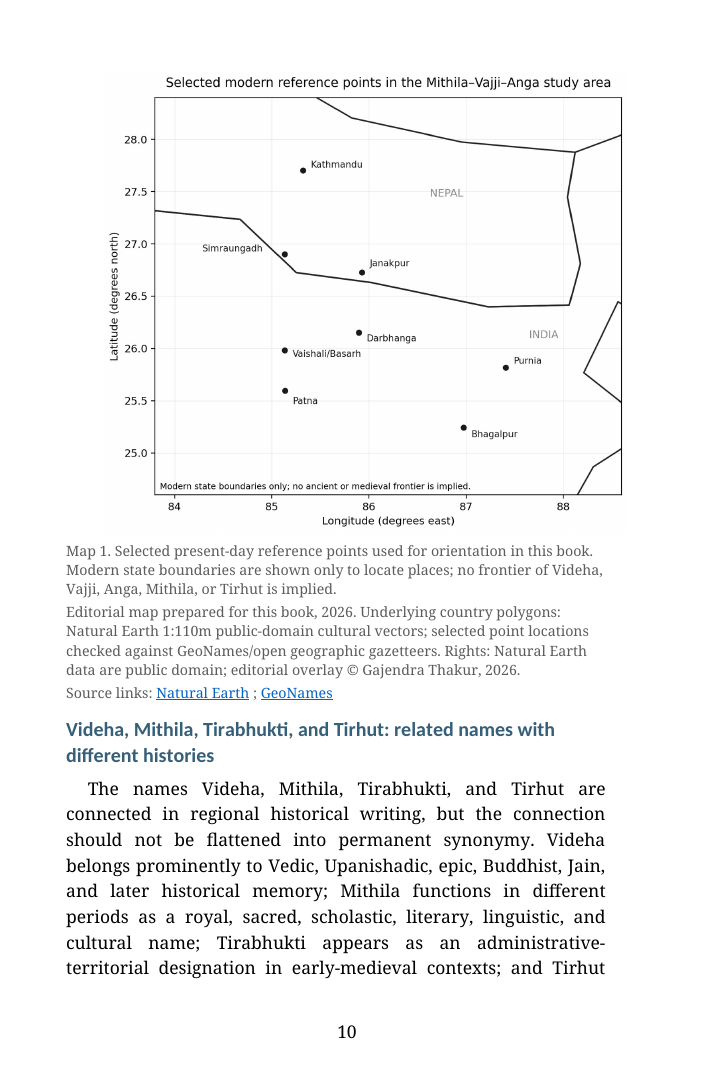
Mithila · Vajji · Anga
Chapter-specific source notes
- Primary chapter witness. Gajendra Thakur, Decoding the Panji of Mithila — Volume IV, formal Chapter 68, PDF pp. 655-662; formal Chapter 68. The HTML transcription is generated from the commit-pinned source PDF and retains the chapter boundary recorded in this edition.
- Internal structure. The repository source-heading inventory records 4 subordinate headings for this chapter: “Entry (565): Bhakhrauli-Kujouli gramarambh toward Chikni-Purnia, Danga and Dhagjari”; “Entries (566)-(568): Porbarauni, Biroti and Harinagar branches”; “Entries (569)-(572): Haripur, Haripur Deodhi and the final Bhakhrauli continuations”; “Chapter conclusion”.
- Digital editorial method. The page keeps the preserved source text distinct from generated navigational, concordance, visual, and provenance apparatus. The synthetic reconstruction is explanatory only and is not evidence for an individual lineage or a determination of social or marital status.