Decoding the Panji of Mithila · Volume IV · Chapter 69
Malangiya-Kujouli: Tharhi, Kakraud, Mahishi, Lagma and Sanha, Entries (573)-(580) This chapter begins the Malangiya-Kujouli gramarambh
Chapter 69. Malangiya-Kujouli: Tharhi,
Kakraud, Mahishi, Lagma and Sanha, Entries
(573)-(580)
  This chapter begins the Malangiya-Kujouli gramarambh
and treats entries (573) through (580) only. It is a compact but
very dense register: the first entry turns from Malangiya
toward Tharhi and Kakraud, the middle entries move through
the Mahishi and Lagma branches, and the closing entries take
the same stream toward Sanha. The chapter stops before the
Dadri-Panichobh gramarambh of entry (581).
  The key technical terms remain unchanged. The repeated
suta/suto/suata formula gives sons, daughters, and
descendants; apara identifies alternate or collateral lines; dau
and ddau preserve the two-sided marriage-route notation; B
references tie the branch to other numbered Panji units; and
dotted portions or blank route clauses mark incomplete or
suspended documentation rather than material to be silently
supplied.

Entry (573): Malangiya-Kujouli gramarambh toward
Tharhi and Kakraud
   Entry (573), invoking Vaidyanath, explicitly opens the
Malangiya-Kujouli gramarambh. Sadanand is the starting
ancestor and gives Murali. The first route is broken, but
Murali then gives Rameshwar and Dharmeshwar through
Karmah-Bhavani-Raghu and Mandar-Nirgati. Rameshwar
gives Akhiya, Bihari and Hengra through Darihara-Manhar-
Nenu and Budhwal-Narottam.
  The Akhiya line gives Shankardatt and Baduki through Pali-
Bhiravani-Kanhai and Belaunch-Bhavnath. Baduki gives
Govinddatt through Pabouli-Kalar-Bandhan and Pali-
Bhavanidatt. Govinddatt gives Sundar through Pali-Durlabh-
Bhairavi and Gangoli-M.M. Baburaiya. Sundar gives Dhudharu

and Shivnath or Phuddi through Khaual-Parshamani-
Devakinandan and Soderpur-Keshavnath. Shivnath or
Phuchchi is tied through Jagati-Pabouli-Vikram-Vaiya Kishori
and Sakararhi-Bachchu.
   The Bihari branch gives Babunath, Shyamnath and Dattu
through    Karmah-Raghudev-Juraun        and    Khaual-Chan.
Babunath is carried to the earlier Malichham-Narun material
through Gunnidhi-Pakhiya and to Pali-Rohini. Shyamnath
gives Prabhunath through Darihara-Garib-Nanu and Pali-
Nidhi. Prabhunath moves through Hariamb-Loknath-Dular
and Soderpur-Jalpadatt. Dattu gives Srinath through Karmah-
Jagan-Ganapati and Sarisab-Chhaban.
   The same entry broadens through Yadunandan,
Ganganand, Mahadev and Govind. Ganganand gives
Shrikrishna and Bachharu through Soderpur-Padmapati-
Bhavi and Satlakha-Shyam. Shrikrishna moves through
Pabouli-Jaykrishna-Gatiram and Alay-Bhavani. Bachharu
gives Sahib, Shivanandan, Jayanand, Rudradatt and
Krishnadatt through Darihara-Chaturbhuj-Indrapati and Pali-
Govinddash. Several apara lines then connect to Panichobh-
Hare-Pranapati,   Sakararhi-Shyam,    Kodariya-Parmanand-
Gangaram and Belaunch-Bandhu. Sahib gives Shashi through
Pali-Gonu-Hridi and Sarisab-Bala; Shashi gives Bhayalal and
Gopinath through Darihara-Hit-Jivanath and Pali-Kare.

Entries (574)-(576): Malangiya to Mahishi and
Mahishi-Lagma
  Entry (574), under the Kapileshwarnath invocation, moves
Malangiya to Mahishi. Bhayalal gives Shrinath, Manbharan,
Basudev and Prayagdatt through Ekhara-Bhaiyaram-Ramnu
and Soderpur-Murali-Shivdatt. A following branch gives Nand
and Buchchu through a Sarisab-Soderpur line linked with
Taradatt, Bhay or Girdhari, while another note preserves a
Narun-Godhi route. Bachchu is connected back to Teldihā-

Parhat-Sakararhi through Gopinath-Vishwanath and onward
to Pali-Hridaynath. Gopinath then passes through Jajival-
Mansukh-Bhimdatt and Pandua-Rudradatt.
   The Shivanandan branch gives Bhavanidatt and Lal
through      Budhwal-Singheshwar-Jangal     and     Pabouli-
Purushottam. Bhavanidatt gives Punyadatt and Tulsidatt
through Pali-Gangadhar-Bodh and Sarisab-Saheb. Punyadatt
gives Ramdatt, Ishdatt, Gundatt and Girijadatt through
Darihara-Subodh-Nidhipani and Karmah-Babunath, with a
further apara group Haradatt, Bhimdatt, Gurudatt and
Devidatt    through     Narun-Dhairyi-Chengan    and    Pali-
Chandradev. Ishdatt gives Kamaladatt, Shridatt, Taradatt and
Ganeshdatt through Soderpur-Bahoran-Govinddatt and a
cross-reference to the Mani line.
  Entry (575) continues Malangiya-Mahishi. Ganeshdatt gives
Kantidatt through Hariamb-Bhagirath-Ramkrishna and
Mandar-Khelanand.     Kantidatt   gives   Shashidatt    and
Bahurandatt through Sara-Mohanpur-Basuari-Balias, although
the route remains partially blank. Nageshdatt gives
Vagishdatt, Vanishdatt, Yogdatt, Bhimdatt and Kirtidatt
through    Satlakha-Jyotishi   Dwarikanath-Basudev      and
Belaunch-Sukeshwar. Vagishdatt gives Shantidatt or Raju-
Shivdatt   through    Mailan-Rajanpura-Darihara-Vidyadhar-
Kedarnath and Alay-Vishnukant; the following lines preserve
several modern or village extensions, including Ramnagar,
Behta, Basanth-Nahas-Khaual, Paramgarh-Alay-Pindaruch,
Mahishi, Mohanpur-Basuari and Bagha-Rajuri-Panichobh.
  The same Mahishi continuation gives Mannu or Gundatt
through Pali-Krishnamani-Gulab and Satlakha-Nena; Vaidik
Girijadatt  through   Sakararhi-Hridaynath-Doman     and
Soderpur-Chaturbhuj; Haradatt through Soderpur-Phani-
Shilanath and Hariamb-Bodhan; and the Mohandatt and
Umandatt     branches   through   Belaunch-Kalar-Thithar,

Budhwal-Nilambar-Mukund, Ekhara-Babulal-Srishtidhar and
Phuldaha-Pali-Musafir. The entry preserves a modern title as
Principal of T.N.B. College for Gangadatt, attached to the Bhola
or Mohandatt line.
   Entry (576) takes Malangiya-Mahishi into Lagma. Lal gives
Teknath or Bachcha, Jivanath, Ramnath, Bhaynath and
Mathuranath through Budhwal-Devkrishna-Mane and Jajival-
Gangadhar, with a further Budhwal-Saheb kasthut note. The
Jayanand line is only partially preserved through Uchati-
Pashupati-Theghi. Rudradatt then gives Babunath, Bhuvan,
Taradatt, Hemnath, Eknath and Kishornath through Jajival-
Chhokar-Viru and Pali-Ganganand. Babunath gives Keshav
through Pabouli-Dukhran-Bhavadatt and Hariamb-Barju;
Bhuvan gives Durganath and Krishnamani through Satlakha-
Narayan-Vishnudatt and Hariamb-Umanath. Durganath gives
Dinanath, Chhotku or Chandranath and Dharmanath through
Ghusaut-Ram-Lootan and Darihara-Raghunath; Dinanath
gives Kulanand and Shobhanand through Pali-Shyamnath-
Ram and Soderpur-Mitranath. The Kulanand line then extends
to Abhiraman, Revatiraman and Jayraman through Balias-
Ishdatt-Vikal and Digho-Damodar.

Entries (577)-(578): Lagma continuation and the
Badrinath heading
   Entry (577), under the Vishwanath invocation, continues
Malangiya to Lagma. Apara Chandranath gives Kumar and
Sundar through Narun-Surendra and Darihara-Lakshmikant.
Chandranath also gives Dharanath through Khaual-Sufal-
Yuvraj and Pali-Govind. Dharanath gives Vidyanath,
Kantinath, Shantinath and Badrinath through Ghusaut-
Mukund-Hiramani and Darihara-Gulab. Vidyanath produces
the modern nicknames Gagan and Pawan; both are
represented by dotted descendant lines, while Kantinath is
tied through Phanandah-Mangu-Madhukant and Khaual-

Teknath. Kumar gives Amarnath through Pali-Balmukund-
Umanand and Balias-Shrikant. Sundar is tied through Balias-
Shardanand-Kashinath and Belaunch-Gunai, and Amarnath
through Ghusaut-Pa Gangadhar-Dwarikanath and Belaunch-
Prabhunandan.
  Entry (578), invoking Badrinath, keeps the Malangiya-
Lagma continuation. Grihimani gives Dhairyanath and
Dharmanath through Budhwal-Loknath-Dullah-Umanath-
Kechwa and Khandbala-Gopinath-Duribaya, while other
routes attach the line to Khaual-Bholi-Kanhai and Pali-
Madhunandan. Apara Grihimani lines go through Jajival-
Dharmanath-Babujan and Pali-Horil, and through Pali-Lal-
Krishnamani and Soderpur-Janakinath. Dhairyanath gives
Shashinath and Yognath through Mahi-Pali-Bacha-Bhagirath,
Soderpur-Hasnu-Shyamlal and Narun-Dullah.
   The Krishnamani and Hemnath strands are then added.
Krishnamani gives Devchandra and Ganeshchandra through
Sarisab-Dinanath-Aniruddha      and     Hariamb-Nandlal.
Devchandra gives Lakshmikant through Jamdauli-Pali-
Bachchi-Madhusudan and Sarisab-Gudar. Hemnath gives
Raghunath and Gangadhar through Karmah-Bachanu-Rama
and Darihara-Lakshmidhar. Eknath gives Nidhnath through
Satlakha-Narayandatt-Vishnudatt and Hariamb-Umanath;
Nidhnath gives Jivanath and Kalanath through Soderpur-
Brahmadatt-Mitranath and Pandua-Rudramani. Apara Eknath
gives    Ramnarayan      through    Soderpur-Bhavanidatt-
Mathuranath and Jalay-Nehal. The closing part preserves
Shilanath, Kishornath, Krishnadatt and Dharmadatt, with
Dharmadatt giving Babujan through Pali-Raghu-Mana and
Ekhara-Bhaiyaram, and an apara Ganga-Prarvad line through
Ghusaut-Ram-Vidu and Belaunch-Dharmadatt.

Entries (579)-(580): Lagma-Sanha and Sanha
  Entry (579) carries Malangiya to Lagma-Sanha. Apara
Dharmadatt is tied through Mandar-Devan-Hiranand and
Belaunch-Ratan. Babujan gives Chandramani through Balias-
Bhayan-Harisingh and Soderpur-Someshwar. Chandramani
has routes through Karmah-Loknath-Jivanath and Jajival-
Bhimdatt, and through Khaual-Bani-Nanu-Shambhudatt.
Chhakauri gives Kirtinath through a broken Soderpur route;
Kirtinath gives Vishwanath through Balias-Shitaladatt-Pyare
and Soderpur-Sardar. Mahadev gives Bhikhi through Pabouli-
Jaykrishna-Gatiram and Alay-Bhavani. Bhikhi gives Durgadatt,
Garib, Murali and Jiveshwar through Soderpur-Ramapati-
Sabhapati and Darihara-Bhagirath; Murali is tied through
Soderpur-Dhanesh-Gokulnath and Mandar-Kant.
   Govind supplies another major branch. One line goes
through Budhwal-Mahai-Vir and Satlakha-Pranapati, while an
apara Govind line gives Karu, Gangadatt and Dattana through
Satlakha-Krishnadev-Lala and Budhwal-Nandan. Karu gives
Shankardatt, Gauridatt, Badri or Devidatt, Bhavanidatt and
Bhairavdatt through Pabouli-Gatiram-Jive and Pali-Bachharu.
Gauridatt gives Ganeshdatt and Bala through Balias-
Bhagirath-Kunja      and    Baheradhi-Thakur     Maherman.
Ganeshdatt gives Dwarikadatt and Prayagdatt through
Gangoli-Pakshadhar-Chhotkani        and      Karmah-Chitra.
Dwarikadatt gives Suryakant, Devkant and Shashikant
through Jajival-Samari-Chandidatt and Kujouli-Shivnath, with
later lines for Ravindra Kumar, Devottam, Yatindra Kumar,
Mahindra Kumar, Satindra, Budh Shailendra Kumar,
Bachchan and Damna. Entry (580) then continues the Sanha
branch through Satindra Kumar, Babanu Kumar, Bachchan
Kumar,     Gauridatt-Bala-Shrinath,  Tarakant,    Ramakant,
Harikant, Dwarikant, Govind, Gopal, Shankar or Nitanand,
Adityanath, Umanand, Sharadanand, Vibhutinath, Bhavnath,
Bhairavdatt, Babulal, Mukund, Hirikant, Gangadatt, Bechan,

Fakir, Dattan, Chhotku and Gokulnath. The record ends this
chapter with Gokulnath giving Gangadatt, Mansukh and
Samidatt through Khaual-Shumtai-Mahidhar and Khandbala-
Mattri.

Chapter conclusion
   Entries (573)-(580) are therefore the Malangiya-Kujouli
chapter proper. Entry (573) establishes the gramarambh and
turns it toward Tharhi and Kakraud; entries (574)-(576) carry
the same stream into Mahishi and Lagma; entries (577)-(580)
complete the Lagma-Sanha continuation. The repeated return
to Pali, Soderpur, Darihara, Karmah, Mandar, Satlakha,
Khaual, Belaunch and Budhwal shows that this is not a simple
village list but a networked marriage-route register. The
chapter also preserves learned and modern markers--M.M.,
Vaidik, Principal, Vaiya, Jyotishi and nicknames such as
Gagan, Pawan and Bachchan--without converting them into
ordinary names. Entry (581), beginning Dadri-Panichobh,
starts a new gramarambh and is left for the next chapter.
Source structure and verification apparatus
Editorial source apparatus. This apparatus is descriptive, not interpretive. It records the source-controlled structure used to verify that this page corresponds to formal Chapter 69 of Decoding the Panji of Mithila — Volume IV. The chapter text above is preserved from PDF pp. 663-669; formal Chapter 69 in the commit-pinned authoritative source. It is not merged with a neighboring chapter, appendix, annexure, or independent front/back-matter unit. The internal headings below come from the repository’s source-heading inventory and are retained as navigational and audit evidence; showing them here does not turn those headings into separate publications or add claims that are absent from the source.
Internal source headings
- Entry (573): Malangiya-Kujouli gramarambh toward Tharhi and Kakraud
- Entries (574)-(576): Malangiya to Mahishi and Mahishi-Lagma
- Entries (577)-(578): Lagma continuation and the Badrinath heading
- Entries (579)-(580): Lagma-Sanha and Sanha
- Chapter conclusion
Source-text concordance
Malangiya-Kujouli · Tharhi · Kakraud · Mahishi · Lagma · Sanha · Entries · begins · gramarambh · treats · compact · dense · register · first · entry · turns · Malangiya · toward · middle · move · branches · closing · take · stream · stops · Dadri-Panichobh · technical · terms · remain · unchanged · repeated · suta · suto · suata · formula · gives · sons · daughters · descendants · apara · identifies · alternate · collateral · lines · ddau · preserve · two-sided · marriage-route · notation · references · branch · numbered · units · dotted · portions · blank · route · clauses · mark · incomplete · suspended · documentation · rather · material · silently · supplied · invoking · Vaidyanath · explicitly · opens · Sadanand · starting · ancestor · Murali · broken · Rameshwar · Dharmeshwar · Karmah-Bhavani-Raghu · Mandar-Nirgati · Akhiya
Boundary verification. In the formal sequence this chapter follows Volume IV Chapter 68, “Bhakhrauli-Kujouli: Chikni- Purnia, Porbarauni and Haripur, Entries (565)-(572) This chapter opens the Bhakhrauli-Kujouli gramarambh” and precedes Volume IV Chapter 70, “Dadri-Panichobh, Nanour- Parasarma, Brahmoli and the Birpur- Panichobh Notice: Entries (581)-(588)”. The chapter extractor begins at the verified formal Chapter 69 marker and stops at the next verified formal chapter marker; for a final chapter it stops before recognized book-level back matter. The concordance above is generated only from distinct terms already present in this chapter’s preserved source text. It is provided for discovery, comparison, and audit, not as an automated judgment about persons, lineages, status, kinship, marriage eligibility, or historical truth.
Illustrated research apparatus
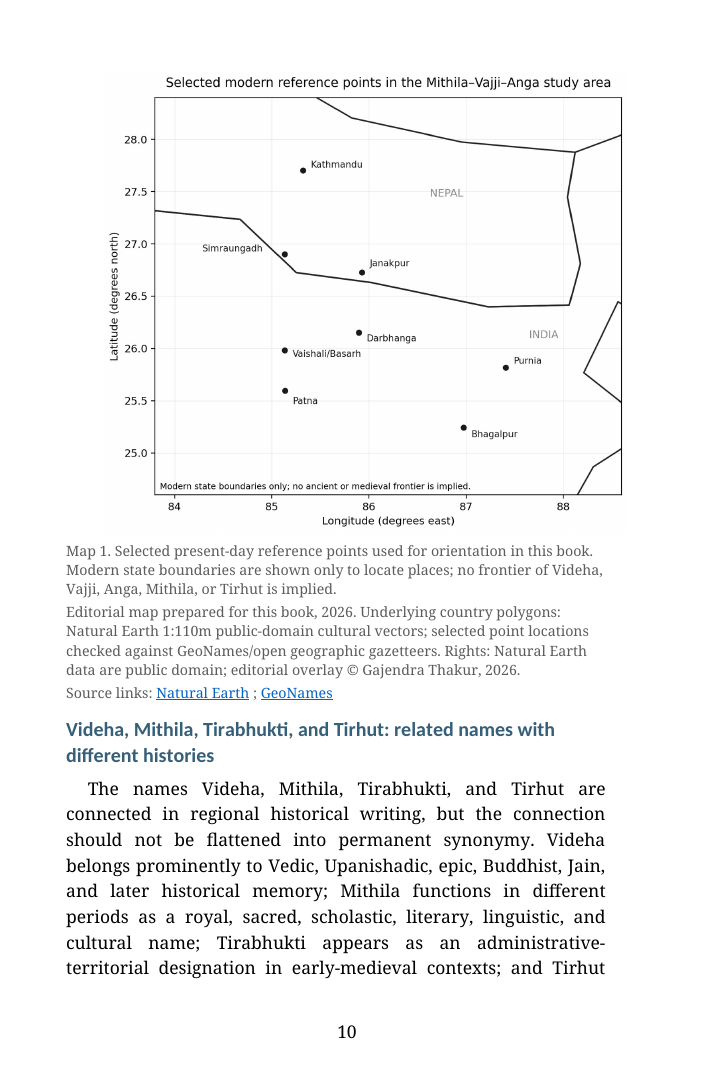
Mithila · Vajji · Anga
Chapter-specific source notes
- Primary chapter witness. Gajendra Thakur, Decoding the Panji of Mithila — Volume IV, formal Chapter 69, PDF pp. 663-669; formal Chapter 69. The HTML transcription is generated from the commit-pinned source PDF and retains the chapter boundary recorded in this edition.
- Internal structure. The repository source-heading inventory records 5 subordinate headings for this chapter: “Entry (573): Malangiya-Kujouli gramarambh toward Tharhi and Kakraud”; “Entries (574)-(576): Malangiya to Mahishi and Mahishi-Lagma”; “Entries (577)-(578): Lagma continuation and the Badrinath heading”; “Entries (579)-(580): Lagma-Sanha and Sanha”; “Chapter conclusion”.
- Digital editorial method. The page keeps the preserved source text distinct from generated navigational, concordance, visual, and provenance apparatus. The synthetic reconstruction is explanatory only and is not evidence for an individual lineage or a determination of social or marital status.