Decoding the Panji of Mithila · Volume IV · Chapter 70
Dadri-Panichobh, Nanour- Parasarma, Brahmoli and the Birpur- Panichobh Notice: Entries (581)-(588)
Chapter 70. Dadri-Panichobh, Nanour-
Parasarma, Brahmoli and the Birpur-
Panichobh Notice: Entries (581)-(588)
   This chapter follows the Malangiya-Kujouli block and opens
a new Panichobh-centred sequence. Its first numbered entry
begins with Dadri-Panichobh gramarambh; the later entries
carry the register through Nanour-Parasarma, Shivipatti,
Brahmoli-Panichobh,        Brahmoli-Bidhi,     Bisauni-Jaipur,
Brahmoli-Saurath, and finally an inserted Birpur-Panichobh
notice. The chapter is kept within this Panichobh/Brahmoli
frame and stops before the next independent Ruchauli-Ekhara
gramarambh.

Entry (581). Dadri-Panichobh to Kakraud-Harinagar
   Entry (581) begins with the invocation and the heading
Dadri to Kakraud-Harinagar, then explicitly states ath Dadri
Panichobh gramarambh. The founding line is carried through
Pashupati, whose son Ghani, also given by the practical name
Ghanshyam, is allied by a route from Soderpur through
Achyut and Aniruddha, and by a second side toward Darihara-
Parmanand. The structure immediately shows the grammar of
a Panichobh record: a local founding identity is not enough;
the entry must declare the route by which the family is joined
to neighbouring mool-lines.
   Ghani gives Khedan and Nidhi. Khedan is entered through
Soderpur-Ghanesh-Dukhran and the Pali-Raghunath side.
From Khedan come Shrishtidhar and Gokulnath. Shrishtidhar
is matched with a Baliyas route through Purandar and Jivi and
with the Karmah-Santoshi side. His own descendants include
Judaaun and Shital. Judaaun is placed by Mandar-Yadav-
Gayadatt and Ekhara-Girdhar; another Shrishtidhar branch
goes through Jajival-Hemu-Dharmanath and Mandar-Bhavi.
Judaaun then opens a Radhe line: Soderpur-Moti-Shriraman is

given, and Shriraman is continued through Hariamb-Yognath-
Bhulan and Kodariya-Kanhaiyalal.
   The Dadri register is not a single direct descent. It keeps the
apara routes visible: Judaaun has another line through Vaiya
Nirsan, connected to Baliyas-Bhaiyan-Harishankar and Pali-
Aankhi. Radha is tied to Darihara-Girdhari-Dular and Pabouli-
Siddhi; another Judaaun branch joins Khaual-Lotan-Gopinath
and Hariamb-Godan. Gokulnath then produces Mannu,
Bachchu, and Parmeshwaridatt, with Baliyas-Jivanath-
Rupnath and Sarisab-Vishram serving as one of the important
validating corridors.
  The entry then turns to Mahadev and Madhurapati.
Mahadev’s son Madhurapati is tied to Soderpur-Padmapati-
Chan and Darihara-Sundar. Madhurapati gives Rudradatt,
Jayadatt, and Yogi. Rudradatt is linked to Satlakha-Madhu-
Vaidyanath and Pali-Govindadas; Jayadatt leads to Kashinath
through Mandar-Ganapati-Sanath and Pali-Manbodh. Sanphul,
son of Krishnadatt, is carried through Baliyas-Dhani-Muni and
Soderpur-Pashupati. The register then records another
Sanphul line through Kanhai, Kujouli-Chan-Aankhi, and
Baliyas-Chhatrapati, and a further Sanphul line through
Prabhunath, Baliyas-Bandhu-Bhairav, and Pabouli-Trilochan.
The entry closes the Dadri-Harinagar piece by retaining Yogi
and Pyare as further descent points; Pyare is tied to Baliyas-
Bhavesh-Hridaynandan and Pali-Jayshiv, and to Pandua-
Sohab-Rudramani and Pali-Tota.

Entries (582)-(584). Nanour-Parasarma and the
Shivipatti continuation
  Entry (582) shifts the place-heading to Nanour, with
Parasarma also named. The initial notation begins from
Devaki and Narayan. Narayan is connected through Ekhara-
Vishwanath-Vaidyanath and Sakararhi-Bhagirath. Narayan’s
son Dharmapati is connected through Belaunch-Das-Bhairav

and Soderpur-Purandar. Dharmapati gives Jagannath and
Vidyanath. Jagannath produces Bhaynath and Umanath; his
routes include Satlakha-Kamal-Lochan, Pali-Bhikhari-Nena,
and a Jajival-Hira attachment.
   The Nanour entry is careful about collateral descent.
Bhaynath gives Durganath by Belaunch-Mansa-Girdhari and
Panichobh-Baburaiya. Durganath is then connected through
Baliyas-Toti-Vanshamani-Apuch, Didho-Sanphul-Modi, Narun-
Bhikhani-Manik, and Baliyas-Rupnath. Vidyanath is attached
to Darihara-Shridatt-Harangi and Hariamb-Jangal. The entry
then introduces Jagdish as son of Hare, with Soderpur-
Pitambar-Anant and Budhwal-Madhusudan references. Hare
gives Ramkrishna and Pranapati by Soderpur-Ramdev-
Shivdev and Baliyas-Rai Vishwanath. Ramkrishna’s sons
Pritham, Bhayas, and Bahoran are carried through Jajival-
Mohan-Devanand and Pali-Mahadev, while Pritham’s
descendants Dukhia and Bhikshuk are preserved with Khaual-
Lakshmikant-Bhangi and Soderpur-Abhiram.
   Entry (583) has no independent place-heading beyond the
invocation marker. It is a continuation of the Nanour-
Parasarma body. Judi gives Matru by Ekhara-Gunapati-
Gokulnath and Baliyas-Khadag. Mannu is tied to Khaual-
Gonod-Kashinath and Ekhara-Dukhia. Pranapati’s sons
Jivanath, Janakinath, and Motinath are entered through
Sakararhi-Moti-Shyam and Baheradhi-Lakhai. Jivanath gives
Sanphul; Sanphul gives Bhaynath and Teknath through
Ekhara-Mahidhar-Shivnath and Baliyas-Bhaiyan, with an
apara Sanphul line to Babunath via Sakararhi-Jaykrishna-
Godhi and Sarisab-Khushihal. Janakinath gives Ishwaridatt
and Lanha through Jajival-Bandi-Shuni and Pali-Bhikhi.
Ishwaridatt gives Teja and Girdhari through Soderpur-Yaddu-
Subodh and Khaual-Harihar-Balkrishna. Girdhari’s Thithar
line is repeated through Nahas-Khaual-Sitaram-Buddhinath

and Panichobh-Bachharan, showing the entry’s effort to hold
two variant route memories together.
  Entry (584) names Dadri to Shivipatti. This is a specific
continuation, not a new gramarambh. Thithar is linked with
Jagaur-Mandar-Shobhan-Tufani and Padmapur-Panichobh-
Nehal-Chandidatt. Lanha gives Baladatt and Gopal through
Khaual-Mahesh-Bhaiya-Murlidhar and Karmah-Sadashiv-
Basant, with Pabouli-Upendra added. Apara Lanha produces
Kalikadatt and Girjadatt, tied to Baliyas-Pankaj-Mahesh and
Sarisab-Ramanath. Gopal gives Vishweshwar and Shiveshwar
through Rajanpura-Darihara-Parshi-Bhaylal and Khandbala-
Bammoli. Vishweshwar gives Maheshwar, Kameshwar,
Jaykishor, Ramkishor, and Harikishor, while Digho-Ram-
Thakur Gayadatt and Ekhara-Panchu define the chief route.
The closing segment returns to Motinath, whose sons
Durgadatt and Chandidatt pass through Soderpur-
Harinandan-Trilochan and Belaunch-Sudarshan, and to
Durga’s Jhau and Jhau’s Gudar lines through Baliyas-Khadag-
Jhaua,    Tisaunt-Manai,      Sarisab-Machal-Fakiran,   and
Babhaniam-Lala.

Entries (585)-(588). Brahmoli-Panichobh, Bidhi-
Bisaubi, Bisauni-Jaipur and Brahmoli-Saurath
   Entry (585) is headed Tarouni and then states ath Brahmoli
Panichobh gramarambh. The founding line begins from
Mahadev, whose son Kangali is connected through Soderpur-
Mangu-Mahesh and Sakararhi-Mahesh. Kangali gives Visuni
by Pabouli-Mohan-Pashupati and Ekhara-Krishnanand.
Visuni’s line passes to Lakshman, whose sons Chhoke,
Sadanand, and Damodar are tied to Mandar-Mahesh-Gosain
Das and Sakouna-Hari. Chhoke gives Hiya, with Khaual-
Parmanand-Gatiram and Hariamb-Bachhai. Hiya gives Nidhi;
Nidhi gives Vaidyanath, Ramanath, and Shyamnath, through
Jajival-Badlu-Bodhram and Budhwal-Raghupati. Ramanath

has a Kujouli-Shivnandan-Lal and Budhwal-Mana route, and
an apara line to Govinddatt through Darihara-Raghunath-
Vanshidhar and Pali-Harihardatt. Govinddatt gives Awadhi,
Chumman, and Babua through Jajival-Mushari-Fakiran and
Kujouli-Shashi. Awadhi gives Pitambar and Shivkumar
through Sakararhi-Dharanath-Bhairavnath and Budhwal-
Chaudhary Kalar; Pitambar is tied to Khandbala-Radhakant-
Muni and Belaunch-Ishdatt. Chumman and Babua are both
recorded by the same Mandar-Chilka-Balki and Soderpur-
Shankarnath route.
   Entry (586), Brahmoli to Bidhi-Bisaubi, continues from
Sadanand. Sadanand gives Vike, Vaidyanath, and Saheb, with
Khaual-Gangadhar-Raghupati and Pali-Ghanapati. Vike gives
Sanphul, Hirphul, Kamal, and Manik by Mandar-Ghani-Chilka
and Karmah-Badali. Sanphul gives Shardi by Mandar-
Harishwar-Chilka and Pali-Gopal. Shardi gives Gopiraman
through    Khaual-Durgadatt-Bholanath     and    Soderpur-
Narayandatt. The branch then brings in Gauriraman, Sakhuri-
Mandar-Jagannath-Shankardatt, and Alay-Kalru. Manik gives
Pitambar through Soderpur-Madhusudan-Mahinath and
Karmah-Harikrishna, and Pitambar is matched with Baliyas-
Rudradatt-Shambhu,    Uchati-Prabhunath-Siddhinath,    and
Khaual-Narpati.
   The Damodar half of the same entry gives Loknath,
Prannath, Bhoranath, Jagannath, and Jivanath through
Sakararhi-Badal-Dukhan and Soderpur-Haridev. Loknath
gives Ratnanand, Vidyanand, Nityanand, and Jayanand
through Baliyas-Mahadev-Bhavdev and Ghusaut-Vanshi.
Ratnanand gives Meghanand and Sarvanand through
Khandbala-Purushottam-Fakir and Pali-Harinandan. Prannath
gives Yadunandan, Harinandan, and Punyanand through
Darihara-Vaidyanath-Gangesh      and        Soderpur-Hari.
Punyanand’s son Diwakar is tied to Belaunch-Tunanand-
Hridaynath and Hariamb-Dulli. Jagannath gives Guninidhi

through Darihara-Narottam-Purushottam and Babhaniam-
Bachharu. Guninidhi produces Babunath, Parashmani,
Hansmani, and Anandmani by Satlakha-Purandar-Dillu and
Soderpur-Chhabnu. Parashmani then gives Kapileshwar,
Singheshwar or Pujeri, Bhagwandatt, Dineshwar, and
Kalikadatt through Darihara-Shridatt-Jhalai and Pali-Gosain
Baburaiya.
   Entry (587), Bisauni-Jaipur, belongs to the same Brahmoli-
Bisaubi context. Kapileshwar is tied to Khandbala-Ban-
Kulmani and Sakararhi-Ishwaridatt. Singheshwar, also called
Pujeshwari in the line, gives Jaykishor through Darihara-
Parmeshwaridatt-Nityanand and Karmah-Nathe. Jaykishor is
linked to Sarisab-Bhaiya-Gokulnath and Baheradhi-Shivlal.
Bhagwandatt gives Lakshmikant, Chandrakant, Harikant, and
Radhakant through Sarisab-Revatiraman-Bhaiya and Pali-
Bachchi. The most extended route is Radhakant to Amarnath;
Amarnath gives Abhaynath, Ajaynath, Amritnath, and Ashtam
Nath through Kujouli-Chandranath-Kumar and Pali-Umanand.
Ajaynath is explicitly associated with Amarnath of Dhagjari-
Mahadev Math, then joined to Rajanpura-Darihara-Govind-
Jivanath. A further Narsinghdatt line connects Darihara-
Digambar-Vaiya Shivshankar and Digho-Muktinath, while
Gangadhar links Belaunch-Kanhaiyalal-Babua and Hariamb-
Tulsidatt.
   Entry (588), Brahmoli to Saurath, supplies a backward-
looking closure. It begins from Purushottam and Ratan,
through Darihara-Govind-Sadanand and Baheradhi-Godhai.
Ratan gives Lambu, Manbodh, Kulpati, and Yadupati through
Ekhara-Jagni-Bahudi and Karmah-Godai. Manbodh gives
Khelpati through Darihara-Sukhi-Indrapati and Panichobh-
Chakor-Bhikhi. Khelpati gives Narayandatt, Bhagwandatt,
Kewal, and Radhenooju by Soderpur-Badlu-Bhola, Panichobh-
Pranapati-Jivanath, and Darihara-Garib. Kulpati is tied to
Soderpur-Chhatu-Machal, Baliyas-Purushottam-Matinath, and

Budhwal-Vaidyanath. Aniruddha gives Govind through
Pabouli-Ratinath-Shubhakar and Tankbal-Mohan. Govind
gives an apara group of Babnu, Gokulnath, Prabhunath, and
Anath through Mandar-Dharadhar-Basudev and Panichobh-
Lakshman-Sadanand. Gokulnath gives Babujan by Mandar-
Chan-Khadgapani and Kujouli-Daun; Babujan joins Darihara-
Shridatt-Bhaldu and Pali-Gosain Baburaiya. Anath repeats a
Mandar-Chan-Khadagpani route, again ending with Kujouli-
Daun. This repetition is not redundant; it shows the copied
and cross-checked character of this register.

The interposed Birpur-Panichobh notice
   After the numbered Brahmoli-Saurath entry and before the
next Ruchauli-Ekhara gramarambh, the source inserts an
unnumbered notice headed Birpur-Panichobh, Akaur, with a
Mehath-Jhanjharpur association. This notice is genealogically
modern in tone. It opens with Thakur Manoj, then passes
through Jhingur, Lattar, and Jaykalit. Jaykalit gives Nityanand
and Engineer Kripanand. Nityanand’s children are Vijay,
Asim, and Vinay. Vijay gives Rajan and Sajan, and the notice
preserves a modern marriage/daughter link through Srimati
Rita and Sweety, wife of I.A.S. Pradeep Kumar. Asim gives
Shubhrajyoti and the daughter-line Puja and Bunty. Engineer
Kripanand gives Jitendra and Gajendra, with Sethy-
Abhayanarayan, Srimati Lakshmi, Srimati Nilima of
Rudrapur,      and    associated     Pabouli      poet    Ramji
Chaudhary/Durganand-Dukhia and Engineer Shri Mohan
lines. Jitendra’s daughter-line includes Bhawanipur-Uday
Kumar Jha and Srimati Shalini with Swastika. Gajendra is
linked     through    Om,     Jageli-Pilkha-Mandar-Gaurikant-
Sudhirchandra, and Belsam-Budhwal-Jaykrishna, with Srimati
Preeti and Sushri Astha recorded. The passage demonstrates
how a Panji register can extend into modern professions and

named daughter-lines without abandoning the older route
logic.

Interpretive conclusion
  Chapter 70 is therefore a bridge chapter. Its first half
completes the Dadri-Panichobh and Nanour-Parasarma
material, including Shivipatti. Its middle section opens
Brahmoli-Panichobh and takes it through Bidhi-Bisaubi,
Bisauni-Jaipur, and Saurath. Its final unnumbered notice
shows the same register accommodating modern names,
professions, and female-linked alliances. The next chapter
begins a separate Ruchauli-Ekhara gramarambh and should
not be merged with this Panichobh/Brahmoli block.
Source structure and verification apparatus
Editorial source apparatus. This apparatus is descriptive, not interpretive. It records the source-controlled structure used to verify that this page corresponds to formal Chapter 70 of Decoding the Panji of Mithila — Volume IV. The chapter text above is preserved from PDF pp. 670-677; formal Chapter 70 in the commit-pinned authoritative source. It is not merged with a neighboring chapter, appendix, annexure, or independent front/back-matter unit. The internal headings below come from the repository’s source-heading inventory and are retained as navigational and audit evidence; showing them here does not turn those headings into separate publications or add claims that are absent from the source.
Internal source headings
- Entry (581). Dadri-Panichobh to Kakraud-Harinagar
- Entries (582)-(584). Nanour-Parasarma and the Shivipatti continuation
- Entries (585)-(588). Brahmoli-Panichobh, Bidhi-Bisaubi, Bisauni-Jaipur and Brahmoli-Saurath
- The interposed Birpur-Panichobh notice
- Interpretive conclusion
Source-text concordance
Dadri-Panichobh · Nanour · Parasarma · Brahmoli · Birpur · Panichobh · Notice · Entries · follows · Malangiya-Kujouli · block · opens · Panichobh-centred · sequence · first · numbered · entry · begins · gramarambh · later · carry · register · Nanour-Parasarma · Shivipatti · Brahmoli-Panichobh · Brahmoli-Bidhi · Bisauni-Jaipur · Brahmoli-Saurath · finally · inserted · Birpur-Panichobh · kept · within · frame · stops · next · independent · Ruchauli-Ekhara · Kakraud-Harinagar · invocation · heading · Dadri · explicitly · states · founding · line · carried · Pashupati · whose · Ghani · given · practical · name · Ghanshyam · allied · route · Soderpur · Achyut · Aniruddha · second · side · toward · Darihara · Parmanand · structure · immediately · shows · grammar · record · local · identity · enough · must · declare · family · joined · neighbouring · mool-lines · gives · Khedan
Boundary verification. In the formal sequence this chapter follows Volume IV Chapter 69, “Malangiya-Kujouli: Tharhi, Kakraud, Mahishi, Lagma and Sanha, Entries (573)-(580) This chapter begins the Malangiya-Kujouli gramarambh” and precedes Volume IV Chapter 71, “Ruchauli-Ekhara, Oda-Ekhara and Khadka-Ekhara: Entries (589)-(597) This chapter begins after the Dadri-Panichobh and”. The chapter extractor begins at the verified formal Chapter 70 marker and stops at the next verified formal chapter marker; for a final chapter it stops before recognized book-level back matter. The concordance above is generated only from distinct terms already present in this chapter’s preserved source text. It is provided for discovery, comparison, and audit, not as an automated judgment about persons, lineages, status, kinship, marriage eligibility, or historical truth.
Illustrated research apparatus
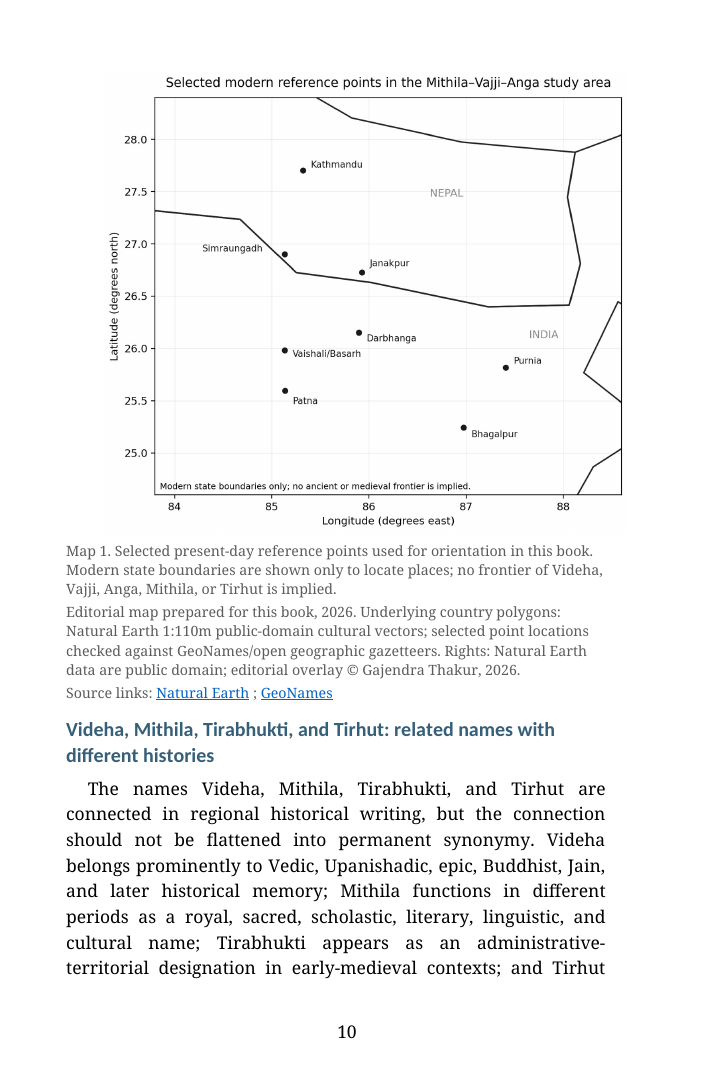
Mithila · Vajji · Anga
Chapter-specific source notes
- Primary chapter witness. Gajendra Thakur, Decoding the Panji of Mithila — Volume IV, formal Chapter 70, PDF pp. 670-677; formal Chapter 70. The HTML transcription is generated from the commit-pinned source PDF and retains the chapter boundary recorded in this edition.
- Internal structure. The repository source-heading inventory records 5 subordinate headings for this chapter: “Entry (581). Dadri-Panichobh to Kakraud-Harinagar”; “Entries (582)-(584). Nanour-Parasarma and the Shivipatti continuation”; “Entries (585)-(588). Brahmoli-Panichobh, Bidhi-Bisaubi, Bisauni-Jaipur and Brahmoli-Saurath”; “The interposed Birpur-Panichobh notice”; “Interpretive conclusion”.
- Digital editorial method. The page keeps the preserved source text distinct from generated navigational, concordance, visual, and provenance apparatus. The synthetic reconstruction is explanatory only and is not evidence for an individual lineage or a determination of social or marital status.