Decoding the Panji of Mithila · Volume IV · Chapter 76
Mardari-Baliyas and Sakuri- Baliyas: Entries (621)-(624)
Chapter 76. Mardari-Baliyas and Sakuri-
Baliyas: Entries (621)-(624)
1. Where Chapter 76 begins
Chapter 76 begins at entry (621), immediately after the Kako-Halo
and Satlakha-Belaunch continuation of Chapter 75. The new entry opens
with the invocation “ॐ नम:” and then announces a new field: “ अथ माड़रि
बलियास ग्रामाराम्भ.” This is not a continuation of the preceding Kako-Halo
unit. It is a fresh Mardari-Baliyas village opening, and therefore
deserves a separate chapter.
The natural boundary for this chapter is entries (621)-(624). Entries
(621)-(622) form the Mardari-Baliyas body; entries (623)-(624) move to
Sakuri-Baliyas and the Jyotishi Jaymant Jha line. Entry (625) then begins
“अथ नरसाम ग्रामारम्भ,” a new Narsam-Baliyas field, so it is held for the next
chapter.
2. Entry (621): the Mardari-Baliyas opening
Entry (621) opens the Mardari-Baliyas gramaramabh through Pandit
Rai Padankit Raghunandan. Raghunandan gives Chaturbhuj and
Shubhankar through Pali-Chhinu and Mandar-Jadu. The title phrase
“Pandit Rai Padankit” is important because it places the line in a
remembered status register while the ordinary Panji grammar
continues to work through sons, daughters and marriage routes.
Apara daughters or branches then carry Shankar, Bandi and
Vishwanath through Karmah-Madhav and Khaual-Gauri. Another apara
son, Lakshmipati, is tied through Karmah-Raghunath and Jajival-
Bhagirath. The source also preserves a damaged apara line through
Karmah and Lakshmipati; the dotted portion is not to be filled by
conjecture, but its presence matters because it shows that the Mardari
entry preserves more than one collateral opening.
Rai Chaturbhuj gives a line through Budhwal-Gopi-Shyam and
Darihara-Chakrapani. Rai Baidyanath gives Rai Chan through Soderpur-
Pitambar and Hariamb-Hrishikesh. Rai Chan then gives a Karmah-
Bhavesh route and a Kujauli-Kavi Gangadas route. The term “kavi” must
be retained as a status marker inside the genealogy, not separated from
the line.
Rai Harichhava is attached through Sarisab-Babu-Hrishikesh and
Khaual-Bhavanand. Harishwar passes through Soderpur-Rambhadra-
Bhagirath and Khaual-Lakshman. Rai Shubhankar gives Pitambar
through Ghusaut-Narhari and Pabouli-Larvami; Rai Pitambar then
continues through Soderpur-Raghuram and Sakararhi-Kishai.
The entry next returns to Rai Shankar. Rai Shankar gives Mahesh,
Nayan and Bhora through Soderpur-Thedh-Gosain Dash and Karmah-
Babu. Another Rai Shankar route goes through Pabouli-Gop-Ramapati
and Budhwal-Baidyanath. Rai Mahesh gives Shri Krishna, Nityanand
and Kamalakant through Karmah-Padmanabh-Chaturbhuj and
Soderpur-Bhikshuk.
Shri Krishna gives Mahipani through Pali-Yadunath-Lakshman and
Sarisab-Dash. Nityanand is tied through Pali-Vishwanath-Harijiv and
Mandar-Ramapati. Kamalakant gives Jiveshwar through Pali-Bhoj and
Darihara-Bahuri. Jiveshwar gives Vanshdhar through Soderpur-
Umanand and Karmah-Jaykrishna. The first entry therefore creates a
long Mardari-Baliyas frame in which titled Rai lines and ordinary village
routes remain inseparable.
The close of entry (621) still remains within Rai Shankar’s wider field.
A Karmah-Chhabanu-Kala route is tied to Sarisab-Bhikhiya; Rai Nayan
gives Hemangad, Bachharu, Ghanesh and Bhuvanesh through Pali-
Ananr and Satlakha-Rambhadra. Rai Hemangad gives Ramchandra,
Vagish, Bhavanath and Prannath through Karmah-Vamdev and
Khandwala-Raghunath. Ramchandra is attached through Kujauli-
Shriram-Jagannath and Pali-Yashodhar. Rai Vagish gives Chintamani
through Pabouli-Kamal-Bhitrakar and Mandar-Mahipati. This prepares
the entry (622) continuation around Rai Chintamani.
3. Entry (622): Mardari continuation through
Chintamani and Gangesh
Entry (622) continues Mardari rather than beginning an unrelated
field. Rai Chintamani gives Bokan, Vighnesh, Mangalesh and Dinesh
through Ghusaut-Chanan-Bhaiya and Kodariya-Bhavani Datt. An apara
Chintamani line goes through Khandwala-Bandhu-Durgadatt and Pali-
Manbodh. Rai Bokan is then tied through Jajival-Shubhpat-Ankhi and
Ekhara-Abhiram.
Rai Bhavanath gives Rupnath through Budhwal-Abhiram-Fakir and
Sarisab-Chaturbhuj. Rai Rupnath gives Mohanlal through Khandwala-
Manchit and Darihara-Subodh. Rai Mohanlal gives Rai Gangesh through
Budhwal-Hemnath-Babulal and Sarisab-Bathan. This sequence makes
Bhavanath, Rupnath, Mohanlal and Gangesh a central descent channel
in the Mardari continuation.
Rai Gangesh gives Shri Krishna and Devkrishna through Jalay-
Pyarelal-Sarvanarayan and Jajival-Devidatt. Apara Gangesh lines are
then preserved through Karmah-Babulal-Yashodhar and Pabouli-
Narsingh, and again through Soderpur-Budhan-Madhusudan and
Ghusaut-Muni. The repetition of apara signals does not weaken the
genealogy; it marks parallel lines that should be read as collateral routes
rather than as one simplified descent.
The entry then moves through Rai Prannath, Rai Dhanesh and
Peman. Rai Prannath gives Teknath through Soderpur-Chilka and
Budhwal-Madhurapati. Rai Dhanesh is attached through Soder-
Madhusudan and Pali-Narayan. Apara Peman returns to Karmah-
Vamdev and Khandwala-Raghunath. The source then preserves a
striking apara Peman route in which Shandilya-gotra and Apur-Karmah-
Gokulnath are mentioned before the Darihara-Kala close. This is a gotra
note embedded in the route grammar, and it should be preserved
without over-expanding it.
The final part of entry (622) gives Pakhia. Pakhia is tied through Pali-
Sonmani-Jhadula and Mandar-Bhola. Pakhia then gives Raghunath,
Babulal, Shrinath, Gopinath and Lalitnath through Gaur-Soderpur-
Bhanjan-Nityanand and Budhwal-Radhav. Rai Babulal gives Gulab
through Darihara-Gauridatt, and Rai Gulab is tied to Hati-Soderpur-
Manohar. This closes the Mardari-Baliyas body before the source turns
to Sakuri.
4. Entry (623): Sakuri-Baliyas and Jyotishi Jaymant Jha
Entry (623) begins “सकु री सँ कै लख ज्यो. जयमन्त झा” and then opens “अथ
सकु री बलियास ग्रामारम्भ.” The heading makes two things clear: the field has
shifted from Mardari to Sakuri, and Jyotishi Jaymant Jha is the
memorable named point through which part of this Sakuri-Baliyas
material is to be read.
Bhikhu gives Raja, Pritinath, Ramnath, Ganesh, Parnamak, Harinath,
Pitambar, Chhotai and Chaturbhuj through Bamniyam-Gyan-Purakhu
and Belaunch-Mukund. Raja gives Harpati and Krishnapati through
Ekhara-Ramanand and Sakararhi-Raghunath. Harpati is tied through
Gangoli-Pritinath-Bhangat and Baliyas-Mahanth.
Chaturbhuj gives Bachharu, also called Umapati, through Budhwal-
Dharani and Darihara-Pati. Bachharu gives Machal through Uchati-
Madani-Vishwanath and Baliyas-Gunakar. Machal then gives
Chandradatt, Shriraman, a damaged or difficult Ji/Jikhkhan reading,
Jagmohan and Ramdhan through Pali-Bhavaland-Pradyumna and
Baliyas-Girish.
Several apara Machal routes follow. One gives Babunath through
Babhaniyam-Ratanu-Mannu and Mandar-Shobhakar. Another goes
through Malichham-Baheradhi-Chhotai-Sonmani and Soderpur-Ratanu.
A further branch gives Jagatnarayan, Kirti, Gopi and Prayagdatt through
Digho-Paran-Balkaram and Pali-Manbodh. The repeated Babunath and
Malichham-Baheradhi references show that the source is preserving
alternate or repeated collateral routes, not a polished narrative.
The entry then turns to Maho Jirakvan, who gives Ravushar, Modi
and Raveli through Kako-Belaunch-Gujar-Buddhi and Pali-Bacha. Apara
Yadunath is attached through Khadka-Ekhara-Haldhar-Teknath and
Khandwala-Viti. Maho Khushas gives Vasant, Sachanu also called
Shrikant, and Hemant through Karmah-Rama-Venidatt and Darihara-
Kanhai.
Sachanu, also remembered as Shrikant, gives Jyotishi Jaymant
through Nawani Badhi, Pabouli-Bhaiyo-Babujan, Raghuwansh and
Mahnaura-Khaual-Nakchedi. Jaymant gives Gopal Chandra, Bharat
Chandra, Shatrughna and a Yamsam-Mahia/Soderpur-Bhai-Feku-
Kamalakant route, with Pandol-Jamdauli-Pali-Basudev at the end. Gopal
Chandra gives Krishnachandra through a dotted, incomplete route;
Bharat Chandra is tied to Mangarath and Khuhi-Khandwala-
Vishwambar Thakur; Shatrughna is tied through Khongur-Maheshwar.
The close of entry (623) returns to Hemant, Modi, Yadunath and
Ramdhan. Hemant gives Rajanikant through Budhwal-Lali-Dukhmohan
and Mandar-Balki. Modi is tied through Hariamb-Ramadatt and Pandua-
Badrinath. Yadunath is linked through Khandwala-Jikhkh and Karmah-
Radhav. Ramdhan is tied through Karmah-Chitradhar-Mannu and
Satlakha-Dharnidhar. This completes the principal Sakuri-Baliyas and
Jaymant Jha body.
5. Entry (624): Sakuri continuation
Entry (624) is short but important because it prevents entry (623)
from ending too abruptly. It continues Sakuri through Jagatnarayan,
Kirti and Siddhi. Jagatnarayan gives Yashodhar through Panichobh-
Harishwar-Bhikari and Mandar-Premnath. Kirti gives Siddhi through
Khandwala-Sudi-Devidatt and Mandar-Nandinath.
Siddhi gives Kheli, also called Bhalok, and the source marks him as a
Tarauni resident, but the route itself is partly dotted and incomplete.
The entry then closes with Bhola giving Mahadev and Shambhudev.
Since entry (625) starts a new Narsam-Baliyas gramaramabh, entry (624)
should be treated as the final small continuation of the Sakuri chapter.
6. Reading Chapter 76 as a single movement
Chapter 76 has two balanced halves. The first half, entries (621)-(622),
is Mardari-Baliyas. It is marked by Rai titles, Pandit and Kavi status
terms, and repeated routes through Pali, Mandar, Karmah, Jajival,
Budhwal, Darihara, Soderpur, Ghusaut, Pabouli, Sarisab and
Khandwala. The second half, entries (623)-(624), is Sakuri-Baliyas. It is
marked by Jyotishi Jaymant Jha, by the movement from Bhikhu to Raja,
Harpati, Chaturbhuj, Bachharu, Machal, Jaymant and Rajanikant, and by
repeated apara routes that must be preserved without forced
simplification.
The chapter also shows how title and profession fit inside Panji
grammar. Rai, Pandit, Kavi and Jyotishi are not ornamental labels. They
explain why certain persons were memorable while still being anchored
to “sut,” “suta,” village routes and marriage connections. The safest
reading is therefore not to isolate titles from genealogy, but to keep title,
descent and place-route together.
The damaged readings and dotted places are also part of the
evidence. The Mardari section has incomplete apara lines; the Sakuri
section has difficult readings around the Machal and Jyotishi Jaymant
routes. These should remain marked as uncertain rather than be silently
repaired. The aim is to decode the Panji, not to invent a smoother family
tree.
Chapter conclusion
Entries (621)-(624) complete a coherent Mardari-Sakuri chapter.
Entry (621) opens Mardari-Baliyas through Pandit Rai Padankit
Raghunandan and the Rai Chaturbhuj, Rai Baidyanath, Rai Shankar, Rai
Mahesh, Rai Nayan and Rai Hemangad chains. Entry (622) continues
Mardari through Rai Chintamani, Rai Bhavanath, Rai Rupnath, Rai
Mohanlal, Rai Gangesh, Rai Prannath, Rai Dhanesh, Peman and Pakhia.
Entry (623) shifts to Sakuri-Baliyas and Jyotishi Jaymant Jha. Entry (624)
provides the brief Sakuri continuation through Jagatnarayan, Kirti,
Siddhi, Kheli/Bhalok, Bhola, Mahadev and Shambhudev.
The next chapter should begin at entry (625), “ अथ नरसाम ग्रामारम्भ,”
where the source announces a new Narsam-Baliyas field.Source structure and verification apparatus
Editorial source apparatus. This apparatus is descriptive, not interpretive. It records the source-controlled structure used to verify that this page corresponds to formal Chapter 76 of Decoding the Panji of Mithila — Volume IV. The chapter text above is preserved from PDF pp. 711-716; formal Chapter 76 in the commit-pinned authoritative source. It is not merged with a neighboring chapter, appendix, annexure, or independent front/back-matter unit. The internal headings below come from the repository’s source-heading inventory and are retained as navigational and audit evidence; showing them here does not turn those headings into separate publications or add claims that are absent from the source.
Internal source headings
- 1. Where Chapter 76 begins
- 2. Entry (621): the Mardari-Baliyas opening
- 3. Entry (622): Mardari continuation through Chintamani and Gangesh
- 4. Entry (623): Sakuri-Baliyas and Jyotishi Jaymant Jha
- 5. Entry (624): Sakuri continuation
- 6. Reading Chapter 76 as a single movement
- Chapter conclusion
Source-text concordance
Mardari-Baliyas · Sakuri · Baliyas · Entries · begins · entry · immediately · Kako-Halo · Satlakha-Belaunch · continuation · opens · invocation · announces · field · preceding · unit · fresh · village · opening · therefore · deserves · separate · natural · boundary · form · body · move · Sakuri-Baliyas · Jyotishi · Jaymant · line · Narsam-Baliyas · held · next · gramaramabh · Pandit · Padankit · Raghunandan · gives · Chaturbhuj · Shubhankar · Pali-Chhinu · Mandar-Jadu · title · phrase · important · places · remembered · status · register · ordinary · grammar · continues · work · sons · daughters · marriage · routes · Apara · branches · carry · Shankar · Bandi · Vishwanath · Karmah-Madhav · Khaual-Gauri · Another · Lakshmipati · tied · Karmah-Raghunath · Jajival · Bhagirath · preserves · damaged · Karmah · dotted · portion · filled · conjecture · presence
Boundary verification. In the formal sequence this chapter follows Volume IV Chapter 75, “Kako-Babu Chhapra-Dath, Dath- Ekma, Pokhrauni-Tarauni-Pindaruch, Kako- Kailakh-Pindaruch, and Satlakha-Belaunch- Halo: Entries (615)-(620)” and precedes Volume IV Chapter 77, “Narsam-Baliyas Opening: Entries (625)-(629)”. The chapter extractor begins at the verified formal Chapter 76 marker and stops at the next verified formal chapter marker; for a final chapter it stops before recognized book-level back matter. The concordance above is generated only from distinct terms already present in this chapter’s preserved source text. It is provided for discovery, comparison, and audit, not as an automated judgment about persons, lineages, status, kinship, marriage eligibility, or historical truth.
Illustrated research apparatus
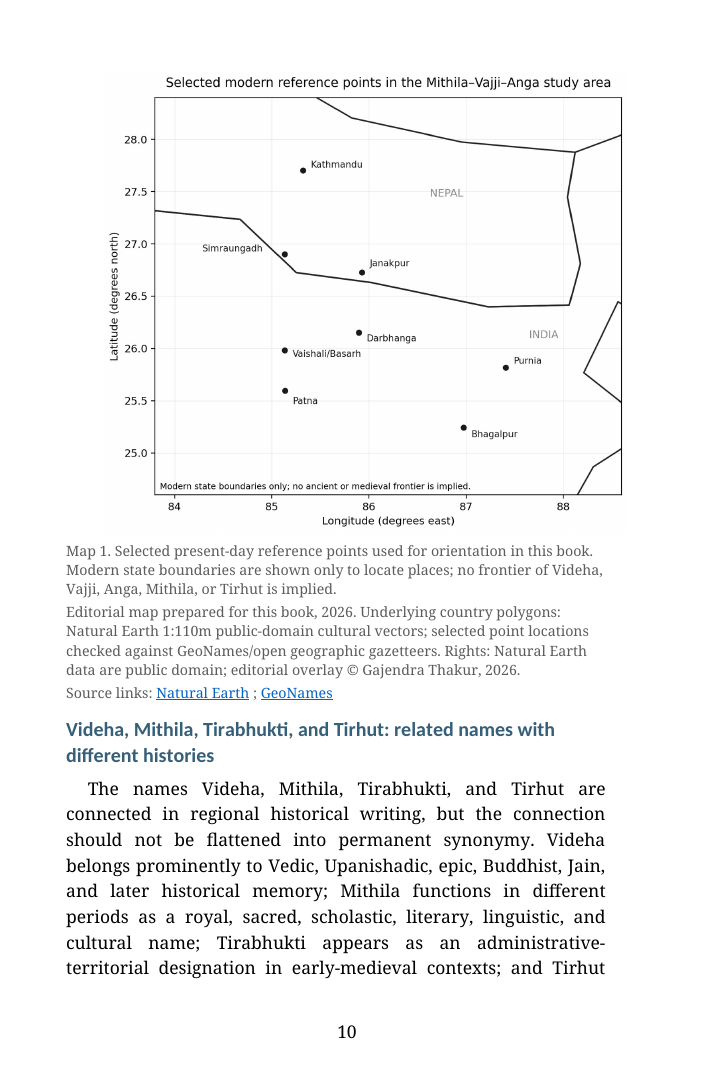
Mithila · Vajji · Anga
Chapter-specific source notes
- Primary chapter witness. Gajendra Thakur, Decoding the Panji of Mithila — Volume IV, formal Chapter 76, PDF pp. 711-716; formal Chapter 76. The HTML transcription is generated from the commit-pinned source PDF and retains the chapter boundary recorded in this edition.
- Internal structure. The repository source-heading inventory records 7 subordinate headings for this chapter: “1. Where Chapter 76 begins”; “2. Entry (621): the Mardari-Baliyas opening”; “3. Entry (622): Mardari continuation through Chintamani and Gangesh”; “4. Entry (623): Sakuri-Baliyas and Jyotishi Jaymant Jha”; “5. Entry (624): Sakuri continuation”; “6. Reading Chapter 76 as a single movement”; “Chapter conclusion”.
- Digital editorial method. The page keeps the preserved source text distinct from generated navigational, concordance, visual, and provenance apparatus. The synthetic reconstruction is explanatory only and is not evidence for an individual lineage or a determination of social or marital status.