Decoding the Panji of Mithila · Volume IV · Chapter 77
Narsam-Baliyas Opening: Entries (625)-(629)
Chapter 77. Narsam-Baliyas Opening: Entries
(625)-(629)
1. Where Chapter 77 begins
  Chapter 77 begins at entry (625), where the source leaves the Sakuri-
Baliyas continuation and opens a new field with the words “ अथ नरसाम
ग्रामारम्भ.” The heading also associates the field with Narsam, Rachandau
and Baliyas. This is a clear village-opening formula, not merely a
continuation of the preceding Sakuri material.
   The natural unit for this chapter is entries (625)-(629). These entries
form the first Narsam-Baliyas body: Raghudev, Ghanshyam, the Vaidik
Ganapati and Vaidik Kulpati lines, the Mishra branches, Vaidik Adinath,
Vaidik Kulpati’s later sons, and the Digambar-invoked continuation.
Entry (630) then opens “नरसाम सँ पडना हरिनगर,” a distinct Narsam-Padna-
Harinagar subfield, so it is reserved for the next chapter.

2. Entry (625): Raghudev, Ghanshyam, Vaidik
Ganapati and Vaidik Kulpati
   Entry (625) opens the Narsam gramaramabh through Raghudev.
Raghudev gives Ghanshyam, who is tied through Gangoli-Pitambar-
Madhusudan and Khaual-Kashipati. An apara line gives Bachharu and
Sadashiv through Pali-Maninath-Lakhai and Khaual-Damodar. The
entry therefore begins with Ghanshyam as the working node but
immediately records collateral movement.
   Ghanshyam then gives Vaidik Ganapati and Vaidik Kulpati. Their
route runs through Soderpur-Jaykrishna-Praneshwar and Pali-Ram.
Another apara son group, Muni and Peman, is attached through Pali-
Bhairav and Darihara-Govardhan. The title “Vaidik” is not decorative
here; it is an internal status marker preserved with the lineage
grammar.
   Vaidik Ganapati gives Ankhi, Vaidik Kaladhar, Rakani, Kavi Bhanu
and Vaidik Adinath through Soderpur-Purandar-Dharani and Mandar-
Badli. Kaladhar then gives Amritnath, Buddhinath, Mani and Kanhai
through Hariamb-Rameshwar and Gangoli-Kriparam. In this portion,
the same family field holds Vaidik, Kavi and ordinary descent markers
together.

   Amritnath gives Durganath, also remembered with the reading Ban,
through Sarisab-Chhitar and Darihara-Hiraphul. Apara Durganath gives
Digambar through Sarisab-Jaykrishna-Keval Krishna and Mandar-
Rudradhar. Durganath then gives Vishwanath through Karmah-
Shambhunath-Badrinath and Belaunch-Bhavi.
   The entry next gives the Mishra Bhailal or Buddhinath line. Lalitnath,
also called Batha, and Jaynath are tied through Alay-Chandrapati-
Devidatt and Belaunch-Vidyanath. Apara Buddhinath gives Apuch and
Abhayanath through Pabouli-Hemkar-Premnath and Mandar-Bhavi.
This closes the first major Narsam descent movement and leads into the
named Mishra descendants.
   Mishra Batha gives Shrinath, Bachanu also called Grihinath, Dhirnath
and Riddhinath through Ruchauli-Ekhara-Khadgmani and Sarisab-
Babunath. Shrinath is tied through Pali-Ramanath-Govind and Sarisab-
Govind. Grihinath/Bachanu carries routes through Kujauli-Eknath-
Nidhinath, Soderpur-Mitranath, Ghusaut-Darihara-Girdhari, and an
apara Narayan route through Baheradhi-Venidatt-Mayji and Soderpur-
Chaturbhuj. The end of entry (625) gives Dhirnath’s line through Hakru,
Chandranath, Maharudra, Kapileshwar, Nath and Lakshminarayan, tied
to Ghusaut-Keshavnarayan-Jaynath and Digho-Raghunath.

3. Entry (626): Narsam-Baliyas continuation through
Hakru, Jagannath, Vaikunth and Kanhai
   Entry (626) continues the same Narsam-Baliyas frame. Mishra Hakru
is tied through Pali-Shaktinath-Jhingur and Baliyas-Khushar. Mishra
Chandranath is connected through Kujauli-Haridev and Kodariya-
Chakradhari. Mishra Riddhinath gives Jagannath through Pabouli-
Musahar-Chaturbhuj and Hariamb-Manmohan.
  Jagannath gives Vaikunth through Alay-Nandlal-Pilu and Baliyas-
Devchandra. Vaikunth is then carried through Karmah-Premnath-
Amritnath and Pabouli-Gunanand. Mishra Mani gives Raja, Ravinath
and Baduknath through Ekhara-Haripani-Hridaymani and Budhwal-
Dhananand. This section preserves both Mishra and Vaidik lines within
one Narsam body.
   Apara Vaidik Kulmani gives Harinath through Pali-Parashuram-
Bhavadatt and Soderpur-Dhirnath. Raja gives Gopal and Yashodhar
through Narun-Barju-Rajmani and Hariamb-Gunanand. Ravinath is tied
through Soderpur-Chandradatt-Jangi and Darihara-Shivan. Baduknath

gives Khadganath, Ramnath and Loknath               through    Soderpur-
Chhotkinma-Kunj Bihari and Pali-Shyamlal.
   The later part of entry (626) turns to Kanhai. Kanhai gives Ishdatt,
Shivdatt and Gulab through Ekhara-Haripani-Hridaymani and Budhwal-
Dhananand. Ishdatt gives Biku, Damodar, Manohar and Thakkan
through Pabouli-Khuni-Musahar and Ghusaut-Kalanath. Biku gives
Nandkishor and Mandanu through Digho-Raghunath-Damodar and
Belaunch-Lalitnath. Damodar, Manohar and Thakkan then open routes
through Kujauli-Bhuvan, Kodariya-Mukundlal and Alay-Mitralal-
Bachcha/Ramakant.

4. Entry (627): Vaidik Adinath and the learned-title
line
   Entry (627) continues from Narsam and begins with Shivdatt.
Shivdatt is tied through Karmah-Loknath-Dayanath and Soderpur-Nanu.
The entry then turns to Vaidik Adinath, whose line carries Giridhari
through Sarisab-Bhagirath-Machal and Hariamb-Umanath.
   Giridhari gives Manbharan through Pali-Bhaura-Ghan and Mandar-
Jayarudra. The apara line then records a learned-title cluster:
Vaiyakaran Bhaiye, Sugge, Mahamahopadhyay Rajnath, and Parnamak
Rajje. This cluster is tied through Pali-Bodhi’s daughter Giridhari and
Belaunch-Sahib. The presence of Vaiyakaran and Mahamahopadhyay
shows that scholastic identity is being preserved inside the route record.
  Manbharan gives Basudev through Belaunch-Judawan-Prayagdatt
and Sarisab-Narayandatt. Other apara routes lead to Sarisab-Soderpur-
Doman, Hariamb-Nena-Dina, Pandua-Vishwanath, Soderpur-Janakinath
and Belaunch-Pranapati. Sugge is tied through Ghusaut-Ram-Nidhi and
Baliyas-Jayram, while Buchan or Jaybhadra is tied through Sarisab-
Chitar-Harshdatt and Pandua-Rudramani.
   Mahamahopadhyay Rajje gives Krishnanath and Subhadra through
Hariamb-Nena-Dina and Pandua-Vishwanath. Krishnanath is tied
through Sarisab-Harshdatt-Halli and Pali-Balmukund. Subhadra passes
through Digho-Raghunath-Damodar and Belaunch-Lalitnath, with
another apara Subhadra route through Ghusaut-Hiramani and
Kodariya-Mukundlal. This is a dense learned-family cluster and must be
read slowly.

5. Entry (628): Vaidik Kulpati’s sons and the
Bhavanath-Gopinath-Ramanath continuation
  Entry (628) begins with “श्री नरसाम” and returns to Vaidik Kulpati.
Kulpati gives Bhavanath, Gopinath and Ramanath through Budhwal-Bal
Gopal-Mahi and Khandwala-Balkrishna. Bhavanath gives Bhaiyan,
Kirtinath, Hridaynath, Shobhanath, Prabhunath and Raghunath through
Karmah-Chhabanu-Chitradhar and Pandua-Vanshidhar.
   Bhaiyan gives Harishankar through Ekhara-Purushi-Chengan and
Hariamb-Gadan. Harishankar is tied through Pali-Manbodh-Ankhi and
Jajival-Manorathi. Kirtinath gives Dinanath through Ekhara-Shivram-
Vishwanath and Brahmpur-Darihara-Bhimsen. Hridaynath gives Keshav
through Ekhara-Purushi-Chengan and Hariamb-Gongan.
   Shobhanath gives Rupnath and Halli, also called Artinath, through
Soderpur-Bandhu-Jivan and Alay-Dubari. Apara Shobhanath gives
Bhangi, also called Raghuvir, and Mahavir through Karmah-Saune-Vaiya
Kanhai and Baheradhi-Sanphul. Another apara Shobhanath line is tied
through Babhaniyam-Sahib-Ranjan and Soderpur-Poshan.
   Rupnath gives Bokan through Fanandah-Amritnath-Chunchun and
Darihara-Shambhu. Apara Rupnath gives Shatanjiv, Aniruddh and
Suresh through Digho-Chitradhar-Raghunath and Mandar-Ishannath.
Shatanjiv is linked to Pabouli-Buddhinath-Thithar and Narun-Lachchhi,
and another Shatanjiv route goes through Jamdauli-Pali-Lal-Banmali
and Satlakha-Jaylal. Aniruddh gives Bhola and Maheshi through
Pabouli-Natha-Juddhi and Pali-Krishnamani. The close of the entry
attaches Suresh and Mahesh through Hariamb-Bodhnath-Parmanand,
Narun-Jaybhani, Ghusaut-Raghunath, and Belaunch-Keshav-Girdhar
Kishor.

6. Entry (629): Digambar invocation and the final
Narsam continuation before Padna-Harinagar
  Entry (629) opens with the invocation “ ॐ दिगम्बराय नम:” and continues
Narsam. Apara Suresh gives Umesh through Ghusaut-Keshav Narayan-
Govardhan and Darihara-Girdhari. Another apara route moves through
Gangoli-Jivannath-Nandkishor and Pali-Hemnath. Feku is remembered
through a dotted or damaged line leading to Mithilesh, who is tied
through Alay-Bechanlal-Chhakauri and Khandwala-Chiranjeev.

   Mithilesh is then linked through Babhaniyam-Shivlal-Purushottam
and Soderpur-Upendra Narayan. Halli gives Baldev through Kujauli-
Rudradatt-Eknath and Satlakha-Vishnudatt. Apara Halli gives Bhua
through Soderpur-Pakhia-Modanand and Baliyas-Devanand, and
another apara Halli route goes through Digho-Bachh-Ram and Mandar-
Jamahir. Baldev continues through Digho-Raghunath-Damodar and
Belaunch-Lalitnath.
   Prabhunath is tied through Karmah-Shambhunath-Premnath and
Darihara-Chanan. Raghunath gives Bhayji, also called Siddhinath,
through Alay-Dubari-Babanu and Darihara-Nidhi. Siddhinath, also
remembered as Mayji, gives Chhedan through Belaunch-Meghan-
Hridaysukh and Bamniyam-Vanshmani. Chhedan is then linked through
Pabouli-Bathan-Savan and Pali-Sadanand.
   The entry closes by returning to Gopinath. Gopinath gives
Dhairyanath and Hemnath through Karmah-Kamalnayan-Baladatt and
Ekhara-Bala. Dhairyanath is tied through Pabouli-Kalar-Bandhan and
Pali-Bhavanidatt; an apara Dhairyanath route goes through Ekhara-Jiya-
Shankar Datt and Soderpur-Kamaladatt. Hemnath is linked through
Hariamb-Machal-Yogi and Sakararhi-Bhora. This is the last Narsam-only
continuation before entry (630) begins the Padna-Harinagar subfield.

7. Reading entries (625)-(629) as one Narsam-Baliyas
unit
   Entries (625)-(629) form a coherent first Narsam-Baliyas chapter. The
sequence begins with Raghudev and Ghanshyam, then expands into
Vaidik Ganapati, Vaidik Kulpati, Vaidik Adinath, Vaidik Kulmani,
Kulpati’s sons, and the later Mishra branches. The repeated use of
Vaidik, Kavi, Vaiyakaran, Mahamahopadhyay and Jyotishi-type markers
shows that the Narsam chapter preserves intellectual and ritual status
alongside ordinary descent.
  The main route-villages in this unit include Gangoli, Khaual, Pali,
Darihara, Soderpur, Mandar, Hariamb, Ruchauli-Ekhara, Sarisab,
Ghusaut, Pabouli, Budhwal, Alay, Belaunch, Kujauli, Kodariya, Narun,
Pandua, Khandwala, Karmah, Ekhara and Satlakha. These routes do not
merely decorate the names; they are the evidence by which each
marriage or branch connection is located.
   The chapter also contains many apara branches and damaged dotted
readings. These must remain visible in the reconstruction. Apara does

not mean minor in value; it means the Panji is preserving a collateral or
additional branch. Dotted readings do not authorize invention. They
mark places where the record is preserved as incomplete.

Chapter conclusion
   Chapter 77 decodes entries (625)-(629), the opening Narsam-Baliyas
unit. Entry (625) establishes the gramaramabh through Raghudev,
Ghanshyam, Vaidik Ganapati, Vaidik Kulpati, Kaladhar, Amritnath,
Durganath, Buddhinath, Batha, Grihinath, Dhirnath and Riddhinath.
Entry (626) continues through Hakru, Jagannath, Vaikunth, Mani, Raja,
Ravinath, Baduknath, Kanhai and Ishdatt. Entry (627) gives the Vaidik
Adinath and learned-title line. Entry (628) returns to Vaidik Kulpati’s
sons and the Bhavanath-Gopinath-Ramanath field. Entry (629) gives the
Digambar-invoked continuation through Suresh, Halli, Baldev,
Prabhunath, Raghunath, Siddhinath, Gopinath, Dhairyanath and
Hemnath.
  The next chapter should begin at entry (630), “ ॐ नरसाम सँ पडना
हरिनगर,” where the source opens a Narsam-Padna-Harinagar subfield.
Source structure and verification apparatus
Editorial source apparatus. This apparatus is descriptive, not interpretive. It records the source-controlled structure used to verify that this page corresponds to formal Chapter 77 of Decoding the Panji of Mithila — Volume IV. The chapter text above is preserved from PDF pp. 717-722; formal Chapter 77 in the commit-pinned authoritative source. It is not merged with a neighboring chapter, appendix, annexure, or independent front/back-matter unit. The internal headings below come from the repository’s source-heading inventory and are retained as navigational and audit evidence; showing them here does not turn those headings into separate publications or add claims that are absent from the source.
Internal source headings
- 1. Where Chapter 77 begins
- 2. Entry (625): Raghudev, Ghanshyam, Vaidik Ganapati and Vaidik Kulpati
- 3. Entry (626): Narsam-Baliyas continuation through Hakru, Jagannath, Vaikunth and Kanhai
- 4. Entry (627): Vaidik Adinath and the learned-title line
- 5. Entry (628): Vaidik Kulpati’s sons and the Bhavanath-Gopinath-Ramanath continuation
- 6. Entry (629): Digambar invocation and the final Narsam continuation before Padna-Harinagar
- 7. Reading entries (625)-(629) as one Narsam-Baliyas unit
- Chapter conclusion
Source-text concordance
Narsam-Baliyas · Opening · Entries · begins · entry · leaves · Sakuri · Baliyas · continuation · opens · field · words · heading · associates · Narsam · Rachandau · clear · village-opening · formula · merely · preceding · material · natural · unit · form · first · body · Raghudev · Ghanshyam · Vaidik · Ganapati · Kulpati · lines · Mishra · branches · Adinath · Kulpati’s · later · sons · Digambar-invoked · distinct · Narsam-Padna · Harinagar · subfield · reserved · next · gramaramabh · gives · tied · Gangoli-Pitambar · Madhusudan · Khaual-Kashipati · apara · line · Bachharu · Sadashiv · Pali-Maninath-Lakhai · Khaual-Damodar · therefore · working · node · immediately · records · collateral · movement · route · runs · Soderpur-Jaykrishna-Praneshwar · Pali-Ram · Another · group · Muni · Peman · attached · Pali · Bhairav · Darihara-Govardhan · title · decorative · internal
Boundary verification. In the formal sequence this chapter follows Volume IV Chapter 76, “Mardari-Baliyas and Sakuri- Baliyas: Entries (621)-(624)” and precedes Volume IV Chapter 78, “Narsam-Padna-Harinagar, Lalbag and Pindaruch: Entries (630)-(638)”. The chapter extractor begins at the verified formal Chapter 77 marker and stops at the next verified formal chapter marker; for a final chapter it stops before recognized book-level back matter. The concordance above is generated only from distinct terms already present in this chapter’s preserved source text. It is provided for discovery, comparison, and audit, not as an automated judgment about persons, lineages, status, kinship, marriage eligibility, or historical truth.
Illustrated research apparatus
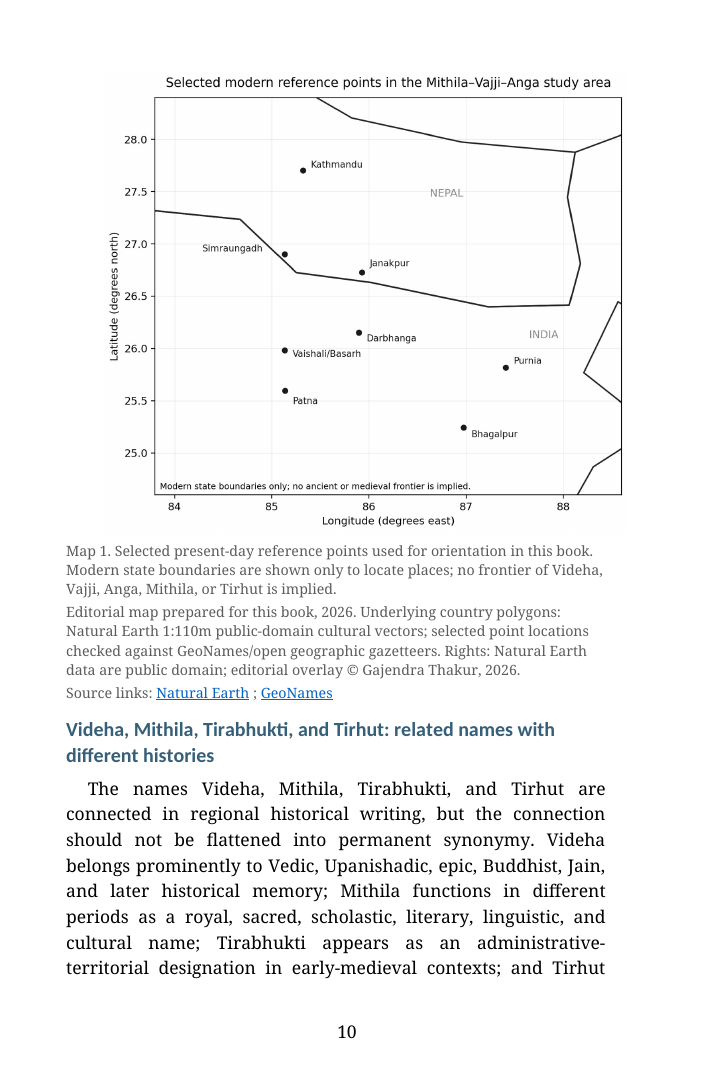
Mithila · Vajji · Anga
Chapter-specific source notes
- Primary chapter witness. Gajendra Thakur, Decoding the Panji of Mithila — Volume IV, formal Chapter 77, PDF pp. 717-722; formal Chapter 77. The HTML transcription is generated from the commit-pinned source PDF and retains the chapter boundary recorded in this edition.
- Internal structure. The repository source-heading inventory records 8 subordinate headings for this chapter: “1. Where Chapter 77 begins”; “2. Entry (625): Raghudev, Ghanshyam, Vaidik Ganapati and Vaidik Kulpati”; “3. Entry (626): Narsam-Baliyas continuation through Hakru, Jagannath, Vaikunth and Kanhai”; “4. Entry (627): Vaidik Adinath and the learned-title line”; “5. Entry (628): Vaidik Kulpati’s sons and the Bhavanath-Gopinath-Ramanath continuation”; “6. Entry (629): Digambar invocation and the final Narsam continuation before Padna-Harinagar”; “7. Reading entries (625)-(629) as one Narsam-Baliyas unit”; “Chapter conclusion”.
- Digital editorial method. The page keeps the preserved source text distinct from generated navigational, concordance, visual, and provenance apparatus. The synthetic reconstruction is explanatory only and is not evidence for an individual lineage or a determination of social or marital status.