Decoding the Panji of Mithila · Volume IV · Chapter 78
Narsam-Padna-Harinagar, Lalbag and Pindaruch: Entries (630)-(638)
Chapter 78. Narsam-Padna-Harinagar, Lalbag
and Pindaruch: Entries (630)-(638)
1. Where Chapter 78 begins
  Chapter 78 begins at entry (630), where the source marks a new
Narsam subfield: “नरसाम सँ पडना हरिनगर.” This is not merely another
Narsam continuation. The entry names Padna and Harinagar in the
heading, so the chapter opens with a more localized Narsam branch
after the broader Narsam-Baliyas opening of the previous chapter.
  The chapter covers entries (630)-(638). These entries carry the
Narsam-Padna-Harinagar line, the following Narsam continuations, the
Purushottam and Shatanjiv-Iswari Datt groups, the Lalbag-Darbhanga
branch, and the Pindaruch line connected with Nilambar Mishra and
Damuna/Mudhar Mishra. Entry (639) begins a fresh invocation and is
best kept for the next chapter.

2. Entry (630): Narsam-Padna-Harinagar
   Entry (630) opens with Vaiya Mishra Ramanath’s line. Ramanath
gives Vishnudas, Mukund, Janardan and Madhusudan through Karmah-
Chhabanu-Chitradhar and Sakararhi-Umapati. Vishnudas is tied through
Pabouli-Hemkar-Dhairyanarayan and Darihara-Devidatt. Janardan gives
the Kushahari line through Narun-Barju-Dular and Murajpur-Khaual-
Shivdatt.
   Kushahari gives Badaru through Pali-Brahmadatt-Jagmohan and
Mandar-Chhavka. Badaru is then linked through Baheradhi-Datt-Bhayji
and Soderpur-Chaturbhuj. The entry then shifts to the older numbered
strand in which Mishra Muni gives Girdhar through Soderpur-Jayi-Pati
and Alay-Anath.
  Girdhar gives Vanshidhar through Jajival-Shubhpat-Durmil and Pali-
Manbodh. Vanshidhar gives Bhai and Bhagirath through Hariamb-Nidhi
and Sakararhi-Sudhakar. The branch also records routes through
Hariamb-Kashinath-Tena, Jajival-Atmaram, Karmah-Kanhai-Jagannath,
Mandar-Bhaiyo, Pali-Devidatt-Durganath, and Khaual-Poshan.
  The second large movement within entry (630) is the Peman line.
Peman gives Chaturanand, Krishnanand, Sevanand, Gunanand,
Shobhanand and Mathuranand through Budhwal-Narottam-Devkrishna
and Bari-Darihara-Gangadhar. Chaturanand gives Bhavanand through

Gangoli-Kriparam-Pakshadhar and Pali-Chilka. Sevanand is tied through
Soderpur-Durgadatt-Jivan, and Shobhanand gives Dharaij through
Karmah-Harikrishna-Jhoti and Khaual-Bandhu-Rakan.

3. Entry (631): Bachdaru, Dharadhar, Laduri, Pankaj
and Hanumandatt
  Entry (631) continues Narsam. Bachdaru gives Dharadhar, Pankaj
and Parashuram through Babhaniyam-Gop-Kamal and Khandwala-
Sadanand. Dharadhar gives Laduri through Tisaunt-Haridev-Anand and
Baliyas-Pranapati. Rudradatt gives Shambhudatt through Narun-Gonor-
Devi and Sakuri-Sarisab-Shivdatt.
   Laduri gives Meghanath and Ishwaridatt through Soderpur-Abhiram-
Andu and Khaual-Bula. Pankaj gives Mahesh through Belaunch-Nenu-
Lakshmidhar and Darihara-Badi. Mahesh gives Hanumandatt through
Sarisab-Narpat-Ramanath and Mandar-Devan.
   Hanumandatt gives Babulal, Biharilal, Mayanath and Yashodhar
through Panichom-Janaki-Ishwaridatt and Soderpur-Subodh. Babulal
gives Lakshmikant through Hariamb-Bhulan-Govardhan and Khaual-
Prandhan. The chapter records later routes through Katka-Soderpur-
Girdhar/Yognath,    Darihara-Dular,  Haripur-Pali-Bhaiyo/Bholanath,
Sarisab-Thakurdatt, and the Sadashiv branch through Belaunch-
Padmanath-Harikrishna-Kamalapati and Budhwal-Mathura-Raghudev.

4. Entry (632): Purushottam, Raghuram, Rameshwar
and Purandar
  Entry (632) begins another Narsam continuation. Mishra
Purushottam gives Raghuram, Gunakar, Ghanshyam Datt, Ram,
Purandar and Lala through Pali-Gadu-Nagan and Ekhara-Shubhankar.
Raghuram gives Rameshwar through Belaunch-Chudamani-Bhavdev
and Panichom-Ramdev.
   Rameshwar gives Narayan through Pali-Ramkrishna-Ghanshyam and
Pandua-Bhagirath. Khadganarayan is tied through Panichom-Damodar-
Loknath and Baliyas-Bhavdev, with another route through Kujauli-
Pradyumn-Bhavesh and Soderpur-Mahinath.
  Purandar gives Nakadu, also called Pakshadhar, Karu, Shivi, Jivi and
Bhakti through Alay-Parashuram-Purushottam and Khaual-Aniruddh.
Nakadu gives Soni and Poshan through Pali-Bhagirath-Sadashiv and
Kujauli-Govind. Soni gives Batha, Ishwaridatt and Girdhari through

Narun-Ganapati-Bhikhani and Karmah-Bachdaru; another Soni route
moves through Babhaniyam-Chaturbhuj-Madhurapati and Darihara-
Dhananand. The entry closes through Shankardatt, Batha, Ishwaridatt,
and Poshan, preserving several collateral routes.

5. Entries (633)-(634): Shivi, Jyotishi Manasukh,
Aniruddh and the Trilochanath-invoked continuation
   Entry (633) continues Narsam through Shivi. Shivi gives Manasukh,
Hiran, Chan and Horil through Pali-Jaykrishna-Girdhar and Jajival-
Shubhpat. Jyotishi Manasukh gives Shyamlal through Hariamb-
Devkrishna-Bok and Sakararhi-Dinbandhu. Shyamlal gives Shriraman
and Raghunath through Karmah-Gauripati-Loknath and Baliyas-
Brajnath.
   Shriraman gives Aniruddh through Soderpur-Rohini-Durmil and Pali-
Gopal. Aniruddh is tied through Karmah-Bachharan-Saday and Sarisab-
Thadu. Apara Aniruddh gives Parmanand, Durganand and Shivanand
through Budhwal-Nandishwar-Parmeshwar and Pabouli-Jhalhan. The
same material is partly repeated in the source, showing that the Panji
transmits both the branch and its reaffirmation.
  The entry also returns to Hiran. Hiran gives Manohar, Riddhinath
and Babulal through Hariamb-Devkrishna-Bouk and Sakararhi-
Dinbandhu. Manohar is tied through Pali-Bhavanidatt-Devanath and
Soderpur-Nandishwar. Babulal gives Ram, Chaturbhuj, Banmali and
Madhusudan through Karmah-Gauripati-Loknath and Baliyas-Brajnath.
   Entry (634), opened by a Trilochanath invocation, begins with
Baidyanath. Baidyanath gives Kanhaiya, also called Bhavanath, through
Alay-Mitralal-Harikant and Baliyas-Ishdatt. Apara Baidyanath gives
Shashinath, Rajnath and Shambhunath through Soderpur-Manmohan-
Radhakant and Narun-Surendra. The entry then carries Bhavanath,
Kashinath,    Vagish,   Kusheshwar,     Kapileshwar,    Vindhyanath,
Chandranand, Purushottam, Jagdish and Jayanand through linked
routes including Digho, Darihara, Belaunch, Baliyas, Karmah, Mandar,
Sargan, Hariamb and Kujauli.

6. Entries (635)-(636): Lalbag-Darbhanga and the
Achyut-Gangadhar continuation
  Entry (635) introduces Narsam to Lalbag in Darbhanga. Mishra
Chaturbhuj gives Keshav, Padmanabh and Achyut through Pali-Sonma-

Kulmani and Belaunch-Jivannath. Padmanabh gives Bhairavdatt and
Shankar through Pabouli-Vedanand-Ramanand and Pali-Kapileshwar.
   Bhairavdatt gives a modern professional branch: a damaged doctor
entry followed by Ganapati, Dhanapati and Vijaynath. Their route is tied
through Ghusaut-Abhayanath-Durganath and Khandwala-Khedan
Singh. Dr. Ganapati, Dhanapati and Vijaynath are then carried through
Soderpur, Ghusaut, Narun and Khandwala routes. Shankar gives
Amarnath through Soderpur-Shitaladatt-Pitambar and Sakararhi-
Durganand, with further routes through Karmah-Paltan-Kashinath,
Baliyas-Harinandan, Kodariya-Deveshchandra and Mandar-Munai.
   Entry (636) continues Narsam. Achyut gives Jibu, also called
Gangadhar, through Pabouli-Ramanand and Pali-Kapileshwar.
Gangadhar gives Panchanand, Ayanand, Khadanand, Ekanand and
Shubhanand through Fanandah-Mangu-Madhukant and Khaual-
Teknath. The entry then records Panchanand through Soderpur-Umesh-
Dr. Jaykant, Gayanand’s damaged line through Pachahi, Banmali
through Pabouli-Natha-Vishwanath and Pali-Shambhudatt, Jyotishi Chan
through Soderpur-Judawan-Lal and Budhwal-Jaynath, and Horil
through Karmah-Shambhunath-Prannath and Sarisab-Shobhanath.

7. Entries (637)-(638): Vrishabhadhvaja invocation and
the Pindaruch/Nilambar Mishra branch
  Entry (637), opened with a Vrishabhadhvaja invocation, continues
Narsam through Jivi. Jivi gives Bala through Karmah-Raghudev-Santoshi
and Darihara-Purandar. Bala gives Parameshwaridatt through Ekhara-
Pururavi-Haripani and Pali-Bhavanidatt. Parameshwaridatt gives a
Hariamb-Jivan-Nanu route and a Soderpur-Raghupati route, and apara
Parameshwaridatt gives Markandey through Narun-Sahib-Baidyanath
and Pali-Shobhanath.
   The same entry records Bhavi’s sons Rudranath, Dharmanath and
Premnath through Budhwal-Ravantar-Shivdatt and Baliyas-Ganapati.
Rudranath gives Taradhar, Govind, Arjun and Babuan through
Soderpur-Bandhu-Jivan and Hariamb-Umanath. Taradhar gives
Yadunath and Raghunath through Belaunch-Dharmadatt-Bani and
Mandar-Ratneshwar, with additional Taradhar routes through Pali-
Bhavanidatt-Amritnath, Ekhara-Vishwanath, Pali-Bhavanidatt-Gopinath
and Pabouli-Prabhunath. The entry closes through Yadunath,
Mukthinath, Mushai, Upendra and Surendra.

   Entry (638) opens with a Nilakantha invocation and identifies the
branch as Narsam-Pindaruch, naming Nilambar Mishra and Damuna or
Mudhar Mishra. Surendra is tied through Narun-Manbharan-
Mukthinath and Ghusaut-Jagati. Arjun gives Bhiravam through Karmah-
Jahali-Mahapurush and Darihara-Vadan; another Arjun route gives
Marich and Yahaghar through Hariamb-Subodh-Baidyanath and
Sakararhi-Akshadhar.
   Bhiravam gives Bhupnarayan and Durvan, also called Keshav
Narayan, through Alay-Raja-Mitralal and Khaual-Nenmani. Chitaru is
tied through the same Alay-Mitralal route. Bhupnarayan’s later line runs
through     Hariamb-Lutan-Sadanand         and   Satlakha-Rameshwar.
Durvan/Keshav Narayan gives Nilambar and Yamunakant through
Karmah-Bihar-Bechan and Satlakha-Rameshwar. Nilambar is tied
through    Mahishi-Budhwal-Artinath-Kripanath      and     Khandwala-
Padmanabh. The entry closes with Chitradhar or Chitaru through Pali-
Shaktinath-Madhav and Baliyas-Babulal-Ram, and with Babuan and
Anikalal through Digho, Fanandah, Mandar, Pali and Belaunch
connections.

8. Reading entries (630)-(638) as a Narsam subfield
  Entries (630)-(638) form the second major Narsam chapter after the
Narsam-Baliyas opening. The subfield begins with Padna-Harinagar,
continues through several Narsam-only entries, reaches the Lalbag-
Darbhanga branch, and ends with the Pindaruch branch of Nilambar
Mishra and Damuna/Mudhar Mishra. This chapter therefore shows the
expansion of one village field into multiple named sublocations.
   The chapter also displays the changing texture of the Panji record.
Alongside older route-villages such as Pali, Karmah, Soderpur, Belaunch,
Darihara, Hariamb, Khaual, Sarisab, Budhwal, Alay, Mandar, Narun,
Pandua and Khandwala, the record preserves modern markers like
Lalbag in Darbhanga and medical titles. The genealogy is not static; it
keeps older descent grammar while absorbing newer social locations.
   Several entries contain repetitions, apara branches and damaged
dotted readings. These have been treated as evidence, not as errors to
erase. Where the record is damaged, the chapter keeps the uncertainty
visible rather than inventing names or routes.

Chapter conclusion
   Chapter 78 decodes entries (630)-(638). Entry (630) begins the
Narsam-Padna-Harinagar subfield through Ramanath, Janardan,
Kushahari, Muni, Girdhar, Vanshidhar and Peman. Entry (631)
continues through Bachdaru, Dharadhar, Laduri, Pankaj, Mahesh and
Hanumandatt. Entry (632) carries Purushottam, Raghuram, Rameshwar,
Narayan, Khadganarayan and Purandar. Entries (633)-(634) develop the
Shivi, Jyotishi Manasukh, Aniruddh, Baidyanath, Kashinath and
Chandranand lines. Entries (635)-(636) preserve the Lalbag-Darbhanga
and Achyut-Gangadhar continuations. Entries (637)-(638) complete this
chapter through Jivi, Bala, Parameshwaridatt, Bhavi, Rudranath,
Taradhar and the Pindaruch-Nilambar Mishra branch.
   The next chapter should begin at entry (639), the new invocation
following the Narsam-Pindaruch line.
Source structure and verification apparatus
Editorial source apparatus. This apparatus is descriptive, not interpretive. It records the source-controlled structure used to verify that this page corresponds to formal Chapter 78 of Decoding the Panji of Mithila — Volume IV. The chapter text above is preserved from PDF pp. 723-728; formal Chapter 78 in the commit-pinned authoritative source. It is not merged with a neighboring chapter, appendix, annexure, or independent front/back-matter unit. The internal headings below come from the repository’s source-heading inventory and are retained as navigational and audit evidence; showing them here does not turn those headings into separate publications or add claims that are absent from the source.
Internal source headings
- 1. Where Chapter 78 begins
- 2. Entry (630): Narsam-Padna-Harinagar
- 3. Entry (631): Bachdaru, Dharadhar, Laduri, Pankaj and Hanumandatt
- 4. Entry (632): Purushottam, Raghuram, Rameshwar and Purandar
- 5. Entries (633)-(634): Shivi, Jyotishi Manasukh, Aniruddh and the Trilochanath-invoked continuation
- 6. Entries (635)-(636): Lalbag-Darbhanga and the Achyut-Gangadhar continuation
- 7. Entries (637)-(638): Vrishabhadhvaja invocation and the Pindaruch/Nilambar Mishra branch
- 8. Reading entries (630)-(638) as a Narsam subfield
- Chapter conclusion
Source-text concordance
Narsam-Padna-Harinagar · Lalbag · Pindaruch · Entries · begins · entry · marks · Narsam · subfield · merely · another · continuation · names · Padna · Harinagar · heading · opens · localized · branch · broader · Narsam-Baliyas · opening · previous · covers · carry · line · following · continuations · Purushottam · Shatanjiv-Iswari · Datt · groups · Lalbag-Darbhanga · connected · Nilambar · Mishra · Damuna · Mudhar · fresh · invocation · best · kept · next · Vaiya · Ramanath’s · Ramanath · gives · Vishnudas · Mukund · Janardan · Madhusudan · Karmah · Chhabanu-Chitradhar · Sakararhi-Umapati · tied · Pabouli-Hemkar-Dhairyanarayan · Darihara-Devidatt · Kushahari · Narun-Barju-Dular · Murajpur-Khaual · Shivdatt · Badaru · Pali-Brahmadatt-Jagmohan · Mandar-Chhavka · linked · Baheradhi-Datt-Bhayji · Soderpur-Chaturbhuj · shifts · older · numbered · strand · Muni · Girdhar · Soderpur-Jayi-Pati · Alay-Anath · Vanshidhar · Jajival-Shubhpat-Durmil · Pali · Manbodh · Bhai
Boundary verification. In the formal sequence this chapter follows Volume IV Chapter 77, “Narsam-Baliyas Opening: Entries (625)-(629)” and precedes Volume IV Chapter 79, “Narsam: Dharmanath, Gunakar, Shalampur, Tabhka and Nagaram-Nahar: Entries (639)-(649)”. The chapter extractor begins at the verified formal Chapter 78 marker and stops at the next verified formal chapter marker; for a final chapter it stops before recognized book-level back matter. The concordance above is generated only from distinct terms already present in this chapter’s preserved source text. It is provided for discovery, comparison, and audit, not as an automated judgment about persons, lineages, status, kinship, marriage eligibility, or historical truth.
Illustrated research apparatus
Mithila · Vajji · Anga
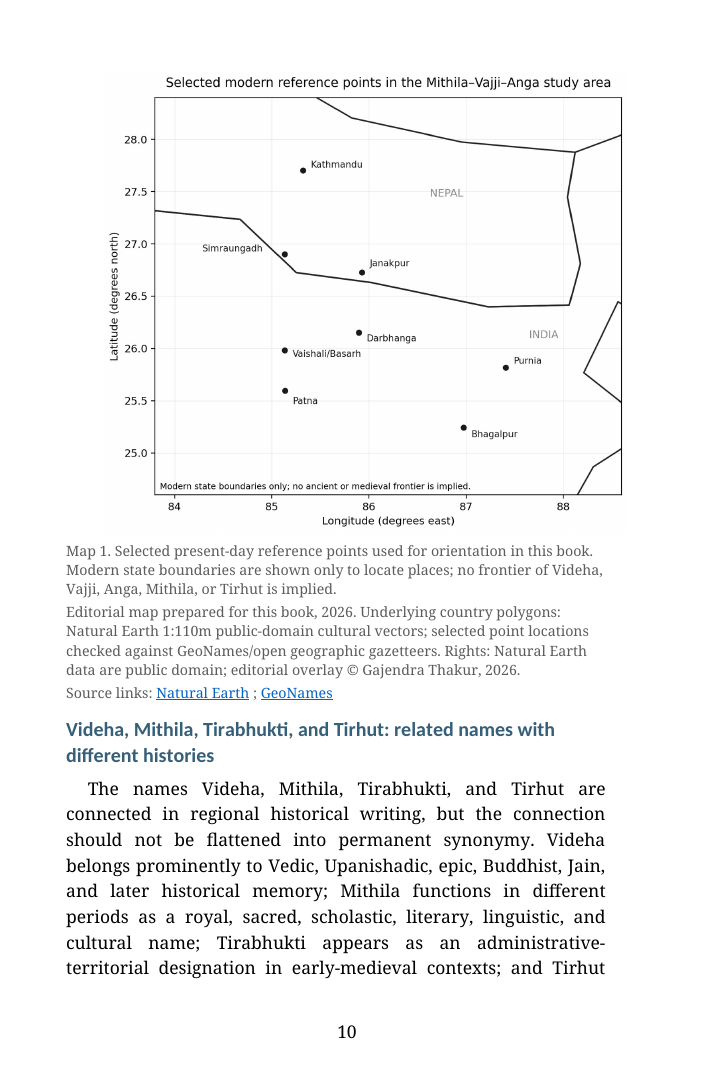
Chapter-specific source notes
- Primary chapter witness. Gajendra Thakur, Decoding the Panji of Mithila — Volume IV, formal Chapter 78, PDF pp. 723-728; formal Chapter 78. The HTML transcription is generated from the commit-pinned source PDF and retains the chapter boundary recorded in this edition.
- Internal structure. The repository source-heading inventory records 9 subordinate headings for this chapter: “1. Where Chapter 78 begins”; “2. Entry (630): Narsam-Padna-Harinagar”; “3. Entry (631): Bachdaru, Dharadhar, Laduri, Pankaj and Hanumandatt”; “4. Entry (632): Purushottam, Raghuram, Rameshwar and Purandar”; “5. Entries (633)-(634): Shivi, Jyotishi Manasukh, Aniruddh and the Trilochanath-invoked continuation”; “6. Entries (635)-(636): Lalbag-Darbhanga and the Achyut-Gangadhar continuation”; “7. Entries (637)-(638): Vrishabhadhvaja invocation and the Pindaruch/Nilambar Mishra branch”; “8. Reading entries (630)-(638) as a Narsam subfield”; ….
- Digital editorial method. The page keeps the preserved source text distinct from generated navigational, concordance, visual, and provenance apparatus. The synthetic reconstruction is explanatory only and is not evidence for an individual lineage or a determination of social or marital status.