Decoding the Panji of Mithila · Volume IV · Chapter 79
Narsam: Dharmanath, Gunakar, Shalampur, Tabhka and Nagaram-Nahar: Entries (639)-(649)
Chapter 79. Narsam: Dharmanath, Gunakar,
Shalampur, Tabhka and Nagaram-Nahar:
Entries (639)-(649)
1. Where Chapter 79 begins
   Chapter 79 begins at entry (639), immediately after the Narsam-
Pindaruch/Nilambar Mishra branch of the previous chapter. The new
entry carries a fresh invocation and returns to Narsam through
Dharmanath, Premnath and the Gunakar line. This makes it a natural
new chapter rather than a continuation of the Pindaruch unit.
   The chapter covers entries (639)-(649). These entries form a dense
Narsam continuation in which Dharmanath, Premnath, Gunakar, Yogin,
Khantar, Krishnadatt, Ishwari Datt Mishra of Shalampur, Tabhka,
Pinakapani-invoked material, Shankar-invoked material and Nagaram-
Nahar are linked through many apara branches. Entry (650) begins a
new invoked heading and is kept for the next chapter.

2. Entry (639): Dharmanath, Premnath and the
Gunakar branch
   Entry (639) opens under a new invocation. Mishra Dharmanath is
followed by a damaged Soderpur-Bholanath line, with another route
through Ghusaut-Chanan-Thakure and Jajival-Babanu. Premnath is tied
through Pali-Nath-Dinanath and Mandar-Prabhunath.
   The entry then moves to Gunakar. Gunakar gives Durgadatt, Thedhu
and Nandika through Babhaniyam-Uddhav-Dhani and Satlakha-Mohan.
Durgadatt gives Revatiraman and Manbodh through Tisaunt-Haridev-
Anand and Baliyas-Pranapati. Revatiraman gives Raja or Modnath,
Mahtha or Ravadganath, Lanhan or Devanath, Pritinath and Hridaynath
through Hariamb-Jagannath-Umanath and Pandua-Chhoti.
   Raja/Modnath gives Ramchandra, also called Babulal, through
Soderpur-Bandhu-Jivan and Budhwal-Ban. Ramchandra/Babulal is then
tied through Belaunch-Chhaban-Jivannath and Sakararhi-Jayanand.
Apara Babulal gives Vagish through Baheradhi-Aankhi-Raja and
Satlakha-Babujan. Vagish is tied through Soderpur-Jangi-Baba Dinanath
and Satlakha-Kirtinath. The same entry also carries the
Lanhan/Devanath branch through Vaiya Brajlal, Yashodhar, Yogi and

Vaiya Arjun, with routes through Karmah, Soderpur, Jajival, Satlakha
and Pali.

3. Entry (640): Yogin, Gangadhar, Kantir and the
Haripani line
  Entry (640), also introduced by an invocation, continues Narsam.
Yogin gives Gangadhar and Kantir through Soderpur-Badari-Kulmani
and Karmah-Mandhan. Gangadhar is tied through Soderpur-Son-
Ganganand and Sakararhi-Keshav. Kantir is tied through Karmah-
Babulal-Yashodhar and Pabouli-Narsinghdatt.
  Vaiya Arjun appears through a Karmah-Horil-Chan route and a
Darihara-Chandidatt route. Hridaynath is linked through Pali-Karu-
Dayanidhi and Baliyas-Brahmadatt. The entry then shifts to Ghanshyam,
who gives Nilambar and Haripani through Panichom-Chiranjiv-Bhavesh
and Pandua-Bhagirath.
   Nilambar gives Hiran through Pabouli-Chandrapati-Kaladhar and
Darihara-Kulpati. Haripani gives Mahavir, Jamahir, Amrit, Dhir,
Krishnadhir and Raghuvir through Budhwal-Brahmapati-Bachharu and
Khandwala-Bandhu. Raghuvir gives Hanumandatt and Gayadatt
through Pali-Jaydatt-Nanu and Sarisab-Vanshidhar. Hanumandatt gives
Lakshmikant and Kapileshwar through Karmah-Hari-Janaki and
Khaual-Parashmani. Gayadatt gives Kamalakant through Sarisab-
Shobhan-Bathan and Hariamb-Yogi. The entry closes with the
Kamalakant branch through Soderpur-Bachchu-Anand Kishor and
Satlakha-Arjun.

4. Entries (641)-(642): Khantar, Harijiv, Krishnadatt
and the Jivanand-Ganganand line
   Entry (641) continues Narsam through Khantar. Khantar gives
Harijiv, Bhikhari, Pradyumn and Lakshman through Babhaniyam-
Sadanand and a damaged Baidyanath reading. Harijiv gives Chilka
through Pali-Lakshmikant and Darihara-Kisai. Chilka gives Hariphool
through Darihara-Saday-Bhagirath and Sakararhi-Bhramar.
   Hariphool gives Hridaychandan, also called Jatadhari, and
Parashmani    through   Khandwala-Manikrishna-Harinarayan     and
Darihara-Bhanor. Hridaychandan gives Prayagdatt through Takbal-
Krishna-Pashupati and Sakararhi-Mataru, with other routes through
Baheradhi-Maherman-Aankhi,     Pabouli-Bhavadatt,  Narun-Dhairyi-

Rupnath and Soderpur-Indramani. Suvansh gives Kashinath and
Dwarikanath through Karmah-Hemnarayan-Mandhan and Soderpur-
Bachchu. Dwarikanath gives Amarnath and Taranath through Jajival-
Jaydatt-Vishnukant and Sakararhi-Bhayalal.
   Entry (642) begins another Narsam continuation. Krishnadatt gives
Jivanand and Ganganand through Jalay-Sarvanarayan-Keshav Narayan
and Kujauli-Raghunath. Jivanand gives Vijaykant through Dath-Pali-
Bhular-Rajeshwar and Bhachhi-Bharav-Sakararhi-Nandalal. Sarvan
gives Kishornath through Sarisab-Bhramar-Shomanath and Mandar-
Moti. The entry also records Kirtinath, Kalanath, Jalpadatt, Bhairav,
Babuann, Girdhar, Prayagdatt, Bhikhia, Khagapati, Devanarayan,
Sabhapati, Pradyumn and Lakshman through routes including Jajival,
Pali, Sarisab, Narun, Kujauli, Karmah, Khandwala, Soderpur, Haripur-
Pali, Ekhara, Pandua and Pabouli.

5. Entries (643)-(644): Ishwari Datt Mishra of
Shalampur and its continuation
   Entry (643) names Ishwari Datt Mishra of Shalampur in the heading.
It begins with Shatanjiv, who gives Raghupati through Pabouli-
Ramchandra-Kalidas and Darihara-Ganapati. Apara branches give
Chiranjiv, Pitambar, Bhora and Gangadhar through Babhaniyam-
Pururavu-Sadanand and Khandwala-Baidyanath.
   Raghupati gives Harinath and Nath through Jajival-Banai-Nitai and
Sakararhi-Purushottam. Harinath gives Mani or Lalitnath through
Khandwala-Purushottam-Fakir and Pali-Harinandan. Mani/Lalitnath
gives Vanshidhar, Murlidhar, Ishwari Datt, Babe or Manodhar, Kalidatt
and Nena through Soderpur-Rameshwar-Vighneshwar and Ghusaut-
Jhondu. Ishwari Datt then gives Madhusudan, Girjadatt, Bhul and
Yadunandan through Digho-Aankhi-Hira and Karmah-Riddhi.
   The later part of entry (643) develops Madhusudan, Girjadatt,
Chiranjiv, Keshav, Basudev, Bhairav, Digambar and Bangdu/Ramanand.
It preserves links through Soderpur, Budhwal, Sarisab, Pandua,
Hariamb, Khaual, Narun, Digho, Alay and Khandwala. Entry (644)
continues    the    same    Shalampur     material   through  Bhul,
Buchchi/Dharanidhar,     Yadunandan,      Mangaladatt,   Ambikadatt,
Babe/Manodhar, Chumman, Janardan and Kalikadatt.

6. Entries (645)-(646): Tabhka and the numbered
continuation
  Entry (645), opened with a Shiva invocation, names Narsam to
Tabhka. Nath gives Gokul through Budhwal-Brahmapati-Bachharu and
Khandwala-Bandhu. Apara branches give Girdhari, Banmali, Teknath,
Mukund and Buddhinath through Soderpur-Dhanai-Chan and
Baheradhi-Ravgesh. Another son, Bhayalal, is tied through Soderpur-
Mahidhar-Phanipati and Baliyas-Bhapan.
   Girdhari gives Lal through Pabouli-Hemkar-Dhairyanarayan and
Darihara-Devidatt. Lal gives Umadatt, Shankardatt and Ganeshdatt
through Jajival-Gonan-Dharmadatt and Ekhara-Hridaymani. The entry
then carries Ramdatt, Umadatt, Shankardatt, Banmali, Teknath,
Janakinath, Jaykant, Tarannath, Adinath, Gopinath, Mukund and
Buddhinath through a broad chain of Ghusaut, Hariamb, Soderpur,
Budhwal, Jajival, Karmah, Pali, Belaunch, Fanandah and Darihara
routes.
   Entry (646) continues without a village name in the heading but
follows the same Tabhka/Narsam stream. Harinandan gives
Chandrashekhar, Sureshwar and Bhuvaneshwar through Belaunch-
Lakshmidatt-Keshav and Darihara-Raghu. Apara Harinandan is tied
through Baliyas-Hariamb-Ugranath-Shrikant/Babue and Siholi-Mandar-
Lakshminath. Chandrashekhar, Sureshwar and Bhuvaneshwar are then
carried through Ghusaut, Sarisab, Dhusaut, Sakararhi, Fanandah and
Pandua connections.
   The same entry continues through Raghunandan, Brajnandan,
Krishnakant, Parashmani, Chiranjiv, Bechu, Hemnath, Pitambar,
Vishnudatt, Devi, Teni, Bhora, Shivdatt and Ramani/Ramkrishna. It is a
densely packed continuation, and the damaged or repeated elements
have been kept as separate evidence rather than smoothed away.

7. Entries (647)-(648): Pinakapani and Shankar
invocations
  Entry (647), opened with a Pinakapani invocation, continues through
Brahmadatt and related lines. The entry begins with a damaged reading
connecting Brahmadatt’s sons with Kujauli-Gaurinath-Rami and
Mandar-Babu. Shironmani gives Bandhu, Hrishi, Yadupati and
Pashupati through Soderpur-Jagtanand-Gangaram and Fanandah-

Rambhadra. Bandhu gives Chanan through Soderpur-Gopal-Judawan
and Narun-Pranapati.
   The entry then gives Jagdish’s sons: Indrapati, Kavi Mani Padankit,
Pashupati, Shubhpat, Shripati and Gauripati, through Sakauna-
Pitambar-Narayan and Pabouli-Jagannath. Indrapati gives Nityanand
and Raghunath through Pali-Lakshminath-Shivdas and Pabouli-
Bhagwan. Pashupati gives Mahinath, Umanath, Mahabal, Kashinath,
Vidyanath and Durganath through Karmah-Mahi-Bahoran and
Darihara-Lakshman. The entry closes through Brahmadatt, Dharmadatt,
Brajnath, Manphool and Durmil.
    Entry (648), opened with a Shankar invocation, continues the same
field. Manphool gives Ramadatt through Pali-Kamaladatt and
Khandwala-Thanu. Durmil gives Ghanshyam, Kumar and Goshain, with
apara routes through Soderpur, Takbal, Alay, Pabouli, Ekhara, Hariamb
and     Fanandah.     Brajnath    gives  Sahib/Yadunath,     Lalitnath,
Jaga/Jagannath and Dihinath through Sarisab-Chaturbhuj-Bhaiyan and
Pali-Bhavanidatt. The entry also records Hiramani, Nanu/Sonmani,
Lalhan, Megnath, Harshnath, Lakshminath, Shaktinath, Chhakkan and
Manrakhan through Ghusaut, Belaunch, Soderpur, Sakararhi, Jajival,
Budhwal, Alay and Baliyas routes.

8. Entry (649): Narsam-Nagaram-Nahar
   Entry (649) names Narsam to Nagaram-Nahar. Harshnath gives
Chiranjiv through Alay-Chaudhary Mitralal and Sarisab-Bhulan.
Another route goes through Digho-Avadh Bihari-Gopal and Tisaunt-
Girdhari. Chiranjiv gives Badrinarayan through Belaunch-Lakshmidatt-
Keshav and Darihara-Raghu.
   The entry also records Chhakkan’s line through Fanandah-
Rukminidatt and Sarisab-Jivannath; Sonmani’s sons Pakhia and Mathuri
through Khandwala-Mahinath-Krishnaram and Sakararhi-Ghana; and
Mathuri’s line through Luchan, Nehanath, Hira, Kunja Bihari, Shyamlal,
Lakshminath, Soni, Goshain, Narsingh, Parmeshwaridatt, Aniruddh,
Rameshwar, Radheshwar and Vishweshwar. The entry closes with
Devanarayan and Ramnarayan through Khandwala-Jagmohan and
Mandar-Shambhunath, followed by Devanath through Pali-Mukthinath-
Chunchun and Khaual-Balagopal.
  Entry (649) is a suitable stopping point because the next entry, (650),
opens with a separate invocation and a new heading. The Narsam-

Nagaram-Nahar unit therefore completes the long Narsam continuation
begun at entry (639).

9. Reading entries (639)-(649) as a transition inside
Narsam
   Entries (639)-(649) are not a single simple descent line. They function
as a transition from the earlier Narsam-Pindaruch material toward later
Narsam branches tied to Tabhka, Shalampur and Nagaram-Nahar. The
repeated invocations at entries (639), (640), (645), (647), (648) and (649)
mark internal restarts while the village field remains largely Narsam-
centered.
  The chapter is especially notable for named localities and modern or
semi-modern labels: Shalampur, Tabhka and Nagaram-Nahar appear
beside the older network of Pali, Karmah, Soderpur, Belaunch, Darihara,
Hariamb, Khaual, Sarisab, Budhwal, Alay, Mandar, Narun, Pandua,
Fanandah, Ghusaut, Khandwala, Ekhara and Jajival. This is the Panji’s
characteristic method: it records descent through persons while also
mapping movement and marital or ritual linkage through places.
   The source contains damaged readings, dotted omissions, repeated
names and variant forms. This chapter preserves those uncertainties in
the interpretation: it identifies the branch movement and the visible
relationships without supplying conjectural missing names.

Chapter conclusion
   Chapter 79 decodes entries (639)-(649). Entry (639) develops
Dharmanath, Premnath and Gunakar. Entry (640) carries Yogin,
Gangadhar, Kantir, Ghanshyam, Nilambar and Haripani. Entries (641)-
(642) continue through Khantar, Harijiv, Hariphool, Hridaychandan,
Krishnadatt, Jivanand and Ganganand. Entries (643)-(644) record
Ishwari Datt Mishra of Shalampur and its continuation. Entries (645)-
(646) carry Tabhka and its continuation. Entries (647)-(648) form the
Pinakapani and Shankar-invoked continuation. Entry (649) closes the
chapter with Narsam-Nagaram-Nahar.
   The next chapter should begin at entry (650), where the source opens
a new invoked heading after the Narsam-Nagaram-Nahar unit.
Source structure and verification apparatus
Editorial source apparatus. This apparatus is descriptive, not interpretive. It records the source-controlled structure used to verify that this page corresponds to formal Chapter 79 of Decoding the Panji of Mithila — Volume IV. The chapter text above is preserved from PDF pp. 729-734; formal Chapter 79 in the commit-pinned authoritative source. It is not merged with a neighboring chapter, appendix, annexure, or independent front/back-matter unit. The internal headings below come from the repository’s source-heading inventory and are retained as navigational and audit evidence; showing them here does not turn those headings into separate publications or add claims that are absent from the source.
Internal source headings
- 1. Where Chapter 79 begins
- 2. Entry (639): Dharmanath, Premnath and the Gunakar branch
- 3. Entry (640): Yogin, Gangadhar, Kantir and the Haripani line
- 4. Entries (641)-(642): Khantar, Harijiv, Krishnadatt and the Jivanand-Ganganand line
- 5. Entries (643)-(644): Ishwari Datt Mishra of Shalampur and its continuation
- 6. Entries (645)-(646): Tabhka and the numbered continuation
- 7. Entries (647)-(648): Pinakapani and Shankar invocations
- 8. Entry (649): Narsam-Nagaram-Nahar
- 9. Reading entries (639)-(649) as a transition inside Narsam
- Chapter conclusion
Source-text concordance
Narsam · Dharmanath · Gunakar · Shalampur · Tabhka · Nagaram-Nahar · Entries · begins · entry · immediately · Pindaruch · Nilambar · Mishra · branch · previous · carries · fresh · invocation · returns · Premnath · line · makes · natural · rather · continuation · unit · covers · form · dense · Yogin · Khantar · Krishnadatt · Ishwari · Datt · Pinakapani-invoked · material · Shankar-invoked · Nagaram · Nahar · linked · many · apara · branches · invoked · heading · kept · next · opens · followed · damaged · Soderpur-Bholanath · another · route · Ghusaut-Chanan-Thakure · Jajival-Babanu · tied · Pali-Nath-Dinanath · Mandar-Prabhunath · moves · gives · Durgadatt · Thedhu · Nandika · Babhaniyam-Uddhav-Dhani · Satlakha-Mohan · Revatiraman · Manbodh · Tisaunt-Haridev · Anand · Baliyas-Pranapati · Raja · Modnath · Mahtha · Ravadganath · Lanhan · Devanath · Pritinath · Hridaynath · Hariamb-Jagannath-Umanath · Pandua-Chhoti
Boundary verification. In the formal sequence this chapter follows Volume IV Chapter 78, “Narsam-Padna-Harinagar, Lalbag and Pindaruch: Entries (630)-(638)” and precedes Volume IV Chapter 80, “Narsam: Kaivlarav, Kakraud, Ranitol, Saurath and Sukhsena: Entries (650)- (664)”. The chapter extractor begins at the verified formal Chapter 79 marker and stops at the next verified formal chapter marker; for a final chapter it stops before recognized book-level back matter. The concordance above is generated only from distinct terms already present in this chapter’s preserved source text. It is provided for discovery, comparison, and audit, not as an automated judgment about persons, lineages, status, kinship, marriage eligibility, or historical truth.
Illustrated research apparatus
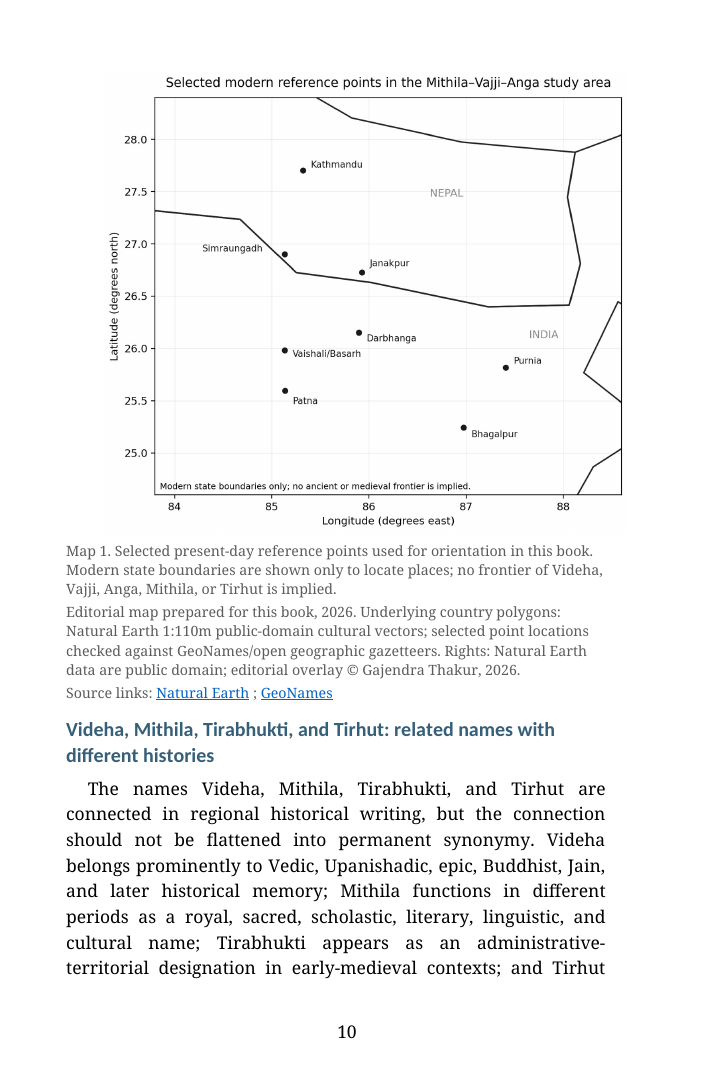
Mithila · Vajji · Anga
Chapter-specific source notes
- Primary chapter witness. Gajendra Thakur, Decoding the Panji of Mithila — Volume IV, formal Chapter 79, PDF pp. 729-734; formal Chapter 79. The HTML transcription is generated from the commit-pinned source PDF and retains the chapter boundary recorded in this edition.
- Internal structure. The repository source-heading inventory records 10 subordinate headings for this chapter: “1. Where Chapter 79 begins”; “2. Entry (639): Dharmanath, Premnath and the Gunakar branch”; “3. Entry (640): Yogin, Gangadhar, Kantir and the Haripani line”; “4. Entries (641)-(642): Khantar, Harijiv, Krishnadatt and the Jivanand-Ganganand line”; “5. Entries (643)-(644): Ishwari Datt Mishra of Shalampur and its continuation”; “6. Entries (645)-(646): Tabhka and the numbered continuation”; “7. Entries (647)-(648): Pinakapani and Shankar invocations”; “8. Entry (649): Narsam-Nagaram-Nahar”; ….
- Digital editorial method. The page keeps the preserved source text distinct from generated navigational, concordance, visual, and provenance apparatus. The synthetic reconstruction is explanatory only and is not evidence for an individual lineage or a determination of social or marital status.