Decoding the Panji of Mithila · Volume IV · Chapter 80
Narsam: Kaivlarav, Kakraud, Ranitol, Saurath and Sukhsena: Entries (650)- (664)
Chapter 80. Narsam: Kaivlarav, Kakraud,
Ranitol, Saurath and Sukhsena: Entries (650)-
(664)
1. Where Chapter 80 begins
    Chapter 80 begins at entry (650), after the Narsam-Nagaram-Nahar
close of the previous chapter. The source opens with a fresh invocation
and the heading read here as Kaivlarav. This separates the new material
from the Nagaram-Nahar unit while still keeping the broader Narsam
field in view.
  The chapter covers entries (650)-(664). These entries move from
Kaivlarav through Jagannath/Parvatinath material, Kakraud and
Kakraul, Ranitol, further Narsam continuations, Saurath, Sukhsena and
a brief Bhailokyanath invocation. Entry (665) begins the Baruwari-
Baliyas village opening and is therefore reserved for the next chapter.

2. Entry (650): Kaivlarav and the Sahib/Yadunath-
Janaknath line
  Entry (650), under the Shulashulapani invocation, opens with the
Kaivlarav heading. Mishra Sahib, also called Yadunath, gives Pan
Ghoghi or Janakinath through Hariamb-Jivan-Yognath and Mandar-
Hiyan. Pan Ghoghi gives Kirtinath, Buchan and Lutan through Karmah-
Rajju-Bihari and Sarisab-Hridaynath.
  Kirtinath gives Krishnadev through Alay-Raja-Mitralal and Khaual-
Nenmani. Buchan gives Kamalakant through Jalay-Mohan Singh-Govind
Narayan and Pandua-Ratnamani. Buchan also gives Jivkant and
Komalkant through Soderpur-Gangadhar-Ratnadatt and Budhwal-
Mukund, with another apara route through Kodariya-Raja-Kumar and
Khaual-Ishwardatt. Shivkant gives Vishwanath through Jajival-
Rudradatt-Ramakant and Kujauli-Haridev.
   The entry then ties Vishwanath through Karmah-Raveli-Bhavanand
and Jajival-Bhaiyo. Krishnadev is linked through Ghusaut-Jayavallabh-
Kumar and Pandua-Apuch. Lutan gives Hirakant through Hariamb-
Babujan-Bhaiyo and Darihara-Kanhai. Hirakant continues through
Digho-Babunu-Nageshwar and Alay-Harikant. The entry is therefore a
compact bridge from the Nagaram-Nahar descent into a new invoked
Narsam branch.

3. Entry (651): Parvatinath invocation and the
Jagannath-Dihinath continuation
   Entry (651), invoked to Parvatinath, develops the Jagannath and
Dihinath material. Jaga or Jagannath gives Balabhadra, Rama and
Batuki through Belaunch-Bandhu-Bhavi and Dih-Darihara-Devanath.
Bhulan or Dihinath gives Maddhu and Sadhu through Narun-
Bhairavdatt-Bana and Pandua-Bhaiya; another Dihinath line goes
through Budhwal-Gharapati-Babujan and Baliyas-Amritnath.
   Maddhu connects through Soderpur-Rohini-Durmil and Belaunch-
Ajitnarayan. Sadhu connects through Khandwala-Teknath-Chiranjiv and
Ghusaut-Shyam. Durganath gives Dharanath, Mayanath, Baidyanath
and Revatinath through Pali-Hemagand and Narun-Gonor. Dharanath
gives Taranath through Hariamb-Chan-Bhikhi and Karmah-Umanath.
Mayanath gives Nena, Fakir and Rakushar through Sarisab-Balabhadra
and Darihara-Rohini.
  The same entry contains a dense Lalitmani branch. Lalitmani is
connected through Budhwal-Narpati-Rudrapati, Ekhara-Aniruddh,
Ekhara-Harishwar-Sona, Jajival-Umapati-Timanjil, Hariamb-Umanath,
Soderpur-Mahinath-Bachanu, and Bithuam-Sadanand-Mahi. Nena and
Shrimani lines follow through Jajival, Pandua, Hariamb, Darihara,
Budhwal, Ekhara and Khandwala. The close of the entry returns to
Shubhpat, Dharadhar, Bhavesh, Harishankar, Rakushihal and Chilka.

4. Entries (652)-(653): Kakraud, Kakraul, Ranitol and
Shalampur
  Entry (652), under the Nagendra-hara invocation, names Kakraud.
The opening is damaged but preserves a Basudev/Darihara-Bhaikh line
and a Gharadhar branch through Ekhara-Dharmapati-Bhushan and
Panichom-Babudi. Harishankar or Bachna is tied through Ekhara-
Babudi-Indrapati and Darihara-Bhramar. Bachna gives Krishnadatt and
Raja/Balha through Sarisab-Mohan-Prannath and Baliyas-Nilambar.
  Krishnadatt gives Gangadatt and Dedhan/Jivdatt through Alay-Kamal.
Gangadatt gives Tumai through Ghusaut-Mahidhar-Rupnath and
Baliyas-Chitranath. The Sri Datt line branches through Kodariya-
Mukund Lal and Pali/Bala/Bhaiya, then through Pali-Babunath-
Manmohan,      Pali-Rudramani-Harisharan   and     Soderpur-Babujan.
Dedhan gives Devchandra, Hari and Nurchandra through Ghusaut-
Mahidhar-Muni and Baliyas-Chitranath; Devchandra gives Srimohan,

Manmohan and Brajmohan through Jajival-Dayanath-Devanath and
Pali-Bacha.
   Entry (653) brings Narsam-Kakraul, Ranitol and Shalampur.
Nilambar gives Kanhaiya through a damaged Alay-Chhakauri-Govind
route and Soderpur-Bachchan. Kanhaiya links through Narun-Bachcha-
Ramakar. Raja gives Babu through Belaunch-Panni-Krishnadatt and
Karmah-Rajju. Babu gives Lakshmimohan through Khandwala-
Parashmani-Radhakant and Karmah-Chhotakani. The entry also records
Khushilal, Bacha, Amritnath, Jayaram, Babulal, Govardhan, Bhayak,
Divakant, Radhakant, Ramkishor, Sushil, Sonbhadra, Kameshwar,
Prabhat and several modern initials or professional labels.

5. Entries (654)-(657): Ranitol and the
Maheshvara/Ashutosha Narsam continuation
   Entry (654) names Ranitol and opens under another invocation.
Babulal gives Hire, Nanuchandra, Premnath, Kirtinath, Artinath and
Raghunath through Alay-Lal-Nena and Darihara-Dharmadatt. Hire gives
Ishdatt and Madhav through Budhwal-Durgapati-Nandalal and
Khandwala-Shyam. Ishdatt gives Dinesh, Mahesh and Gangesh through
Pali-Sonman-Nityanand and Baliyas-Raja. Dinesh gives Chandramohan
and Narendramohan through Kodariya-Madhav-Rameshwar and
Satlakha-Dwarikanath.
   The entry continues through Madhav, Ramanand, Achyutanand,
Gokulanand, Chandra, Purushottam, Purandar, Lakshmipati, Premnath,
Ramesh, Kapileshwar, Kirtinath, Artinath, Murari, Basudev, Amarkant,
Devchandra/Jivkant and others. Routes include Soderpur, Babhaniyam,
Alay, Darihara, Fanandah, Pandua, Budhwal, Kujauli, Baliyas, Pabouli,
Ekhara and Khaual. Entry (655) then continues the Raghunath-
Baidyanath line, with Vishwanath, Ajaykumar and Vibhutinath tied
through Khandwala, Ghusaut, Kodariya, Belaunch, Kujauli and Khaual.
   Entry (656), invoked to Maheshwar, re-centers Narsam. It carries
Pakshadhar, Premraj, Amritnath, Baldev, Krishnadev, Khedan, Mana,
Phani, Premnath, Grihinath, Rajnath, Bilah, Ramanath, Jageshwar,
Ugranath, Mahadhan, Vishwanath, Ramdhan, Lakshman, Kanhaiya,
Madhusudan and related branches. Entry (657), under an Ashutosha
invocation, continues Madhusudan and Bhikhia. It carries Jaydatt,
Bhavanidatt, Anardan, Chhakauri, Lekhraj, Gangadhar, Ugraraj,
Krishna, Bhaiyo, Balabhadra, Chandra Dhar, Shashi Dhar, Bhavesh,

Hridaynandan, Devi, Parmeshwar, Babuann, Theghan and Chaan. This
forms one long Narsam continuation, but it closes before a new
numbered Narsam entry begins.

6. Entries (658)-(659): Narsam continuation and
Birsayar
   Entry (658) begins another Narsam unit. Devi gives Neya, Kishor and
Jhingur through Panichom-Govind-Anath and Mandar-Ravadapani. Devi
also gives Mukund through Digho-Khushihal Singh. Kishori gives
Jaykrishna through Pali-Sone, and Jaykrishna gives Balkrishna through
Pali-Jivannath-Doman and Mandar-Karja. Balkrishna continues through
Ghusaut-Gopal-Harivansh and Pabouli-Kirtinath.
   Mukund gives the grammarian Chintamani through Pabouli-Paran-
Amritnath and Pali-Sonmani. Chintamani gives Ramchandra through
Tisaunt-Babuann-Nakchhed and Gangoli-Mahipani. The entry then
moves through Parameshwar, Mahopadhyay Sita, Ishandatt,
Gaurinandan, Sufal, Girijanath, Raja, Fakir, Kunjbihari, Avadhbihari,
Chaturbhuj and Jagadbhuj. These branches show a mixed pattern of
older locality ties and learned titles.
   Entry (659) names Narsam to Birsayar. Dullah gives Banmali,
Kirtinath and Amritnath through Karmah-Bhikhari-Rudra and
Belaunch-Bhaiya. Banmali gives Vishwanath, Harshalal and Sumarna
through Jajival-Umapati-Timangil and Panichom-Jagnath, with another
route through Soderpur-Harpati-Nanu and Baliyas-Janakinath. Kirtinath
and Amritnath are then linked through Narun, Darihara, Karmah and
Baliyas. The entry proceeds through Bhaiyan, Lal, Thithar, Narapati,
Bhikhni, Ravadgu, Buddhinath, Premnath, Batu/Shyamnath, Ratinath,
Mchal, Babu Nath, Gopal and Mahinal.

7. Entries (660)-(661): Maheshvara invocation and the
Chitrnath-Girish continuation
   Entry (660), invoked to Maheshwar, opens with Chandradev and
Bhannulal, then develops Manipani and Adinath. Adinath is tied
through Khandwala-Radhakant-Muni and Belaunch-Ishdatt. Shripati
gives Dimdim, Lakshmidev, Girish and Bandhu through Alay-Gopai.
Dimdim gives Ramjiv, Chanchal and Mchal through Jajival-Saday-
Chhokar and Karmah-Raghudev.

   The entry continues through Lakshmidev, Jivan, Lakshmidatt, Kavi
Jivan, Vinma, Chitranath, Ramsharan, Halli, Narasingh, Manmohan,
Geeta, Vishweshwar and other branches. Routes include Sarisab, Pani,
Mandar, Soderpur, Khaual, Kodariya, Pali, Kako-Belaunch, Karmah,
Darihara, Kujauli and Fanandah.
   Entry (661) begins with a short invocation and follows Mahopadhyay
Chitranath, Shambhunath and Girish. Girish gives Bhanudatt,
Dharmadatt and Raja through Sarisab-Lakshman-Nandan and Pani-
Bhavesh. Apara branches add Pritam, Bhainu, Shivnath, Shivdatt and
Manik through Babhaniyam, Mandar, Tisaunt, Baheradhi and Khaual.
The entry then develops Bhanudatt, Dukhia, Shyamlal, Dharmadatt,
Yogdhar, Bahoran, Hridaynath, Vidyanath and Premnath with several
repeated or damaged readings preserved.

8. Entries (662)-(664): Saurath, Sukhsena and the
Bhailokyanath threshold
  Entry (662), under the Nilagriva invocation, names Narsam to
Saurath and Shriveshwar Mishra. It includes Bhulbhur, Nehal, Kanhai,
Gudar, Bahoran, Govardhan, Siddhinath, Janardan, Damodar,
Yadunandan, Raghunandan, Vishweshwar, Jiveshwar, Nandishwar,
Baua Lal, Chandrakant, Raja, Pritam, Bhaiya, Kirtinath, Shambhunath,
Hridaynath, Bhular, Bokan and Eknath. The entry is notable for its
Saurath anchoring and for the dense Soderpur, Pali, Belaunch, Baliyas,
Pabouli, Baheradhi, Khandwala and Fanandah routes.
   Entry (663) is headed Sukhsena. Shambhunath gives Gonor, Bihari
and Ramlal through Soderpur-Jayapati-Apuch and Pali-Man. Gonor gives
Govardhan and Chaturi through Pali-Sanath-Gana. The entry then
brings in a modern-education cluster: Baua Lal gives Sharadendu, with
a B.Sc. Electrical note, and Vijendra, with a B.Sc. Engineering note. Their
descendants are linked to Bhandari-Sukhsena, Lasakari-Ekma,
Khandwala, Babuvabhani and related family-note material.
   Entry (664) appears only as a brief Bhailokyanath invocation and
Narsam heading. Since it carries no developed genealogy before entry
(665), it is best read as a threshold marker at the end of the Narsam
sequence. Entry (665) then begins a new village opening, Baruwari-
Baliyas, so the next chapter should start there.

9. Reading entries (650)-(664) as a closing Narsam arc
   Entries (650)-(664) close the large Narsam arc that began several
chapters earlier. The entries are not a single straight pedigree; they are a
layered record of connected branches, repeated personal names,
learned titles, modern qualifications, damaged readings and place-links.
The important pattern is the continued movement among Narsam,
Kaivlarav, Kakraud, Kakraul, Ranitol, Shalampur, Birsayar, Saurath and
Sukhsena, with older route-names such as Pali, Karmah, Soderpur,
Belaunch, Darihara, Hariamb, Khaual, Sarisab, Budhwal, Alay, Mandar,
Narun, Pandua, Fanandah, Ghusaut, Khandwala and Ekhara.
   The chapter also shows how the Panji absorbs later evidence without
abandoning older genealogical formulae. Professional titles and modern
educational markers occur beside the same descent-and-place grammar
used for older entries. For that reason, entries (650)-(664) function as
both continuation and closure: they complete the Narsam chain just
before Baruwari-Baliyas begins.

Chapter conclusion
   Chapter 80 decodes entries (650)-(664). Entry (650) develops the
Kaivlarav/Jyadunath-Janakinath line. Entry (651) carries the
Parvatinath-invoked Jagannath and Dihinath continuation. Entries
(652)-(653) move through Kakraud, Kakraul, Ranitol and Shalampur.
Entries (654)-(657) develop Ranitol and the Maheshvara/Ashutosha
Narsam continuation. Entries (658)-(659) carry the later Narsam and
Birsayar branches. Entries (660)-(661) develop the Maheshvara-invoked
and Chitrnath-Girish continuations. Entries (662)-(664) close the arc
through Saurath, Sukhsena and a Bhailokyanath threshold.
  The next chapter should begin at entry (665), where the source
explicitly starts the Baruwari-Baliyas village opening.
Source structure and verification apparatus
Editorial source apparatus. This apparatus is descriptive, not interpretive. It records the source-controlled structure used to verify that this page corresponds to formal Chapter 80 of Decoding the Panji of Mithila — Volume IV. The chapter text above is preserved from PDF pp. 735-740; formal Chapter 80 in the commit-pinned authoritative source. It is not merged with a neighboring chapter, appendix, annexure, or independent front/back-matter unit. The internal headings below come from the repository’s source-heading inventory and are retained as navigational and audit evidence; showing them here does not turn those headings into separate publications or add claims that are absent from the source.
Internal source headings
- 1. Where Chapter 80 begins
- 2. Entry (650): Kaivlarav and the Sahib/Yadunath-Janaknath line
- 3. Entry (651): Parvatinath invocation and the Jagannath-Dihinath continuation
- 4. Entries (652)-(653): Kakraud, Kakraul, Ranitol and Shalampur
- 5. Entries (654)-(657): Ranitol and the Maheshvara/Ashutosha Narsam continuation
- 6. Entries (658)-(659): Narsam continuation and Birsayar
- 7. Entries (660)-(661): Maheshvara invocation and the Chitrnath-Girish continuation
- 8. Entries (662)-(664): Saurath, Sukhsena and the Bhailokyanath threshold
- 9. Reading entries (650)-(664) as a closing Narsam arc
- Chapter conclusion
Source-text concordance
Narsam · Kaivlarav · Kakraud · Ranitol · Saurath · Sukhsena · Entries · begins · entry · Narsam-Nagaram-Nahar · close · previous · opens · fresh · invocation · heading · read · separates · material · Nagaram-Nahar · unit · still · keeping · broader · field · view · covers · move · Jagannath · Parvatinath · Kakraul · continuations · brief · Bhailokyanath · Baruwari · Baliyas · village · opening · therefore · reserved · next · Sahib · Yadunath · Janaknath · line · Shulashulapani · Mishra · called · gives · Ghoghi · Janakinath · Hariamb-Jivan-Yognath · Mandar · Hiyan · Kirtinath · Buchan · Lutan · Karmah · Rajju-Bihari · Sarisab-Hridaynath · Krishnadev · Alay-Raja-Mitralal · Khaual · Nenmani · Kamalakant · Jalay-Mohan · Singh-Govind · Narayan · Pandua-Ratnamani · Jivkant · Komalkant · Soderpur-Gangadhar-Ratnadatt · Budhwal · Mukund · another · apara · route · Kodariya-Raja-Kumar · Khaual-Ishwardatt · Shivkant
Boundary verification. In the formal sequence this chapter follows Volume IV Chapter 79, “Narsam: Dharmanath, Gunakar, Shalampur, Tabhka and Nagaram-Nahar: Entries (639)-(649)” and precedes Volume IV Chapter 81, “Baruwari-Baliyas: Nandishwar Invocation and Empty Closing Entries: Entries (665)-(668)”. The chapter extractor begins at the verified formal Chapter 80 marker and stops at the next verified formal chapter marker; for a final chapter it stops before recognized book-level back matter. The concordance above is generated only from distinct terms already present in this chapter’s preserved source text. It is provided for discovery, comparison, and audit, not as an automated judgment about persons, lineages, status, kinship, marriage eligibility, or historical truth.
Illustrated research apparatus
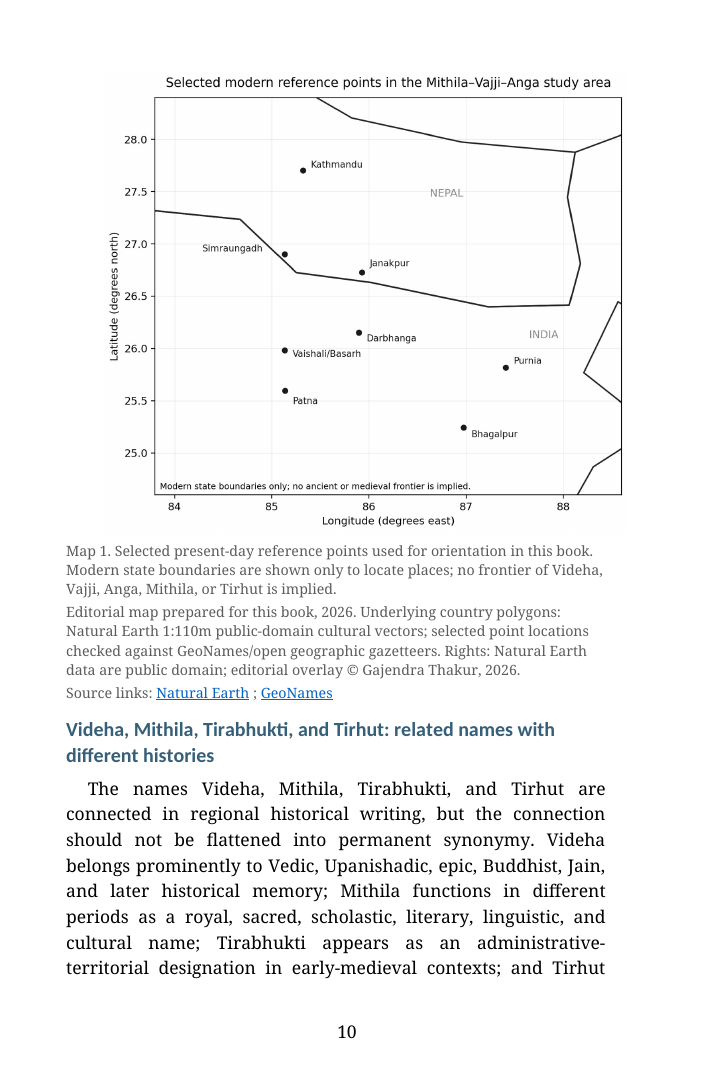
Mithila · Vajji · Anga
Chapter-specific source notes
- Primary chapter witness. Gajendra Thakur, Decoding the Panji of Mithila — Volume IV, formal Chapter 80, PDF pp. 735-740; formal Chapter 80. The HTML transcription is generated from the commit-pinned source PDF and retains the chapter boundary recorded in this edition.
- Internal structure. The repository source-heading inventory records 10 subordinate headings for this chapter: “1. Where Chapter 80 begins”; “2. Entry (650): Kaivlarav and the Sahib/Yadunath-Janaknath line”; “3. Entry (651): Parvatinath invocation and the Jagannath-Dihinath continuation”; “4. Entries (652)-(653): Kakraud, Kakraul, Ranitol and Shalampur”; “5. Entries (654)-(657): Ranitol and the Maheshvara/Ashutosha Narsam continuation”; “6. Entries (658)-(659): Narsam continuation and Birsayar”; “7. Entries (660)-(661): Maheshvara invocation and the Chitrnath-Girish continuation”; “8. Entries (662)-(664): Saurath, Sukhsena and the Bhailokyanath threshold”; ….
- Digital editorial method. The page keeps the preserved source text distinct from generated navigational, concordance, visual, and provenance apparatus. The synthetic reconstruction is explanatory only and is not evidence for an individual lineage or a determination of social or marital status.