Decoding the Panji of Mithila · Volume IV · Chapter 81
Baruwari-Baliyas: Nandishwar Invocation and Empty Closing Entries: Entries (665)-(668)
Chapter 81. Baruwari-Baliyas: Nandishwar
Invocation and Empty Closing Entries: Entries
(665)-(668)
1. Where Chapter 81 begins
   Chapter 81 begins at entry (665), immediately after the short
Bhailokyanath threshold at the end of the Narsam sequence. The source
gives a fresh Nandishwar invocation and then explicitly opens the
Baruwari-Baliyas village field. This makes entry (665) a new village
opening, not a continuation of the Narsam material.
   The chapter covers entries (665)-(668). Entry (665) contains the only
developed genealogy in this final unit. Entries (666), (667) and (668) are
all marked ricta, or vacant, and are therefore treated as closing
placeholders rather than as genealogical branches.

2. Entry (665): the Baruwari-Baliyas village opening
   Entry (665) opens with the Nandishwar invocation and the formula
'atha Baruwari Baliyas gramarambh'. The first named figure is Andi.
Through Andi comes Pranpati, and through Pranpati the source names
Sarvan and Kaladhar. Sarvan is connected through Pabouli-Bhairavi-
Gokulnath, with a damaged Mahipali/Vibunath reading preserved in the
source.
   Kaladhar gives Nena. Nena is tied through Soderpur-Baudhi-
Baburam and Tisaunt-Bacha. A second Kaladhar line gives Acha, who is
linked through Pali-Bhavaditya-Ishwaridatt and Belaunch-Juraun. These
short links make the opening a compact network rather than a long
linear descent.
   Nena gives Shyam and Madhusudan. Shyam is connected through
Pabouli-Kas-Barju and Darihara-Hema. Shyam's further branch goes
through Karmah-Gopal and Kujauli-Jhangur. Another Shyam-related
route passes through Ahil-Hariamb-Gharbharan-Bhaylal and Pandua-
Hridaymani. Madhusudan is tied through Pani-Dukhia-Nityanand and
Soderpur-Jhadula-Bhaivan.

3. The Jyotirvid Achal branch
   After the Nena-Shyam-Madhusudan unit, the source introduces
Jyotirvid Achal. Achal gives Shridhar, Mahidhar and Gangadhar through

Karmah-Neya-Kuber and Satlakha-Jage. The use of the title Jyotirvid
marks Achal as a learned or specialist figure within the Baruwari-
Baliyas record.
   Shridhar gives Vanshidhar and Jakhadhar, with a Purohi/Purohit-like
reading in the same line. This branch runs through Pali-Kotishwar,
Bacha and Madhav, and then returns to Belaunch-Pranpati. Vanshidhar
continues through Umadhar, Budhwal-Harishnath-Bechu, and Baliyas-
Babu, also called Shridhar. The line is brief but important because it
connects the new Baruwari-Baliyas opening back into the same wider
place-network seen throughout Volume IV.
   The continuation across the page break brings Umadhar through
Ghusaut-Abhayanath-Durganath and Khandwala-Gudan Singh. Jatadhar
gives Murli Dhar, Phani Dhar and Mani Dhar through Digho-Ram-
Gayadatt and Ekhara-Panchu. Murli Dhar then links to Bhakhrauli-
Kujauli, and through Jyotirvid Mahidhar gives Nilambar and Pitambar
through Pali-Pan Nena-Gudar and Sarisab-Bhaiya.

4. Entries (666)-(668): vacant closing entries
   Entry (666) carries the Vrishabheshwar invocation but is marked
ricta. Entry (667) carries the Kapileshwar invocation and is also marked
ricta. Entry (668) carries the Dukhahar invocation and is likewise
marked ricta. The sequence therefore preserves headings or invocatory
slots without supplying genealogical detail.
   These vacant entries should not be expanded by inference. Their
significance is structural: they show that the record expected or
reserved space for additional material, but the surviving text gives no
developed pedigree for them. In a decoded chapter they belong in the
narrative as closing markers, not as missing branches to be
reconstructed.

5. Reading entries (665)-(668) as the close of this
source segment
   Entries (665)-(668) form a small but clear closing unit. Entry (665) is a
real village opening for Baruwari-Baliyas, built around Andi, Pranpati,
Sarvan, Kaladhar, Nena, Shyam, Madhusudan and Jyotirvid Achal.
Entries (666)-(668) then close the sequence with three empty invocatory
placeholders.

   The important feature of entry (665) is its concentration of place-
links. Pabouli, Mahipali, Soderpur, Tisaunt, Pali, Belaunch, Darihara,
Karmah, Kujauli, Ahil, Hariamb, Pandua, Pani, Satlakha, Budhwal,
Baliyas, Ghusaut, Khandwala, Digho, Ekhara, Bhakhrauli and Sarisab all
appear in or around this short entry. That density shows how even a
brief village opening preserves the broader Panji method of identifying
descent through named local and marital routes.

Chapter conclusion
   Chapter 81 decodes entries (665)-(668). Entry (665) begins the
Baruwari-Baliyas village field under the Nandishwar invocation and
records the Andi-Pranpati-Sarvan-Kaladhar-Nena-Shyam-Madhusudan-
Achal complex. It then follows the Jyotirvid Achal branch through
Shridhar, Vanshidhar, Jakhadhar, Umadhar, Jatadhar, Murli Dhar, Phani
Dhar, Mani Dhar, Nilambar and Pitambar.
  Entries (666), (667) and (668) are vacant. They are preserved as
numbered invocatory headings but contain no genealogical
development. This makes Chapter 81 the natural closing chapter for the
available text in this source file.
Source structure and verification apparatus
Editorial source apparatus. This apparatus is descriptive, not interpretive. It records the source-controlled structure used to verify that this page corresponds to formal Chapter 81 of Decoding the Panji of Mithila — Volume IV. The chapter text above is preserved from PDF pp. 741-743; formal Chapter 81 in the commit-pinned authoritative source. It is not merged with a neighboring chapter, appendix, annexure, or independent front/back-matter unit. The internal headings below come from the repository’s source-heading inventory and are retained as navigational and audit evidence; showing them here does not turn those headings into separate publications or add claims that are absent from the source.
Internal source headings
- 1. Where Chapter 81 begins
- 2. Entry (665): the Baruwari-Baliyas village opening
- 3. The Jyotirvid Achal branch
- 4. Entries (666)-(668): vacant closing entries
- 5. Reading entries (665)-(668) as the close of this source segment
- Chapter conclusion
Source-text concordance
Baruwari-Baliyas · Nandishwar · Invocation · Empty · Closing · Entries · begins · entry · immediately · short · Bhailokyanath · threshold · Narsam · sequence · gives · fresh · explicitly · opens · village · field · makes · opening · continuation · material · covers · contains · developed · genealogy · final · unit · marked · ricta · vacant · therefore · treated · placeholders · rather · genealogical · branches · formula · atha · Baruwari · Baliyas · gramarambh · first · named · figure · Andi · comes · Pranpati · names · Sarvan · Kaladhar · connected · Pabouli-Bhairavi · Gokulnath · damaged · Mahipali · Vibunath · reading · preserved · Nena · tied · Soderpur-Baudhi · Baburam · Tisaunt-Bacha · second · line · Acha · linked · Pali-Bhavaditya-Ishwaridatt · Belaunch-Juraun · links · make · compact · network · long · linear · descent · Shyam
Boundary verification. In the formal sequence this chapter follows Volume IV Chapter 80, “Narsam: Kaivlarav, Kakraud, Ranitol, Saurath and Sukhsena: Entries (650)- (664)” and precedes Volume IV Chapter 82, “Major Lineage Nodes of the Nagram Panji Analytical Summary after the Source-Entry Decoding”. The chapter extractor begins at the verified formal Chapter 81 marker and stops at the next verified formal chapter marker; for a final chapter it stops before recognized book-level back matter. The concordance above is generated only from distinct terms already present in this chapter’s preserved source text. It is provided for discovery, comparison, and audit, not as an automated judgment about persons, lineages, status, kinship, marriage eligibility, or historical truth.
Illustrated research apparatus
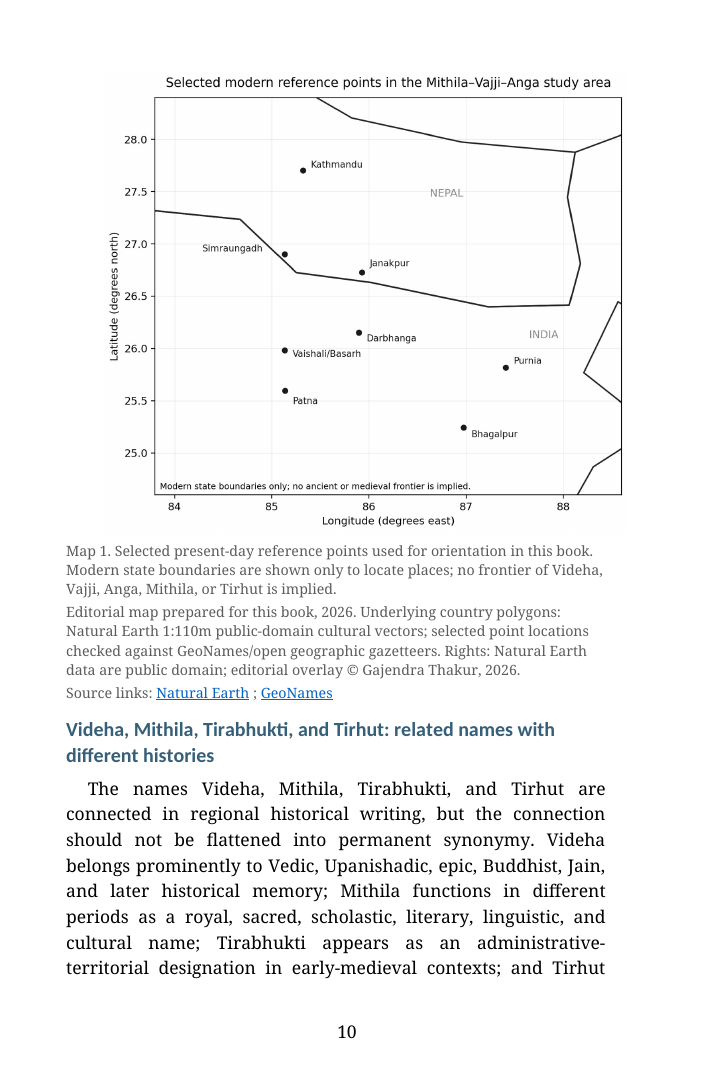
Mithila · Vajji · Anga
Chapter-specific source notes
- Primary chapter witness. Gajendra Thakur, Decoding the Panji of Mithila — Volume IV, formal Chapter 81, PDF pp. 741-743; formal Chapter 81. The HTML transcription is generated from the commit-pinned source PDF and retains the chapter boundary recorded in this edition.
- Internal structure. The repository source-heading inventory records 6 subordinate headings for this chapter: “1. Where Chapter 81 begins”; “2. Entry (665): the Baruwari-Baliyas village opening”; “3. The Jyotirvid Achal branch”; “4. Entries (666)-(668): vacant closing entries”; “5. Reading entries (665)-(668) as the close of this source segment”; “Chapter conclusion”.
- Digital editorial method. The page keeps the preserved source text distinct from generated navigational, concordance, visual, and provenance apparatus. The synthetic reconstruction is explanatory only and is not evidence for an individual lineage or a determination of social or marital status.