Decoding the Panji of Mithila · Volume IV · Chapter 82
Major Lineage Nodes of the Nagram Panji Analytical Summary after the Source-Entry Decoding
Chapter 82. Major Lineage Nodes of the
Nagram Panji
  Analytical Summary after the Source-Entry Decoding
   This analytical chapter comes after the source-entry decoding and
turns the sequential entries into a usable genealogical map.

1. Why a lineage node matters
   The Nagram Panji is not arranged like a modern family tree. It
is a compressed register in which a single heading can hold a
village opening, a descent formula, a marriage connection, a
collateral branch, a later professional marker, and a cross-
reference to another record. For that reason the most useful way
to read the completed source-entry decoding is to identify the
major lineage nodes. A node is a point where several lines gather:
a person who becomes a branching centre, a village that becomes
a repeated route, or a phrase that holds together otherwise
scattered names.
   The source chapters have already followed the entry order.
This analytical chapter now turns that linear reading into a map.
It does not replace the entry-by-entry decoding; it helps the
reader see which persons and villages function as anchors across
the whole Nagram record. A node may be old or recent, large or
small, clear or damaged. Even when the source is dotted or
incomplete, repetition around a name or place may show that the
record is preserving an important link rather than a casual
mention.
   Three kinds of nodes are especially important. First are
descent nodes: names that generate sons, grandsons, or collateral
lines. Second are route nodes: villages such as Singhwar,
Shashipur, Mangrauni, Hati, Rohar, Tatail, Rajanpura,
Bhakharouli, Malangia, Narsam, and Baliyas that repeatedly
connect one part of the register to another. Third are interpretive
nodes: invocations, B-references, numbered references, titles,

and words such as apara and rikta, which control how the
genealogy should be read.

2. The opening Sandahpur-Singhwar-Shashipur frame
  The opening Nagram cluster establishes the grammar of the
entire volume. Sandahpur, Singhwar, and Shashipur are not
merely early place names; they teach the reader how the source
moves from one local frame to another. The early entries gather
families around names such as Aankhi, Lal, Gunakar, Udan,
Gangesh, Girdhari, Abadh Bihari, Gopal, Teknarayan, Bandhu,
Madhurapati, Narpati, Bachh, Chitradhar, Chandīdatta, Fatur
Ram, and Lakshman. These names are not isolated. They show
how a single village phrase can open into many linked families.
   The Sandahpur-Singhwar material should therefore be treated
as the first major node of the Nagram Panji. It creates a model in
which Karmahā, Padua or Pandua, Hariam, Darihara, Sarisab,
and related villages appear as route markers. When the same
names reappear later, the reader should not immediately assume
duplication. The Panji frequently repeats names because the
same families are being seen through different village or
marriage routes.
  Shashipur becomes the second centre of gravity. The
Shashipur-Pindaruch and Shashipur-Survana branches show
how a secondary centre can become a genealogical hub in its
own right. Bachkun Thakur, Survana Thakur, Sarvanarayan,
Bhaiyalal,  Naubatlal,    Madankant,    Sadankant,     Modkant,
Promodkant, Vijaykant, Kumudkant, Bharatikant, and similar
names show a later layer in which the register keeps older forms
while absorbing newer naming patterns.

3. Khangur, Pilkhwar, Bhatsimar, Rohar, and early
extensions
  After the opening clusters, the Nagram material begins to
widen geographically. Khangur, Nahar, Pilkhwar, Bhatsimar, and
Rohar form an early movement zone. These places are important

because they show how the Panji links settlement memory with
route memory. A person may be connected to one village by
origin, another by marriage, and another by later residence or
branch movement. The repeated formula of 'from one village to
another' is the visible surface of a deeper map.
  Pilkhwar and Bhatsimar are especially useful as route-cluster
names. They do not always function as the largest descent nodes,
but they appear at points where one line touches another. In
practical genealogical work, such places should be indexed
carefully because they help locate a family whose personal
names are common or repeated elsewhere.
   Rohar becomes a recurring cross-link. It appears both as an
early place of connection and as a later reference point. The
reader should watch Rohar as a bridging node rather than as a
closed village unit. Its value lies in its capacity to connect earlier
and later portions of the Nagram record.

4. Mangrauni, Hati, Samauli, Balirajpur, and Siwa
   The next major concentration comes through Mangrauni, Hati,
Samauli, Balirajpur, and Siwa. These entries create the first dense
transitional middle of the volume. Mangrauni-Madari brings
forward names such as Devkinandan, Dayashankar, Ramanath,
Durganath, Premnath, Dinanath, and other connected figures.
The importance of this node is not only its size but its repetition:
names recur, branches are reintroduced, and the same route may
be seen through a different descendant.
   Hati becomes significant because it carries the formula of
village beginning. An 'atha ... gramārambha' heading is never
ornamental. It tells the reader that the Panji is beginning a new
village-centred unit. Hati to Satlakha, Hati to Pilkhwar, Hati to
Saurath, Hati to Thanga, and Hati to Danga should therefore be
read as a branching zone. Each route shows how a village
opening can generate many directions.
  Samauli is another major route node. The Samauli sequence
moves through Tarauni, Nanour, Vindhi, Sanha, Jhanjharpur,

Bagahi, and other branches. Its importance lies in multiplicity.
The reader meets many outward lines, and the source forces the
reader to hold several routes together without flattening them
into a single family. Balirajpur and Siwa then widen the map
further. Balirajpur touches Ranitole, Ramnagar, Kakraur, Chopra,
Purnea, and Champaran references, while Siwa connects Virsair,
Saurath, Singhwar, Vishnupur, Pilkhwar, and Kachhua.

5. Sacred invocation headings as lineage nodes
   The Nagram Panji repeatedly uses Shaiva and other sacred
invocations: Om Rameshwaraya Namah, Om Vasukinathaya
Namah, Om Kedarnathaya Namah, Om Nandishwaraya Namah,
and similar formulae. These headings should not be read as
decorative piety alone. They organize archival sequence. They
mark the beginning of a new block, or the continuation of an
older branch under a fresh ceremonial sign.
   Vicharhi, Kua, Parhat, Chanpura, Malichham, Bhachhi,
Mangrauni, Pilkhwar, Rajgram, Rashadh, Baligarh, Lagma,
Baigani, Banaili, Sultan Ganj, Pindaruch, Paramgarh, Karma, and
Satlakha all become clearer when the invocation headings are
treated as structural markers. The sacred formula holds the
genealogy together even when the personal chain is dense or
damaged.
  The invocatory frame also reminds the reader that Panji
memory is not only administrative. It is ritual, social, and
scholarly. A single heading may preserve religious orientation,
archival order, and family descent at once. This is why the source
must be decoded by respecting the heading, not by stripping it
away.

6. Rohar, Tatail, Rajanpura, Ratauli, Dih, Bargam,
Sihouli, and Rajoura
   The middle-late portion of the Nagram Panji contains some of
the most complex route mapping. Rohar to Jhanjharpur brings
together Bandhu, Jagannath, Vedi, Bhanjan, Chalbali, and related

descendants. Tatail then becomes a large node, reaching Nanour,
Pilwarwad, Tharhi, Dhankauli, Bharam, Pindaruch, Jamshedpur,
Rahika, and Kanhouli. Tatail is important because it shows the
widening of the Nagram field into semi-modern geographical
references.
   Rajanpura is a scholarly and interregional node. It includes
Saurath, Kailakh, Rajgram, Shashipur, and even Rajasthan or
Amerkila-type references. Such names show that the Panji is not
limited to a narrow village-memory system. It records mobility,
prestige, service, learning, and residence across a much wider
area.
   Ratauli, Tharhi, Betia, Dih, Uttar Pradesh, Bargam, Sihouli, and
Rajoura form another group of late route-nodes. These entries
require caution because they contain interregional movement
and sometimes damaged or compressed wording. Rajoura also
reintroduces sacred invocation headings, showing that late
material can still be organized by the older ceremonial grammar
of the register.

7. Bhakharouli, Malangia, Dadari, Brahmoli,
Ruchauli, Oda, Berma, Suday, and the final source
nodes
   The final large section before the closing blanks begins with
Bhakharouli. Shubhankar, Pradyumna, Abhiram, Bhavesh,
Rudra, Umanath, and related lines show how the Panji can
reopen dense genealogical work even near the end of a source
file. Bhakharouli to Chikni, Purnea, Danga, and Dhagjari is not a
minor tail; it is a late cluster of real importance.
   The Porwarouni sequence strengthens this late-stage density
through names such as Vagish, Madhurapati, Janakinath,
Ramdev, Mahadev, Kamdev, Vishwadev, and later branches.
Malangia then connects to Tharhi, Kakraur, Mahishi, Lagma, and
Sanha. These nodes show that the final part of the volume is not
merely residual. It is a rich map of continuing movement and
collateral memory.

   Dadari, Nanour, Parsarma, Shivipatti, Tarauni, Brahmoli,
Bisaubi, Ruchauli, Kailakh, Rashadh, Oda, Berma, Sangram,
Shahpur, Ratipar, Maheshpur, and Suday form the final sequence
of place chains. Some phrases are unresolved, but unresolved
wording is not useless. It tells the reader where the archive has
preserved a signal without preserving all details. A careful
edition must mark such uncertainty rather than erase it.

8. Narsam, Baliyas, and the closing concentration
   The last source-entry chapters dealt heavily with Narsam and
Baliyas. This final concentration is one of the most important
nodes in the completed decoding. Narsam appears with Baliyas,
Padna, Harinagar, Lalbag, Pindaruch, Kaivlarav, Kakraud,
Ranitol, Saurath, Sukhsena, and finally Baruwari-Baliyas. The
repeated Narsam heading shows a strong late-stage family field
rather than a simple village list.
   The Narsam material also displays modern layers more
openly: doctors, engineers, B.Sc. references, and other
professional or educational markers appear alongside old
formulae. These markers should not be treated as alien additions.
They show that the Panji continued to absorb living social
identity into its genealogical framework.
   The final Baruwari-Baliyas entry under the Nandishwar
invocation is followed by entries marked rikta. This closing
pattern has interpretive value. It shows that the source preserves
blank or vacant positions as part of the register. The blanks are
not to be deleted. They are evidence that the record had a place
for memory even where the details were absent, lost, deferred, or
intentionally left open.

9. Practical use of the node map
  For researchers, this chapter should be used as a navigation
map. When a personal name is repeated, first locate the village
node. When a village is repeated, identify whether it is
functioning as origin, marriage route, settlement route, or

collateral reference. When an entry contains a B-reference or
numbered cross-reference, record it separately before drawing a
conclusion. When the source has dots or blanks, do not fill them
from memory or convenience.
   A reliable Nagram index should therefore have at least four
layers: personal names, village nodes, titles or roles, and cross-
references. The major lineage nodes identified here should be
used as anchors for the Personal Name Index, Village Index,
Route Tables, and Lineage Tables promised in the appendices.
Without such a node map, the reader may see only a long list of
names. With it, the Nagram Panji becomes a networked archive.
  The most important rule is to separate transcription, decoding,
and conclusion. The source gives a compressed formula. The
decoder expands its grammar. The historian then draws cautious
conclusions. If these three acts are mixed together, the Panji
becomes either unreadable or overinterpreted. This volume’s
method is to keep them distinct while showing how they support
one another.

10. Conclusion
   The major lineage nodes of the Nagram Panji reveal a living
geography of Mithila. Sandahpur, Singhwar, Shashipur,
Mangrauni, Hati, Samauli, Balirajpur, Siwa, Rohar, Tatail,
Rajanpura, Bhakharouli, Malangia, Ruchauli, Oda, Suday,
Narsam, Baliyas, and many other places are not passive labels.
They are the architecture of memory. Through them the Panji
records descent, affiliation, marriage, migration, scholarship,
status, and uncertainty.
  The completed source-entry decoding has preserved the line-
by-line evidence. This analytical chapter gathers the major nodes
so that the reader can move from detail to pattern. The next
analytical work should turn from lineage nodes to village nodes
and route networks, because the Nagram Panji is not only a
genealogy of persons; it is also a genealogy of places.
Source structure and verification apparatus
Editorial source apparatus. This apparatus is descriptive, not interpretive. It records the source-controlled structure used to verify that this page corresponds to formal Chapter 82 of Decoding the Panji of Mithila — Volume IV. The chapter text above is preserved from PDF pp. 744-750; formal Chapter 82 in the commit-pinned authoritative source. It is not merged with a neighboring chapter, appendix, annexure, or independent front/back-matter unit. The internal headings below come from the repository’s source-heading inventory and are retained as navigational and audit evidence; showing them here does not turn those headings into separate publications or add claims that are absent from the source.
Internal source headings
- 1. Why a lineage node matters
- 2. The opening Sandahpur-Singhwar-Shashipur frame
- 3. Khangur, Pilkhwar, Bhatsimar, Rohar, and early extensions
- 4. Mangrauni, Hati, Samauli, Balirajpur, and Siwa
- 5. Sacred invocation headings as lineage nodes
- 6. Rohar, Tatail, Rajanpura, Ratauli, Dih, Bargam, Sihouli, and Rajoura
- 7. Bhakharouli, Malangia, Dadari, Brahmoli, Ruchauli, Oda, Berma, Suday, and the final source nodes
- 8. Narsam, Baliyas, and the closing concentration
- 9. Practical use of the node map
- 10. Conclusion
Source-text concordance
Major · Lineage · Nodes · Nagram · Analytical · Summary · Source-Entry · Decoding · comes · turns · sequential · entries · usable · genealogical · node · matters · arranged · like · modern · family · tree · compressed · register · single · heading · hold · village · opening · descent · formula · marriage · connection · collateral · branch · later · professional · marker · cross · reference · another · record · reason · useful · read · completed · identify · point · several · lines · gather · person · becomes · branching · centre · repeated · route · phrase · holds · together · otherwise · scattered · names · chapters · already · followed · entry · order · linear · reading · replace · entry-by-entry · helps · reader · persons · villages · function · anchors · across · whole · recent
Boundary verification. In the formal sequence this chapter follows Volume IV Chapter 81, “Baruwari-Baliyas: Nandishwar Invocation and Empty Closing Entries: Entries (665)-(668)” and precedes Volume IV Chapter 83, “Major Village Nodes and Route Networks”. The chapter extractor begins at the verified formal Chapter 82 marker and stops at the next verified formal chapter marker; for a final chapter it stops before recognized book-level back matter. The concordance above is generated only from distinct terms already present in this chapter’s preserved source text. It is provided for discovery, comparison, and audit, not as an automated judgment about persons, lineages, status, kinship, marriage eligibility, or historical truth.
Illustrated research apparatus
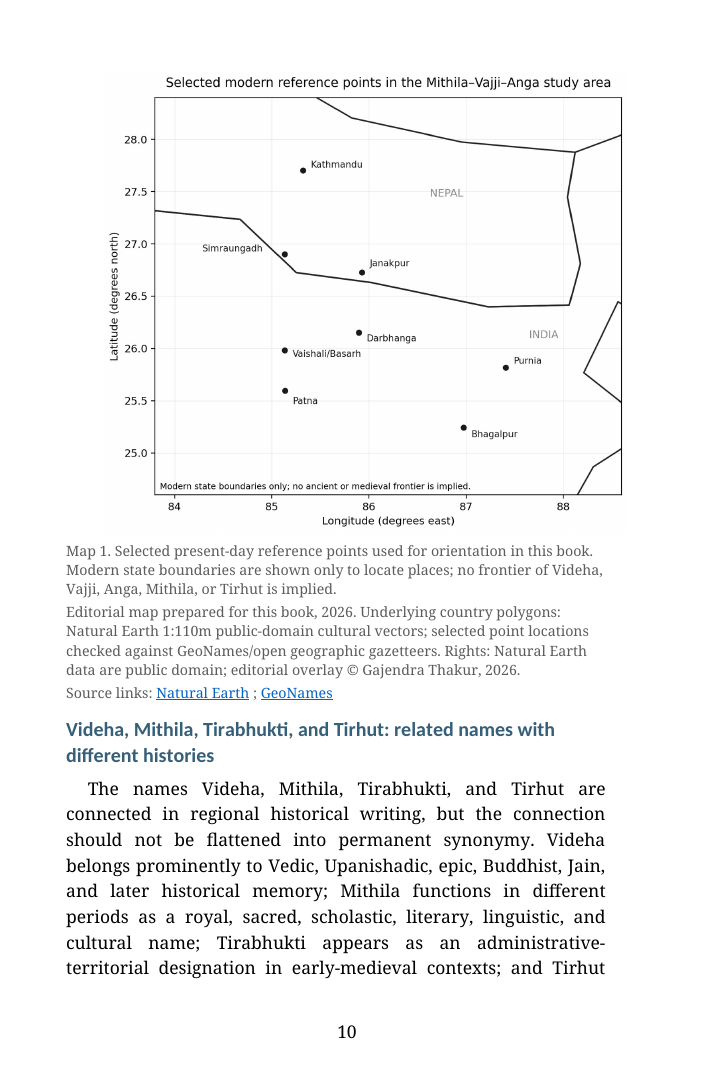
Mithila · Vajji · Anga
Chapter-specific source notes
- Primary chapter witness. Gajendra Thakur, Decoding the Panji of Mithila — Volume IV, formal Chapter 82, PDF pp. 744-750; formal Chapter 82. The HTML transcription is generated from the commit-pinned source PDF and retains the chapter boundary recorded in this edition.
- Internal structure. The repository source-heading inventory records 10 subordinate headings for this chapter: “1. Why a lineage node matters”; “2. The opening Sandahpur-Singhwar-Shashipur frame”; “3. Khangur, Pilkhwar, Bhatsimar, Rohar, and early extensions”; “4. Mangrauni, Hati, Samauli, Balirajpur, and Siwa”; “5. Sacred invocation headings as lineage nodes”; “6. Rohar, Tatail, Rajanpura, Ratauli, Dih, Bargam, Sihouli, and Rajoura”; “7. Bhakharouli, Malangia, Dadari, Brahmoli, Ruchauli, Oda, Berma, Suday, and the final source nodes”; “8. Narsam, Baliyas, and the closing concentration”; ….
- Digital editorial method. The page keeps the preserved source text distinct from generated navigational, concordance, visual, and provenance apparatus. The synthetic reconstruction is explanatory only and is not evidence for an individual lineage or a determination of social or marital status.