Decoding the Panji of Mithila · Volume V · Chapter 4
Shiva Hariam, Sandahpur Didhoy, and Danti-Chopra
Chapter 4
   Shiva Hariam, Sandahpur Didhoy, and Danti-Chopra
Bakhari: Additional Settlements, Scholarly Branches, and
                   Marriage Networks

  1. Where Chapter 4 begins
   Chapter 3 ended after the early expansion from Phoolsara, Haraut, Pothia
Sultanpur, Varadaha, Dhangri, Govindpur, Fattehpur, and Majlishpur. At
that point the Panji had already become a dense social web. Chapter 4 begins
exactly where that promise leads: the record now moves into further
settlement headings and secondary clusters, especially Shiva Hariam in
Dharmapur Desh Dhanaghatta, Sandahpur Didhoy Kumhdi Purv Dandkhora,
and Danti or Chopra Bakhari.
    The shift is important. The earlier chapter showed how a known branch
spreads into several village and marriage fields. This chapter shows the next
stage: the record no longer needs to introduce the whole system. It assumes
the reader understands the grammar of descent, wives, daughters, aliases,
titles, and village-links. Therefore, the language becomes even more
compressed. The branch is not explained in modern prose; it is made visible
through repeated formulas: suta, suta, apra, aadya, vasi, deshe, dau, and du
dau.
   The editorial task is to unfold that compression without pretending that
the Panji is a modern narrative. Chapter 4 therefore reads each entry through
five linked questions: who descends from whom, which settlement or mool
gives identity, which women form marriage bridges, which titles or
professions mark status, and how the branch continues into the next unit.

  2. Shiva Hariam in Dharmapur Desh Dhanaghatta
   The new section opens with Shiva Hariam, placed in Dharmapur Desh
Dhanaghatta. The first figure is Ramkrishna, whose son Abhiram begins the
active line. Abhiram’s son Jeevanath is then linked with Mander through
Rameshwar’s son Shivdatt, and with Belauch through Doni. This is already
enough to show that the entry is not merely local. It joins Hariam,
Dharmapur, Dhanaghatta, Mander, and Belauch within one line.
   Jeevanath’s sons include Abhay Krishna and Zhingur. Abhay Krishna is
linked with Dharoura Baliyas, Vadani’s grandson Paramanand, Daya Ram,
and Udanpur Jajival through Balami and Narpati. This gives a pattern that
appears throughout the chapter: one son carries the branch outward through

                  Decoding the Panji of Mithila - Volume V | 55
a chain of father, place, and allied house. The Panji does not explain the
social meaning at length because the trained reader understands that such a
chain preserves marriage memory.
   Zhingur’s branch is even more revealing. His son Ramanath is linked with
Raiyam Sodarpur through Krishnapati’s grandson Bhaiyaram and
Balbhadra, and also with Mahishi Budhwal through Vishwambhar and Babu.
The same branch touches Sakuri Baliyas and Pathak Chanan. In one small
cluster, the record connects Shiva Hariam to Sodarpur, Budhwal, Baliyas,
and Pathak houses. This is exactly the kind of cross-house information that
makes the Panji a social atlas rather than a mere list of fathers and sons.

  3. Zhingur’s additional sons: Shashinath, Firangi, Dular, and
the Chandravati marker
   After Ramanath, the record adds additional branches from Zhingur.
Shashinath is linked with Belauch through Raghav’s son Prannath and with
Parasanda through Kala. Firangi is linked with Katai and Gatiram. Dular is
linked with Gadh Belauch, Mishra Shyam, and the maternal marker
Chandravati. Each of these entries functions as a branch-marker.
  The name Chandravati must not be treated casually. In Panji grammar,
women’s names often help separate sub-branches that might otherwise be
confused. Here the record moves through male names very quickly, but the
appearance of Chandravati tells the reader that a particular maternal or
female-associated line is being indicated. If a chart omitted Chandravati, it
would lose one of the branch identifiers.
   Ramanath’s son Babulal is then connected with Mander, Parashuram,
Kauskidatt, Pinaki, Panichobh, Kamalapati, and Bhanjan. This is a striking
example of the Panji’s chain style: one descendant is placed within several
relational fields. It is not necessary that every place be read as residence.
Some may be marriage houses, some ancestral labels, some cross-links. The
safe editorial method is to preserve all links and explain the branch field
rather than flatten the entry into a single village.

  4. Shashinath’s line: Pyare, Shambhunath, and Haladhar
   The next cluster follows Shashinath. His son Pyare is linked with
Dhamdaha-vasi Narwal, Jagannath’s son Machal, Pandoli, and Judaun. A
maternal marker, Manaini, appears, followed by Bhutvati and a connection
involving Shankar and Ratinath. This confirms again that the Panji groups
branches by both father and maternal or marriage-linked identity.
  Another Shashinath branch gives Shambhunath, linked with Guldi
Khandwala and Brajlal. Pyare’s daughter or female line is connected with

                  Decoding the Panji of Mithila - Volume V | 56
Darihara, Lakshman, Alay, and Bhavani. Then Pyare’s son Haladhar is
linked with Pothia-vasi Katai, Gangadhar’s son Pyarelal, Nanouti, and
Acharya Kharg Nandan. The presence of the title Acharya marks learned
authority within the branch.
   Haladhar’s son Chakradhar is linked with Rankpura-vasi Bhadgam
Jajival, Bhaiya’s son Raghuvar, and a daughter Subhadra who is connected
with Rupauli-vasi Madari Baliyas and Rai Krishnachandra. This branch then
gives a group of names: Raghunandan, Yadunandan, Harinandan, and
Shivanandan. The line is further tied to Shalampur, Badgam Darihara,
Majra-vasi Pali, and Genalal. At this point the branch has moved through
Hariam, Jajival, Baliyas, Darihara, Pali, and Acharya-linked houses.

  5. The daughters Tara, Manjula, Mira, and Durga
  After the male cluster, the record names Tara, Manjula, Mira, and Durga.
These women form a complete alliance set. Tara is linked with Mangalwad
and Shukdev’s son Bhuvaneshwar. Manjula is linked with Gadhi Parasa and
Oda Ekhara through Punitlal’s son Mahavir. Mira is linked with Jarlahi
Badhiya Pawauli through Chhedi’s son Shyamanand. Durga is linked with
Bela-vasi Kirtyanand’s son Vyas.
   This is one of the clearest examples in Chapter 4 of daughters as
genealogical bridges. The male branch cannot be understood without the
women’s destinations. Each daughter or female descendant joins this branch
to another house. Later marriage decisions would require remembering such
links. The Panji therefore preserves the names and destinations, not because
they are ornamental, but because they keep the social map accurate.
   The cluster also demonstrates the importance of the words aadya and apra.
The record moves from one woman to another through additional marriage
or branch markers. The reader must not merge these entries. Each marriage-
link creates its own line of memory.

  6. Chakradhar, Sunil, Raghunandan, and the modern family
continuation
   Chakradhar’s son Sunil is linked with Raghunathpur, Samauli Ekhara,
Vagi’s grandson Laggi, Giranand, Belahi, Mahishi Budhwal, and Kunj
Bihari. The entry also records Mira as a maternal figure and names Shweta.
This brings the branch into a more recent naming register while still using
the old Panji grammar.
  Raghunandan’s sons Pravin and Pranav are linked with Vishnupur
DyoDhi Kako Belauch, Avadhnarayan’s son Kusheshwar, Gamail-vasi
Simarwad Khaual, and Madhusudan. The branch then gives Manorama’s

                 Decoding the Panji of Mithila - Volume V | 57
children: Anita, Kavita, Manju, and Mamta. Their marriages connect Kazi-
vasi Pakaliya, Sridhar’s son Lakshmi Narayan, Hari Prasad-vasi Nanouti,
Satyanarayan’s grandson Shivnarayan, and Narayan or Vikas. This part of
the record shows that the old genealogical language remains active even
when names and professions become modern.
  The most significant modernizing note is the reference to Yadunandan as
an education - promoter , school founder , B.A. , and bank manager. His
sons or descendants include Alok , known as Shankar , Deepak , known as
Shubhankar , and Ambuja. These are linked with Bela - vasi Gaur Sodarpur ,
Devanand’s son Suryanand , and Bharatkhanda - vasi Kamal Kishor. The
branch then mentions Srimati Usha connected with Alok / Shankar. Such
details show that Volume II Panji carries the record into modern public life
while keeping the older framework of village and marriage identity.

  7. Damaged or dotted readings in the modern continuation
  Immediately after the modern Yadunandan cluster , the record contains
dotted or partially unread entries : B.A. Deepak / Shubhankar , B.A. Ambuj ,
Dighdi - vasi Brahmpura , Vibhutinath , Gangora Budhwal , Radholi
Bholanath , B.A. Harinandan , Soma - vasi Amaravati Hariam , Mahanand ,
Dhamdaha - vasi Sakuri , Krishnakant , and B.A. Shivanandan’s son
Rupesh. Some parts are missing or represented by dots.
   These damaged readings must be preserved honestly. A responsible
decoding should not invent missing names. The proper method is to record
the visible relationships and mark the incomplete portions as such. The
dotted entries show that the Panji manuscript or typed source carried gaps,
but the remaining pieces still preserve useful branch connections.
   The pattern remains clear even where names are incomplete: modern
education marks, professional identity, and settlement links are inserted into
the same genealogical field. Therefore, even an incomplete modern entry has
value. It shows where the branch continued and which houses remained
connected.

  8. Sandahpur Didhoy Kumhdi Purv Dandkhora
  The next major heading is Sandahpur Didhoy Kumhdi Purv Dandkhora.
The source begins with Dirghosh, also read as Didhwe, and then brings in
Jeeveshwar Bhatt’s line through Premdhar. The children or descendants of
Nath are given as Amru, Ratan, Vir, and Panthu. Mander appears through
Raghudau, and Amru’s line gives Shubhe, Vasudev, and Ganesh.
  This shift is important because it moves the chapter from a Shiva Hariam
branch into a different settlement-root frame. The earlier section carried

                  Decoding the Panji of Mithila - Volume V | 58
modern professional branches. The Sandahpur-Didhoy section brings back
older learned names and dense descent. Yet the method remains identical:
identify the branch head, follow sons and daughters, preserve place-links,
and keep the marital geography intact.
   Vasudev’s son Kunai is linked with Ekma Baliyas and Vishnupati, with
Indra as a maternal or associated figure. Kunai’s son Harishankar is linked
with Bela Sakaradhi and Chhotai. Panthu’s line gives Ratidev, Haridev, and
Krishnanand. Ratidev’s sons Madhav, Gopal, and Krishna are then recorded.
This sequence creates the first major chain inside the Sandahpur-Didhoy
block.

  9. Madhav, Gondu, and the Khaual-Khandwala links
  Madhav’s son Gondu is linked with Gnam Khaual and Vidyapati.
Gondu’s sons or descendants include Madhusudan, also known as Manohar,
Fakir, Hedan, and Kamal. The record attaches these names to Gautam,
Khandwala, and Judaon. The line then states that these belong to a
Shokheta-associated maternal or branch context.
   Madhusudan / Manohar gives Raghunath , Narayan , and Durlabh. These
are linked with Sakona and Kangai , with Malati as a maternal figure.
Narayan’s son Paran becomes a key figure. Paran’s son Yadunandan gives
Lala and Kalanath , with Suhath - vasi and later Pakaliya , Gadh Belauch ,
and Dhepai links. This shows how Sandahpur Didhoy expands from a
compact learned line into a full marriage network.
   The name Madhusudan also being known as Manohar is an important
alias. Earlier chapters have already shown that names such as Taradatt /
Chanda , Hardatt / Badrinath , and Umanath / Bauku must be retained in
both forms. Here the same principle applies. If Madhusudan and Manohar
were treated as two different people , the branch would fracture incorrectly.

  10. Yadunandan, Deonarayan, and the daughter-line
through Champavati and Subha
  Yadunandan’s son Deonarayan appears with children Champavati and
Subha. The marriage links include Ruchauli Ekhara through Ram’s son
Lalit, also known as Sukhan, and Nikhuti through Genalal’s son Sonmani.
These names are followed by Vanshmani and Bankhandi.
   Babu or Babuan’s son Parashnath is linked with Mataon Darihara and
Gangadatt, while Kanti is linked with Karmah-vasi Sodarpur and Balbhadra.
Dayani appears as a maternal or female marker. Parashnath’s son Sadanand
is linked with Ratauli Darihara and another Parashnath’s son Kailan, then

                  Decoding the Panji of Mithila - Volume V | 59
with Belauch and Jhavan. Yogmaya appears as a maternal marker, followed
by Sitavati.
  Sadanand’s son Khelanand is linked with Medhaily-vasi Brahmpura,
Babuni, Lakshmikant, Koiyar, and Janakinath. Khelanand’s children include
Vivekanand, Dayanand, and Adityanand, linked with Rupsapur Majhaura,
Chaudhary Nilmani, Panchanand, Bhadri Guldi Khandwala, and Nafar Nath.
Hira, Sulochana, and Bela then appear as women’s names, each linked to
separate houses. This is a typical Panji expansion: one male line produces
several women whose marriages become the true structure of the social map.

 11. Vivekanand, Dayanand, Adityanand, and the railway-
modern layer
   Vivekanand’s line gives Jeevanand, connected with Shirimatpur. Another
Vivekanand branch gives Rupesh, linked with Chunapur, Jagatpur Mander,
Chamkalal’s son Chandradev, Digho, and Chaudhary Shivanand. The record
then names Rupam and Dayanand, who is identified with railway service.
This modern occupational marker is significant.
  Dayanand’s link with Vishnupur Kurma Khaual, Devkrishna’s son
Muralidhar, Majra, Salhni Talhanpur, and Motikant shows again that
modern service identity does not replace Panji identity. A railway employee
is still placed within mool, village, father, and marriage networks.
Adityanand’s son Ritesh is then linked with Navtol-vasi Muktinath’s son
Dineshchandra, Dhamdaha-vasi Thakur Aniruddh, and the child Chanchal.
   The chapter must preserve this mixture. A modern profession should not
be removed as irrelevant. It tells us the line continued into modern social
institutions while still being registered through the older genealogical
grammar.

  12. Rangi, Ramakant, and the Pranvati cluster
   The record then returns to the Paran-Yadunandan line and gives
Deonarayan’s son Rangi. Rangi is linked with Basaha, Kusumnarayan, Alay,
and Bhutkani. Rangi’s son Ramakant is connected with Badgam Darihara,
Ishwardatt, Khori Sodarpur, and Mohan. Pranvati appears as a maternal
figure, followed by Shrishtivati, Adishtavati, Nityamaya, and Gita.
   These daughters or female-associated names are distributed across
Shaktiraypur Naroun, Shyamalal, Shashibhushan, Basaha, Shambhu,
Balirajpur Hariam, Pushpnath, Ghaul Karmah, Khushihal, and
Shyamshankar. The record again uses aadya and apra logic to show multiple
links. Nityamaya is not merely a name; she is a branch-organizing figure.

                 Decoding the Panji of Mithila - Volume V | 60
  Another Yadunandan branch gives Lala, then Ghoghai, linked with
Padmapur Panichobh and Mahi. Janakvati is linked with Jhanjharpur
Karmah and Jhonthi; Satilal Ghoghai and Shivanand are linked with Basaha,
Chetanarayan, Shravan, Baigani Alay, and Bhavani Datt. Shivanand’s sons
Satyadev and Baldev connect to Brahmpur Darihara and other houses. This
part of the section shows how the Sandahpur-Didhoy block spreads across
Karmah, Alay, Panichobh, Basaha, and Darihara.

  13. Gondu’s Hedan line: Gangaram, Gangadhar, Jivan, and
Khyalinath
   Gondu’s son Hedan gives Lala, Gangaram, and Gangadhar. Panichobh
appears with Lakhai, and Gangadhar’s son Jivan is linked with Shyam.
Jivan’s son Khyalinath is connected with Takwal, Nikharail-vasi Vir, and
Jiveshwari as a maternal or associated figure.
  Khyalinath’s sons include Amritnath, also known as Latai, Fatkan,
Baidyanath, and Shyamnath. They are linked with Mander, Jonia-vasi
Kamal, Lala, Nikhuti, Manikrishna, and Raghu Nath. The record then names
Toatvati and Kamalvati, with marriages into Karmah through Dhir’s son
Kanhaiya and Jangli’s son Kantalal.
  This is a dense cluster, and it illustrates why names must be tied to the
nearest father. Gangadhar appears in many Panji contexts. Here he belongs
to Gondu’s Hedan line. A later chart must therefore identify him as
Gangadhar in the Gondu-Hedan-Jivan-Khyalinath branch, not as a generic
Gangadhar from another mool.

  14. Amritnath, Nandipati, and the daughters Hitvati,
Sipuavati, Hirvati, and Chitravati
  Amritnath’s line gives Chhado, Nena, also known as Nandipati,
Triloknath, and Shomanath. These are linked with Naroun, Durmil, Dhir,
Baliyas, and Nanu. Vatikavati appears as a maternal figure, followed by
Harshvati, Siddhivati, and Ugravati. The first marriage link goes to
Sakaradhi through Mansukh’s son Vikal and Muktinath; Hitvati links to
Balirajpur Hariam through Shri Matakun and Pushpnath.
   Another branch gives Sipuavati, linked with Tisaut, Nena’s son Jirakkhan,
and the daughters Hirvati and Chitravati. Hirvati is linked with Digaun
Gangoli through Kanhaiya, Rai Mantod, and sons Manmohan, Jagmohan,
Harimohan, and Raghunath. This is another daughter-line that must be
retained because it joins Sandahpur Didhoy to Gangoli and Tisaut fields.
  The names in this passage also show the feminine style of the Panji:
Hitvati, Sipuavati, Hirvati, Chitravati, Toatvati, Kamalvati. These names are

                  Decoding the Panji of Mithila - Volume V | 61
not interchangeable. Each one organizes a different marriage or maternal
stream.

  15. Sundarmani and the four sons: Manmohan,
Indramohan, Brajmohan, Jagmohan
  Chhaba’s son Sundarmani is linked with Kurma Khaual, Raman’s son
Medhu, Ekma Khandwala, and Manik. Sundarmani’s sons include
Manmohan, Indramohan, Brajmohan, and Jagmohan. They are connected
with Pariyamb Budhwal through Pathak Gopinath and with Simarwad
Khaual through Hira. Kumudini appears as a maternal figure, followed by
Hridayvati and Shraddhavati.
  Manmohan is linked with Rajaura Darihara through Chhotku’s son
Ugramohan, and with Kanhauli Sodarpur through Lakshman. Another
Manmohan branch links to Radheli-vasi Gangora Budhwal through
Dharanath’s son Khushi. Vindhyavasini is named, connected with Balirajpur
Hariam, Amritnath’s grandson Badari, and Bachanu. The sons Shivshankar
and Ramashankar, also known as Asarfi, appear.
  Indramohan’s son Avadh Mohan, also known as Fatkan, is linked with
Sulhni Naroun, Khokha-vasi Jagmohan, Rashmohan, Narsam Baliyas, and
Manmohan. Tara appears as a maternal figure, followed by Nirmala,
connected with Sakma Alay and Ganesh. The branch then records Nareś,
Ganesh, and Mahesh, connected with Kadwa, Khadka Baliyas, Govind,
Ajbalal, Kanhauli Sodarpur, and Harshmani. Premalata and Pushpalata
continue the female alliance network.

  16. Brajmohan and the Jhulanand/Kamalanand
continuation
   Brajmohan’s line gives Narsingh Mohan. The daughters connect with
Rupsapur Malangia Kujouli through Vighnesh, and with Simarwad Khaual
through Ruchinath. Chandrakala appears as a maternal figure, followed by
Padmavati, linked with Kudum Deohar, Chaudhary Dayanath, and
Chaudhary Dhirendra Nath. Other links include Majra-vasi Satlakha,
Bachkan, Sadanand, Lakhpura, Dumaria Belsam Budhwal, Suresh,
Rajendra, Nonagada Pariyamb Budhwal, Shrishtinath, Paramanand,
Gopalpur Bhoganand, and Dinanath.
  Another Brajmohan branch gives Jhulanand , also known as Kamalanand.
This is a separate occurrence from the earlier Jhulanand / Devanand - style
passage in Chapter 3 and must be kept distinct by context. Here the branch is
connected with Chanka - vasi Murajpur Khaual , Nena’s son Tirthanand ,

                  Decoding the Panji of Mithila - Volume V | 62
and Naroun through Manmohan. Sandhya is linked with Bahora - vasi
Malangia Kujouli and Sundarkant’s son Chiranjeev.
   Jhulanand / Kamalanand’s sons Vinodanand and Panchanand are linked
with Jahanpur Simarwad Khaual through Indranath’s son Banmali , and with
Parwaha Kanhauli Ekhara through Sadanand. Ashalata appears as a maternal
figure , and the daughters Renu , Venu , Kalpana , and Vandana are linked
with Duvasay Pindokhari Surgan , Vabhani Jajival , and Vasantpur
Radhakant. Vinodanand’s sons Rajiv and Navin , and Panchanand’s sons
Sanjiv Kumar and Shailendra Kumar , show the movement into modern
naming while preserving older village links.

  17. Danti and Chopra Bakhari: Kavi Gangadhar and the
learned branch
  The next heading is Danti, with an additional Chopra Bakhari reference.
The record begins with Kavi Gangadhar. His descendants include the
grammarian or learned figure Harishankar, Keshav, also known as Bhatu,
Govind Narayan, and a Karmah connection through Karam’s son
Madhusudan. Oghi Baliyas and Yadunath also appear.
   The presence of Kavi and Vaiyakarana-type markers is important. This
section brings the book back to the learned ecology that appeared in the
opening Halayudh chapter. The Panji does not treat learning as separate
from genealogy. A poet or grammarian belongs to a descent line, a village
network, and a marriage field. Learned identity is social identity.
  Harishankar’s son Jyotishi Harishwar gives Ratneshwar , linked with
Darihara and Manhar. Ratneshwar’s line includes Buddhinath , Bhatari ,
Khelpati , Asura - vasi Ganesh , Shulpani , Jajival , and Mahesh.
Buddhinath’s son Rupnath is linked with Darihara and Bhaiya. Rupnath’s
son Patinath , also known as Patti , is linked with Khaual , Bangali’s son
Gelhu , Sodarpur , and Bhavan. This chain makes Danti / Chopra Bakhari an
important learned branch with strong cross - mool links.

  18. Patti, Kumarnath, Dwarikanath, Rashmohan, and the
Asura-Badgam line
  Patti’s sons Kumarnath and Dwarikanath are linked with Mander through
Nanu’s grandson Ram and Dular, and with Khandwala through Ram’s son
Deonath. Kumarnath’s sons include Rashmohan and Banmali, connected
with Mataon Darihara, Jeevanath’s son Kishori, Pachahi Sodarpur, and
Kohili. Rashmohan’s descendants include Madan Mohan, Sushil Mohan,
and Kapil Mohan, linked with Asura-vasi Badgam Darihara, Mannulal,
Nandalal, Khandwala, and Hansmani.

                 Decoding the Panji of Mithila - Volume V | 63
  This is a direct continuation into a named learned-professional cluster.
Madan Mohan is identified as Sadachari and teacher; the line includes
Sachin, also known as Badal, Vipin, also known as Munna Ji, Kavindra, also
known as Shankar Ji, Trilok, Nripendra, also known as Nanha, and links
with Sangram Ekhara, Bahora, Jahanpur, Muralidhar, Jaynarayan, Ekma
Khandwala, and Giranand. The record then notes graduates and further
modern descendants such as Shishir Kumar and Mihir Kumar.
  The chapter therefore closes with a learned branch that has become
modern without ceasing to be Panji-based. Kavi, Jyotishi, teacher, graduate,
and professional labels are folded into the same genealogical syntax as suta,
vasi, mool, village, and marriage.

  19. What Chapter 4 adds to the book
  Chapter 4 adds three major lessons to Volume V.
   First, it shows that the early branch expansion of Chapter 3 was not an
isolated block. The subsequent source continues immediately into Shiva
Hariam, Sandahpur Didhoy, and Danti-Chopra Bakhari. The genealogy is
therefore continuous, but the headings change as the branch enters new
settlement fields.
  Second, it shows the full social function of women’s names. Tara,
Manjula, Mira, Durga, Manorama, Anita, Kavita, Manju, Mamta,
Champavati, Subha, Dayani, Yogmaya, Sitavati, Hira, Sulochana, Bela,
Nityamaya, Pranvati, Toatvati, Kamalvati, Vatikavati, Hitvati, Sipuavati,
Hirvati, Chitravati, Kumudini, Hridayvati, Shraddhavati, Vindhyavasini,
Tara, Premalata, Pushpalata, Chandrakala, Padmavati, Ashalata, Renu,
Venu, Kalpana, Vandana, and Sandhya all function as genealogical bridges.
   Third, it shows that modern titles do not break the Panji. B.A., bank
manager, education promoter, school founder, railway service, teacher,
graduate, and professional designations appear inside the traditional
structure. The old grammar continues to hold the record together.

  20. Branch summary for Chapter 4
  Shiva Hariam - Dhanaghatta branch : Ramkrishna , Abhiram , Jeevanath ,
Abhay Krishna , Zhingur , Ramanath , Shashinath , Firangi , Dular ,
Babulal , Pyare , Shambhunath , Haladhar , Chakradhar , Sunil ,
Raghunandan , Yadunandan , Harinandan , Shivanandan , Pravin , Pranav ,
Alok / Shankar , Deepak / Shubhankar , Ambuja , Usha.
  Sandahpur Didhoy - Kumhdi branch : Dirghosh / Didhwe , Jeeveshwar
Bhatt , Premdhar , Nath , Amru , Ratan , Vir , Panthu , Vasudev , Kunai ,
Harishankar , Ratidev , Haridev , Krishnanand , Madhav , Gondu ,

                  Decoding the Panji of Mithila - Volume V | 64
Madhusudan / Manohar , Fakir , Hedan , Kamal , Raghunath , Narayan ,
Durlabh , Paran , Yadunandan , Deonarayan , Parashnath , Sadanand ,
Khelanand , Vivekanand , Dayanand , Adityanand , Rangi , Ramakant ,
Lala , Ghoghai.
   Gondu - Hedan - Sundarmani branch : Hedan , Gangaram , Gangadhar ,
Jivan , Khyalinath , Amritnath / Latai , Fatkan , Baidyanath , Shyamnath ,
Chhado , Nena / Nandipati , Triloknath , Shomanath , Chhaba , Sundarmani ,
Manmohan , Indramohan , Brajmohan , Jagmohan , Avadh Mohan / Fatkan ,
Narsingh Mohan , Jhulanand / Kamalanand , Vinodanand , Panchanand.
  Danti - Chopra Bakhari branch : Kavi Gangadhar , Harishankar , Keshav /
Bhatu , Govind Narayan , Jyotishi Harishwar , Ratneshwar , Buddhinath ,
Rupnath , Patinath / Patti , Kumarnath , Dwarikanath , Rashmohan , Banmali
, Madan Mohan , Sushil Mohan , Kapil Mohan , Sachin / Badal , Vipin /
Munna , Kavindra / Shankar , Trilok , Nripendra / Nanha.

  21. Conclusion: continuity after early expansion
   Chapter 4 fulfills the transition promised at the end of Chapter 3. The
genealogy has moved into additional settlements, scholarly branches, and
marriage networks, but the method remains unchanged. Every line must be
read through descent, place, marriage, title, and branch-continuity.
   The material also makes clear why Volume II Panji needs a long
decoding. A short summary would say only that the branch continues
through Shiva Hariam, Sandahpur Didhoy, and Danti-Chopra Bakhari. That
would miss the real structure. The important matter is how the branch
continues: through Zhingur, Shashinath, Haladhar, Yadunandan, Dirghosh,
Jeeveshwar Bhatt, Panthu, Gondu, Sundarmani, Kavi Gangadhar,
Ratneshwar, and many women whose marriages join the branch to other
houses.
   The next chapter should begin from the following source movements,
especially the continuation after Danti-Chopra Bakhari into Mahadev Digdhi
and the wider Behat Khandwala-Parbaha and Padmapur networks. The same
discipline will be required: do not read the Panji as a list. Read it as a map.

                  Decoding the Panji of Mithila - Volume V | 65
Source structure and verification apparatus
Editorial source apparatus. This apparatus is descriptive, not interpretive. It records the source-controlled structure used to verify that this page corresponds to formal Chapter 4 of Decoding the Panji of Mithila — Volume V. The chapter text above is preserved from PDF pp. 56-66; formal Chapter 4 in the commit-pinned authoritative source. It is not merged with a neighboring chapter, appendix, annexure, or independent front/back-matter unit. The internal headings below come from the repository’s source-heading inventory and are retained as navigational and audit evidence; showing them here does not turn those headings into separate publications or add claims that are absent from the source.
Internal source headings
- 2. Shiva Hariam in Dharmapur Desh Dhanaghatta
- 3. Zhingur’s additional sons: Shashinath, Firangi, Dular, and the Chandravati marker
- 4. Shashinath’s line: Pyare, Shambhunath, and Haladhar
- 5. The daughters Tara, Manjula, Mira, and Durga
- 6. Chakradhar, Sunil, Raghunandan, and the modern family continuation
- 7. Damaged or dotted readings in the modern continuation
- 8. Sandahpur Didhoy Kumhdi Purv Dandkhora
- 9. Madhav, Gondu, and the Khaual-Khandwala links
- 10. Yadunandan, Deonarayan, and the daughter-line through Champavati and Subha
- 11. Vivekanand, Dayanand, Adityanand, and the railway-modern layer
- 12. Rangi, Ramakant, and the Pranvati cluster
- 13. Gondu’s Hedan line: Gangaram, Gangadhar, Jivan, and Khyalinath
- 14. Amritnath, Nandipati, and the daughters Hitvati, Sipuavati, Hirvati, and Chitravati
- 15. Sundarmani and the four sons: Manmohan, Indramohan, Brajmohan, Jagmohan
- 16. Brajmohan and the Jhulanand/Kamalanand continuation
- 17. Danti and Chopra Bakhari: Kavi Gangadhar and the learned branch
- 18. Patti, Kumarnath, Dwarikanath, Rashmohan, and the Asura-Badgam line
- 19. What Chapter 4 adds to the book
- 20. Branch summary for Chapter 4
- 21. Conclusion: continuity after early expansion
Source-text concordance
Shiva · Hariam · Sandahpur · Didhoy · Danti-Chopra · Bakhari · Additional · Settlements · Scholarly · Branches · Marriage · Networks · begins · ended · early · expansion · Phoolsara · Haraut · Pothia · Sultanpur · Varadaha · Dhangri · Govindpur · Fattehpur · Majlishpur · point · already · become · dense · social · exactly · promise · leads · record · moves · settlement · headings · secondary · clusters · especially · Dharmapur · Desh · Dhanaghatta · Kumhdi · Purv · Dandkhora · Danti · Chopra · shift · important · earlier · showed · known · branch · spreads · several · village · fields · shows · next · stage · longer · needs · introduce · whole · system · assumes · reader · understands · grammar · descent · wives · daughters · aliases · titles · village-links · Therefore · language · becomes · even
Boundary verification. In the formal sequence this chapter follows Volume V Chapter 3, “Phoolsara, Haraut, Pothia Sultanpur, Varadaha, and Majlishpur: Early Branch Expansion After the Halayudh Frame” and precedes Volume V Chapter 5, “Mahadev Digdhi, Behat Khandwala-Parbaha, Padmapur, and Pada: Scholarly Branches, Modern Titles, and Expanding Marriage Fields”. The chapter extractor begins at the verified formal Chapter 4 marker and stops at the next verified formal chapter marker; for a final chapter it stops before recognized book-level back matter. The concordance above is generated only from distinct terms already present in this chapter’s preserved source text. It is provided for discovery, comparison, and audit, not as an automated judgment about persons, lineages, status, kinship, marriage eligibility, or historical truth.
Illustrated research apparatus
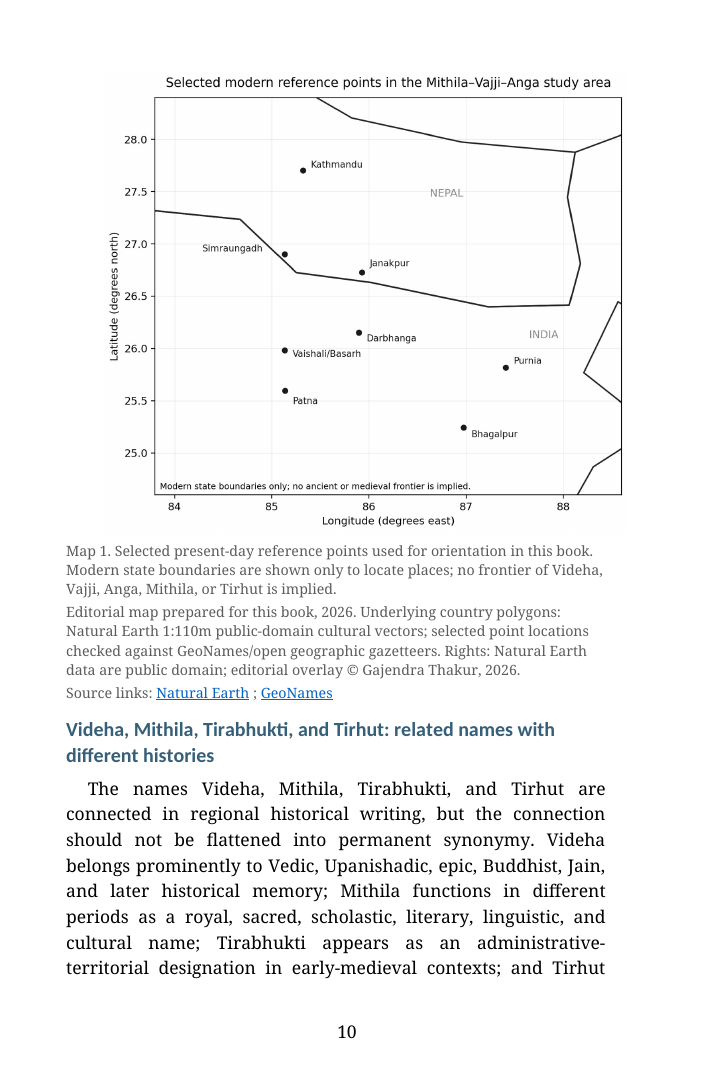
Mithila · Vajji · Anga
Chapter-specific source notes
- Primary chapter witness. Gajendra Thakur, Decoding the Panji of Mithila — Volume V, formal Chapter 4, PDF pp. 56-66; formal Chapter 4. The HTML transcription is generated from the commit-pinned source PDF and retains the chapter boundary recorded in this edition.
- Internal structure. The repository source-heading inventory records 20 subordinate headings for this chapter: “2. Shiva Hariam in Dharmapur Desh Dhanaghatta”; “3. Zhingur’s additional sons: Shashinath, Firangi, Dular, and the Chandravati marker”; “4. Shashinath’s line: Pyare, Shambhunath, and Haladhar”; “5. The daughters Tara, Manjula, Mira, and Durga”; “6. Chakradhar, Sunil, Raghunandan, and the modern family continuation”; “7. Damaged or dotted readings in the modern continuation”; “8. Sandahpur Didhoy Kumhdi Purv Dandkhora”; “9. Madhav, Gondu, and the Khaual-Khandwala links”; ….
- Digital editorial method. The page keeps the preserved source text distinct from generated navigational, concordance, visual, and provenance apparatus. The synthetic reconstruction is explanatory only and is not evidence for an individual lineage or a determination of social or marital status.