Decoding the Panji of Mithila · Volume V · Chapter 5
Mahadev Digdhi, Behat Khandwala-Parbaha, Padmapur, and Pada: Scholarly Branches, Modern Titles, and Expanding Marriage Fields
Chapter 5
   Mahadev Digdhi, Behat Khandwala-Parbaha, Padmapur,
    and Pada: Scholarly Branches, Modern Titles, and
               Expanding Marriage Fields

  1. Where Chapter 5 begins
   Chapter 4 ended at the point where the record had carried the branch
through Shiva Hariam, Sandahpur Didhoy, and Danti-Chopra Bakhari. The
next source movement does not begin a disconnected story. It continues the
same genealogical field through Mahadev Digdhi, Behat Khandwala-
Parbaha, Padmapur, Pada, and the final small cluster before the new heading
Ath Dom Tekari Gram.
   The method remains the same. Every name must be read through descent,
place, marriage, title, and branch-continuity. A person is not only a son. He
may also be a resident of a village, an inheritor of a learned title, a link to a
wife’s house, a node in a mool network, and a point from which later
descendants move into modern professions.
  This chapter therefore continues the actual sequence after Chapter 4. It
does not jump to the later Volume II index. It stays with the living line of the
source and reads the next compact blocks as one expanding network.

  2. Mahadev Digdhi: Dwarikanath, Kunjmohan, Ugramohan,
and Gangadhar
   The first new heading is Mahadev Digdhi. The record begins with
Dwarikanath and gives two sons: Kunjmohan and Ugramohan. Their branch
is immediately attached to Singholi Mander through Jayanand’s son Kadam
Lal. This opening already tells us that Mahadev Digdhi is not a village
isolated from the previous material. It is a new settlement heading inside a
larger Mander-linked field.
   Ugramohan’s son Gangadhar is then linked with Khamgada-vasi Tarouni
Karmah through Karel Lal’s son Lakshminath. This gives another major
cross-link: Mahadev Digdhi is joined to Karmah, Khamgada, and Tarouni.
Gangadhar’s descendants include Pramod, Vinod, and Amoda. These names
are linked with Sangram Ekhara through Jyotishi Achkalal’s son
Lakshminath and with Mahiya Sodarpur through Mahesh.
  The structure is compact but important. Dwarikanath gives the branch-
head; Kunjmohan and Ugramohan divide the line; Gangadhar carries the

                  Decoding the Panji of Mithila - Volume V | 66
active continuation; Pramod, Vinod, and Amoda move the branch into
Ekhara and Sodarpur networks. The Jyotishi marker shows that learned or
ritual status remains relevant even in a short settlement entry.

  3. Behat Khandwala-Parbaha: Mahipati, Dinu, Dhanpati,
and Kanha
   The next major heading is Behat Khandwala-Parbaha. The branch begins
with Mahipati, whose sons include Dinu and Dhanpati. Dhanpati is linked
with Karmah through Madhav; another Mahipati branch gives Kanha,
connected with Darihara through Badhu. This is the usual Panji method: a
father’s sons are named, and immediately each son is located by marriage or
branch connection.
   Dhanpati’s sons form a large group: Harakhu, Purkhu, Mati, Vishwanath,
Rati, Gopi, Maniram, and Nath. The branch is then linked with Baheradhi
through Vishwambhar and Batu. Gopinath’s line gives Lakshminath,
Vaidyanath, and Umanath, with links to Bela Sakaradhi, Virpur Panichobh,
and Harikar. These names carry the branch from Behat and Khandwala into
Sakaradhi and Panichobh fields.
   Vaidyanath’s descendants open the next expansion: Paramanand,
Bhavanand, Sarvanand, and Devanand. This is one of the most important
descendant clusters in the chapter because it leads to both learned lines and
later modernized branches. The Panji’s compact style does not pause to
make a family tree, but the line is clear: Mahipati leads to Dhanpati;
Dhanpati leads to several sons; through Gopinath and Vaidyanath the branch
becomes a major network.

  4. Paramanand and the Haridev-Vamdev-Govinddev-
Ratidev-Kamdev cluster
   Paramanand’s sons include Haridev, Vamdev, Govinddev, Ratidev, and
Kamdev, linked with Narwal and the great poet Girish. The mention of a
poet is not incidental. As in the opening Halayudh chapter, learned or
literary identity is part of the genealogical record. A poetic or scholarly title
preserves family prestige and helps locate the person in the intellectual
culture of Mithila.
  Haridev’s line gives Ghanashyam, Ramabhadra, and Hariram, connected
with Bijhara Mander and with Ekhara through Harinath’s son Vaidyanath.
The female marker Shilavati appears. This branch then gives the grammarian
Dharabharan and the grammarian Dhanesh, also known as Nandan, and the
grammarian Vighnesh, also known as Machal. These titles show a learned
sub-branch within the Behat Khandwala-Parbaha field.

                  Decoding the Panji of Mithila - Volume V | 67
   The line of Vaiyakarana Dhanesh / Nandan gives Ratnakar , Giripati ,
Vidyapati , and Pranapati , with links to Kanhouli Ekhara , Hariram ,
Halayudh , and Deshual Khandwala. Vighnesh / Machal’s line gives Revati ,
Raman , and Ghananand , with Tarouni Karmah , Visho , Mani , Ahil
Khaual , Krishna Nand , and Jambavati. This cluster must be read as a
learned genealogy inside a broader marriage map.

  5. Ghananand, Panchanath, Kumarnath, and the Alay-Tilay
continuation
   Ghananand’s line continues through Motinath, Bodhan, and Panchanand,
linked with Pariyamb Budhwal and Madhukar’s son Nanu. Panchanath’s son
Kumarnath is linked with Sakma-vasi Parmagadh Alay and Devani’s son
Bholanath. Kumarnath’s descendants include Yoganand, Devanand, and
Bhavanand, linked with Alay through Thakur Datt’s grandson Tilakdatt and
Photan, and with Rabhida-Tilay through Rai Mohan Singh.
   Bhavanand’s son Taranand is connected with Takwal through Andi’s son
Shivshankar. The record then moves to Sachchidanand and Brahmanand,
linked with Ratauli Darihara, Babujan, Rudranand, Sodarpur, Devi, and
Bhaktinath. These entries show how the branch continues to cross mool and
village boundaries: Alay, Tilay, Takwal, Darihara, and Sodarpur all enter the
same family field.
  Sachchidanand’s line gives Mayanand, associated with Asarna-vasi
Kurma Khaual and Devanand’s son Kokil Mohan; it also links with
Ruchauli Ekhara through Dharamran’s son Banmali. A modern political
marker appears: Thakur Mayanand, member of the Bihar Legislative
Assembly from the BJP. The Panji preserves this public identity in the same
grammar as older village and marriage links.

 6. Devanand and Radharaman: Acharya names inside the
modern branch
  Brahmanand’s line includes a Madanpur connection through Anhara Katai
and Bachhilal’s great-grandson Sonelal’s son Chandra Kishor. Then
Devanand’s son Radharaman is linked with Alay through Bauki’s son
Ganesh and with Sodarpur through Nenan. This is followed by
Radharaman’s sons: Manikant Acharya, Indrakant Acharya, Amarkant
Acharya, and Maryadhukant.
   The repeated title Acharya is significant. It marks not merely name but
learned status. These men are connected with Ekhara through Dharbharan’s
son Basundhar, with Phanandah through Jalp Datt’s son Uchit Lal, and with
Gnam Khaual through Kaushik-vasi Indranath’s son Manindranath. The

                  Decoding the Panji of Mithila - Volume V | 68
branch therefore retains old scholarly prestige while entering a dense
settlement network.
   This part of the record demonstrates one of the main arguments of
Volume V: titles are genealogical evidence. Acharya, Vaiyakarana, Jyotishi,
teacher, graduate, and public-office markers all help identify persons and
distinguish similarly named branches.

 7. Behat-Chopra Bakhari-Basaiti: Thakuri, Tilaknath, and
Mangaladatt
  The source then turns to Behat-Chopra Bakhari-Basaiti. Here another
branch from Buddhinath gives Thakuri, linked with Alay through Yogi’s son
Harinath. Thakuri’s son Tilaknath is connected with Ekhara through
Halayudh’s grandson Baburam’s son Buddhinath and with Uchati through
Chhavu’s son Bhola.
   Tilaknath’s descendants include Bachan, Sarvalal, and Mangaladatt. They
are connected with Baheradhi through Atmaram’s son Modnath and with
Jajival through Kala. Mangaladatt, also known as Mangali, gives Sundarlal,
Manoharlal, and Munilal, linked with Sakaradhi, Bechan, Pali, and
Sarveshwar. Manoharlal’s son Yoganand is linked with Alay through
Poshan’s son Jayan and with Sodarpur through Shilanath.
  This section again shows the Panji’s bridge method. A short heading
opens into Alay, Ekhara, Uchati, Baheradhi, Jajival, Sakaradhi, Pali, and
Sodarpur. The genealogy is not provincial; it is networked.

  8. Nashiradesh Padmapur: Keshav/Bhatu and the Padmapur
continuation
   The next heading is Nashiradesh Padmapur. The branch begins with
Thakur Keshav, also known as Bhatu, whose sons include Jaykrishna,
Manikrishna, and Aniruddha. They are linked with Budhwal through
Shyam’s son Lakshmidhar and with Sodarpur through Murari. Jaykrishna’s
line gives Bhanjan and Sadasiva, linked with Darihara, Pawauli, and
Hariram.
   Sadasiva’s son Lal is connected with Hariam through Visho’s son
Balkrishna and with Sodarpur through Lala. Lal’s sons include Krishna
Gopal and Chunni, linked with Ekhara through Bhanjan’s son Shambhu and
with Khaual through Pathak Shulpani. Krishna Gopal’s sons Tilakdatt and
Shankardatt are linked with Budhwal and Shibu; Tilakdatt’s son Hansmani
leads into Jaydev, Vedanand, Chaturanan, Chintamani, Sadanand, and
Ramanand.

                 Decoding the Panji of Mithila - Volume V | 69
   This Padmapur section is not just another descendant list. It forms a large
transition into modern genealogical memory. Vedanand’s descendants
include Gokhulanand, Shivanand, Shashikant, and Kailash, with
Farasagangi-vasi Vasaha, Vanshi, Somdatt, Digho, and Shivnath links.
Teacher Gokhulanand’s sons include Naveen, Praveen, and Dravin, and
modern professional detail continues with engineer Navneet. The Panji thus
carries the Padmapur branch into the contemporary era.

  9. Chaturanan, Chintamani, and the educated modern
continuation
   Chaturanan’s line includes Vishwambhar and Digambar, connected with
Simarwad Khaual, Jahanpur-vasi Yognath, Vasudev, Hemnagar DyoDhi
Khandwala, Parashnath, and Pakhiya. Digambar’s descendants include
Prabhat Kumar, Abhash Kumar, Subhash, Ravishankar, and Sanjiv, with
links to Karmah and Darihara.
   Chintamani’s line includes Avadhesh, Mithilesh, Rajesh, and Devesh,
connected with Jahanpur-vasi Darihara, Kulanand’s son Chakradhar,
Panichobh, Govind, and Chumman. The record then names Avadhesh as a
President’s Award-winning headmaster and gives daughters or descendants
Anita, Sangita, Preeti, and Triprika with links to Palasi, Nagwad Ghosot, and
Singheshwar. Mithilesh, Rajesh, Jaydev, Nishikant, Upendra Mohan, and
others continue the branch into more recent educational and professional
identities.
  This part of the chapter teaches that modern titles must be preserved.
Teacher, President’s Award headmaster, engineer, graduate, and
professional markers are not decorative. They help identify persons in a
period when many old names repeat. Modern identity becomes part of
genealogical identity.

  10. Shankardatt Jahanpur and the Pāda-Bhadra-Dwāśay-
Rūpaspur field
  The record next names Shankardatt Jahanpur. Shankardatt’s son
Nityanand , also known as Nitu , is linked with Budhwal through Pritinath’s
son Kashinath and with Ekhara through Hridayanand. Nityanand / Nitu’s son
Bachcha gives further branches through Pali , Khandwala , Shivnarayan ,
Tejnarayan , and Surgan. Shivnarayan’s sons include Professor
Satyanarayan , Pratap Narayan , Vir Narayan , and Shyam Narayan.
  After this comes Pada Bhadra Dwashay Rupaspur. Here Thakur Lal’s son
Chunni gives Garju, Brajmohan, Chandramohan, Vanshi, and Vadan, linked
with Ekhara and Khaual. Garju’s son Manmohan is connected with Budhwal

                  Decoding the Panji of Mithila - Volume V | 70
and Janakinath. Manmohan’s descendants include Indramani and Ugramani,
linked with Darihara, Shambhunath, Tilay, and Mohan Singh.
   Indramani’s sons include Gulab Mohan and Atrimohan, also known as
Chhotu, with Sakaradhi, Dwarikanath, and Khandwala links. Gulab Mohan’s
line gives Narayan Mohan and Lakshmi Mohan; Narayan Mohan, also
known as Bangtu, gives Surendra Mohan, graduate Dhirendra Mohan,
Birendra Mohan, and Devendra Mohan, tied to Darihara, Ekhara, and
modern professional identity. Dhirendra’s branch includes management
specialist Abhishek, showing again how recent professions enter the Panji
without breaking its older structure.

  11. The Pada sub-branch: Chandramohan, Lekhmani, and
later descendants
  A new Pāda note then begins with Thakur Chandramohan’s son
Lekhmani. Lekhmani is linked with Budhwal through Shibu’s son
Shambhunath and with Khandwala through Shyamnath. Lekhmani’s
descendants include Paramanand, Gajanand, Devanand, Kamalanand,
Giranand, and Rudranand, with links to Mander, Chetanath, Yognath,
Khandwala, and Harshmani.
   Paramanand’s son Ganganand appears, followed by other Paramanand-
linked descendants such as Radhanand, Abhayanand, Dukhmochan,
Narayan, Govind, and Gopika. These connect with Chhamusakaradhi,
Mukteshwar, Mungrauni Pali, Rajanpura Darihara, Raghéli Singholi
Mander, and Brahmpura. The line then continues into bank manager Rajesh,
B.A. Santosh, and an explicit inter-provincial marriage note. This is
important because it shows geographic and social expansion beyond the
older village matrix.
   The branch continues through Dukhmochan’s son Ravishankar, also
known as Bhikhari, linked with Tirasi, Jhaua Alay, Chandra Shekhar, and a
railway-service note. The line also mentions Pashchim Bengal Buniadpur
and Rani Ganj, showing eastern movement. Gajanand’s line gives
Mathuranand, Bholanand, Krishnanand, and further descendants through
Hariam, Gaur Sodarpur, Kanhouli Ekhara, Shalampur Badgam Darihara,
Mahishi Budhwal, and Purnea-related branches.

  12. Gokhulanand, Balanand, Swarupanand, and Vivekanand
  Devanand’s line gives Gokhulanand and Balanand, linked with Hemnagar
Rajanpura Darihara and Dunmun. Gokhulanand’s sons include Vivekanand,
Vijayanand, and Ajayanand, also known as Pappu, with links to Tarouni-
vasi Brahmoli Panichobh, Chumman, Belauch, Narayan, and other houses.

                 Decoding the Panji of Mithila - Volume V | 71
Vivekanand is tied to Parhat Sakaradhi, Jahuri, the grammarian Yadav
Chandra, Ahil Hariam, and Gunanand. Vijayanand and Ajayanand connect
with Patuaaha, Narendra Mohan, Nahar Parhat Sakaradhi, Pitambar, Ahil
Hariam, and Nageshwar.
  Balanand’s son Vinayanand is linked with Bardabatta Simarbad Khaual,
Chandranath’s son Shivnath, Malangia Kujouli, Chhotelal, and later sons
Naveen Kumar and Vikas. Through Vikas, the line reaches Balua Nagwad
Ghosot and Ugranand Thakur. Giranand’s sons include Swarupanand, also
known as Bechu, and Vivekanand, connected with Vishnupur Ahil Hariam,
Vanshmani, Yashodhar, and Simarbad Khaual.
  M.A. Swarupanand / Bechu’s sons Sanjay and Shraddhanand connect
with Sarouni - vasi Rajanpura Darihara and Ranjan’s son Kapileshwar.
Sanjay’s line mentions Madedhar Surgan , Shankar , Leela , Nandini ,
Parwaha Kanhouli Ekhara , and Tirasi - Katihar - Satlakha. Another
Vivekanand line is marked with public - service status and connects with
Parihari Mahishi Budhwal , Suvansh , Janardan , Vinu , Nitu , Gadh
Khandwala , and Dharampur Desh Bhudi. This is a dense modern sub -
branch , and it must be retained because it shows the living continuity of the
Panji.

  13. Final pre-Dom Tekari cluster: Mohan, Pranapati, Modi,
Jaydatt, and Dayanath
  Before the next formal heading, the record gives a smaller cluster: Thakur
Mohan’s son Thakur Pranapati. Pranapati’s descendants include Bhairavi,
Modi, Mansukha, and a Gadh Belauch connection through Chhotkini’s son
Khedu. Another link goes to Parasanda through Mukund’s son Lakshman.
Bhagirathi appears as a maternal marker, followed by Thakini and a Kakdih
Khaual connection through Harchati’s son Ramsinehi.
  Modi’s descendants include Jaydatt and Yashodhar, with links to Vasti
Lala, Sakuri Pali, Digambar, Sanath, Kujouli, and Nandlal. Urmila appears
as a maternal figure, followed by Jeeveshwari, Majhaura Karmah, Sagar,
Krishnadatt, and Rohinidatt. Jaydatt’s son Dayanath is linked with Belsam
Budhwal, Sadhu’s son Mangaliya, Guldi Khandwala, and Thakur Dina.
   This small closing cluster is important because it completes the movement
before a new formal section. It shows that the branch does not stop abruptly.
The Panji lets the line taper through a smaller alliance sequence before
announcing the next heading, Ath Dom Tekari Gram. Therefore, Chapter 5
should stop here and allow Chapter 6 to begin with Dom Tekari as a new
formal opening.

                  Decoding the Panji of Mithila - Volume V | 72
  14. Main branches decoded in this chapter
  Mahadev Digdhi branch: Dwarikanath, Kunjmohan, Ugramohan,
Gangadhar, Pramod, Vinod, Amoda, and the links to Singholi Mander,
Tarouni Karmah, Sangram Ekhara, Mahiya Sodarpur, and Jyotishi
Achkalal’s house.
  Behat Khandwala-Parbaha branch: Mahipati, Dinu, Dhanpati, Kanha,
Harakhu, Purkhu, Mati, Vishwanath, Rati, Gopi, Maniram, Nath, Gopinath,
Lakshminath, Vaidyanath, Umanath, Paramanand, Bhavanand, Sarvanand,
Devanand, Haridev, Vamdev, Govinddev, Ratidev, Kamdev.
  Learned Behat branch : Ghanashyam , Ramabhadra , Hariram ,
Vaiyakarana Dharabharan , Vaiyakarana Dhanesh / Nandan , Vaiyakarana
Vighnesh / Machal , Ratnakar , Giripati , Vidyapati , Pranapati , Revati ,
Raman , Ghananand , Motinath , Bodhan , Panchanand , Kumarnath ,
Yoganand , Devanand , Bhavanand , Taranand , Sachchidanand ,
Brahmanand , Mayanand , Radharaman , Manikant Acharya , Indrakant
Acharya , Amarkant Acharya , Maryadhukant.
  Padmapur branch : Keshav / Bhatu , Jaykrishna , Manikrishna , Aniruddha
, Bhanjan , Sadasiva , Lal , Krishna Gopal , Chunni , Tilakdatt ,
Shankardatt , Hansmani , Jaydev , Vedanand , Chaturanan , Chintamani ,
Sadanand , Ramanand , Gokhulanand , Shivanand , Shashikant , Kailash ,
Naveen , Praveen , Dravin , Vishwambhar , Digambar , Avadhesh ,
Mithilesh , Rajesh , Devesh , Nishikant , Upendra Mohan.
  Jahanpur and Pada - Rupaspur branch : Shankardatt , Nityanand / Nitu ,
Bachcha , Shivnarayan , Tejnarayan , Professor Satyanarayan , Pratap
Narayan , Vir Narayan , Shyam Narayan , Chunni , Garju , Brajmohan ,
Chandramohan , Vanshi , Vadan , Manmohan , Indramani , Ugramani ,
Gulab Mohan , Atrimohan / Chhotu , Narayan Mohan / Bangtu , Lakshmi
Mohan , Surendra Mohan , Dhirendra Mohan , Birendra Mohan , Devendra
Mohan , Abhishek.
  Pada late - modern branch : Chandramohan , Lekhmani , Paramanand ,
Gajanand , Devanand , Kamalanand , Giranand , Rudranand , Ganganand ,
Radhanand , Abhayanand , Dukhmochan , Ravishankar / Bhikhari ,
Gokhulanand , Balanand , Vivekanand , Vijayanand , Ajayanand / Pappu ,
Vinayanand , Naveen Kumar / Vikas , Swarupanand / Bechu , Sanjay ,
Shraddhanand , and the public - service Vivekanand branch.

  15. What Chapter 5 teaches
  Chapter 5 teaches five lessons. First, a new heading does not necessarily
mean a new family universe. Mahadev Digdhi continues from the earlier
branch but reorganizes the material under a new settlement label. Second,

                 Decoding the Panji of Mithila - Volume V | 73
learned titles remain central. Vaiyakarana, Acharya, Jyotishi, teacher, and
public-service markers are part of genealogical identity. Third, modern
professions do not weaken the Panji; they show its continuation. Bank
manager, railway employee, public servant, graduate, engineer, management
specialist, and President’s Award headmaster all enter the same record.
  Fourth, women continue to hold the network together. Shilavati,
Jambavati, Mayanand’s connected women, Sitavati, Hira, Sulochana,
Prabha-type and later modern women, Anita, Sangita, Preeti, Triprika,
Ashalata, Renu, Venu, Kalpana, Vandana, Santhya, Urmila, Jeeveshwari,
Bhairavi, Thakini, and many others are not ornamental names. They mark
marriage destinations and maternal sub-branches.
   Fifth, migration and expansion become increasingly visible. The line
touches Purnea, Katihar, Rani Ganj, Pashchim Bengal, Buniadpur, and inter-
provincial marriage contexts. Yet all of this remains inside the older Panji
structure.

 16. Conclusion: from Mahadev Digdhi to the threshold of
Dom Tekari
   Chapter 5 carries the line from Mahadev Digdhi through Behat
Khandwala-Parbaha, Padmapur, Jahanpur, Pada, Rupaspur, and the final
Mohan-Pranapati cluster. The whole chapter confirms that the Panji is a
living genealogical map. It records descent, place, marriage, title, migration,
and public identity in one compressed style.
   The next formal opening in the source is Ath Dom Tekari Gram. That
heading should begin the next chapter. It introduces a new organized unit
and should not be swallowed into the present chapter. This chapter ends at
the threshold, after completing the preceding settlement and branch-
continuity sequence.

                  Decoding the Panji of Mithila - Volume V | 74
Source structure and verification apparatus
Editorial source apparatus. This apparatus is descriptive, not interpretive. It records the source-controlled structure used to verify that this page corresponds to formal Chapter 5 of Decoding the Panji of Mithila — Volume V. The chapter text above is preserved from PDF pp. 67-75; formal Chapter 5 in the commit-pinned authoritative source. It is not merged with a neighboring chapter, appendix, annexure, or independent front/back-matter unit. The internal headings below come from the repository’s source-heading inventory and are retained as navigational and audit evidence; showing them here does not turn those headings into separate publications or add claims that are absent from the source.
Internal source headings
- 2. Mahadev Digdhi: Dwarikanath, Kunjmohan, Ugramohan, and Gangadhar
- 3. Behat Khandwala-Parbaha: Mahipati, Dinu, Dhanpati, and Kanha
- 4. Paramanand and the Haridev-Vamdev-Govinddev-Ratidev-Kamdev cluster
- 5. Ghananand, Panchanath, Kumarnath, and the Alay-Tilay continuation
- 6. Devanand and Radharaman: Acharya names inside the modern branch
- 7. Behat-Chopra Bakhari-Basaiti: Thakuri, Tilaknath, and Mangaladatt
- 8. Nashiradesh Padmapur: Keshav/Bhatu and the Padmapur continuation
- 9. Chaturanan, Chintamani, and the educated modern continuation
- 10. Shankardatt Jahanpur and the Pāda-Bhadra-Dwāśay-Rūpaspur field
- 11. The Pada sub-branch: Chandramohan, Lekhmani, and later descendants
- 12. Gokhulanand, Balanand, Swarupanand, and Vivekanand
- 13. Final pre-Dom Tekari cluster: Mohan, Pranapati, Modi, Jaydatt, and Dayanath
- 14. Main branches decoded in this chapter
- 15. What Chapter 5 teaches
- 16. Conclusion: from Mahadev Digdhi to the threshold of Dom Tekari
Source-text concordance
Mahadev · Digdhi · Behat · Khandwala-Parbaha · Padmapur · Pada · Scholarly · Branches · Modern · Titles · Expanding · Marriage · Fields · begins · ended · point · record · carried · branch · Shiva · Hariam · Sandahpur · Didhoy · Danti-Chopra · Bakhari · next · movement · begin · disconnected · story · continues · genealogical · field · Khandwala · Parbaha · final · small · cluster · heading · Tekari · Gram · method · remains · Every · name · must · read · descent · place · title · branch-continuity · person · resident · village · inheritor · learned · link · wife’s · house · node · mool · network · later · descendants · move · professions · therefore · actual · sequence · jump · index · stays · living · line · reads · compact · blocks · Dwarikanath · Kunjmohan · Ugramohan
Boundary verification. In the formal sequence this chapter follows Volume V Chapter 4, “Shiva Hariam, Sandahpur Didhoy, and Danti-Chopra” and precedes Volume V Chapter 6, “Dom Tekari Gram: Jayaditya, Pashupati, Vasudev, Dhirakant, Anantalal, Ram Sundar, and the Learned- Modern Continuation”. The chapter extractor begins at the verified formal Chapter 5 marker and stops at the next verified formal chapter marker; for a final chapter it stops before recognized book-level back matter. The concordance above is generated only from distinct terms already present in this chapter’s preserved source text. It is provided for discovery, comparison, and audit, not as an automated judgment about persons, lineages, status, kinship, marriage eligibility, or historical truth.
Illustrated research apparatus
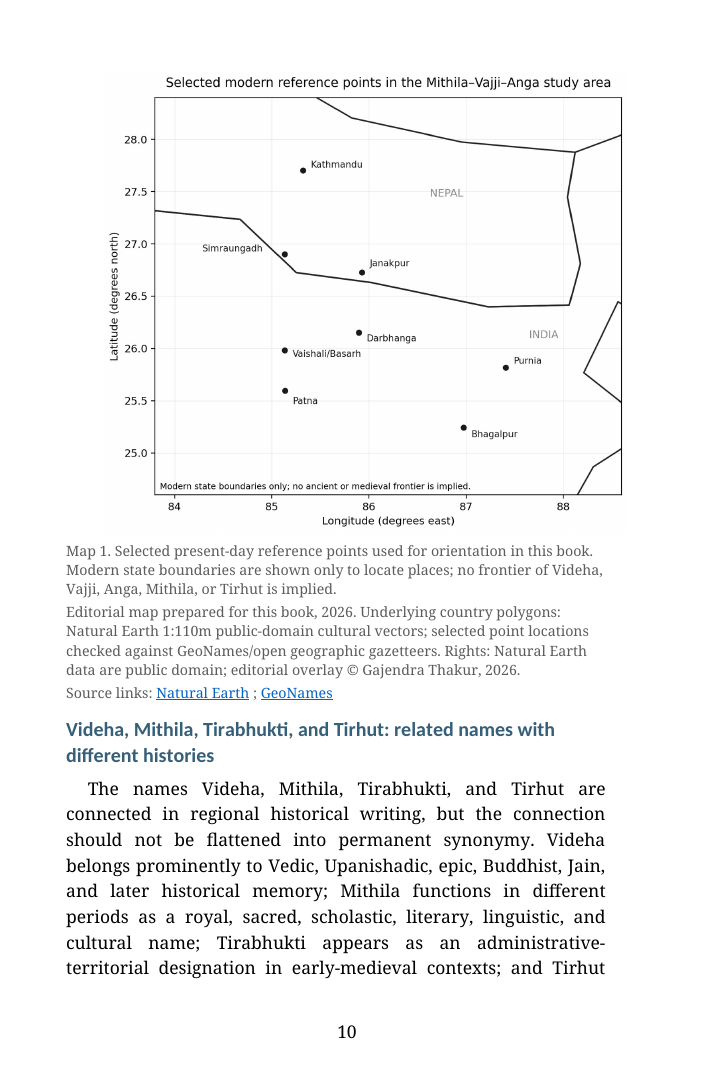
Mithila · Vajji · Anga
Chapter-specific source notes
- Primary chapter witness. Gajendra Thakur, Decoding the Panji of Mithila — Volume V, formal Chapter 5, PDF pp. 67-75; formal Chapter 5. The HTML transcription is generated from the commit-pinned source PDF and retains the chapter boundary recorded in this edition.
- Internal structure. The repository source-heading inventory records 15 subordinate headings for this chapter: “2. Mahadev Digdhi: Dwarikanath, Kunjmohan, Ugramohan, and Gangadhar”; “3. Behat Khandwala-Parbaha: Mahipati, Dinu, Dhanpati, and Kanha”; “4. Paramanand and the Haridev-Vamdev-Govinddev-Ratidev-Kamdev cluster”; “5. Ghananand, Panchanath, Kumarnath, and the Alay-Tilay continuation”; “6. Devanand and Radharaman: Acharya names inside the modern branch”; “7. Behat-Chopra Bakhari-Basaiti: Thakuri, Tilaknath, and Mangaladatt”; “8. Nashiradesh Padmapur: Keshav/Bhatu and the Padmapur continuation”; “9. Chaturanan, Chintamani, and the educated modern continuation”; ….
- Digital editorial method. The page keeps the preserved source text distinct from generated navigational, concordance, visual, and provenance apparatus. The synthetic reconstruction is explanatory only and is not evidence for an individual lineage or a determination of social or marital status.