Decoding the Panji of Mithila · Volume V · Chapter 6
Dom Tekari Gram: Jayaditya, Pashupati, Vasudev, Dhirakant, Anantalal, Ram Sundar, and the Learned- Modern Continuation
Chapter 6
 Dom Tekari Gram: Jayaditya, Pashupati, Vasudev,
Dhirakant, Anantalal, Ram Sundar, and the Learned-
Modern Continuation

  Source span decoded in this chapter
  Decoded source span and focus:
• Source movement - Decoded focus
• अथ डोम टे कारी ग्राम - Opening of the new village - root section after Chapter 5.
• महामहो जयादित्य ... महो हल्लेश्वर - Learned title , ancestor - frame , and
  scholarly continuity.
• हरदत्त ... बसाओन बिशो अमरू ... ओहरि दूबन - First split of the line through
  Sakaradhi , Khandwala , Mander , and related houses.
• नारायण , श्याम , कमल , परमानन्द , पशुपति , वासुदेव - Bridge into the large
  Pashupati - Vasudev son - cluster.
• रामेश्वर , भुवनेश्वर , गंगादत्त , दुर्गादत्त , धीरकान्त - Major Vasudev branches
  and their descent / marriage maps.
• धीरकान्त ... महोन्नद ... अनन्तलाल ... रामसुन्दर ... बस्तीलाल - Extended
  learned - modern continuation and daughter - marriage networks.
• घोडाघाट रतिपाड बेलउंच - Next heading ; reserved for the following chapter.

  1. Where Chapter 6 begins
  Chapter 5 stopped at the threshold of the next formal heading: अथ
डोम टे कारी ग्राम. That phrase is not a decorative divider. It signals the
opening of a new village-root section inside the same moving
genealogical field. The record now turns from Mahadev Digdhi, Behat
Khandwala-Parbaha, Padmapur, Jahanpur, Pada, and Rupaspur into Dom
Tekari and its connected lines.
  The method remains the same. Every name must be read through
descent, place, marriage, title, and branch-continuity. Dom Tekari is not
decoded as an isolated village. It is decoded as a point where learned
ancestry, older titles, sons, daughters, wives, mools, and later modern
markers meet.

                    Decoding the Panji of Mithila - Volume V | 75
   The chapter follows the source movement from Mahamahopadhyay
Jayaditya, Ram, Haradatt, Sudeshiru, Tatail Pandua, and Mahopadhyay
Halleshwar; then through Haradatt, Basaoan, Bisho, Amaru, Narayan,
Shyam, Kamal, Parmanand, Pashupati, Vasudev, and Vasudev’s large
son cluster; and finally into the later lines of Dhirakant, Anantalal, Ram
Sundar, Basti Lal, and Balgovind. It stops before the next major
settlement heading, Ghoda Ghat Ratipad Belauch.

  2. Jayaditya and the scholarly opening of Dom Tekari
   The heading begins with Mahamahopadhyay Jayaditya. The title is
important. A Panji section that opens with a high scholarly title is not
merely giving a private ancestor. It is identifying the branch through
learned prestige. Jayaditya is followed by Ram, Haradatt, and Sudeshiru,
and the line is connected with Tatail Pandua and Mahopadhyay
Halleshwar.
   This beginning places Dom Tekari inside the same world of learned
genealogy that was visible in earlier chapters. The repeated
Mahamahopadhyay and Mahopadhyay marks show that scholarship is
part of branch authority. The Panji does not need to narrate biographies.
It records title, descent, and place so that the reader understands the
social standing of the line.
   The structure is compact. Jayaditya gives the high title; Ram and
Haradatt give the descent-opening; Sudeshiru and Tatail Pandua give the
settlement or connection; and Halleshwar links the line with learned
continuity. A modern prose tree must preserve all four elements.

  3. Haradatt, Basaoan, Bisho, Amaru, and the first branch
division
  Haradatt’s line opens through Basaoan, Bisho, and Amaru. The source
then attaches the branch to Sakaradhi, Nandi’s son Guned, Khandwala,
and Hore. These are not random additions. They tell us that the Dom
Tekari line is immediately tied to other recognized mool and village
networks.
  Amaru is also known through Budhes. His sons or branch figures
include Ohari and Duban, and the line is linked with Mander and Gayan.
Bisho’s associated children or female-linked figures are Moha and
Surasa. These names must not be omitted because they may distinguish
one maternal or marital branch from another.

                 Decoding the Panji of Mithila - Volume V | 76
  The first lesson of the chapter appears here: the Panji does not wait
long before distributing a branch. A heading begins with Dom Tekari,
but within a few lines the branch is already tied to Sakaradhi,
Khandwala, Mander, and named female lines.

  4. Ohari, Narayan, Shyam, Kamal, and the Pashupati
approach
  Ohari’s son Narayan continues the line. Narayan is linked with
Darhiara and Lakhu, and also with Karmah and Raghu. This means that
Narayan’s identity is not complete until the place-links are retained. The
Panji is saying: read him through father, village, and cross-house
connection.
   Narayan’s sons include Shyam and Kamal. Shyam’s son Parmanand is
then connected with Kujouli and Jagannath. The record also names
Babuna as a mother or maternal marker. Parmanand’s line proceeds
toward Pashupati, Kulapati, and a Didhoy link through Jaykrishna. The
line therefore moves from Dom Tekari into Kujouli, Didhoy, Darhiara,
Karmah, and Jajival-type relational fields.
   Pashupati is the next major node. He does not stand alone. He is the
result of the earlier Narayan-Shyam-Parmanand movement, and he
becomes the bridge into Vasudev and the large son-cluster that
dominates the next part of the chapter.

  5. Pashupati and Vasudev: the line becomes broad
  Pashupati’s son Vasudev opens one of the largest internal expansions
of this chapter. Vasudev is connected with Sakauna through Ram’s son
Pati and with Beheda Belauch through Vaidyanath. A maternal marker,
Durga, appears. This means that Vasudev’s identity should be charted
with paternal descent, settlement, affinal links, and maternal notation.
  Vasudev’s sons include Rameshwar, Bhuvaneshwar, Gangadatt,
Durgadatt, and Dhirakant. The Panji then links them with Sataidh
Sarisav, Chatur, Asi Valiyas, Vaidyanath, and Rupa. A female or
maternal group, Maravati and Kamalavati, also appears, with Hati Pali
and Dinbandhu’s son Bhaiyaram.
   This is a typical Panji expansion. One father gives several sons, and
each son opens a new branch. The sons cannot be treated as mere names
in a list. Each must be followed through the places and marriages that the
Panji attaches to him.

                 Decoding the Panji of Mithila - Volume V | 77
  6. Rameshwar’s line: Mansharam, Saburdatt, Banmali, and
Hiramanik
  Rameshwar’s branch gives Mansharam, Saburdatt, Banmali, and
Hiramanik. The line moves through Murajpur Darhiara and Purandar’s
grandson Gunakar’s son Bhaiyaram, and also through Raudh. A maternal
or female marker, Sohouni, appears, followed by Jayanti, Mula, and
Havo.
  These details are crucial. The names Jayanti, Mula, and Havo should
not be discarded as incidental. In a Panji structure, female names and
maternal notations help later readers distinguish branches. They also
preserve the alliance field created by marriage.
   Mansharam’s line gives Babunath and Jhotan, also known as Parshi.
These are connected with Darhiara, Pitambar’s son Bandhu, and Raudh-
Jayanarayan. The sequence shows how Rameshwar’s branch does not
stay in one settlement. It reaches Darhiara, Raudh, Murajpur, and related
houses.

  7. Babunath, Bastilal/Chhotku, Dharmalal, and Sonalal
  Babunath’s sons include Bastilal, also known as Chhotku, Dharmalal,
and Sonalal. The line links them with Satlakha and Bhola. A maternal
note, Hansavati, appears, followed by Dayavati and Chanchalavati.
Again the structure is not only male descent. The women help organize
the branch.
  Bastilal / Chhotku’s son Buddhinath is connected with Nanauti and
Shripur - vasi Acharya Manulal. Bhuvaneshwar’s line is also linked with
Katak Mander , Anathi’s son Saheb , and Mandari Sam / Mahi. This part
of the source shows a dense relation between Dom Tekari , Shripur ,
Mander , and related learned houses.
  The phrase Acharya Manulal is important. Titles inside the branch are
not ornamental. They show the learned authority of the family, just as
Mahamahopadhyay and Mahopadhyay did in the opening. Chapter 6
therefore continues the book’s larger argument: genealogy and
scholarship are interwoven.

 8. Bhuvaneshwar’s daughters and the Karmah-Rasadh-
Mander links
  Bhuvaneshwar’s associated female line includes Madhurani, Jiva, and
Chintavati. Their marriages and links carry the line into Karmah, Rasadh,

                 Decoding the Panji of Mithila - Volume V | 78
and Mander. One connection links Karmah through Judaun’s son Saheb.
Another links Rasadh through Krishnaram’s son Anand. Another names
Giridhari, Chhatradhari, and Shridhar, and then Chitravati through
Mander and Kalidatt.
   This part of the chapter demonstrates the Panji’s practical purpose. If
only the male names are charted, the actual marriage map disappears.
Madhurani, Jiva, and Chintavati are not secondary. They are bridge-
figures connecting the branch to houses that later generations must
remember.
   Buddhinath’s son Jaykrishna continues through Bad Darhiara and
Shambhu’s son Gudar, and also through Ekma Khandwala and
Harshmani. The line therefore moves from the Dom Tekari heading into
Darhiara and Khandwala fields while retaining the memory of the
original branch.

  9. Gangadatt, Vaiyakarana Krishnaram, and Ghanaram
   Gangadatt’s sons include Vaiyakarana Krishnaram and Ghanaram.
The title Vaiyakarana matters. It marks grammatical learning and
identifies Krishnaram not merely as a descendant, but as part of a learned
tradition. The branch is linked with Murajpur Khaual through Uttim’s
son Harpati and with Sundar Sodarpur through Ratan’s son Dharu.
  A maternal note, Mandodari, appears, followed by Anandi and
Jambavati. Anandi is linked through Tarouni Karmah and Judaun’s son
Bauku, with sons Jharula and Jhumak Lal. Krishnaram’s line then gives
Chandradatt and Prithvidatt, linked with Baheradhi and Paran’s daughter
None.
   This is one of the places where title , descent , and marriage geography
meet perfectly. Krishnaram is a Vaiyakarana , but his genealogical value
lies equally in his links to Khaual , Sodarpur , Karmah , Baheradhi , and
the maternal / daughter markers.

  10. Chandradatt, Ram Lal, Bengalal, and the daughter-lines
  Chandradatt’s line gives Ram Lal, Devlal, and the well-known
Bengalal. These are linked with Satlakha, Babunath, Odha Ekhara, and
Nanhku. Chanchalavati appears as a maternal or female marker, followed
by Ram Lal’s son Bokai and then Dayavati through Jalay and Shrilal’s
son Sarvalal.

                 Decoding the Panji of Mithila - Volume V | 79
   This cluster shows how the Panji records both known names and
relational pathways. A name such as Bengalal may be memorable, but
the genealogy becomes meaningful only when the surrounding village
and marriage links are preserved.
  The chapter therefore treats this passage not as a list of scattered
descendants, but as a branching continuation of Gangadatt’s line through
Krishnaram, Chandradatt, and their connected houses.

  11. Dhirakant’s branch : Mahonnad , Nidhinath ,
Shambhunath , Ramanath / Neena , Tota , Lakshminath
   Dhirakant’s sons include Mahonnad, Nidhinath, Shambhunath,
Ramanath also known as Neena, Tota, and Lakshminath also known as
Thitharu. They are connected with Phoolsara, Kavai Naroun, Badan’s
son Prannath, Mahua Khaual, and Chhabu. The line therefore ties Dom
Tekari back into the larger Phoolsara-Naroun-Khaual field already seen
in earlier chapters.
   A female group, Nageshwari, appears, followed by Hiravati. Hiravati
is linked with Anilpur Karmah and Bachhar’s son Poshan. Her line gives
Tofalal and Vanshilal. This is another example of women shaping
branch-continuity. Hiravati is not an ornament. She is the channel
through which Karmah and the later sons enter the record.
  Mahonand and Nidhinath give Ugramani and Shiromani , linked with
Kansam Mander and Kalidas / Kalar , and also with Sakauna and
Parmanand’s son Hari. Kanchani appears as another maternal marker.
The Dhirakant section is therefore a dense web of male descent and
maternal organization.

  12. Ugramani/Lataru, Mushay, Shiromani,
Krishnamani/Mukund
  Ugramani, also known as Lataru, has a son Mushay, connected with
Majhaura Karmah, Dhan’s son Premnath, Badgam Darhiara, and
Meghan. Mushay’s line is connected with Singhauli Mander through
Jayanand’s son Kadamlal and with Behat Khandwala through Ghotan.
  Shiromani’s son Krishnamani , also known as Mukund , is connected
with Majhaura Karmah , Jhumak Lal , Jyotishi Tofalal , and Valiyas /
Babunath. A maternal note , Baba Day , appears , followed by Lalvati ,
Murajpur Khaual , Chanka - vasi Hridayphool , Neena , and Yogmani.

                Decoding the Panji of Mithila - Volume V | 80
  The Panji then gives Anantalal and Ram Sundar, also known as
Nunulal, linked with Pariyamb Budhwal, Durgapati’s son Hibharan, and
Neyam Kujouli through Khadagnath. Jhabavati appears as a female
marker, followed by Ambika and Chandika. This is the turning point
where the branch begins to move toward more visible modern figures.

  13. Anantalal and the modern public branch
  Anantalal’s sons include Balkrishna, Harikrishna also known as
Gorelal, and others. The record links them with Singhwad Shiva
Hariamb through Vaiyakarana Babujan’s son Dukharan and with
Khangud Sarisav through Indramani. Nageshwari appears as a maternal
marker, followed by Gauri and Kishori. Their marriages connect to
Shivnagar Parhat Baheradhi and Bardabatta Simarbad Khaual.
  Balkrishna is marked as a retired Bihar Legislative Assembly member
associated with Jan Sangh, with the dates 1930-1990. This is a major
modern historical marker inside the Panji. The record then names
Narayan Ji, Vijay, and Ajay, connected with Simarwad Khaual,
Nandkishor’s son Jaynath, and Hati Sodarpur.
  The presence of a legislative title does not break the Panji pattern. It
shows continuity. A person may be a modern public figure, yet the
record still locates him through father, village, mool, marriage, and
branch.

  14. Narayan Ji, Vikash Kumar, Ajay Kumar, and modern
education
  Narayan Ji is described as M.A. and as a social worker connected with
Araria district BJP. His sons include Akash also known as Shrinivas,
Shripati, and Abhishek. They are linked with Ujan Singholi Mander,
Badrinath’s son Leelanath Upadhyay, Bhaura Khandwala, and Shivani.
The line also enters Madanpur Mangalia Katai through Abhijit and
Dineshwar.
   Vikash Kumar is linked with Pindaruchh Pamgarh Alay, Vinita, and
children named Rishi and Shruti. Ajay Kumar is described as a graduate,
and his sons include Atul and Vaibhav, linked with Satauli Satlakha,
Justice Vaidyanath’s son engineer Bholanath, and Anilpur Karmah
through Leelanath. These modern educational and professional markers
must be preserved.

                 Decoding the Panji of Mithila - Volume V | 81
   Harikrishna / Gore’s sons include Ashok Kumar and Vinod , linked
with Vishnupur Ahil Hariam and Lal’s son Tirthanand. Ashok Kumar is
described with M.Sc. and Ph.D. in physics and with scholarly - social
interests. The Panji thus continues to absorb modern education , public
life , and professional distinction within the old genealogical grammar.

  15. Ram Sundar, Hem Sundar, and Prem Sundar
   Ram Sundar’s son Hem Sundar is linked with Shiva Hariam through
Babujan’s son Dukharan and with Khangud Sarisav through Indramani.
The record names Durga / Parga - like readings and children including
Suryakanta and Vishwakarma. Ram Sundar’s other son Prem Sundar ,
also known as Sadanand , is connected with Khori Sodarpur and Ghutar.
Mandodari appears as a maternal marker , followed by Madhuri , Malati ,
Arundhati , and Neelam.
  The daughters’ marriage links are extensive. Suryakanta connects with
Samauli Pali and Shridas / Gokhulanand ; Vishwakarma connects with
Ramnagar Rakhwari Hariam and Rajendra ; Madhuri connects with
Kursa Kanta Bhadgam Jajival and Kritiyanand Sharma ; Malati connects
with Pada Behat Khandwala and Murlimohan ; Arundhati connects with
Madanpur Talisma Panichobh and Amarendra ; Neelam connects with
Patwaha Chhadan Sarisav and Dhruv Kumar.
  This part of the chapter is a clear example of marriage-network
architecture. The branch cannot be understood by sons alone. The
daughters carry the branch into Pali, Hariam, Jajival, Khandwala,
Panichobh, and Sarisav fields.

   16. Basti Lal/Chhotku, Balgovind, and the chapter’s closing
field
  The passage then returns to Basti Lal, also known as Chhotku. His son
Buddhinath’s son Balgovind is linked with Asura Badgam Darhiara and
Gudar. Yogarupa appears as a maternal marker, followed by Godavari
and a Dhangri Narsam Valiyas link through Vanshidhar.
  Balgovind’s sons include Narendra Mohan, Devendra Mohan, and
Acharya Dr. Virendra Kumar. The branch is linked with Maldwand
Badhiya Pawauli through Gudar’s son Krishnadev and with Sahdazpur
Sahashram Darhiara through Shripati. Saraswati appears as a maternal
marker, followed by Gita, Amrita, Sangeeta, and Rekha.

                Decoding the Panji of Mithila - Volume V | 82
   The daughter-lines again carry the branch into Sijhua Mudari, Babhani
Parhat Makarahi, Babhani Parhat Sakaradhi, and Belgachhi Ratauli
Darhiara. Narendra Mohan is marked M.Sc. and his son Nitish Bhardwaj
is linked with Taranagar Tarouni Karmah, Revathinath, and Hemnagar
Malangia Karmah. This closes the chapter’s Dom Tekari field and
prepares the next chapter to begin with the next heading: Ghoda Ghat
Ratipad Belauch.

  17. Main branches decoded in this chapter
  Jayaditya - Haradatt opening : Jayaditya , Ram , Haradatt , Sudeshiru ,
Halleshwar , Basaoan , Bisho , Amaru / Budhes , Ohari , Duban ,
Narayan , Shyam , Kamal , Parmanand.
  Pashupati-Vasudev branch: Pashupati, Vasudev, Rameshwar,
Bhuvaneshwar, Gangadatt, Durgadatt, Dhirakant, with Sakauna, Beheda
Belauch, Sataidh Sarisav, Asi Valiyas, and Hati Pali links.
  Rameshwar - Babunath branch : Mansharam , Saburdatt , Banmali ,
Hiramanik , Babunath , Jhotan / Parshi , Bastilal / Chhotku , Dharmalal ,
Sonalal , Buddhinath.
  Gangadatt learned branch: Vaiyakarana Krishnaram, Ghanaram,
Chandradatt, Prithvidatt, Ram Lal, Devlal, Bengalal, Bokai, Dayavati,
Sarvalal.
  Dhirakant branch : Mahonnad , Nidhinath , Shambhunath , Ramanath /
Neena , Tota , Lakshminath / Thitharu , Ugramani / Lataru , Mushay ,
Shiromani , Krishnamani / Mukund , Anantalal , Ram Sundar / Nunulal.
  Modern continuation : Balkrishna , Narayan Ji , Vijay , Ajay , Vikash
Kumar , Ashok Kumar , Vinod Kumar , Hem Sundar , Prem Sundar /
Sadanand , Balgovind , Narendra Mohan , Devendra Mohan , Acharya
Dr. Virendra Kumar.

  18. What Chapter 6 teaches
   Chapter 6 teaches that a formal village heading may contain several
layers of time. The Dom Tekari section begins in a learned premodern
world, with Mahamahopadhyay and Mahopadhyay titles, but it continues
into modern education, legislative office, social work, engineering,
science, and public life.
  It also teaches that the Panji’s method does not change when names
become modern. A modern graduate , professor , doctor , engineer , or
political worker is still recorded through father , branch , village ,

                 Decoding the Panji of Mithila - Volume V | 83
marriage connection , and maternal / daughter lines. The old grammar
survives inside the modern record.
   Most importantly, the chapter confirms that women’s names must be
retained. Durga, Babuna, Maravati, Kamalavati, Sohouni, Hansavati,
Dayavati, Chanchalavati, Mandodari, Anandi, Jambavati, Hiravati,
Kanchani, Jhabavati, Ambika, Chandika, Nageshwari, Gauri, Kishori,
Mandodari, Madhuri, Malati, Arundhati, Neelam, Yogarupa, Saraswati,
Gita, Amrita, Sangeeta, and Rekha are not decorative additions. They
organize the marriage memory of the branch.

  19. Conclusion: Dom Tekari as continuity of learning,
descent, and public memory
   Chapter 6 carries the line from Dom Tekari through Jayaditya’s
learned opening, Haradatt’s branch division, Pashupati and Vasudev’s
large son-cluster, Gangadatt’s Vaiyakarana line, Dhirakant’s extended
descendants, and the modern public branches of Anantalal, Ram Sundar,
Balgovind, and their descendants.
  The chapter shows how the Panji preserves continuity across centuries.
A line may begin with Mahamahopadhyay Jayaditya and later contain an
assembly member, a social worker, a physicist, an engineer, an acharya,
and many modern family names. Yet the structure remains the same:
descent, place, marriage, title, and branch-continuity.
   The next chapter should begin with the following major settlement
movement after this Dom Tekari field: Ghoda Ghat Ratipad Belauch.
The same method must continue, because every new settlement heading
is not merely a place-name but another doorway into the living social
map of Mithila.

                Decoding the Panji of Mithila - Volume V | 84
Source structure and verification apparatus
Editorial source apparatus. This apparatus is descriptive, not interpretive. It records the source-controlled structure used to verify that this page corresponds to formal Chapter 6 of Decoding the Panji of Mithila — Volume V. The chapter text above is preserved from PDF pp. 76-85; formal Chapter 6 in the commit-pinned authoritative source. It is not merged with a neighboring chapter, appendix, annexure, or independent front/back-matter unit. The internal headings below come from the repository’s source-heading inventory and are retained as navigational and audit evidence; showing them here does not turn those headings into separate publications or add claims that are absent from the source.
Internal source headings
- 1. Where Chapter 6 begins
- 2. Jayaditya and the scholarly opening of Dom Tekari
- 3. Haradatt, Basaoan, Bisho, Amaru, and the first branch division
- 4. Ohari, Narayan, Shyam, Kamal, and the Pashupati approach
- 5. Pashupati and Vasudev: the line becomes broad
- 6. Rameshwar’s line: Mansharam, Saburdatt, Banmali, and Hiramanik
- 7. Babunath, Bastilal/Chhotku, Dharmalal, and Sonalal
- 8. Bhuvaneshwar’s daughters and the Karmah-Rasadh-Mander links
- 9. Gangadatt, Vaiyakarana Krishnaram, and Ghanaram
- 10. Chandradatt, Ram Lal, Bengalal, and the daughter-lines
- 11. Dhirakant’s branch : Mahonnad , Nidhinath , Shambhunath , Ramanath / Neena , Tota , Lakshminath
- 12. Ugramani/Lataru, Mushay, Shiromani, Krishnamani/Mukund
- 13. Anantalal and the modern public branch
- 14. Narayan Ji, Vikash Kumar, Ajay Kumar, and modern education
- 15. Ram Sundar, Hem Sundar, and Prem Sundar
- 16. Basti Lal/Chhotku, Balgovind, and the chapter’s closing field
- 17. Main branches decoded in this chapter
- 18. What Chapter 6 teaches
- 19. Conclusion: Dom Tekari as continuity of learning, descent, and public memory
Source-text concordance
Tekari · Gram · Jayaditya · Pashupati · Vasudev · Dhirakant · Anantalal · Sundar · Learned · Modern · Continuation · span · decoded · focus · movement · Opening · village · root · section · title · ancestor · frame · scholarly · continuity · हरदत · First · split · line · Sakaradhi · Khandwala · Mander · related · houses · Bridge · large · cluster · Major · branches · descent · marriage · maps · Extended · daughter · networks · Next · heading · reserved · following · begins · stopped · threshold · formal · phrase · decorative · divider · signals · village-root · inside · moving · genealogical · field · record · turns · Mahadev · Digdhi · Behat · Khandwala-Parbaha · Padmapur · Jahanpur · Pada · Rupaspur · connected · lines · method · remains · Every · name · must · read · place
Boundary verification. In the formal sequence this chapter follows Volume V Chapter 5, “Mahadev Digdhi, Behat Khandwala-Parbaha, Padmapur, and Pada: Scholarly Branches, Modern Titles, and Expanding Marriage Fields” and precedes Volume V Chapter 7, “Ghoda Ghat Ratipad Belauch: Vasudev, Durgadatt, Bhim, Manohar, Harishwar, Mohanlal, Chaturanan, and the Belauch Marriage Field Source span decoded in this chapter”. The chapter extractor begins at the verified formal Chapter 6 marker and stops at the next verified formal chapter marker; for a final chapter it stops before recognized book-level back matter. The concordance above is generated only from distinct terms already present in this chapter’s preserved source text. It is provided for discovery, comparison, and audit, not as an automated judgment about persons, lineages, status, kinship, marriage eligibility, or historical truth.
Illustrated research apparatus
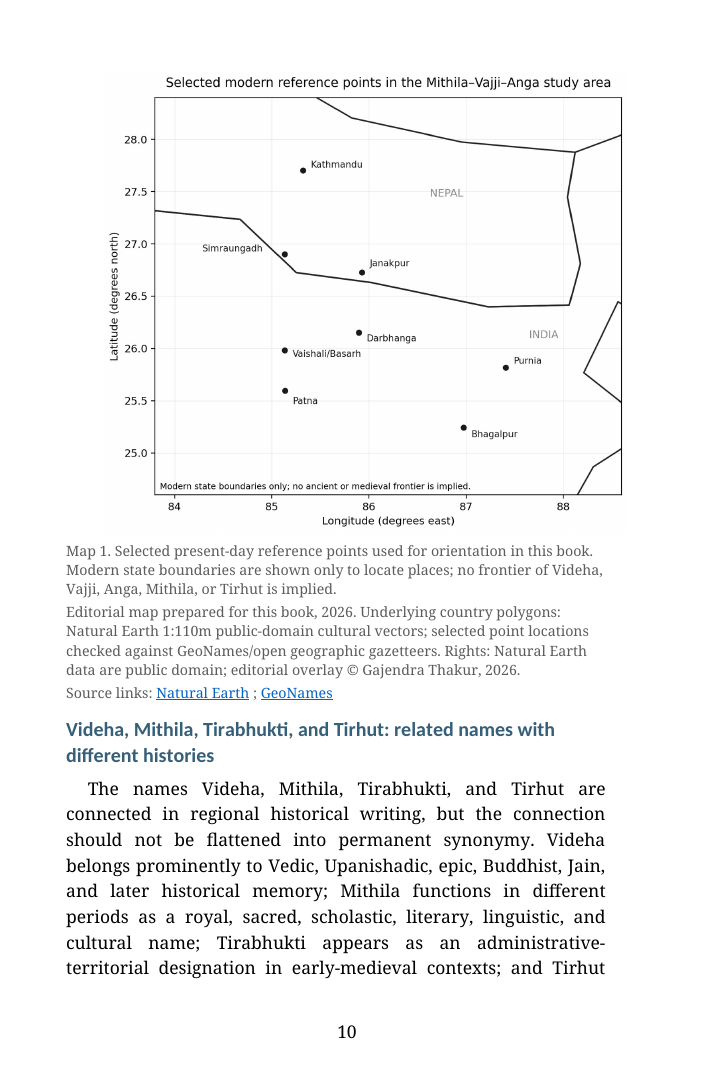
Mithila · Vajji · Anga
Chapter-specific source notes
- Primary chapter witness. Gajendra Thakur, Decoding the Panji of Mithila — Volume V, formal Chapter 6, PDF pp. 76-85; formal Chapter 6. The HTML transcription is generated from the commit-pinned source PDF and retains the chapter boundary recorded in this edition.
- Internal structure. The repository source-heading inventory records 19 subordinate headings for this chapter: “1. Where Chapter 6 begins”; “2. Jayaditya and the scholarly opening of Dom Tekari”; “3. Haradatt, Basaoan, Bisho, Amaru, and the first branch division”; “4. Ohari, Narayan, Shyam, Kamal, and the Pashupati approach”; “5. Pashupati and Vasudev: the line becomes broad”; “6. Rameshwar’s line: Mansharam, Saburdatt, Banmali, and Hiramanik”; “7. Babunath, Bastilal/Chhotku, Dharmalal, and Sonalal”; “8. Bhuvaneshwar’s daughters and the Karmah-Rasadh-Mander links”; ….
- Digital editorial method. The page keeps the preserved source text distinct from generated navigational, concordance, visual, and provenance apparatus. The synthetic reconstruction is explanatory only and is not evidence for an individual lineage or a determination of social or marital status.