Decoding the Panji of Mithila · Volume V · Chapter 7
Decoded source span and focus:
Chapter 7
  Ghoda Ghat Ratipad Belauch: Vasudev, Durgadatt,
Bhim, Manohar, Harishwar, Mohanlal, Chaturanan, and
the Belauch Marriage Field
  Source span decoded in this chapter
  Decoded source span and focus:
• Source movement - Decoded focus
• घोडाघाट रतिपाड बेलउंच - New settlement heading after Dom Tekari ; opening of
  the Ratipad - Belauch field.
• वासुदेव → दुर्गादत्त → ठकरू → भीम → मनोहर - Main descent line through
  which the section begins.
• मनोहर सुता आनन्दी , कोकील , खेदन , दुर्लभ , क्षेमकर , बालकृ ष्ण - First son
  - cluster from Manohar and the branch toward Harishwar and Baidyanath.
• गंगा , ठकिनी , कु मरि , पूर्णिमा ; तारावती ; धीवती ; हेमवती - Women and
  daughter - marriage markers that organize the early section.
• बैद्यनाथ → मोहनलाल → फू दीलाल / फू दकन / कलर → चतुरानन्द - Second
  major descent cluster with Khaual , Karmah , Budhwal , Sodarpur , Darhiara , and
  Sakaradhi links.
• चतुरानन्द सुता रमाकान्त , लक्ष्मीकान्त , उमाकान्त ; यदुनन्दन प्र0 बेचन -
  Large modernizing branch with daughters , wives , and public - social titles.
• विश्वनाथ → महेशनाथ / रविन्द्रनाथ / मुटु कनाथ / बटे शनाथ - Late
  continuation through Naroun , Karmah , Pali , Khandwala , and Darhiara links.
• तिलय रतनपुर - रभिडा - बनैली , परवाहा असूरा सकमा - Next heading ;
  reserved for the following chapter.

  1. Where Chapter 7 begins
  Chapter 6 stopped before the next major settlement heading: घोडाघाट
रतिपाड बेलउंच. Chapter 7 begins from that exact point. The chapter does
not treat Ghoda Ghat as a mere place-name. It reads the heading as a new
doorway into a branch where Belauch, Ratipad, Sodarpur, Khaual, Jalay,
Nikhuti, Pali, Darhiara, Baliyas, and Karmah are drawn into one
genealogical field.
  The method remains the same: every name is read through descent,
place, marriage, title, and branch-continuity. The section begins with
Vasudev, Durgadatt, Thakaru, Bhim, and Manohar, but it quickly

                    Decoding the Panji of Mithila - Volume V | 85
expands through sons, wives, daughters, maternal markers, village links,
and later modern titles.
  This chapter follows the source until the next formal heading, तिलय
रतनपुर-रभिडा-बनैली, परवाहा असूरा सकमा. That next heading is reserved
for Chapter 8. The present chapter is therefore the full Ghoda Ghat
Ratipad Belauch field.

  2. Vasudev, Durgadatt, Thakaru, Bhim, and Manohar
   The section opens with Vasudev’s son Durgadatt, then Durgadatt’s son
Thakaru, and then Bhim. Bhim’s son is Manohar. This gives the first
clean descent chain of the chapter: Vasudev -> Durgadatt -> Thakaru ->
Bhim -> Manohar.
  The text immediately connects Manohar with Andoli Jalay through
Thanu. This is the first warning that the section will not remain limited to
Belauch. A person standing under the Ghoda Ghat Ratipad Belauch
heading is made socially legible through another place connection.
   Devsena appears as a maternal or female-associated marker, followed
by the children Machalini and others. Machalini is linked with
Singhashram and Mohan. This early female note must be preserved,
because the branch does not move only through male descent. The Panji
is already recording the marriage and maternal web alongside the
paternal line.

  3. Manohar’s sons and the first Harishwar line
  Manohar’s descendants include Anandi, Kokil, Khedan, Durlabh,
Kshemkar, and Balkrishna. The group is linked with Busvan and
Hardev’s son Bhramar. The record then moves into Manoroma, also
remembered as Medhna, and from there into Balkrishna’s sons Durgadatt
and Harishwar.
   The branch is connected with Barhi Nikhuti through Dukha and
Bhramar, and with Kanakaura Didhoy through Gosain Das and
Khadgari. These links make the Ghoda Ghat heading a center of
distribution rather than a narrow residence label. A correct chart must
therefore mark the heading, then list the outward links under each
branch.
  The women Ganga, Thakini, Kumari, and Purnima appear in this
section. Their marriages connect Didhoy, Usrauli Alay, Neyam Kujouli,
and Kusamal. These are not incidental names. They carry the marriage
memory by which the branch enters other houses.

                 Decoding the Panji of Mithila - Volume V | 86
  4. Harishwar, Baidyanath, and the daughter-marriage
structure
  Harishwar’s son Baidyanath becomes a major figure in the next
movement. Baidyanath is connected with Pachadhia Darhiara through
Abhiram’s son Dani and with Pali through Yadunandan. The source then
names Taravati as a maternal marker and continues to another set of
Harishwar’s sons: Bholadatt, Hanumandatt, and Gosain Ramdatt.
  This second Harishwar grouping is linked with Gaur Sodarpur through
Kinkar Vahu’s son Bhaiyaram, and with Virpur Panichobh through
Thakur Harishwar. Dheevati appears as a maternal or female marker.
Daughters or female-linked names such as Dau and Hemvati connect
Jarhatiya Pali and Satauli Satlakha.
  The point is important: Harishwar’s identity cannot be decoded only
by listing his sons. His line is made clear only when the Sodarpur,
Panichobh, Pali, and Satlakha links are retained. Women’s names carry
the branch across those houses.

  5. Baidyanath’s son Mohanlal and the Fudilal branch
   Baidyanath’s son Mohanlal is linked with Hati Pali through Dayakar’s
son Tulakrishna, also known as Benga, and with Baheda Sakaradhi
through Chiranjiv. Kumudini appears as the maternal marker, followed
by Shantavati, Shankarvati, and Vani.
   These women are placed into marriage networks: Shantavati through
Ratauli Darhiara and Dular, Shankarvati through Narsam Baliyas and
Jagatmani, and Vani through Khadik Khaual and Yogi’s son Bhai. The
Panji is not narrating domestic detail for its own sake. It is preserving the
relations needed for future marriage judgment.
   Mohanlal’s sons include Fudilal, also known as Fudkan or Kalar.
Fudilal is linked with Simarwad Khaual, Bhikshuk, Baharaiya,
Mahindrapur Karmah, and Kali. Dayamani appears as the maternal
marker, followed by Khevidati and Vinavati. Their marriage links run
through Tatail Sakaradhi, Naroun, Suryamani, Jayadatt, and Ramlal.

  6. Fudilal’s sons: Mohitlal, Shobhitlal, and Chaturanan
  Fudilal’s sons include Mohitlal, Shobhitlal, and Chaturanan. These
names open another large sub-branch. The line is attached to Belsam
Budhwal, Ramaivasi Loknathpur, Pushpanath, and then to several

                  Decoding the Panji of Mithila - Volume V | 87
female-linked    names:     Kavavati,     Shailajyavati,    Sajjanvati,   and
Buddhimata.
   The marriage paths connected with this group include Raiyam
Sodarpur through Jhapat’s son Bengali, Rahatmina Ratauli Darhiara
through Kanhaiya and Sadanand, and Bailebhitthi Panichobh through
Achamit and Lalbihari. These entries show the branch moving
simultaneously into Sodarpur, Darhiara, and Panichobh fields.
   Chaturanan is therefore not a small side figure. Through him the
chapter turns into a broad matrix of sons, daughters, village ties, and later
modern names. The Panji’s logic remains consistent: father, son, wife,
village, mool, and continuity must all be kept together.

 7. Chaturanan’s sons: Ramakant, Lakshmikant,
Umakant, and Yadunandan/Bechan
  Chaturanan’s descendants include Ramakant, Lakshmikant, and
Umakant. The line is linked with Hati Sodarpur through Parashnath, with
Vaiyakarana Sodarpur, and with Badgam Darhiara through Bhupalal.
This is one of the important scholarly markers of the chapter: the word
Vaiyakarana shows that learned identity continues inside the
genealogical record.
   Another Chaturanan branch gives Yadunandan, also known as Bechan,
along with Jagannath, Shambhunath, Ashok Kumar, and Vinay Kumar.
This branch is linked with Rahatmina Tatail Sakaradhi, Gulli, Bhorelal,
Shiva Hariamb, and Ramlal.
   Devaki appears as a maternal marker, followed by Nirmala and
Sulochana. Nirmala is linked with Madanpur Phulday Pali; Sulochana is
linked with Sarnajpur Jagati Pawauli. These entries again show that
women’s lines are the bridge by which Chaturanan’s branch enters other
houses.

  8. Ramakant, Lakshmikant, and the daughters of Urmila
   Ramakant is linked with Gilhabadi Rajaura Mander through Jyoti.
Lakshmikant’s sons include Vivekanand and Hiranand. The line moves
through Madanpur Katai, Bachchilal, Kumar, Parakhand Baheradhi, and
Mohanlal. Urmila appears as the maternal marker.
  Urmila’s daughters or female-linked descendants include Shanti,
Basanti, Mira, Tira, Usha, and Jayamala. Their marriage paths reach
Bhadeshwar Nagvad Ghosot, Araria Simarbad Sodarpur, Belbadi Barhi
Nirauti, Maldwar Dadhiyam Pawauli, and Taranagar Ruchauli Karmah.

                  Decoding the Panji of Mithila - Volume V | 88
   This passage is one of the clearest proofs that daughter-lines must not
be omitted. The women’s names are the architecture of the marriage
field. They show how the Ghoda Ghat Ratipad Belauch branch becomes
connected with Ghosot, Sodarpur, Nirauti, Pawauli, and Karmah.

  9. Umakant, Shyama, Vipin, and the modernizing public
branch
  Umakant’s line is linked with Barari Deshuaal Khandwala,
Mangaladatt, Bhairavdatt, Parwaha Kanhouli Ekhara, and Nityanand.
Shyama appears as a maternal marker, followed by Asha and Leela.
Asha connects through Gharwari Anilpur Karmah and Muralidhar’s son
Narayan; Leela connects through Pategana Nagvad Ghosot and
Bhuvaneshwar’s son Buddhinath.
   The section then records Umakant’s son Vipin, marked as B.A. and
connected with Birvan Nagvad Ghosot, Udhoran, Haldharan, Badhiya
Pawauli, and Ugri. Shashikala appears as a mother or female marker,
followed by Sheela and Bindu. Vipin’s line then connects through
Ramai, Gaurinath, Kumkum, and Rakhi.
  The presence of B.A. is significant. The Panji has moved into modern
educational identity while retaining the old grammar. A man may be
marked by modern education, but he is still recorded through father,
place, wife, and branch.

  10. Yadunandan/Bechan: Mukhiya, social service, and
daughter-marriage continuity
    The source describes Yadunandan, also known as Bechan, as a
Mukhiya and a renowned social worker. This public title belongs inside
the genealogy. It shows that the Panji records not only older scholarly
titles but also modern social authority.
  Yadunandan’s sons include Arun, Tarun, and Shailendra, connected
with Madanpur Katai, Bachchilal’s son Raja, Akbarpur Karmah, and
Baleshwar. Sushila appears as a maternal marker, followed by Gita, Sita,
Gudiya, and Nikki. Gita connects through Tegachhia Mahua Khaual and
Shobhakant’s son Devendra; Sita connects through Khavashpur and
Triloknath.
  The passage then continues with Mulur, also known as Jagannath, and
with Varun Kumar and Bhagwan. These later names show modern
family memory within the older Panji format. The line still uses the same

                 Decoding the Panji of Mithila - Volume V | 89
logic: sons are named, women are named, places are named, and
marriage destinations are preserved.

 11. Harishwar’s later branch: Rajnath, Tejnath,
Mutuknath, and Vishwanath
  The record returns to Harishwar’s line through Bholadatt, Rajnath,
Tejnath, and Mutuknath. These are linked with Samauli Pali, Harinath,
Mayanath, Badgam Darhiara, and Saheb. Khadgavati appears as a
maternal marker, followed by Vadanvati.
  Tejnath’s son Vishwanath is linked with Nanyapur Alay, Brajlal,
Jaykant, Kako Belauch, and Parashmani. Parashmani’s line includes
Gyanvati and Phokachavati. These names help distinguish the later
branch from earlier Harishwar-related figures.
  Vishwanath’s sons include Maheshnath and Ravindranath. The source
then links Maheshnath with Chainpur Mahishi Pali, Latai, Shrikant, and
Katka Sodarpur. It also records Satyabhama as the maternal marker, with
Pramila and Radha. One Radha marriage is through Ramai-vasi Jarhatiya
Darhiara; another is through Narayanpur in the Chhai region and a
Chakraprayag Bhumihar Brahmin link. This last note should be retained
exactly because it signals an unusual or externally marked marriage field.

  12. Jayprakash, Ravindranath, Mutuknath, and the stop
before the next heading
  Maheshnath’s son Jayprakash is linked with Ramai-vasi Kavai
Naroun, Jagmohan, Mathuranand, Majhaura Karmah, and Anant Lal.
Ravindranath’s line gives Suman and Ratan, connected with Ramai
Shubhankar and Harinath.
  Mutuknath’s son Batenath is linked with Deshuaal Khandwala and
Mohanlal. Batenath’s descendants include Buddhinath, Babunath,
Durganand, and Narayan, with Matyahi Majhaura Karmah, Nokhelal,
Anant Lal, Ruh Darhiara, and Shaktinath Datt. Buddhinath’s sons
Amarnath and Samarnath are linked with Deviganj Mahishi Budhwal
and Kripanand.
   At this point the Ghoda Ghat Ratipad Belauch chapter has completed
its internal field. The next words in the source open a new heading:
तिलय रतनपुर-रभिडा-बनैली, परवाहा असूरा सकमा. That heading belongs
to Chapter 8, because it introduces a new settlement and branch
movement.

                 Decoding the Panji of Mithila - Volume V | 90
  13. Main branches decoded in this chapter
  Vasudev-Durgadatt-Bhim-Manohar branch: Vasudev, Durgadatt,
Thakaru, Bhim, Manohar, Devsena, Machalini, Anandi, Kokil, Khedan,
Durlabh, Kshemkar, Balkrishna.
  Harishwar - Baidyanath - Mohanlal branch : Harishwar , Baidyanath ,
Mohanlal , Fudilal / Fudkan / Kalar , Mohitlal , Shobhitlal , Chaturanan ,
Dayamani , Khevidati , Vinavati , Kavavati , Shailajyavati , Sajjanvati ,
Buddhimata.
  Chaturanan branch : Ramakant , Lakshmikant , Umakant ,
Yadunandan / Bechan , Jagannath , Shambhunath , Ashok Kumar , Vinay
Kumar , Devaki , Nirmala , Sulochana , Urmila , Shanti , Basanti , Mira ,
Tira , Usha , Jayamala.
  Public and modern branch : Vipin B.A. , Yadunandan / Bechan as
Mukhiya and social worker , Varun Kumar , Bhagwan , Navneet , Arun
Kumar , Manish Kumar , Tejnath , Mutuknath , Jayprakash , Suman ,
Ratan , Batenath , Amarnath , Samarnath.

  14. What Chapter 7 teaches
  Chapter 7 teaches that a Belauch heading may contain a dense
marriage map reaching into Jalay, Nikhuti, Didhoy, Alay, Kujouli,
Darhiara, Pali, Sodarpur, Panichobh, Sakaradhi, Khaual, Karmah,
Budhwal, Mander, Ghosot, Pawauli, and Baliyas.
  It also teaches that old and modern status markers can appear in one
continuous record. Vaiyakarana Sodarpur, Mukhiya, social worker, B.A.,
and later personal names all belong to the same Panji grammar.
   Most importantly, the chapter confirms again that women are
structural to the genealogy. Devsena, Ganga, Thakini, Kumari, Purnima,
Taravati, Dheevati, Hemvati, Kumudini, Shantavati, Shankarvati, Vani,
Dayamani, Kavavati, Devaki, Urmila, Shyama, Sushila, Satyabhama,
Pramila, Radha, and many others preserve the marriage paths of the
branch.

  15. Conclusion: Ghoda Ghat as a living marriage field
   The Ghoda Ghat Ratipad Belauch section begins with a simple -
looking descent chain , but it becomes a large marriage field. The line
starts from Vasudev , Durgadatt , Thakaru , Bhim , and Manohar , then
spreads through Harishwar , Baidyanath , Mohanlal , Fudilal ,

                 Decoding the Panji of Mithila - Volume V | 91
Chaturanan , Ramakant , Lakshmikant , Umakant , Yadunandan / Bechan
, and the later modern branches.
   This is the living nature of the Panji. A village heading does not
merely locate a family. It opens a network of descent, residence, marital
alliance, title, and memory. The branch remains legible only when all of
these elements are preserved together.
    The next chapter should begin with the following formal heading:
तिलय रतनपुर-रभिडा-बनैली, परवाहा असूरा सकमा. The same method must
continue: every person must be read through descent, place, marriage,
title, and branch-continuity.

                 Decoding the Panji of Mithila - Volume V | 92
Source structure and verification apparatus
Editorial source apparatus. This apparatus is descriptive, not interpretive. It records the source-controlled structure used to verify that this page corresponds to formal Chapter 7 of Decoding the Panji of Mithila — Volume V. The chapter text above is preserved from PDF pp. 86-93; formal Chapter 7 in the commit-pinned authoritative source. It is not merged with a neighboring chapter, appendix, annexure, or independent front/back-matter unit. The internal headings below come from the repository’s source-heading inventory and are retained as navigational and audit evidence; showing them here does not turn those headings into separate publications or add claims that are absent from the source.
Internal source headings
- 1. Where Chapter 7 begins
- 2. Vasudev, Durgadatt, Thakaru, Bhim, and Manohar
- 3. Manohar’s sons and the first Harishwar line
- 4. Harishwar, Baidyanath, and the daughter-marriage structure
- 5. Baidyanath’s son Mohanlal and the Fudilal branch
- 6. Fudilal’s sons: Mohitlal, Shobhitlal, and Chaturanan
- 7. Chaturanan’s sons: Ramakant, Lakshmikant, Umakant, and Yadunandan/Bechan
- 8. Ramakant, Lakshmikant, and the daughters of Urmila
- 9. Umakant, Shyama, Vipin, and the modernizing public branch
- 10. Yadunandan/Bechan: Mukhiya, social service, and daughter-marriage continuity
- 11. Harishwar’s later branch: Rajnath, Tejnath, Mutuknath, and Vishwanath
- 12. Jayprakash, Ravindranath, Mutuknath, and the stop before the next heading
- 13. Main branches decoded in this chapter
- 14. What Chapter 7 teaches
- 15. Conclusion: Ghoda Ghat as a living marriage field
Source-text concordance
Ghoda · Ghat · Ratipad · Belauch · Vasudev · Durgadatt · Bhim · Manohar · Harishwar · Mohanlal · Chaturanan · Marriage · Field · span · decoded · focus · movement · settlement · heading · Tekari · opening · Main · descent · line · section · begins · First · cluster · branch · toward · Baidyanath · Women · daughter · markers · organize · early · Second · major · Khaual · Karmah · Budhwal · Sodarpur · Darhiara · Sakaradhi · links · Large · modernizing · daughters · wives · public · social · titles · Late · continuation · Naroun · Pali · Khandwala · रतनप · Next · reserved · following · stopped · exact · point · treat · mere · place-name · reads · doorway · Jalay · Nikhuti · Baliyas · drawn · genealogical · method · remains · every · name · read · place
Boundary verification. In the formal sequence this chapter follows Volume V Chapter 6, “Dom Tekari Gram: Jayaditya, Pashupati, Vasudev, Dhirakant, Anantalal, Ram Sundar, and the Learned- Modern Continuation” and precedes Volume V Chapter 8, “Tilay Ratanpur-Rabhida-Banaili, Parwaha Asura Sakma: Agaru, Harikar, Banaili Dyodhi, Rai Jahad Singh, Rai Brajraj Singh, Rai Pachkaudi, and the Raj-Branch Marriage Network”. The chapter extractor begins at the verified formal Chapter 7 marker and stops at the next verified formal chapter marker; for a final chapter it stops before recognized book-level back matter. The concordance above is generated only from distinct terms already present in this chapter’s preserved source text. It is provided for discovery, comparison, and audit, not as an automated judgment about persons, lineages, status, kinship, marriage eligibility, or historical truth.
Illustrated research apparatus
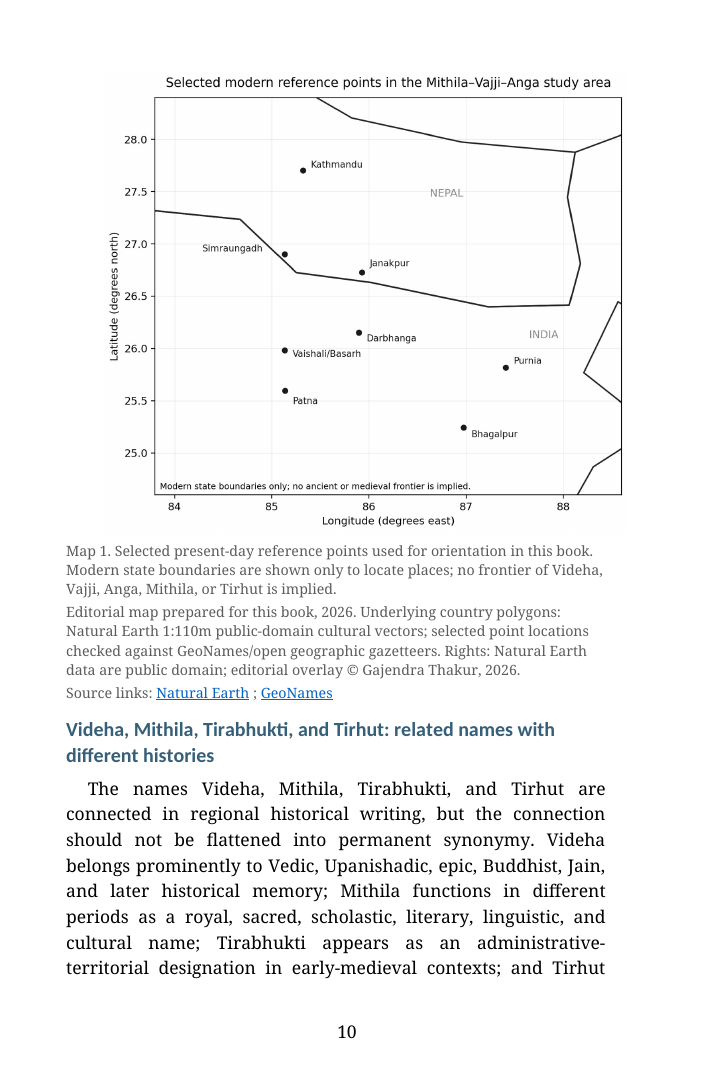
Mithila · Vajji · Anga
Chapter-specific source notes
- Primary chapter witness. Gajendra Thakur, Decoding the Panji of Mithila — Volume V, formal Chapter 7, PDF pp. 86-93; formal Chapter 7. The HTML transcription is generated from the commit-pinned source PDF and retains the chapter boundary recorded in this edition.
- Internal structure. The repository source-heading inventory records 15 subordinate headings for this chapter: “1. Where Chapter 7 begins”; “2. Vasudev, Durgadatt, Thakaru, Bhim, and Manohar”; “3. Manohar’s sons and the first Harishwar line”; “4. Harishwar, Baidyanath, and the daughter-marriage structure”; “5. Baidyanath’s son Mohanlal and the Fudilal branch”; “6. Fudilal’s sons: Mohitlal, Shobhitlal, and Chaturanan”; “7. Chaturanan’s sons: Ramakant, Lakshmikant, Umakant, and Yadunandan/Bechan”; “8. Ramakant, Lakshmikant, and the daughters of Urmila”; ….
- Digital editorial method. The page keeps the preserved source text distinct from generated navigational, concordance, visual, and provenance apparatus. The synthetic reconstruction is explanatory only and is not evidence for an individual lineage or a determination of social or marital status.