Decoding the Panji of Mithila · Volume V · Chapter 8
Tilay Ratanpur-Rabhida-Banaili, Parwaha Asura Sakma: Agaru, Harikar, Banaili Dyodhi, Rai Jahad Singh, Rai Brajraj Singh, Rai Pachkaudi, and the Raj-Branch Marriage Network
Chapter 8
 Tilay Ratanpur-Rabhida-Banaili, Parwaha Asura Sakma:
Agaru, Harikar, Banaili Dyodhi, Rai Jahad Singh, Rai
Brajraj Singh, Rai Pachkaudi, and the Raj-Branch
Marriage Network
  Source span decoded in this chapter
  Decoded source span and focus:
• Source movement - Decoded focus
• तिलय रतनपुर - रभिडा - बनैली , परवाहा असूरा सकमा - New formal heading
  after Ghoda Ghat Ratipad Belauch ; opening of the Tilay - Ratanpur - Rabhida -
  Banaili field.
• अगरू → जु डाउन / मतिकर → हरिकर → खाँ अगुआन → फकीर / कल्ली -
  Opening descent line and the first movement into Panichobh , Jalay , Darhiara ,
  Baheradhi , and Mander.
• फकीर → जगन्नाथ → गंगाधर / रामकृ ष्ण - Branch through Jagannath ;
  Gangadhar gives Panchvadan , Madhukar , Nanu , and Chhota.
• मेदिनी , अहिल्या , दुर्गा , जगदम्बा ; राजा दुलार सिंह (बनैली ड्योढी) -
  Female - line and estate - status markers ; entry into Banaili Dyodhi memory.
• मधुकर → भूपति / पृथ्वीपति - Core branch moving toward Abhayanath , Nirmala ,
  Sarisav Sodarpur , Mahia Sodarpur , Khedan , and later Rai lines.
• राय जहाद सिंह → राय ब्र जराज सिंह → कन्हैया सिंह / झपट सिंह / बदल
  सिंह - Rai - title branch ; Darhiara , Khandwala , Budhwal , Baliyas , and daughter -
  marriage connections.
• राय अमर सिंह → राय पचकौडी → शिवानन्द / उग्रानन्द - Parwaha - linked
  Pachkaudi branch and movement through Darhiara , Sodarpur , Khaual , Khandwala ,
  and Sri Khand.
• राय झपट सिंह → मोहन सिंह / उदय सिंह / राम सिंह - Later Rai branch with
  Budhwal , Khaual , Darhiara , Alay , Ekhara , Jajival , and Ghosot marriage paths.
• रतनपुर तिलय महलबाडी - Internal continuation before the next major heading ;
  closes the chapter before बडगाम दरिहरा असूरा.
• बडगाम दरिहरा असूरा - Next formal heading ; reserved for Chapter 9.

  1. Where Chapter 8 begins
  Chapter 7 ended at the next formal source heading: तिलय रतनपुर-
रभिडा-बनैली, परवाहा असूरा सकमा. Chapter 8 begins from that exact

                    Decoding the Panji of Mithila - Volume V | 93
heading. This is not a mere change of village-name; it opens a new
branch field where Tilya, Ratanpur, Rabhida, Banaili, Parwaha, Asura,
and Sakma become the organizing geography of descent and marriage.
  The chapter follows the line until the next major heading, बडगाम
दरिहरा असूरा. The material between these headings is dense. It includes
old descent, the Banaili Dyodhi note, repeated Rai titles, and many
daughter-marriage links. The method remains the same: every name is
read through descent, place, marriage, title, and branch-continuity.
   This chapter is especially important because the genealogy begins to
carry a more visible landed and public register. The names Raja Dular
Singh, Babu Eklal, Rai Jahad Singh, Rai Brajraj Singh, Rai Pachkaudi,
and other Rai-linked figures show that the Panji records status as part of
lineage identity, but it does not let status replace the ordinary grammar of
sons, daughters, wives, and settlement links.

  2. Agaru, Judaun, Matikar, Harikar, and Khan Aguwan
  The new heading begins with Agaru. Agaru has two sons, Judaun and
Matikar. Immediately the source links this line with Panichobh, Sona,
and Bhavanand. Devaki appears as a maternal or female-associated
marker, and the children include Rambha. Rambha is connected through
Loam Surgan to Som, son of Pranpati, and the line gives Chaturdhari
Maharaj Samar Singh.
   This opening already shows the structure of the chapter. It is not only a
descent from Agaru. It is a branch network connecting Panichobh,
Surgan, Jalay, and later Darhiara and Baheradhi. Matikar’s son Harikar is
linked with Jalay and Kuldhar. Harikar’s son is Khan Aguwan, and Khan
Aguwan is connected with Panichobh through Gonu.
   Aguwan’s sons include Fakir and Kalli. Fakir is linked with Darhiara
through Achyut. The early line therefore gives : Agaru - > Judaun /
Matikar - > Harikar - > Khan Aguwan - > Fakir and Kalli. But each
descent step is also a place step. Without Panichobh , Jalay , Darhiara ,
and the female markers Devaki and Rambha , the branch cannot be
properly decoded.

 3. Fakir, Jagannath, Gangadhar, Ramkrishna, and the
Mander-Ghusaut link
  Fakir’s son is Jagannath, linked with Baheradhi and Vishnudas.
Jagannath’s sons include Gangadhar and Ramkrishna. These are linked
with Mander through Haridev’s son Krishnadev and with Ghusaut

                 Decoding the Panji of Mithila - Volume V | 94
through Kamdev. Thus, the branch moves quickly from the Tilya-
Ratanpur heading into the Mander and Ghusaut fields.
  Gangadhar’s sons include Panchvadan, Madhukar, Nanu, and Chhota.
They are linked through Kayaniyam, Mohan, Warah, Khaual, and
Madhu. Medini appears as a maternal or female-associated marker. After
Medini, the source names Ahilya and records marriage connections to
Rohad Sakaradhi and Ramnath’s son Gopal.
   The point to preserve is that Gangadhar is not merely a name in a
straight male line. Through Medini, Ahilya, and the following marriage
entries, Gangadhar’s branch enters Sakaradhi and then opens toward the
estate-status memory of Banaili Dyodhi. The female lines are the hinge
through which the chapter moves from a descent list to a social map.

  4. Ahilya, Durga, Jagadamba, and the Banaili Dyodhi note
  The text records Ahilya through Rohad Sakaradhi, then gives
descendants such as Nehal. Another line names Durga, linked with
Teghara Badhiya Pawauli, and then Jagadamba. Jagadamba is linked
with Baigani Alay through Chaudhary Devanand and Chaudhary
Parmanand, also known as Hazari.
  From this point the source gives a remarkable status marker: Raja
Dular Singh of Banaili Dyodhi and Babu Eklal, also known as Tejanand.
This note must be read carefully. It does not remove the branch from the
Panji’s ordinary grammar. It adds a status layer to it. The genealogy still
proceeds by descent and marriage, but it also records the public estate
memory of Banaili.
   The presence of Raja, Babu, and Dyodhi language shows that the Panji
is an archive of social rank as well as descent. However, the editor must
not turn it into a court history. The safer reading is genealogical: the
Banaili Dyodhi note identifies a socially visible branch within the wider
Tilya-Ratanpur field.

  5. Madhukar, Bhupati, Prithvipati, and Abhayanath
   Madhukar’s sons include Bhupati and Prithvipati. This becomes one of
the central sub-branches of the chapter. Bhupati is linked with Khaual
through Harishwar’s son Dharmeshwar and with Bhadgam Jajival
through Ghani and Ramanand. Bhupati’s son Abhayanath is linked with
Pariyamb Budhwal through Bhaiya’s son Chhaban and with Darhiara
through Saheb.

                 Decoding the Panji of Mithila - Volume V | 95
   Abhayanath’s daughter or female line connects with Khaual through
Brajnath’s son Dinanath, and with Sakma-vasi Gadh Alay through
Chamu’s son Bhuvan. Nirmala appears as a maternal marker. Nirmala’s
line gives Savitri and a marriage to Padmapur Panichobh through
Madhurapati’s son Bholanath.
   This sub-branch shows the Panji’s connective method clearly. A male
descent line moves from Madhukar to Bhupati to Abhayanath, but the
living network is carried through Khaual, Budhwal, Darhiara, Alay,
Panichobh, and the women linked with those houses.

 6. Nirmala, Savitri, Champura, Sarisav Sodarpur, and
Mahia Sodarpur
  Nirmala’s line also names Jagmohan and Laturan, and then Makranda
and Bhavani. The first marriage link is through Champura in Tirhut,
connected with Sarisav Sodarpur and Bahujan’s son Jaydev. This
produces a son, Singheshwar. Another marriage link goes to Thadhi-vasi
Mahia Sodarpur through Chandramani’s son Gangadhar.
   These two Sodarpur links are important because this chapter, though
headed by Tilya-Ratanpur and Banaili, keeps touching the Sodarpur
world. Sarisav Sodarpur and Mahia Sodarpur appear not as random
references, but as marriage and branch anchors. The branch cannot be
mapped if these links are omitted.
   The same passage then returns to Rai Prithvipati. His son Khedan is
linked with Pali through Bhanjan. Rai Nanu’s daughter-line connects
with Sakaradhi through Kamalakant, while another Sodarpur link is
preserved through Bhotai’s son Damodar. The editor must therefore hold
the geography together: Tirhut, Sarisav Sodarpur, Mahia Sodarpur, Pali,
Sakaradhi, and Darhiara all belong to the same expanding field.

 7. Rai Kalli, Rai Madhusudan, Rai Jahad Singh, and Rai
Brajraj Singh
   Rai Kalli’s son Madhusudan is linked with Mander through Haridev’s
son Krishnadev and with Ghusaut through Kamdev. Madhusudan’s son
is Rai Jahad Singh. Rai Jahad Singh is linked with Lohana Sakaradhi
through Lakshman’s son Chaturbhuj and with Budhwal through Babu’s
son Manai.
   Rai Jahad Singh’s son is Rai Brajraj Singh. This is the point at which
the Rai title becomes a repeated branch marker. Rai Brajraj Singh is
linked with Karmah through Raghudev’s son Santoshi and with Mander

                 Decoding the Panji of Mithila - Volume V | 96
through Yashodhar’s son Basudev. His children include Kanhaiya Singh,
Jhapat Singh, and Badal Singh.
  This is not merely an honorific passage. The title Rai identifies a
branch that must still be read through the same Panji rules. Kanhaiya
Singh, Jhapat Singh, and Badal Singh are not free-floating names. Their
identity is attached to Darhiara, Khandwala, Budhwal, Baliyas, and
subsequent wife and daughter lines.

  8. Kanhaiya Singh, Jivan Singh, Kumar Singh, and Amar
Singh
 Rai Kanhaiya Singh’s sons include Jivan Singh, Kumar Singh, and
Amar Singh. They are linked with Budhwal through Nandan’s son
Mahidhar and with Agadi Baliyas through Damu. Hiramati appears as a
maternal marker, followed by Mohavati and Shyamavati.
   Mohavati’s marriage line is through Ratauli Darhiara and Dhirnath’s
son Lotan, producing Babunath and Parashnath. Another connection
leads to Madhubani Baigani Alay through Chanan’s son Babunath and
produces Artinath. A further Mohavati link goes to Hati Pali through
Chhaba’s son Sarveshwar, producing Rajkumari.
  Shyamavati is linked with Chopra Bakhari, Mataun Darhiara, and
Rupnath’s son Shashinath, producing Premnath. This cluster is a strong
example of how female lines organize the Rai branch. Mohavati and
Shyamavati are not secondary; they tell us how the Rai Kanhaiya Singh
branch entered Darhiara, Alay, Hati Pali, and Chopra Bakhari.

  9. Ramjivan Singh, Kumar Singh, and the Pachaudi-
Parwaha opening
   The source then names Ramjivan Singh’s son Khushi, linked with
Samaya Pali through Manik’s son Shyam and with Ruchauli Ekhara
through Bachanu. Jayavati appears as a maternal marker, and the
children include Kumavati. Kumavati is linked with Rashadh-vasi
Mahindrapur Pandua through Thakur Devanath’s son Badrinath.
   Rai Kumar Singh’s daughter-line connects with Pariyamb Budhwal
through Chilkha’s son Shambhunath and with Teterihar Sodarpur
through Harinath. Chandravati appears as a maternal marker, followed
by Jhulanvati, Vadanvati, and Phulanvati. Vadanvati is linked with
Vishnupur in Shripur Desh through Kurma Khaual and Patani’s son
Parashnath, and another line connects Jahanpur Ratauli Darhiara with
Babujan’s son Babulal.

                Decoding the Panji of Mithila - Volume V | 97
  The next clear sub-heading is Pachaudi se Parwaha. Here Rai Amar
Singh’s son Rai Pachaudi begins a new branch. This is still part of the
Tilya-Ratanpur chapter because it follows directly before the next major
heading. It should not be split off prematurely unless a later full volume
organization requires it.

 10. Rai Pachaudi, Shivanand, Ugranand, and Sri Khand-
Gunmanti
  Rai Pachaudi is linked with Ratauli Darhiara through Ram’s son
Harinath and with Sodarpur through Sona. Lakshmi appears as a
maternal marker, followed by Bula. Bula is linked with Mahishi
Budhwal through Khadganath’s son Harihar, and this line gives
Dayanand and Vishnunath.
   Vishnunath is linked with Simarwad Khaual through Ratinath’s son
Dwarikanath, and gives Maheshnath. Purnia and Gunja then appear as
female or maternal markers. One Gunja link goes to Simarwad Sodarpur
through Ugranath’s son Kripanath; another goes to Bhor Khandwala
through Jayraj Singh’s son Bateshnath Singh.
   Rai Pachaudi’s sons include Shivanand and Ugranand. Shivanand is
linked with Asura-vasi Badgam Darhiara through Kunjbihari. Ugranand
is linked with Asura-vasi Bad Darhiara through Doman’s son
Chammanlal and with Sodarpur through Keshavnath. Rai Shivanand’s
son Parmanand is linked with Gunmanti-vasi Sri Khand and with
Brahmanpura. Ugranand’s daughter-line again connects through Kurma
Khaual and Simarbar Sodarpur. This branch is therefore a bridge from
Parwaha into Asura, Darhiara, Khaual, Sodarpur, and Sri Khand.

  11. Rai Jhapat Singh, Mohan Singh, Uday Singh, Ram
Singh, and the daughter field
  Rai Jhapat Singh’s sons include Mohan Singh, Uday Singh, and Ram
Singh. Their line is linked with Budhwal through Hardatt’s son Saheb
and with Khaual through Baidyanath. Thakani appears as a maternal
marker. Rai Mohan Singh’s sons include Kirat Singh, Babulal, and
Manilal, linked with Mahishi Budhwal, Kamalnayan, Tejnath, and
Bhainsdiyar Darhiara.
  Nehavati appears as a maternal marker, followed by Nandmani,
Bhagvati, and Bhagyavati. Their marriage entries connect Khadik
Khaual, Mataun Darhiara, Jagwari Alay, and the sons Jaydatt and
Govind. Rai Kirat Singh’s line links with Hati Pali, Deshuaal

                 Decoding the Panji of Mithila - Volume V | 98
Khandwala, and Dhirnath. Rai Manilal gives Sadanand, Dayanand,
Shivanand, also known as Munshi, Gunanand, also known as Gobhi, and
Asarna Kurma Khaual connections.
   This is another passage where repeated titles and repeated village
names must not be flattened. Rai Jhapat Singh’s branch has several
internal streams. The women Nehavati, Nandmani, Bhagvati,
Bhagyavati, and Ujanvati structure those streams through marriage into
Khaual, Darhiara, Alay, Khandwala, and Baliyas-related fields.

 12. Rai Suday Singh, Pyarelal, Vadan Singh, and the
Ratanpur Tilay Mahalbadi continuation
   Rai Suday Singh’s sons include Narendra Singh, Thakur Singh, and
Pyarelal. They are linked with Darhiara through Bandhu’s son Janakinath
and with Alay through Hulas. Shyamavati appears as a maternal marker,
followed by Chandramani, Kanakvati, and Indravati. Their marriage
links reach Budhwal, Ratauli Darhiara, Jahanpur Ekma Khandwala,
Satauli Satlakha, Nag Ghosot, and Mahindrapur Panduaha.
  Rai Pyarelal’s son Bhailal is connected with Simarbad Khaual, Vadan,
Tejnath, Gangaur, and Shivnath. A second Pyarelal branch gives
Devanand, linked with Narwal, Hiran, Mishra Garibnath, and
Mandarisam. Rai Vadan Singh’s sons include Babuan Singh, Lalit Singh,
Gokhul Singh, and Chhatra Singh, connected with Tilount, Narayan,
Yagyapati, Khandwala, and Garib.
   After these Rai branches the source marks Ratanpur Tilay Mahalbadi.
This is the internal continuation of the chapter before the next major
heading. It connects Gopal, Raghudev, Vasudev, Nanu, Amar Singh,
Ramnand Singh, Kumar Singh, Shrimani, Bholanath, Rankvati,
Khudnavati, and Dayavati. It closes the Tilya-Ratanpur field by returning
to Ratanpur and Mahalbadi while still carrying Khaual, Ekhara, Darhiara,
Mander, Sakaradhi, and Baliyas links.

  13. Main branches decoded in this chapter
  Agaru-Harikar-Aguwan branch: Agaru, Judaun, Matikar, Harikar,
Khan Aguwan, Fakir, Kalli, Jagannath, Gangadhar, Ramkrishna,
Panchvadan, Madhukar, Nanu, Chhota.
  Banaili Dyodhi branch : Medini , Ahilya , Durga , Jagadamba ,
Chaudhary Devanand , Chaudhary Parmanand / Hazari , Raja Dular
Singh , Babu Eklal / Tejanand.

                 Decoding the Panji of Mithila - Volume V | 99
  Madhukar-Bhupati-Prithvipati    branch:    Bhupati,  Prithvipati,
Abhayanath, Nirmala, Savitri, Jagmohan, Makranda, Bhavani, Sarisav
Sodarpur, Mahia Sodarpur, Khedan, Bhotai, Damodar.
  Rai Jahad Singh-Brajraj Singh branch: Rai Jahad Singh, Rai Brajraj
Singh, Kanhaiya Singh, Jhapat Singh, Badal Singh, Jivan Singh, Kumar
Singh, Amar Singh, Mohavati, Shyamavati, Rajkumari.
  Rai Pachaudi branch: Rai Amar Singh, Rai Pachaudi, Shivanand,
Ugranand, Parmanand, Lakshmi, Bula, Dayanand, Vishnunath,
Maheshnath, Gunja, Kripanath.
  Rai Jhapat Singh and later Rai branch : Mohan Singh , Uday Singh ,
Ram Singh , Kirat Singh , Babulal , Manilal , Sadanand , Dayanand ,
Shivanand / Munshi , Gunanand / Gobhi , Suday Singh , Narendra
Singh , Thakur Singh , Pyarelal , Vadan Singh.
  Ratanpur Tilay Mahalbadi continuation: Gopal, Raghudev, Vasudev,
Lal, Shridhar, Bhaiya, Saheb, Nanu, Nand Singh, Amar Singh, Ramnand
Singh, Kumar Singh, Shrimani, Bholanath, Rankvati, Khudnavati,
Dayavati.

  14. What Chapter 8 teaches
   Chapter 8 teaches that the Panji can combine old descent, female
marriage memory, and public status inside one continuous record. The
names Raja, Babu, and Rai do not replace the genealogical method; they
add a title layer to it. The editor must still ask who is whose son, which
village is attached, which daughter married where, and what branch
continues afterward.
  The chapter also shows that the same branch can repeatedly enter
Sodarpur, Darhiara, Khaual, Khandwala, Budhwal, Mander, Pali,
Baliyas, Sakaradhi, Alay, Ekhara, and Panichobh. Repetition here does
not mean duplication. It may mark different marriage links from different
generations.
   Most of all, the chapter shows that women’s entries create the real
structure of the branch. Devaki, Rambha, Medini, Ahilya, Durga,
Jagadamba, Nirmala, Savitri, Bhavani, Mohavati, Shyamavati, Jayavati,
Chandravati, Lakshmi, Gunja, Nehavati, Nandmani, Bhagvati,
Bhagyavati, Ujanvati, Shyamavati, Kanakvati, Indravati, Kamini,
Karpura, and many others are the bridge-lines by which the branch enters
other houses.

                Decoding the Panji of Mithila - Volume V | 100
  15. Conclusion: the Rai branch as a marriage network
   The Tilya Ratanpur-Rabhida-Banaili, Parwaha Asura Sakma chapter
begins with Agaru and moves through Harikar, Aguwan, Fakir,
Jagannath, Gangadhar, Madhukar, Bhupati, Prithvipati, and the Rai
branches. Its center is not only one ancestor; it is a network of status,
settlement, descent, and marriage.
   Banaili Dyodhi, Rai Jahad Singh, Rai Brajraj Singh, Rai Pachaudi, Rai
Jhapat Singh, Rai Suday Singh, and the Ratanpur Tilay Mahalbadi
continuation show how public and landed memory can be preserved
inside the Panji without breaking the Panji’s older grammar.
    The next chapter should begin with बडगाम दरिहरा असूरा. That
heading opens a new Darhiara-Asura field and should be decoded by the
same method: every name must be read through descent, place, marriage,
title, and branch-continuity.

                Decoding the Panji of Mithila - Volume V | 101
Source structure and verification apparatus
Editorial source apparatus. This apparatus is descriptive, not interpretive. It records the source-controlled structure used to verify that this page corresponds to formal Chapter 8 of Decoding the Panji of Mithila — Volume V. The chapter text above is preserved from PDF pp. 94-102; formal Chapter 8 in the commit-pinned authoritative source. It is not merged with a neighboring chapter, appendix, annexure, or independent front/back-matter unit. The internal headings below come from the repository’s source-heading inventory and are retained as navigational and audit evidence; showing them here does not turn those headings into separate publications or add claims that are absent from the source.
Internal source headings
- 1. Where Chapter 8 begins
- 2. Agaru, Judaun, Matikar, Harikar, and Khan Aguwan
- 3. Fakir, Jagannath, Gangadhar, Ramkrishna, and the Mander-Ghusaut link
- 4. Ahilya, Durga, Jagadamba, and the Banaili Dyodhi note
- 5. Madhukar, Bhupati, Prithvipati, and Abhayanath
- 6. Nirmala, Savitri, Champura, Sarisav Sodarpur, and Mahia Sodarpur
- 7. Rai Kalli, Rai Madhusudan, Rai Jahad Singh, and Rai Brajraj Singh
- 8. Kanhaiya Singh, Jivan Singh, Kumar Singh, and Amar Singh
- 9. Ramjivan Singh, Kumar Singh, and the Pachaudi-Parwaha opening
- 10. Rai Pachaudi, Shivanand, Ugranand, and Sri Khand-Gunmanti
- 11. Rai Jhapat Singh, Mohan Singh, Uday Singh, Ram Singh, and the daughter field
- 12. Rai Suday Singh, Pyarelal, Vadan Singh, and the Ratanpur Tilay Mahalbadi continuation
- 13. Main branches decoded in this chapter
- 14. What Chapter 8 teaches
- 15. Conclusion: the Rai branch as a marriage network
Source-text concordance
Tilay · Ratanpur-Rabhida-Banaili · Parwaha · Asura · Sakma · Agaru · Harikar · Banaili · Dyodhi · Jahad · Singh · Brajraj · Pachkaudi · Raj-Branch · Marriage · Network · span · decoded · focus · movement · रतनप · formal · heading · Ghoda · Ghat · Ratipad · Belauch · opening · Ratanpur · Rabhida · field · descent · line · first · Panichobh · Jalay · Darhiara · Baheradhi · Mander · Branch · Jagannath · Gangadhar · gives · Panchvadan · Madhukar · Nanu · Chhota · जगदम · Female · estate · status · markers · entry · memory · Core · moving · toward · Abhayanath · Nirmala · Sarisav · Sodarpur · Mahia · Khedan · later · lines · title · Khandwala · Budhwal · Baliyas · daughter · connections · linked · Khaual · Khand · Alay · Ekhara · Jajival · Ghosot · paths · महलब
Boundary verification. In the formal sequence this chapter follows Volume V Chapter 7, “Decoded source span and focus:” and precedes Volume V Chapter 9, “Badgam Darhiara Asura: Ravikar, Bhakta Kavi Dhanapati, Govardhan, Shulpani, Kalidatt, Durgadatt, Manna Lal, Pranmohan, and the Chopra Bakhari-Tetrihar Sodarpur Continuation”. The chapter extractor begins at the verified formal Chapter 8 marker and stops at the next verified formal chapter marker; for a final chapter it stops before recognized book-level back matter. The concordance above is generated only from distinct terms already present in this chapter’s preserved source text. It is provided for discovery, comparison, and audit, not as an automated judgment about persons, lineages, status, kinship, marriage eligibility, or historical truth.
Illustrated research apparatus
Mithila · Vajji · Anga
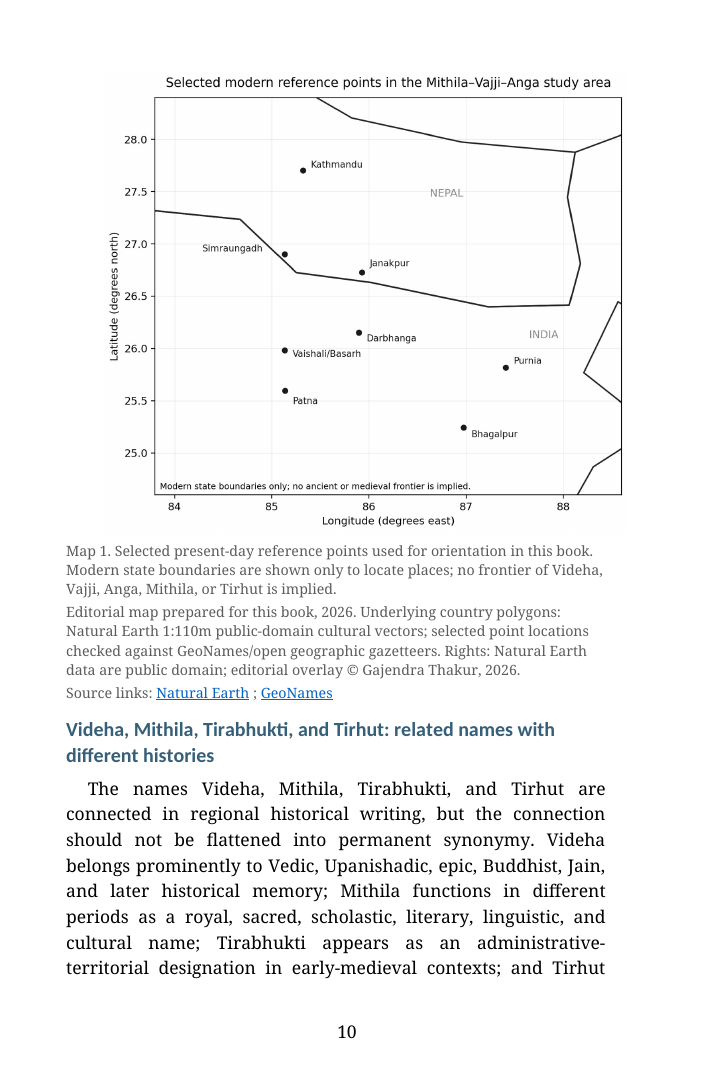
Chapter-specific source notes
- Primary chapter witness. Gajendra Thakur, Decoding the Panji of Mithila — Volume V, formal Chapter 8, PDF pp. 94-102; formal Chapter 8. The HTML transcription is generated from the commit-pinned source PDF and retains the chapter boundary recorded in this edition.
- Internal structure. The repository source-heading inventory records 15 subordinate headings for this chapter: “1. Where Chapter 8 begins”; “2. Agaru, Judaun, Matikar, Harikar, and Khan Aguwan”; “3. Fakir, Jagannath, Gangadhar, Ramkrishna, and the Mander-Ghusaut link”; “4. Ahilya, Durga, Jagadamba, and the Banaili Dyodhi note”; “5. Madhukar, Bhupati, Prithvipati, and Abhayanath”; “6. Nirmala, Savitri, Champura, Sarisav Sodarpur, and Mahia Sodarpur”; “7. Rai Kalli, Rai Madhusudan, Rai Jahad Singh, and Rai Brajraj Singh”; “8. Kanhaiya Singh, Jivan Singh, Kumar Singh, and Amar Singh”; ….
- Digital editorial method. The page keeps the preserved source text distinct from generated navigational, concordance, visual, and provenance apparatus. The synthetic reconstruction is explanatory only and is not evidence for an individual lineage or a determination of social or marital status.