Decoding the Panji of Mithila · Volume V · Chapter 9
Badgam Darhiara Asura: Ravikar, Bhakta Kavi Dhanapati, Govardhan, Shulpani, Kalidatt, Durgadatt, Manna Lal, Pranmohan, and the Chopra Bakhari-Tetrihar Sodarpur Continuation
Chapter 9
  Badgam Darhiara Asura: Ravikar, Bhakta Kavi
Dhanapati, Govardhan, Shulpani, Kalidatt, Durgadatt,
Manna Lal, Pranmohan, and the Chopra Bakhari-Tetrihar
Sodarpur Continuation
  Source span decoded in this chapter
  Decoded source span and focus:
• Source movement - Decoded focus
• बडगाम दरिहरा असूरा - Formal heading after the Tilay - Ratanpur field ; opening
  of the Badgam - Darhiara - Asura branch.
• रविकर → शुभंकर / गुणाकर / प्रज्ञाकर / कु सुमाकर / पद्माकर - Opening descent
  cluster connected with Nadam , Sudhakar , Hariam , Alay , Ekhara , and Khaual.
• भक्त कवि धनपति → ठकु री / गोपाल / मनोरथ प्र0 माजी - Scholarly - poetic
  title and the line through Naroun , Murari , Revati , Manorath / Maani , Saheb , and
  Keshav.
• गोवर्द्धन → भगवती प्र0 भगति / शंकर / गौरीनाथ - Govardhan branch linked
  with Karmah , Hati Pali , Kishori , Budheshwari , and later Haridev - Dukhharan.
• हरिदेव → शूलपाणि / शिवदत्त / देवकी - Branch through Digho , Pachadh Jajival ,
  and the next son cluster through Shulpani.
• शूलपाणि → कमल / गणपति / चन्द्रपति प्र0 / सिद्धानन्द / देवनाथ / हेमनाथ -
  Large son cluster linked with Guldi Khandwala , Karmah , Gangauli , Nanyapur Alay ,
  and Pachahi Sodarpur.
• कमल → कालीदत्त / दुर्गादत्त / प्रीतिनाथ / होरील / भाइनाथ - Core line
  through Kalidatt , Durgadatt / Khushru , Shashinath , Horil , Gaur Sodarpur , and
  Sundar Sodarpur.
• मन्नूलाल → जगमोहन → प्राणमोहन / विश्वमोहन - Modern expansion through
  Badhiyam Pawauli , Rajanpura Darhiara , Chopda Bakhari , and Tetrihar Sodarpur.
• प्राणमोहन , नरे श मोहन , विजय मोहन प्र0 लफोदर , सुधीर मोहन ,
  विश्वमोहन - Late and modern branch with titles : Mahavid , Principal , M.A. ,
  B.A. , and multiple marriage links.
• असूरा बडगाम दरिहरा - Internal continuation of the same heading before the next
  formal chapter field.
• बलियास ओगही - द्वाशय , बनैली , कोबरा (कोहबरा) - Next formal heading ;
  reserved for Chapter 10.

                   Decoding the Panji of Mithila - Volume V | 102
  Editorial principle
   This chapter is a decoding of the source passage from बडगाम दरिहरा
असूरा up to, but not including, बलियास ओगही-द्वाशय, बनैली, कोबरा
(कोहबरा). Names have not been treated as decorative lists. Each name is
interpreted through descent, attached place, marriage formula, title, alias,
and branch continuity.

  1. Where Chapter 9 begins
  Chapter 8 closed just before the source heading बडगाम दरिहरा असूरा.
Chapter 9 begins from that heading and follows the branch until the next
formal heading, बलियास ओगही-द्वाशय, बनैली, कोबरा (कोहबरा). This
keeps the cumulative reading in the actual source order.
  The chapter is organized around the Badgam-Darhiara-Asura field.
The opening ancestor-cluster begins with Ravikar and his sons
Shubhankar, Gunakar, Pragyakar, Kusumakar, and Padmakar. From
there the text moves through Bhakta Kavi Dhanapati, Govardhan,
Haridev, Shulpani, Kamal, Kalidatt, Durgadatt, Horil, Manna Lal,
Jagmohan, Pranmohan, and the modern Chopra Bakhari-Tetrihar
Sodarpur continuation.
    This chapter is important because it combines four layers: older
descent, poetic and learned title, the Badgam-Darhiara-Asura settlement
field, and late modern family continuations. The same method remains
necessary: every name must be read through descent, place, marriage,
title, and branch-continuity.

  2. Ravikar and the opening son-cluster
   The heading बडगाम दरिहरा असूरा opens with Ravikar. Ravikar’s sons
are named as Shubhankar, Gunakar, Pragyakar, Kusumakar, and
Padmakar. The line immediately connects with Nadam through
Sudhakar. This opening shows that the Badgam-Darhiara-Asura heading
is not an isolated place label; it is a branch field that uses several
neighboring settlement-links to organize descent.
  Kusumakar’s sons include Shiru, Giru, and Biru. These are linked with
Hariam through Vage and with Alay through Sudhakar. Biru’s sons
include Vibhu, Ganapati, and Dhanapati, linked with Ekhara and Ganesh,
and with Khaual and Mangu. Thus, the very first movement of the
chapter reaches into Hariam, Alay, Ekhara, and Khaual.
  The important point is that Ravikar’s branch is structured through sons
and through places simultaneously. A family tree that only lists

                 Decoding the Panji of Mithila - Volume V | 103
Ravikar’s sons would miss the social geography. The Panji is already
telling the reader where the branch becomes matrimonially legible.

  3. Bhakta Kavi Dhanapati and the learned-poetic marker
   One of the most striking features of this opening is the phrase भक्त
कवि धनपति. The title marks Dhanapati not only as a descendant but as a
figure remembered through devotional or poetic distinction. This is the
same broader pattern seen in Volume II: learned, poetic, ritual, and
administrative titles are preserved because they become part of social
identity.
   Dhanapati’s sons include Thakuri , Gopal , and Manorath , also known
as Maji. Manorath / Maani is linked with Naroun through Murari. Revati
appears as a maternal or female - associated marker. Manorath / Maani
then gives Saheb and Keshav , linked with Dhaula Sodarpur and
Madhav. This is a compact but important branch because it ties poetic
memory to a Sodarpur - linked marriage field.
  The editor should not isolate the title भक्त कवि from the genealogy.
The title is part of the name’s social value. At the same time, the branch
must still be read by the ordinary Panji method: father, son, alias, place,
marriage, and continuation.

 4. Saheb, Govardhan, Bhagvati/Bhagti, Shankar, and
Gaurinath
  Saheb’s son is Govardhan, linked with Karmah through Keval Ram.
Govardhan’s children include Bhagvati, also called Bhagti, Shankar, and
Gaurinath. They are linked with Hati Pali through Kishori’s son Hari
Govind, and Budheshwari appears as a maternal or female-associated
marker.
  Bhagvati / Bhagti’s sons include Haridev and Dukhharan , linked with
Digho through Gangu. Haridev’s sons include Shulpani , Shivdatt , and
Devaki , linked with Pachahi Jajival. This sequence creates a bridge from
Badgam - Darhiara - Asura to Karmah , Hati Pali , Digho , and Jajival.
   The names Bhagvati and Devaki may appear as female forms, yet in
this compressed Panji grammar they function inside a descent and
branch-continuity frame. They must be preserved exactly as branch
identifiers rather than smoothed into a simplified male-only line.

                Decoding the Panji of Mithila - Volume V | 104
  5. Shulpani and the large son-cluster
   Shulpani’s descendants include Kamal, Ganapati, Chandrapati,
Siddhanand, Devanath, and Hemnath. These are linked with Guldi
Khandwala through Chintamani’s son Dhanapati and with Karmah
through Uddhav. Majari appears as a maternal marker, followed by
Sanandi and Nandi.
   One line connects Gangoli through Ghoghan’s grandson Shivdatt and
Chhatradhar. It gives Bhavanidatt, Devidatt, and Vishnudatt. Another
line connects Nandi with Nanyapur Alay through Sadanand’s son
Dukhia, giving Lalit and Hirphool. This is a major example of how one
son-cluster branches through multiple maternal or marital fields.
  The Shulpani passage is therefore not a simple list of sons. It is a hub.
Khandwala, Karmah, Gangoli, Nanyapur Alay, Pachahi Sodarpur,
Valiyas, and later Gaur Sodarpur all attach to it. The branch has to be
decoded as a connected map, not as a straight vertical descent.

 6. Kamal, Kalidatt, Durgadatt, Preetinath, Horil, and
Bhainath
  Kamal’s descendants include Kalidatt, Durgadatt, Preetinath, Horil,
and Bhainath. These are linked with Pachahi Sodarpur through
Lakshman’s son Nanu and with Sakuri Valiyas through Harikrishna.
Taravati appears as a maternal marker, followed by Jhalphali and
Chaudharaini.
  The first marriage link goes to Tetarihar Sodarpur through
Kamalpani’s son Hira. Another goes to Raiyam Sodarpur through Sona’s
son Moti. This is a key passage because it shows the Badgam-Darhiara-
Asura branch entering multiple Sodarpur subfields. Pachahi, Tetarihar,
and Raiyam are not casual references; they are marriage and branch
markers.
   Kalidatt’s sons include Nirbhayanath, Shashinath, Srinath, and
Venidatt, linked with Kanhouli Ekhara, Bhelauja Mander, and other
fields. The line shows how the branch, having passed through Kamal,
begins to expand into recognizable settlement clusters that appear
elsewhere in Volume II.

  7. Durgadatt/Khushru, Shashinath, Horil, and Gaur
Sodarpur
  Durgadatt is also identified as Khushru. The alias matters. Without
preserving Durgadatt / Khushru , a later reader might split one person

                Decoding the Panji of Mithila - Volume V | 105
into two. The line connects him with Behat Khandwala , Madhav , and
Rohin ; it also connects with Singhali Mander through Prabhakar.
Shashinath’s line links with Katma Vabhaniyam and Saburdatt.
   Horil’s sons include Shivanandan, Genalal, Ghinalal, Mannalal, and
Nakatulal. They are connected with Gaur Sodarpur through Mishra
Mansukh’s son Baunu; another Gaur Sodarpur link is through Mansukh’s
son Babu, and an Ujan Belauch link is through Narpati. Nehavati appears
as a maternal marker, followed by Sonmati, Nenmati, and Jhumakvati.
  The Horil branch is especially important because it opens the later
modern continuation. It also shows the role of women: Sonmati,
Nenmati, Jhumakvati, Mahamaya, Jagadamba, Shobhanvati, Sharada,
Anuradha, Virakhi, and Parameshwari are not optional details. They are
the routes by which the branch enters other houses.

  8. Manna Lal, Jagmohan, Pranmohan, and Vishwamohan
  Mannalal’s son Jagmohan is linked with Badhiyam Pawauli through
Shyamlal’s son Achmit Lal and with Rajanpura Darhiara through Dular.
Jagmohan’s children include Pranmohan and Vishwamohan.
Shobhanvati appears as a maternal marker, followed by Sharada,
Anuradha, Virakhi, and Parameshwari.
   The first marriage line is through Banaili Tilya and Mannilal’s son
Dayanand, giving Govind, also known as Fakir. Another marriage links
Anuradha with Jahanpur Ekma Khandwala through Khushinath’s son
Indranand, giving Shardanand. Virakhi links with Nagwad Ghosot
through Hiralal, and Parameshwari links with Ekma Khandwala through
Artinath’s son Narendra.
   This section is a model of Panji expansion. Jagmohan’s line cannot be
understood by counting sons only. The daughters and maternal markers
build the actual bridge to Banaili Tilya, Jahanpur Ekma Khandwala,
Nagwad Ghosot, and Ekma Khandwala. Each marriage link enlarges the
future marriage memory of the branch.

  9. Pranmohan’s learned and modern branch
   Pranmohan is given with the honorific or scholarly-social phrase
महाविद श्रीमान. His sons include Naresh Mohan, Ramji, Keshav Mohan,
also known as Lakshman Ji, Shri Mohan, also known as Bharat Ji, Vijay
Mohan, also known as Laphodar, and Dhir Mohan. This is a large
modernizing branch.

                Decoding the Panji of Mithila - Volume V | 106
  The branch is linked with Chopra Bakhari , Tetarihar Sodarpur ,
Ghotan’s son Madhav , and Bairgachhi Ratauli Darhiara. Naresh
Mohan / Ramji links with Vishnupur Ahil Hariam and Padmanand. Vijay
Mohan / Laphodar is marked as M.A. Principal , linked with Bodhgram
Nagwad Ghosot , Kali Shankar’s son Vipin Bihari , and Dihiya Khangud
Sarisav.
   These late entries show the Panji absorbing modern education and
occupation while continuing the same old structure. M.A., Principal,
B.A., and similar markers do not replace mool and marriage. They stand
alongside them. The family remains legible through village, father, son,
wife, daughter, and branch continuity.

  10. Sudhir Mohan, Vishwamohan, Gajanand, Devanand,
Suryanand, and the daughter lines
  Sudhir Mohan is linked through Jafarapur Badhiyam Pawauli and
Vaidyanath. The line then records wife and daughter connections through
Valirajpur Hariam, Chhajan Sarisav, and others. Vishwamohan’s sons
include lines through Bodhgram Nagwad Ghosot and Dayashankar. The
source then names Gajanand’s line with Brajdev, Devanand, and
Suryanand, and connects them with Hasauli Sodarpur, Nokhelal, Raiyam
Sodarpur, Mahua Khaual, and other fields.
   Gajanand’s daughters or descendant lines include Mahanand,
Vedanand, and Gunanand. One branch links with Raiyam Sodarpur
through Ramanath’s son Preetinath; another connects with Mahua
Khaual. Saraswati appears as a maternal marker, followed by Ganga and
Mandakini. Their marriage entries reach Ekma Khandwala and Dadari
Panichobh.
   This passage is a reminder that late genealogies are still structurally
traditional. Even when names feel modern or the social register changes,
the Panji continues to preserve the same essentials: descent, marriage,
village, and cross-house relation.

  11. Nandlal, Keshavlal, Surendra Mohan, Devendra Mohan,
and the Chopra Bakhari return
  The source then names Nandlal and his sons Keshavlal, Surendra
Mohan, and Devendra Mohan, linked with Behat Khandwala Sadravasi,
Hansmani, Jhaua Panichobh, and Hitnath. Sandhya appears as a maternal
marker, followed by Buddhi, Rupa, Ati Rupa, Adhavati, and Vidyavati.

                Decoding the Panji of Mithila - Volume V | 107
   These women connect the line to Superani Gangoli, Gnam Khaual,
Behat Khandwala, Chopra Bakhari, and Sri Khand Takwal. The Chopra
Bakhari reference returns the chapter to one of its central modern branch
labels. Surendra Mohan’s sons include Manindra Mohan and Ravindra
Mohan, linked with Panichobh and Muktinath, and with Ekma
Khandwala and Giranand.
  Devendra Mohan’s sons connect with Dumaria Katihar, Sundar
Sodarpur, Harasundar, Vedanand, and Singhali Mander. The chapter thus
widens geographically toward Katihar while keeping Sodarpur and
Mander inside the same branch memory.

 12. Kuldev / Bhangi , Ruchidatt / Gudar , Nityanand ,
Chaturanan , and the late continuation
  The line continues through Shyamdatt, Kunjbihari, and Revatinath.
Shyamdatt’s descendant Kuldev, also known as Bhangi, gives
Krishnadev and Bhavdev, linked with Kavai Naroun and Jaydatt.
Another line from Kunjbihari gives Ruchidatt, also known as Gudar.
Gudar’s sons include Baldev, Basudev, Jagdev, and Mahadev, linked
with Jahanpur Ekma Khandwala and Harshmani.
  Nityanand’s line records a pious and scholarly register: Sadachari,
Naishthik Pandit Chaturanan, and Krishnanand. Chaturanan’s son
Harinarayan gives Satyanarayan and Gautam. Krishnanand’s sons
include Subodh, Ramnarayan, and Shyam Narayan, linked with Soneli
Deep Baheradhi and Nityanand.
  The late continuation includes Vinod, Pramod, and Amod at
Phoolsara, Ramnarayan’s son Sunil, and another branch through
Mannunath, Baikunth Lal, Chiranand, Bhupalal, Sundarlal, Padmanand,
Kalikanand, Kirtianand, Chandranand, and Brahmanand. The line then
moves into modern names such as Vivekanand, Vijay, Vinay, Diwakar,
Sanjay, Santosh, Ashutosh, Abhishek, Abhijit, and others. This is not a
new system; it is the older system continuing into modern naming
practice.

  13. The internal continuation: Asura Badgam Darhiara
   Near the end of the chapter the source gives an internal continuation :
असूरा बडगाम दरिहरा. This is still inside the same Darhiara - Asura field.
It names Surendra Mohan’s sons Manindra Mohan and Ravindra
Mohan , and connects them with Chikni , Muktinath , Bodhgaon Nagwad

                Decoding the Panji of Mithila - Volume V | 108
Ghosot , Dinesh Chandra , and later Devesh / Jaynath / Shivesh - type
continuations.
  Rudranand’s sons include Jaykrishna, Jayanarayan, Balkrishna,
Vidyanand, Achyutanand, and Sachchidanand. They are linked with
Asura Suphani Gangoli and Sundarlal. Later lines name Pradip,
Omprakash, Ravindra, Vipin, Arvind, Ranjit, Rajiv, Saurabh, Gaurav,
and other modern descendants.
    This internal Asura Badgam Darhiara continuation closes the chapter
by reinforcing the central field rather than shifting to a new chapter. The
next formal shift comes only when the source reaches बलियास ओगही-
द्वाशय, बनैली, कोबरा (कोहबरा).

  14. Main branches decoded in this chapter
  Ravikar branch: Ravikar, Shubhankar, Gunakar, Pragyakar,
Kusumakar, Padmakar, Shiru, Giru, Biru, Vibhu, Ganapati, Dhanapati.
  Bhakta Kavi Dhanapati branch : Dhanapati , Thakuri , Gopal ,
Manorath / Maji / Maani , Saheb , Keshav , Govardhan , Bhagvati /
Bhagti , Shankar , Gaurinath.
  Haridev-Shulpani branch: Haridev, Dukhharan, Shulpani, Shivdatt,
Devaki, Kamal, Ganapati, Chandrapati, Siddhanand, Devanath,
Hemnath.
  Kamal - Horil branch : Kalidatt , Durgadatt / Khushru , Preetinath ,
Horil , Bhainath , Nirbhayanath , Shashinath , Srinath , Venidatt ,
Shivanandan , Genalal , Ghinalal , Mannalal , Nakatulal.
   Mannalal - Jagmohan branch : Jagmohan , Pranmohan , Vishwamohan
, Naresh Mohan , Ramji , Keshav Mohan / Lakshman Ji , Shri Mohan /
Bharat Ji , Vijay Mohan / Laphodar , Dhir Mohan.
  Modern Chopra Bakhari-Tetrihar Sodarpur branch: Sudhir Mohan,
Gajanand, Brajdev, Devanand, Suryanand, Mahanand, Vedanand,
Gunanand, Nandlal, Keshavlal, Surendra Mohan, Devendra Mohan,
Manindra Mohan, Ravindra Mohan.
  Late learned-modern branch: Nityanand, Sadachari Naishthik Pandit
Chaturanan, Krishnanand, Harinarayan, Satyanarayan, Gautam, Subodh,
Ramnarayan, Shyam Narayan, Vinod, Pramod, Amod, Sunil,
Kalikanand, Kirtianand, Chandranand, Brahmanand, Vivekanand, Vijay,
Vinay, Diwakar, Sanjay, Santosh, Ashutosh.

                Decoding the Panji of Mithila - Volume V | 109
  15. What Chapter 9 teaches
  Chapter 9 teaches that a Darhiara-Asura heading may contain a full
genealogy of learned memory, poetic title, Sodarpur marriage links, and
modern educational or professional identity. The phrase भक्त कवि
धनपति and the later phrase सदाचारी नैष्ठिक पं0 चतुरानन्द show that titles
remain important across generations.
  It also teaches that the late modern names should not be treated as a
break from the Panji. M.A., Principal, B.A., and other markers are
absorbed into the same genealogical grammar. The old structure
survives: father, son, daughter, wife, village, branch, title, and cross-
house relation.
  Most importantly, this chapter shows the density of women’s
genealogical work. Revati, Budheshwari, Taravati, Nehavati, Sonmati,
Nenmati, Jhumakvati, Mahamaya, Jagadamba, Shobhanvati, Sharada,
Anuradha, Virakhi, Parameshwari, Saraswati, Ganga, Mandakini,
Sandhya, Rupa, Ati Rupa, Adhavati, Vidyavati, Sanjita, Sarita, Sunita,
Sugandha, and others keep the branch connected to its marriage
geography.

 16. Conclusion: from Badgam Darhiara Asura to the next
Baliyas field
  The Badgam Darhiara Asura chapter begins with Ravikar and ends
with an internal Asura Badgam Darhiara continuation. Between those
points it carries the branch through Bhakta Kavi Dhanapati, Govardhan,
Haridev, Shulpani, Kamal, Durgadatt, Horil, Mannalal, Jagmohan,
Pranmohan, and several modern continuations.
  The chapter confirms that Volume II Panji is not a simple line of
descent. It is a dense social web. The web includes Badgam, Darhiara,
Asura, Naroun, Sodarpur, Jajival, Khandwala, Karmah, Alay, Mander,
Badhiyam Pawauli, Chopra Bakhari, Tetrihar Sodarpur, Katihar, Ghosot,
Gangoli, and many more branches.
  The next chapter should begin with the next formal heading: बलियास
ओगही-द्वाशय, बनैली, कोबरा (कोहबरा). That chapter will move into the
Baliyas-Ogahi-Dwashay-Banaili-Kobara field and continue the same
method: descent, place, marriage, title, and branch-continuity.

                Decoding the Panji of Mithila - Volume V | 110
  Source note
  Primary source span: punji-02-Diwali2014(1).docx, pages 18-22 in the
extracted text, beginning with बडगाम दरिहरा असूरा and ending
immediately before बलियास ओगही-द्वाशय, बनैली, कोबरा (कोहबरा).

                Decoding the Panji of Mithila - Volume V | 111
Source structure and verification apparatus
Editorial source apparatus. This apparatus is descriptive, not interpretive. It records the source-controlled structure used to verify that this page corresponds to formal Chapter 9 of Decoding the Panji of Mithila — Volume V. The chapter text above is preserved from PDF pp. 103-112; formal Chapter 9 in the commit-pinned authoritative source. It is not merged with a neighboring chapter, appendix, annexure, or independent front/back-matter unit. The internal headings below come from the repository’s source-heading inventory and are retained as navigational and audit evidence; showing them here does not turn those headings into separate publications or add claims that are absent from the source.
Internal source headings
- Editorial principle
- 1. Where Chapter 9 begins
- 2. Ravikar and the opening son-cluster
- 3. Bhakta Kavi Dhanapati and the learned-poetic marker
- 4. Saheb, Govardhan, Bhagvati/Bhagti, Shankar, and Gaurinath
- 5. Shulpani and the large son-cluster
- 6. Kamal, Kalidatt, Durgadatt, Preetinath, Horil, and Bhainath
- 7. Durgadatt/Khushru, Shashinath, Horil, and Gaur Sodarpur
- 8. Manna Lal, Jagmohan, Pranmohan, and Vishwamohan
- 9. Pranmohan’s learned and modern branch
- 10. Sudhir Mohan, Vishwamohan, Gajanand, Devanand, Suryanand, and the daughter lines
- 11. Nandlal, Keshavlal, Surendra Mohan, Devendra Mohan, and the Chopra Bakhari return
- 12. Kuldev / Bhangi , Ruchidatt / Gudar , Nityanand , Chaturanan , and the late continuation
- 13. The internal continuation: Asura Badgam Darhiara
- 14. Main branches decoded in this chapter
- 15. What Chapter 9 teaches
- 16. Conclusion: from Badgam Darhiara Asura to the next Baliyas field
- Source note
Source-text concordance
Badgam · Darhiara · Asura · Ravikar · Bhakta · Kavi · Dhanapati · Govardhan · Shulpani · Kalidatt · Durgadatt · Manna · Pranmohan · Chopra · Bakhari-Tetrihar · Sodarpur · Continuation · span · decoded · focus · movement · Formal · heading · Tilay · Ratanpur · field · opening · branch · descent · cluster · connected · Nadam · Sudhakar · Hariam · Alay · Ekhara · Khaual · धनपत · Scholarly · poetic · title · line · Naroun · Murari · Revati · Manorath · Maani · Saheb · Keshav · भगवत · linked · Karmah · Hati · Pali · Kishori · Budheshwari · later · Haridev · Dukhharan · Digho · Pachadh · Jajival · next · गणपत · Large · Guldi · Khandwala · Gangauli · Nanyapur · Pachahi · Core · Khushru · Shashinath · Horil · Gaur · Sundar · Modern · expansion · Badhiyam · Pawauli
Boundary verification. In the formal sequence this chapter follows Volume V Chapter 8, “Tilay Ratanpur-Rabhida-Banaili, Parwaha Asura Sakma: Agaru, Harikar, Banaili Dyodhi, Rai Jahad Singh, Rai Brajraj Singh, Rai Pachkaudi, and the Raj-Branch Marriage Network” and precedes Volume V Chapter 10, “Baliyas Ogahi-Dwashay, Banaili, Kobara (Kohbara): Dharanidhar, Padmanabh, Pathak Mohan, Harinath, Baliyas Ekma Barahkona, and the Pakhaliya Threshold Source span decoded in this chapter”. The chapter extractor begins at the verified formal Chapter 9 marker and stops at the next verified formal chapter marker; for a final chapter it stops before recognized book-level back matter. The concordance above is generated only from distinct terms already present in this chapter’s preserved source text. It is provided for discovery, comparison, and audit, not as an automated judgment about persons, lineages, status, kinship, marriage eligibility, or historical truth.
Illustrated research apparatus
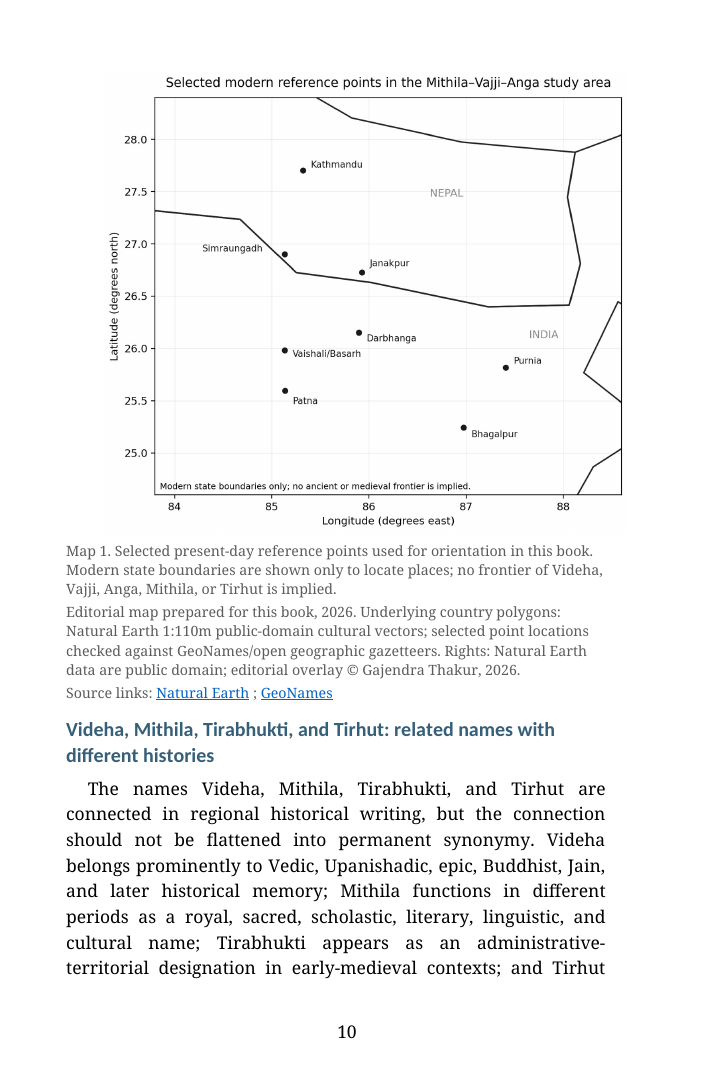
Mithila · Vajji · Anga
Chapter-specific source notes
- Primary chapter witness. Gajendra Thakur, Decoding the Panji of Mithila — Volume V, formal Chapter 9, PDF pp. 103-112; formal Chapter 9. The HTML transcription is generated from the commit-pinned source PDF and retains the chapter boundary recorded in this edition.
- Internal structure. The repository source-heading inventory records 18 subordinate headings for this chapter: “Editorial principle”; “1. Where Chapter 9 begins”; “2. Ravikar and the opening son-cluster”; “3. Bhakta Kavi Dhanapati and the learned-poetic marker”; “4. Saheb, Govardhan, Bhagvati/Bhagti, Shankar, and Gaurinath”; “5. Shulpani and the large son-cluster”; “6. Kamal, Kalidatt, Durgadatt, Preetinath, Horil, and Bhainath”; “7. Durgadatt/Khushru, Shashinath, Horil, and Gaur Sodarpur”; ….
- Digital editorial method. The page keeps the preserved source text distinct from generated navigational, concordance, visual, and provenance apparatus. The synthetic reconstruction is explanatory only and is not evidence for an individual lineage or a determination of social or marital status.