Decoding the Panji of Mithila · Volume V · Chapter 10
Decoded source span and focus:
Chapter 10
 Baliyas Ogahi-Dwashay, Banaili, Kobara (Kohbara):
Dharanidhar, Padmanabh, Pathak Mohan, Harinath,
Baliyas Ekma Barahkona, and the Pakhaliya Threshold
  Source span decoded in this chapter
  Decoded source span and focus:
• Source movement - Decoded focus
• बलियास ओगही - द्वाशय , बनैली , कोबरा (कोहबरा) - Formal chapter heading
  after Badgam Darhiara Asura ; opens the Baliyas - Ogahi - Dwashay - Banaili -
  Kobara field.
• एकमा बलियास सॅ वीजी धरनीधर - Root opening through Dharanidhar and the
  Padmanabh - Shrinidhi - Shrinath cluster.
• पद्मनाभ → शुक्ल हरिवंश / हरिशर्मा - The next descent line through Shukla
  Harivansh , Harisharma , Ratikar , Som , Diwakar , Lakshmikar , Sadhukar , and
  Shubhankar.
• साधुकर → जीवेक → शिवादित्य - Scholarly - looking branch tied to Samugam ,
  Ghoghi , Pali , Narasingh , Karmah , and Girishwar.
• रूद्र → विश्वनाथ / हरिनाथ / गणपति / श्रीनाथ - The Rudra line develops
  through Alay , Pani / Panichobh , Pali , Sakaradhi , Kujouli , Kakō Belauch , and
  Khandwala.
• पाठक मोहन → उंमाई / सदाय / चक्रपाणि - Pathak Mohan’s children connect
  Gaur Sodarpur , Ullu Kujouli , Budhwal , Sodarpur , Belauch , Baliyas , Ekhara ,
  Khaual , and Alay.
• पाठक पद्मनाथ प्र0 पद्मक - Padmanath / Padmak and the line through Shashinath ,
  Jaynath , Eknath , Kamal , Lochana , Girijanath , Umanath / Chiranjeev , Durganath ,
  Vibhutinath , and Triloknath.
• ओगही वलियास दुवाशय अपर बनैली - Internal Ogahi - Valiyas - Dwashay -
  Banaili continuation through Pathak Chakrapani , Harinath , Prannath , Vaishnav , and
  Nandan.
• बलियास एकमा बरहकोना - Second Baliyas block through Dharanidhar ,
  Padmanabhādi , Srinath , Jay Sharma , Jatadhar , Ratanakar , Chandrakar , Suryakar ,
  Jagannath , Maheshwar , Kartik , and further lines.
• पकलिया महिषी धर्मपुर देशे / काझी , पूर्णिया - Next formal field ; reserved for
Source structure and verification apparatus
Editorial source apparatus. This apparatus is descriptive, not interpretive. It records the source-controlled structure used to verify that this page corresponds to formal Chapter 10 of Decoding the Panji of Mithila — Volume V. The chapter text above is preserved from PDF pp. 113-113; formal Chapter 10 in the commit-pinned authoritative source. It is not merged with a neighboring chapter, appendix, annexure, or independent front/back-matter unit. The internal headings below come from the repository’s source-heading inventory and are retained as navigational and audit evidence; showing them here does not turn those headings into separate publications or add claims that are absent from the source.
Internal source headings
- Editorial principle
- 1. Where Chapter 10 begins
- 2. Dharanidhar and the Padmanabh-Shrinidhi-Shrinath opening
- 3. Sadhukar, Jivek, Shivaditya, Ratikar, Gaurishwar, and Maheshwar
- 4. Rudra, Vishwanath, Harinath, Ganapati, and Shrinath
- 5. Pathak Mohan and the children Umai, Saday, and Chakrapani
- 6. Pathak Padmanath / Padmak , Shashinath , Jaynath , Girijanath , Umanath , and Durganath
- 7. Ogahi Valiyas Duwashay and the Banaili continuation
- 8. Baliyas Ekma Barahkona: the second Baliyas block
- 9. Kartik, Horai, Hirai, Ranjan, Kamalnai, Suryakar, and the Jagdish-Dharmeshwar branch
- 10. Bodhi, Bhairav, Mainath, Umanath/Vishnudatt, and Bokan-Eklal
- 11. Mushay, Lambodar, Muktinath, Upendra, Jagdish, Umakant, and Radhakant
- 12. Main branches decoded in this chapter
- 13. What Chapter 10 teaches
- 14. Conclusion: the Baliyas field before Pakhaliya
Source-text concordance
Baliyas · Ogahi-Dwashay · Banaili · Kobara · Kohbara · Dharanidhar · Padmanabh · Pathak · Mohan · Harinath · Ekma · Barahkona · Pakhaliya · Threshold · span · decoded · focus · movement · Formal · heading · Badgam · Darhiara · Asura · opens · Ogahi · Dwashay · field · Root · opening · Shrinidhi · Shrinath · cluster · next · descent · line · Shukla · Harivansh · Harisharma · Ratikar · Diwakar · Lakshmikar · Sadhukar · Shubhankar · Scholarly · looking · branch · tied · Samugam · Ghoghi · Pali · Narasingh · Karmah · Girishwar · गणपत · Rudra · develops · Alay · Pani · Panichobh · Sakaradhi · Kujouli · Kakō · Belauch · Khandwala · Mohan’s · children · connect · Gaur · Sodarpur · Ullu · Budhwal · Ekhara · Khaual · Padmanath · Padmak · Shashinath · Jaynath · Eknath · Kamal · Lochana
Boundary verification. In the formal sequence this chapter follows Volume V Chapter 9, “Badgam Darhiara Asura: Ravikar, Bhakta Kavi Dhanapati, Govardhan, Shulpani, Kalidatt, Durgadatt, Manna Lal, Pranmohan, and the Chopra Bakhari-Tetrihar Sodarpur Continuation” and precedes Volume V Chapter 11, “Editorial principle”. The chapter extractor begins at the verified formal Chapter 10 marker and stops at the next verified formal chapter marker; for a final chapter it stops before recognized book-level back matter. The concordance above is generated only from distinct terms already present in this chapter’s preserved source text. It is provided for discovery, comparison, and audit, not as an automated judgment about persons, lineages, status, kinship, marriage eligibility, or historical truth.
Illustrated research apparatus
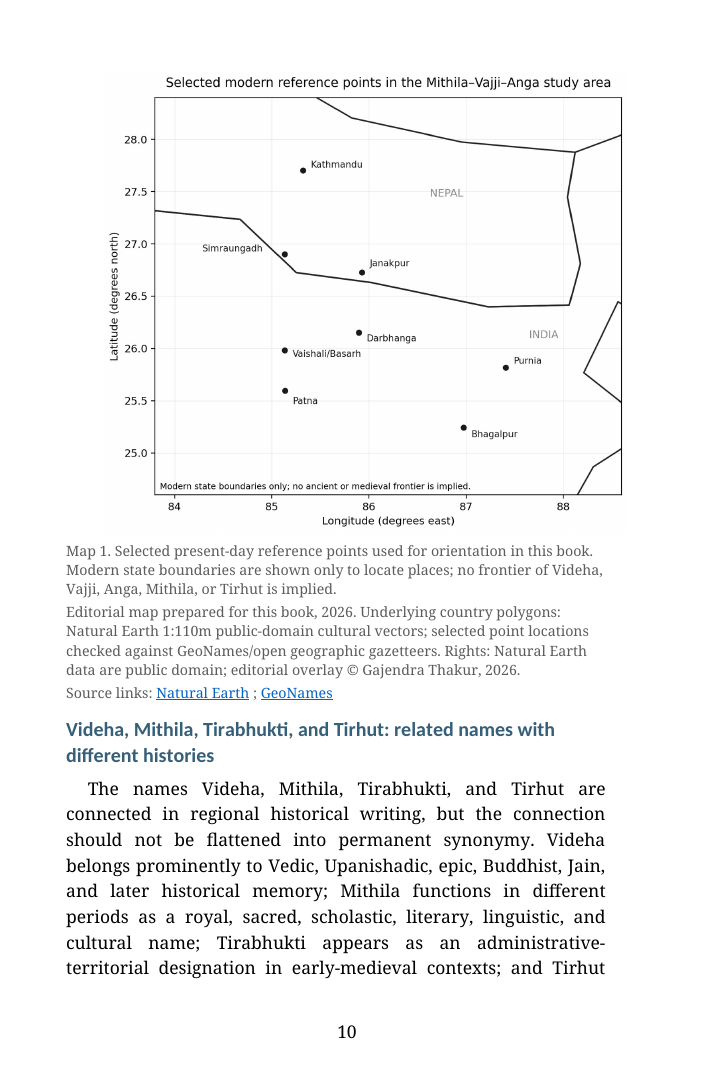
Mithila · Vajji · Anga
Chapter-specific source notes
- Primary chapter witness. Gajendra Thakur, Decoding the Panji of Mithila — Volume V, formal Chapter 10, PDF pp. 113-113; formal Chapter 10. The HTML transcription is generated from the commit-pinned source PDF and retains the chapter boundary recorded in this edition.
- Internal structure. The repository source-heading inventory records 15 subordinate headings for this chapter: “Editorial principle”; “1. Where Chapter 10 begins”; “2. Dharanidhar and the Padmanabh-Shrinidhi-Shrinath opening”; “3. Sadhukar, Jivek, Shivaditya, Ratikar, Gaurishwar, and Maheshwar”; “4. Rudra, Vishwanath, Harinath, Ganapati, and Shrinath”; “5. Pathak Mohan and the children Umai, Saday, and Chakrapani”; “6. Pathak Padmanath / Padmak , Shashinath , Jaynath , Girijanath , Umanath , and Durganath”; “7. Ogahi Valiyas Duwashay and the Banaili continuation”; ….
- Digital editorial method. The page keeps the preserved source text distinct from generated navigational, concordance, visual, and provenance apparatus. The synthetic reconstruction is explanatory only and is not evidence for an individual lineage or a determination of social or marital status.