Decoding the Panji of Mithila · Volume V · Chapter 11
Editorial principle
Chapter 11.

  Editorial principle
  This chapter decodes the source passage from बलियास ओगही - द्वाशय
, बनैली , कोबरा (कोहबरा) up to , but not including , पकलिया महिषी

                   Decoding the Panji of Mithila - Volume V | 112
धर्मपुर देशे / काझी , पूर्णिया. The chapter keeps the same method as the
preceding chapters : every name is read through descent , attached place ,
marriage formula , title , alias , and branch - continuity.

  1. Where Chapter 10 begins
   Chapter 10 begins at the next formal heading after the Badgam -
Darhiara - Asura chapter : बलियास ओगही - द्वाशय , बनैली , कोबरा
(कोहबरा). The heading itself is composite. It does not name a single
village only ; it announces a field made from Baliyas , Ogahi , Dwashay ,
Banaili , and Kobara / Kohbara connections.
   The source immediately places the branch in the Ekma Baliyas field
through Biji Dharanidhar. From that root, the chapter moves through
Padmanabh, Shrinidhi, Shrinath, Shukla Harivansh, Harisharma,
Sadhukar, Jivek, Shivaditya, Rudra, Pathak Mohan, Pathak Padmanath,
and then into the internal Ogahi-Valiyas-Dwashay-Banaili continuation.
   The chapter stops before the next major field , पकलिया महिषी धर्मपुर
देशे / काझी , पूर्णिया. That next heading should begin Chapter 11. This
keeps the cumulative reading in source order and prevents one settlement
field from swallowing the next.

  2. Dharanidhar and the Padmanabh-Shrinidhi-Shrinath
opening
   The line begins : एकमा बलियास सॅ वीजी धरनीधर. Dharanidhar is
therefore the Biji or controlling ancestor for this chapter’s opening field.
His sons include Padmanabh , Shrinidhi , and Shrinath , with a Tilaut
link through Halneshwar. The opening is already layered : Biji ancestor ,
Baliyas place - field , son - cluster , and a linked house.
  Padmanabh’s sons are Shukla Harivansh and Harisharma. Shukla
Harivansh’s descendants include Ratikar, Som, Diwakar, Lakshmikar,
Sadhukar, and Shubhankar. The names preserve a Sanskritic learned
tone, but the Panji does not leave them as abstract names. It attaches
them to Samugam, Ghoghi, Pali, Karmah, and other fields.
  The reading rule here is simple but essential: the Baliyas section
should not be reduced to a vertical Dharanidhar-to-Padmanabh chart. The
real structure begins when the sons are carried outward into their village
and marriage relations.

                 Decoding the Panji of Mithila - Volume V | 113
 3. Sadhukar, Jivek, Shivaditya, Ratikar, Gaurishwar, and
Maheshwar
  Sadhukar gives Jivek, linked with Samugam and Ghoghi. Jivek gives
Shivaditya, connected with Pali and Narasingh. Another Jivek line gives
Ratikar and Udaykar, connected with Karmah and Girishwar. This is a
compact but important branching point: one father-line produces more
than one relational direction.
   Ratikar’s son Naruk is connected with Ghusaut and Ravikar. Another
Ratikar branch gives Gaurishwar and Govind , linked with Pali and
Narasingh. Gaurishwar’s son Maheshwar is linked with Belauch and
Gayaditya , and Maheshwar’s son Gayan / Konek / Gaulkar - like line
leads to Babu’s son Hari. Another Maheshwar branch connects with
Ekhara , Than , Dine , Alay , Hari , Rati , Rudra , and Basuka.
  This passage demonstrates the difference between a name and a node.
Ratikar and Maheshwar are not simply names; they organize multiple
sub-branches. Their identity must be read by father, place, and the
“apara” grammar that separates related but distinct lines.

  4. Rudra, Vishwanath, Harinath, Ganapati, and Shrinath
  Rudra’s descendants include Vishwanath, Harinath, Ganapati, and
Shrinath, connected with Badh Alay through Haladhar’s son Madhav.
Another Rudra branch gives Harakhu and Gopal through Panichobh and
Nitikar. The source therefore gives two movements: a named son-cluster
and a further paired branch.
  Harinath’s sons include Lakshminath, Ruchinath, and Yadunath. They
are linked with Pali, Shivapati’s son Vishwanath, Sakaradhi, and Ravi.
Ruchinath gives Vasudev, linked with Kujouli and Raghu. Yadunath
gives Ramnath, linked with Kakō Belauch, Rati, and Khandwala.
   Ganapati gives Shripati, connected with Tapanpur Pali and Ahiyari-
vasi Nathu’s son Shuchinath. Shripati gives Mohan, linked with Mahishi
Budhwal and Badgam Darhiara. This shows how the Baliyas line reaches
into Budhwal and Darhiara without becoming those branches. It remains
Baliyas-led, but with cross-house ties.

 5. Pathak Mohan and the children Umai, Saday, and
Chakrapani
  Pathak Mohan’s children include Umai, Saday, and Chakrapani. They
connect with Gaur Sodarpur through Vasudev’s son Chhotai and with
Ullu Kujouli through Gadodhar. Krishnavati appears as a maternal or

                Decoding the Panji of Mithila - Volume V | 114
female-associated marker. The Pathak identifier must be preserved
because it gives scholarly and family-status value to the line.
  Pathak Umai’s son Mangalik is linked with Budhwal and Vamdev’s
son Gopal, and with Sodarpur through Bhavani. Hridayavati appears as
another maternal marker. Pathak Mangati gives Bachharu, connected
with Belauch through Hetu’s son Shrikrishna and with Baliyas through
Mathura. Radhā appears as a maternal marker.
   Bachharu’s descendants include Kavi Kamalapati and Nanu / Damu -
like forms. Kavi Kamalapati is especially important because the title
“Kavi” marks remembered literary or learned identity. The line connects
Ekhara , Khaual , Alay , Baheradhi , and Sodarpur. A purely
genealogical chart must therefore carry the title and not only the descent.

 6. Pathak Padmanath / Padmak , Shashinath , Jaynath ,
Girijanath , Umanath , and Durganath
   Pathak Padmanath, also read as Padmak, gives Shashinath, Jaynath,
Eknath, Kamal, and Lochana. These are linked with Raiyam Sodarpur,
Darhiara, Tilavati, Manavati, Hansavati, Valirajpur Hariam, Ekhara, and
other fields. The repeated appearance of women’s names here is not
ornamental; Tilavati, Manavati, Hansavati, Kundani, Sitavati, Parvati,
Jambavati, Rudrani, Devavati, Leelavati, and Gita help divide the branch
into intelligible marriage lines.
   Jaynath connects with Samauli Pali through Mishra Korishwar and
with Mahindrapur Mandua through Pa. Devanand, also known as Chhoti,
and Shobha. Another Jaynath line gives Girijanath, also known as Dundi,
linked with Deep Baheradhi and Khagesh. Girijanath then links with
Majhiyam Karmah and Chandramani, and later with Tilya through Rai
Vadan and Rai Babuan.
   Umanath, also known as Chiranjeev, and Durganath continue the line
through Karmah and Valiyas. Durganath’s descendants include
Vibhutinath and Triloknath, connected with Ramnagar Parhat Uchit,
Narsam Valiyas, Hariam, Jahanpur Bhadgam Jajival, and Banaili
Simarwad Sodarpur. This section shows how a Pathak line spreads into
Jajival, Sodarpur, Ghosot, and Khandwala fields.

  7. Ogahi Valiyas Duwashay and the Banaili continuation
  The next internal heading is ओगही वलियास दुवाशय अपर बनैली. It
continues through Pathak Mohan’s son Pathak Chakrapani, whose son

                Decoding the Panji of Mithila - Volume V | 115
Harinath is linked with Sodarpur and Chhotai. Harinath’s son Prannath is
linked with Sodarpur through Gopi.
   Prannath’s descendants include Babunandan and Rama, linked with
Kakō Belauch and Shrikrishna’s son Anand. Damu’s son Vaishnav is
linked with Jhallaari and Hari. Vaishnav’s sons include Kashinath,
Shrinath, and Pushpanath, tied to Ahil Hariam, Abhiram, Bhatari,
Gangoli, and Madhav.
  Pathak Nandan’s sons include Jaynath, Tejnath, Siddhinath, and
Meghanath. They connect with Sundar Sodarpur, Ghanshyam, Judaun,
and Budhmati. Jaynath’s sons Krishnamani and Harshmani lead into
Tilya, Rai Prithvi, Raut Darhiara, Shukla Jayanarayan, Budhwal,
Gopinath, Ekhara, Manikrishna, Pali, Gangoli, and Gidar. This
continuation is the chapter’s clearest example of a single named field
becoming a marriage web.

  8. Baliyas Ekma Barahkona: the second Baliyas block
   After the Ogahi-Valiyas-Dwashay continuation, the source gives a
new internal heading: बलियास एकमा बरहकोना. The text says that from
Baliyas comes Biji Dharanidhar and that Padmanabhādi should be seen
later. It then moves through Shrinath, Jay Sharma, Ram Sharma, and
Jatadhar, also called Jadu, connected with Pokhrauni Takwal and
Mahamahopadhyay Ravidhar.
   Jatadhar’s sons include Ratandhar, Damodar, and Keshav. The first is
connected with Vithual and Sona, while another line enters Nanya
through Dordant and Suman. Ratanakar’s sons include Chandrakar and
Suryakar. Chandrakar gives Jagannath, Jagannath gives Maheshwar, and
Maheshwar gives Kartik, linked with Takwal and Pali.
  This second Baliyas block is not a duplicate of the first. It is another
organized field under the same broad Baliyas identity. The editor must
keep “Baliyas Ogahi-Dwashay” and “Baliyas Ekma Barahkona” related
but distinct.

  9. Kartik, Horai, Hirai, Ranjan, Kamalnai, Suryakar, and
the Jagdish-Dharmeshwar branch
  Kartik’s descendants include Horai, Hirai, Ranjan, Kamalnai, and
Suryakar, linked with Brahmpura and Shiv. Horai gives Bhikari, linked
with Jajival and Govind. Bhikari’s sons include Jagdish and
Dharmeshwar, connected with Pali and Mishra.

                Decoding the Panji of Mithila - Volume V | 116
  Jagdish gives Anant and Krishnadev, linked with Panichobh and
Keshav. Krishnadev gives Mani, Veni, Madhav, and Panchavadan,
connected with Jalay and Gopal. Lochana appears as a maternal marker.
Mani gives Jagannath, Vaidyanath, Mushay, Suresh, and Dukhia, linked
with Barahi Nikhuti and Hansraj’s son Chakrapani.
  This part of the chapter is dense because the same pattern repeats
rapidly: son-cluster, place-link, maternal marker, and next son-cluster.
The names cannot be read safely without carrying the attached village
and family-reference.

 10. Bodhi, Bhairav, Mainath, Umanath/Vishnudatt, and
Bokan-Eklal
   Jagannath’s descendants include Bodhi, Bhairav, Mainath, and Amik.
Bodhi’s sons include Bholanath, Khagapati, Ganesh, Mahesh, Bhavesh,
and Batesh, linked with Gadh Belauch and Harishankar’s son Gulal. The
line then brings in Vishnudatt and Durgadatt through Talhanpur and
Kripa.
  Vishnudatt, also read with Umanath, gives Kanhaiya, linked with
Rakhwari Hariam and Mishra Sitaram. The maternal and female markers
here include Mana, Usha, and further linked daughters. Khagapati,
Bhavesh, and Mahesh appear with “no continuation” or limited
continuation in places, while Ganesh gives Bodhan, Bhavanath, and
Pakshadhar through Chhajan Sarisav and Vaidyanath.
  Another line through Bokan gives Eklal, connected with Gangoli and
Gauri. These shorter entries matter because they explain how the broad
Baliyas-Ekma-Barahkona block touches Sarisav, Gangoli, Karmah,
Panichobh, and other familiar Volume II fields.

 11. Mushay, Lambodar, Muktinath, Upendra, Jagdish,
Umakant, and Radhakant
  Eknath’s sons include Mushay and Bachkan, linked with Chhajan
Sarisav, Manasukh, Mahisan Panichobh, and Durbhil. Mushay’s son
Feku is linked with Tarouni Karmah and Ramanath. Another Mushay
branch gives Lambodar and Muktinath, connected with Pokhram Basay
and Chitrapati.
  Lambodar’s descendants include Upendra , Jagdish , Umakant , and
Radhakant. These connect with Ruchouli Ekhara , Majhaura Karmah ,
Gangor , Murlī / Chandwa , Chikni - vasi Malangia Kujouli , Naduar

                Decoding the Panji of Mithila - Volume V | 117
Karmah , Badhari Naduar Karmah , Sukhsena Bhandarisam , and other
fields. This is the chapter’s late dense expansion.
  The branch then moves into names such as Prabhakar, Sudhakar,
Vidyakar, Divakar, Ratnakar, Satyakar, Vibhakar, Deepak, Ritesh,
Avinash, Shravan, Arpan, Rahul, Chandan, Chakradhar, Muralidhar, and
Gangadhar. The modern-sounding names are still placed in the old Panji
grammar: father, village, mool, marital connection, and maternal marker.

  12. Main branches decoded in this chapter
  Dharanidhar opening branch: Dharanidhar, Padmanabh, Shrinidhi,
Shrinath, Shukla Harivansh, Harisharma, Ratikar, Som, Diwakar,
Lakshmikar, Sadhukar, Shubhankar.
  Sadhukar - Jivek branch : Sadhukar , Jivek , Shivaditya , Ratikar ,
Udaykar , Naruk , Gaurishwar , Govind , Maheshwar , Gayan / Konek /
Gaulkar , Rudra , Basuka.
  Rudra-Pathak Mohan branch: Vishwanath, Harinath, Ganapati,
Shrinath, Harakhu, Gopal, Lakshminath, Ruchinath, Yadunath, Ramnath,
Shripati, Mohan, Pathak Mohan, Umai, Saday, Chakrapani.
  Pathak Padmanath branch : Padmanath / Padmak , Shashinath ,
Jaynath , Eknath , Kamal , Lochana , Girijanath / Dundi , Umanath /
Chiranjeev , Durganath , Vibhutinath , Triloknath.
  Ogahi-Valiyas-Dwashay-Banaili branch: Pathak Chakrapani, Harinath,
Prannath, Babunandan, Rama, Vaishnav, Kashinath, Shrinath,
Pushpanath, Nandan, Jaynath, Tejnath, Siddhinath, Meghanath,
Krishnamani, Harshmani, Shrimani.
  Baliyas Ekma Barahkona branch : Shrinath , Jay Sharma , Ram
Sharma , Jatadhar / Jadu , Ratanakar , Chandrakar , Suryakar ,
Jagannath , Maheshwar , Kartik , Horai , Hirai , Ranjan , Kamalnai ,
Suryakar , Bhikari , Jagdish , Dharmeshwar.
  Late expansion branch : Mani , Jagannath , Vaidyanath , Mushay ,
Suresh , Dukhia , Bodhi , Bholanath , Khagapati , Ganesh , Mahesh ,
Bhavesh , Batesh , Vishnudatt / Umanath , Kanhaiya , Bokan , Eklal ,
Mushay , Feku , Lambodar , Muktinath , Upendra , Jagdish , Umakant ,
Radhakant.

  13. What Chapter 10 teaches
  Chapter 10 teaches that a composite heading must be read as a map.
बलियास ओगही-द्वाशय, बनैली, कोबरा (कोहबरा) is not one simple address.

                Decoding the Panji of Mithila - Volume V | 118
It is a set of linked settlement and branch fields, and the record moves
through them by descent and marriage.
   The chapter also teaches that Pathak and Kavi identifiers matter.
Pathak Mohan, Pathak Padmanath, Pathak Chakrapani, and Kavi
Kamalapati are not only personal names. They preserve scholarly or
status-bearing identifiers inside the genealogical memory.
  Finally, the chapter shows the importance of women and maternal
markers: Krishnavati, Hridayavati, Radha, Domna, Tilavati, Manavati,
Hansavati, Kundani, Sitavati, Parvati, Jambavati, Rudrani, Devavati,
Leelavati, Gita, Shyamavati, Budhmati, Nityavati, Yogmaya, Ramaa,
Lochana, Mana, Usha, Savitri, and others help organize the branch into
separate marriage lines.

  14. Conclusion: the Baliyas field before Pakhaliya
   The Baliyas - Ogahi - Dwashay - Banaili - Kobara chapter begins with
Biji Dharanidhar and reaches through Padmanabh , Harivansh , Sadhukar
, Jivek , Shivaditya , Rudra , Pathak Mohan , Padmanath , Ogahi -
Valiyas - Dwashay , and Baliyas Ekma Barahkona. It ends before the
next formal heading , पकलिया महिषी धर्मपुर देशे / काझी , पूर्णिया.
  The cumulative Volume V method remains unchanged. Each name is
read through descent, place, marriage, title, alias, and branch-continuity.
The branch is not only a list of male descendants; it is a network of
houses, women’s marriage routes, learned titles, and regional memory.
   Chapter 11 should begin with पकलिया महिषी धर्मपुर देशे / काझी ,
पूर्णिया and follow the Pakhaliya / Purnea field in the same way.

                Decoding the Panji of Mithila - Volume V | 119
  Chapter 11
 Pakhaliya Mahishi Dharmapur Desh, Kazi Purnia:
Vasudev, Sitikanth, Vishwambhar, Hingu-Mangu,
Balbhadra, Roshan, Babhola, and the Purnia-Sodarpur
Continuation
  Source span decoded in this chapter
  Decoded source span and focus:
• Source movement - Decoded focus
• पकलिया महिषी धर्मपुर देशे / काझी , पूर्णिया - Formal new field after the
  Baliyas chapter ; opens the Pakhaliya - Mahishi - Dharmapur - Kazi / Purnia
  settlement field.
• पकलिया सॅ वीजी वासुदेव - First Biji opening ; Vasudev gives Sitikanth and
  Shyamkanth.
• सितिकण्ठ - > सीधू - > बाछे - > गिरीश्वर / चन्द्रकर - First descent stream
  through Sitikanth , Sidhu , Bachhe , Girishwar , and Chandrakar.
• चन्द्रकर - > बाटू - > सुरयाति / गणपति / कीर्ति / राम / वंशीधर - Batu branch
  tied to Pali , Panichobh , Pritikar , Sukhsena , Mandarisam , and other links.
• अरविन्द / परशुराम / लक्ष्मण / गंगोली - Rajkar - Arvind - Parashuram side
  route ; Lakshman connects to Gangoli , Purushottam , and several descendants.
• विश्वम्भर - > हरिहर - > जीवेक - > हिंगू / मांगू - Second Biji or parallel opening
  within Pakhaliya , expanding through Hingu and Mangu.
• हिंगू - > बाभन / दामोदर / परशुराम / गोविन्द - The Hingu line ; Parashuram
  gives Babu / Chhotai and the later Dhanpati - Balbhadra - Sonai stream.
• बलभद्र / सोनाई / मेधू / दुखिया / दुखन - Important branch through Talhanpur ,
  Haripur Pali , Mandar , and related fields.
• मनु - > रोझन / दुलरै या / दुलार / पोषण - Manu branch through Virpur
  Panichobh , Pachaahi Jajival , Pandua , Bhour Khandwala , and Hasaeli Sodarpur.
• बबूनी प्र0 बाबूनाथ - > गृहिनाथ / खङ् गनाथ / प्रेमनाथ / बाबूलाल / गोपाल -
  Babuni / Babunath branch and the continuation into Jiyalal , Jhaptalal , Babhola /
  Bhola , Naresh , Gajendra , and later lines.
• धर्मपुर देशे बलुआक दक्षिण रघु नाथपुर - Next formal heading ; reserved for
Source structure and verification apparatus
Editorial source apparatus. This apparatus is descriptive, not interpretive. It records the source-controlled structure used to verify that this page corresponds to formal Chapter 11 of Decoding the Panji of Mithila — Volume V. The chapter text above is preserved from PDF pp. 113-121; formal Chapter 11 in the commit-pinned authoritative source. It is not merged with a neighboring chapter, appendix, annexure, or independent front/back-matter unit. The internal headings below come from the repository’s source-heading inventory and are retained as navigational and audit evidence; showing them here does not turn those headings into separate publications or add claims that are absent from the source.
Internal source headings
- Editorial principle
- 1. Where Chapter 11 begins
- 2. Vasudev, Sitikanth, Shyamkanth, Sidhu, Bachhe, and Chandrakar
- 3. Batu and the Surayati-Ganapati-Kirti-Ram-Vanshidhar cluster
- 4. Lakshman, Harijiv, Madhav, Dinmani, Govind, Jaykrishna, and Anand
- 5. The second Pakhaliya opening: Vishwambhar, Harihar, Jivek, Hingu, and Mangu
- 6. Balbhadra, Medhu, Dukhia, Dukhan, Sonai, Manuk, and the Virpur Panichobh links
- 7. Babuni/Babunath, Grihinath, Khangnath, Premnath, Babulal, and Gopal
- 8. Jiyalal , Maujilal , Mahavir , Rupan / Rupnath , Yadunath , Sapan , and Ramanath / Raman
- 9. The Babhola/Bhola modern continuation and the Hasaeli Sodarpur route
- 10. Chhotkani, Mahia Sodarpur, Raiyam Sodarpur, Kedar, and the Chainpur-Digaundh connection
- 11. Kedar’s descendants and the final threshold before Balua-Raghunathpur
- 12. Main branches decoded in this chapter
- 13. What Chapter 11 teaches
- 14. Conclusion: Pakhaliya as a Purnia-linked marriage field
Source-text concordance
Editorial · principle · decodes · passage · including · Decoding · keeps · method · preceding · chapters · every · name · read · descent · attached · place · marriage · formula · title · alias · branch · continuity · begins · next · formal · heading · Badgam · Darhiara · Asura · composite · single · village · announces · field · made · Baliyas · Ogahi · Dwashay · Banaili · Kobara · Kohbara · connections · immediately · places · Ekma · Biji · Dharanidhar · root · moves · Padmanabh · Shrinidhi · Shrinath · Shukla · Harivansh · Harisharma · Sadhukar · Jivek · Shivaditya · Rudra · Pathak · Mohan · Padmanath · internal · Ogahi-Valiyas-Dwashay-Banaili · continuation · stops · major · begin · cumulative · reading · order · prevents · settlement · swallowing · Padmanabh-Shrinidhi-Shrinath · opening · line · therefore · controlling · ancestor
Boundary verification. In the formal sequence this chapter follows Volume V Chapter 10, “Decoded source span and focus:” and precedes Volume V Chapter 12, “Editorial principle”. The chapter extractor begins at the verified formal Chapter 11 marker and stops at the next verified formal chapter marker; for a final chapter it stops before recognized book-level back matter. The concordance above is generated only from distinct terms already present in this chapter’s preserved source text. It is provided for discovery, comparison, and audit, not as an automated judgment about persons, lineages, status, kinship, marriage eligibility, or historical truth.
Illustrated research apparatus
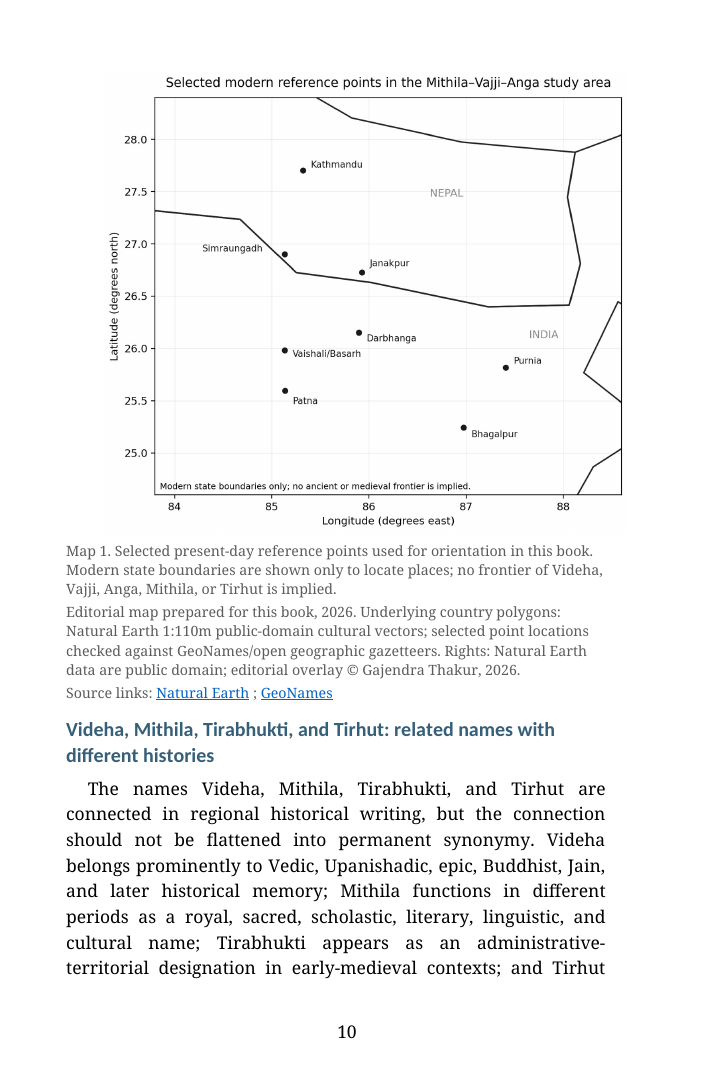
Mithila · Vajji · Anga
Chapter-specific source notes
- Primary chapter witness. Gajendra Thakur, Decoding the Panji of Mithila — Volume V, formal Chapter 11, PDF pp. 113-121; formal Chapter 11. The HTML transcription is generated from the commit-pinned source PDF and retains the chapter boundary recorded in this edition.
- Internal structure. The repository source-heading inventory records 15 subordinate headings for this chapter: “Editorial principle”; “1. Where Chapter 11 begins”; “2. Vasudev, Sitikanth, Shyamkanth, Sidhu, Bachhe, and Chandrakar”; “3. Batu and the Surayati-Ganapati-Kirti-Ram-Vanshidhar cluster”; “4. Lakshman, Harijiv, Madhav, Dinmani, Govind, Jaykrishna, and Anand”; “5. The second Pakhaliya opening: Vishwambhar, Harihar, Jivek, Hingu, and Mangu”; “6. Balbhadra, Medhu, Dukhia, Dukhan, Sonai, Manuk, and the Virpur Panichobh links”; “7. Babuni/Babunath, Grihinath, Khangnath, Premnath, Babulal, and Gopal”; ….
- Digital editorial method. The page keeps the preserved source text distinct from generated navigational, concordance, visual, and provenance apparatus. The synthetic reconstruction is explanatory only and is not evidence for an individual lineage or a determination of social or marital status.