Decoding the Panji of Mithila · Volume V · Chapter 12
Editorial principle
Chapter 12.

  Editorial principle
   This chapter decodes the source passage from पकलिया महिषी धर्मपुर
देशे / काझी , पूर्णिया up to , but not including , धर्मपुर देशे बलुआक दक्षिण
रघु नाथपुर. The same method is retained : every name is read through

                   Decoding the Panji of Mithila - Volume V | 120
descent , attached place , marriage formula , title , alias , and branch -
continuity.

  1. Where Chapter 11 begins
   Chapter 11 begins at the next formal heading after the Baliyas - Ogahi
- Dwashay - Banaili - Kobara chapter : पकलिया महिषी धर्मपुर देशे / काझी
, पूर्णिया. The heading is not merely a place - name. It joins Pakhaliya ,
Mahishi , the Dharmapur territorial field , Kazi , and Purnia into one
genealogical field.
   The source then opens with पकलिया सॅ वीजी वासुदेव. This tells the
reader that Vasudev is the controlling Biji figure for the first movement
of the chapter. From him the line proceeds to Sitikanth and Shyamkanth ,
and then through Sidhu , Bachhe , Girishwar , Chandrakar , Batu , and
several marriage - connected branches.
  The chapter stops before the next formal heading, धर्मपुर देशे बलुआक
दक्षिण रघुनाथपुर. That next heading should begin Chapter 12. This
preserves source order and prevents the Pakhaliya-Purnia field from
being confused with the later Balua-Raghunathpur field.

 2. Vasudev, Sitikanth, Shyamkanth, Sidhu, Bachhe, and
Chandrakar
  The opening says that from Pakhaliya comes Biji Vasudev, and his
sons are Sitikanth and Shyamkanth. Sitikanth gives Sidhu; Sidhu gives
Bachhe and Girishwar. Bachhe gives Chandrakar, who is linked with
Chilkour Darhiara and Bhav. The line then moves from Chandrakar to
Batu, linked with Pali and Mitu.
   This is a compressed descent chain, but it is not only descent.
Pakhaliya identifies the field, Vasudev provides the Biji anchor,
Sitikanth and Shyamkanth form the first generation, and Chilkour
Darhiara and Pali begin attaching the line to other settlement and
marriage networks.
   The reader must therefore preserve both the straight line and the lateral
links. If the line is drawn only as Vasudev -> Sitikanth -> Sidhu ->
Bachhe -> Chandrakar -> Batu, the Panji meaning is incomplete. The
linked houses are part of the identity of the branch.

                 Decoding the Panji of Mithila - Volume V | 121
  3. Batu and the Surayati-Ganapati-Kirti-Ram-Vanshidhar
cluster
  Batu gives a cluster including Surayati , Ganapati , Kirti , Ram , and
Vanshidhar. These descendants are tied to Panichobh through Pritikar.
The next movement gives Surapati / Surayati - related sons or
descendants such as Ram , Prayag , and Manorath , with a Sukhsena -
Mandarisam link through Harishwar.
   Rajkar then gives Arvind and Parashuram, connected with Khandwala
and Rati. Arvind gives Bhavani, Dukhharan, and Dasharath, linked with
Nikhuti and Vasudev. Bhavani gives Lakshman, and Lakshman leads
into Gangoli through Purushottam.
   The section is a useful example of how the Panji shifts from one
brother-cluster to a separate branch without long explanation. A modern
editor must not merge every name into one single brother-list. The place
links and the sequence of descent identify the sub-branches.

  4. Lakshman, Harijiv, Madhav, Dinmani, Govind,
Jaykrishna, and Anand
  Lakshman gives a broad set of descendants: Harijiv, Madhav,
Dinmani, Govind, Jaykrishna, Jahali, Anand, and Ganapati-like readings.
They are tied with Gangi Didhoy and Bhavani’s son Purkhu. Harijiv then
gives Raghupati, connected with Andoli Jalay and the line of Vanshi,
Shankar, and Gogai Das.
  Madhav gives Dharmanayaran and Modaranarayan , connected with
Babhaniyam and Raghu. Dinmani gives Jay Shivkanth through
Shaktiraypur Naroun and Budhai’s son Kamal. Jahali gives a Sahib /
Rudranath reading connected with Pawauli , Mohan’s son Vir , and
Madhumati.
  Anand , also marked through Ganapati in the compressed reading ,
gives Kanhu , Mahaval / Bhim , and Atival / Raghu , connected with
Parakhand Baheradhi and Shrikrishna. Dasharath gives Shripati and
Gangaram. Thus one Lakshman branch spreads into Jalay , Babhaniyam ,
Naroun , Pawauli , Baheradhi , Gangor , and Alay.

  5. The second Pakhaliya opening: Vishwambhar, Harihar,
Jivek, Hingu, and Mangu
   After the Vasudev stream , the source gives another Pakhaliya opening
: पकलिया सॅ वीजी विश्वम्भर. Vishwambhar gives Harihar , Harihar gives

                Decoding the Panji of Mithila - Volume V | 122
Jivek , and Jivek gives Hingu and Mangu. This is a second controlling
line within the same Pakhaliya field and must be kept distinct from the
earlier Vasudev stream.
  Hingu gives Babhan, Damodar, Parashuram, and Govind, linked with
Panichobh and Chaturi. Parashuram gives Babu and Chhotai, linked with
Alay and Purushottam. Chhotai gives Dhanpati, linked with Sataid
Kujouli and Thakur Shyam.
  Dhanpati gives Balbhadra and Sonai, connected with Talhanpur,
Mishra Bhatari, Haripur Pali, Jiveshwar, Mandar, and Govardhan. This
sequence shows a second major route by which the Pakhaliya field enters
older learned and marriage networks.

  6. Balbhadra, Medhu, Dukhia, Dukhan, Sonai, Manuk, and
the Virpur Panichobh links
   Balbhadra’s son Medhu is connected with Haripur Pali, Gharmai’s son
Jiveshwar, Mandar, and Govardhan. Savitri appears as a maternal
marker, and Medhu gives Dukhia and Dukhan. Sonai gives Manuk,
linked with Jaji Bharadu, Dhanpati, Kashi, Belauch, and Garib.
  Manuk gives Roshan, Dularaiya, Dular, and Poshan, connected with
Virpur Panichobh, Bhikhan, Kripanidhi, Bijouli Khaual, and Shatanjiv.
Roshan’s sons include Babuni, Sapan, and Ramanath, linked with
Pachaahi Jajival, Pathak Bal, Bhayaram, Pandua, and Bhavanand.
   Here the Pakhaliya chapter begins to behave like a working marriage
register. The branch is no longer only a Pakhaliya descent line; it is tied
to Panichobh, Jajival, Pandua, Khaual, and Belauch through sons, wives,
and maternal markers.

 7. Babuni/Babunath, Grihinath, Khangnath, Premnath,
Babulal, and Gopal
  Babuni, also called Babunath, gives Grihinath, Khangnath, Premnath,
Babulal, and Gopal. These descendants are linked with Bhour
Khandwala, Thakur Saheb, Nanhku, Bhauda Alay, and Mishra Barju.
The branch therefore moves strongly into Khandwala and Alay houses.
  Grihinath gives Muluki and Shrikant. Roshan’s son Dular gives Nena,
Gena, Bhainath, Jagannath, and Punachh, linked with Baheradhi and
Lochan. Bhainath gives Chhotkani and Adhikalal; Chhotkani later
becomes important because her line connects to Mahia Sodarpur and
Raiyam Sodarpur.

                Decoding the Panji of Mithila - Volume V | 123
   Jagannath, also known as Jaynath, gives Jiyalal and Jhaptalal, linked
with Badhiyam Pawauli, Gambhir, Shashinath Datt, Ratauli Darhiara,
and Keshavnath. The sequence shows how the Babunath line becomes a
bridge between Pakhaliya, Khandwala, Baheradhi, Pawauli, and
Darhiara.

   8. Jiyalal , Maujilal , Mahavir , Rupan / Rupnath , Yadunath
, Sapan , and Ramanath / Raman
  Jiyalal’s line gives Maujilal and Mahavir, connected with Digho and
Vikal. Roshan’s son Rupan, also known as Rupnath, gives Yadunath,
connected with Jofra Fanandah and Chaudhary Nand Kumar. Another
branch from Sapan gives Dayanath, linked with Nikhuti and Thakur
Kari.
  Ramanath, also called Raman, gives Rashiklal and Chamitlal.
Rashiklal gives Lakshminath, connected with Gogi Didhoy and Harilal’s
son Ghoghar. Chamitlal gives Babhola and Kusheshwar, linked with
Rajpur Jamdauli Pali and Fakir.
   Babhola, also called Bhola, becomes a significant later node. His
descendants include Naresh, Gajendra, Shyamanand, and Nityanand,
linked with Rahipura Jalay, Jikkhan Jha, Chainpur, Abhirama, Jhalari
Mandar, and Shobhanand Jha. The source then continues into modern
names such as Niraj, Amit, Akhilesh, and Vinaya.

  9. The Babhola/Bhola modern continuation and the Hasaeli
Sodarpur route
  The modern continuation of Babhola / Bhola includes Naresh ,
Gajendra , Shyamanand , Nityanand , Jagannath , Ashok / Mani ,
Akhilesh , and other later figures. These lines connect Jalay , Chainpur ,
Jhalari Mandar , Ruchouli Ekhara , Bodhgram Ghusaut , Karmah
Badhari , Kusheshwar , and Jayanagar - Sukhet - Sodarpur.
   Adhikalal gives Dinanath, Suryanarayan, Avadhnarayan, and
Raghunath, linked with Kujouli and Gopal. Dinanath gives Udaynath,
linked with Jayanagar, Usrauli Alay, Lalmani, Raghuwar, and Sodarpur.
Suryanarayan is linked with Budhuchak and Nima Takwal.
  Raghunath gives Chandranath through Chhajan Sarisav and
Abhaynath’s son Madhusudan, and also Goloknath through Kuandi, Oda
Ekhara, and Tanuklal. This stage shows the branch in a modern social
geography while still obeying the old grammar of descent, place, wife,
and marriage field.

                Decoding the Panji of Mithila - Volume V | 124
  10. Chhotkani, Mahia Sodarpur, Raiyam Sodarpur, Kedar,
and the Chainpur-Digaundh connection
  Chhotkani is not a minor side entry. Her line connects Ekhara, Gokhul,
Nena, and the daughters Bhavani and Durga. One marriage links Mahia
Sodarpur through Govind’s son Sadanand and gives Panchanand.
Another links Durga with Raiyam Sodarpur through Dukhmochan’s son
Kamalakant and gives Jayanarayan, Badrinarayan, and Bhupnarayan.
   Another Chhotkani branch gives Kedar , linked with Chainpur
Digaundh Sodarpur through Veni’s son Jhagad , and with Ullu Kujouli
through Bhailal. Lukhi Day appears as a maternal marker , with
Indrakala linked to Bhadgam / Hariam / Maujilal and further into Anilpur
Karmah through Jivanath’s grandson Gehanath and Chhatranath.
  This section is one of the chapter’s strongest examples of female-
mediated branch continuity. Through Chhotkani and her linked
daughters, the Pakhaliya field is tied directly into Mahia Sodarpur,
Raiyam Sodarpur, Digaundh Sodarpur, Ullu Kujouli, Bhadgam, Hariam,
and Karmah.

 11. Kedar’s descendants and the final threshold before
Balua-Raghunathpur
  Kedarnath’s sons include Gyan Shankar and Diva Shankar, with
modern markers such as B.Sc. and bank manager attached to Gyan
Shankar. The line also gives Gamel and Kadma-Parmeshwar
connections. These are not ornamental modern notes; they show that the
Panji continued to absorb education and occupation while preserving
older descent links.
   Eklal’s son Tanuklal gives Sadanand, Indranand, and Girijanand,
linked with Sukhsena Bhandarisam and Sahajram’s son Khadgi.
Sadanand gives Durganand, linked with Kakō Belauch and Kalar’s son
Thithar. Eklal’s son Nrityalal leads to Shridhar, Shankar, Jain Ram Jha,
Babuan, Maujilal, Vishwanath, Hari Kishor, Shiv Kishor, Manoj,
Mahavir, Umakant, Parmeshwar, and Madaneshwar.
  The chapter closes at this point because the next source heading,
धर्मपुर देशे बलुआक दक्षिण रघु नाथपुर, begins a new field. The Pakhaliya
chapter has completed its movement from Vasudev and Vishwambhar to
modern extended branches and Sodarpur-related marriage routes.

                Decoding the Panji of Mithila - Volume V | 125
  12. Main branches decoded in this chapter
   Vasudev - Sitikanth branch : Vasudev , Sitikanth , Shyamkanth , Sidhu
, Bachhe , Girishwar , Chandrakar , Batu , Surayati , Ganapati , Kirti ,
Ram , Vanshidhar , Surapati / Surayati , Ram , Prayag , Manorath.
  Lakshman - Gangoli branch : Arvind , Parashuram , Bhavani ,
Dukhharan , Dasharath , Lakshman , Harijiv , Madhav , Dinmani ,
Govind , Jaykrishna , Jahali , Anand / Ganapati , Raghupati ,
Dharmanayaran , Modaranarayan , Jay Shivkanth , Rudranath , Kanhu ,
Mahaval / Bhim , Atival / Raghu.
  Vishwambhar - Hingu branch : Vishwambhar , Harihar , Jivek ,
Hingu , Mangu , Babhan , Damodar , Parashuram , Govind , Babu /
Chhotai , Dhanpati , Balbhadra , Sonai , Medhu , Dukhia , Dukhan ,
Manuk.
  Manuk - Roshan branch : Roshan , Dularaiya , Dular , Poshan , Babuni
/ Babunath , Sapan , Ramanath / Raman , Grihinath , Khangnath ,
Premnath , Babulal , Gopal , Muluki , Shrikant , Nena , Gena , Bhainath ,
Jagannath / Jaynath , Punachh.
  Babhola and later branch : Jiyalal , Jhaptalal , Rupan / Rupnath ,
Yadunath , Dayanath , Rashiklal , Chamitlal , Babhola / Bhola ,
Kusheshwar , Naresh , Gajendra , Shyamanand , Nityanand , Ashok /
Mani , Akhilesh , Adhikalal , Dinanath , Suryanarayan , Avadhnarayan ,
Raghunath.
  Chhotkani-Sodarpur bridge: Chhotkani, Bhavani, Durga, Panchanand,
Jayanarayan, Badrinarayan, Bhupnarayan, Kedar, Veni, Jhagad, Bhailal,
Lukhi Day, Indrakala, Gyan Shankar, Diva Shankar, Tanuklal, Sadanand,
Indranand, Girijanand, Durganand, Nrityalal.

  13. What Chapter 11 teaches
  Chapter 11 teaches that Pakhaliya is not a small local entry. It is a
gateway into Purnia, Mahishi, Dharmapur, Gangoli, Panichobh, Jajival,
Khandwala, Alay, Baheradhi, Pawauli, Darhiara, Sodarpur, Kujouli, and
Karmah networks.
   It also shows the importance of parallel Biji openings. Vasudev and
Vishwambhar both function as controlling figures inside the Pakhaliya
field. If the two are merged carelessly, the genealogy loses its structure.
   Finally, the chapter shows how daughters and female-marked branches
drive the record: Chhotkani, Bhavani, Durga, Lukhi Day, Indrakala, and

                Decoding the Panji of Mithila - Volume V | 126
other women create the visible bridges into Mahia Sodarpur, Raiyam
Sodarpur, Digaundh Sodarpur, and related houses.

  14. Conclusion: Pakhaliya as a Purnia-linked marriage field
   The Pakhaliya - Mahishi - Dharmapur - Kazi / Purnia chapter begins
with Vasudev and later reopens through Vishwambhar. It moves through
Sitikanth , Chandrakar , Batu , Lakshman , Hingu , Balbhadra , Manuk ,
Roshan , Babuni / Babunath , Babhola / Bhola , Chhotkani , Kedar , and
modern descendants.
   The branch is not a straight tree. It is a Purnia-linked marriage field
with repeated crossings into Sodarpur, Darhiara, Khaual, Panichobh,
Jajival, Kujouli, Karmah, and other houses. The correct decoding
therefore reads each name through descent, place, marriage, title, alias,
and branch-continuity.
  Chapter 12 should begin with धर्मपुर देशे बलुआक दक्षिण रघु नाथपुर and
continue the next field in the same method.

                Decoding the Panji of Mithila - Volume V | 127
   Chapter 12
  Dharmapur     Desh     Baluak   Dakshin
Raghunathpur: Vachaspati, Kavi Keshari
Bhim, Satyakavi Nityanand, Gangadhar, and
the Katayi-Anhara Threshold
   Decoded source span and focus:
• Source block decoded in this chapter
• This chapter begins with the heading “धर्मपुर देशे बलुआक दक्षिण रघु नाथपुर :
   अन्हरा कटाई हेमनगर , सरसी , रघु नाथपुर , मदनपुर तमकु डा रहिकपुर.” It
   reads the line from कटाई सॅ बीजी वाचस्पति through देवपाणि , ऐल पाणि ,
   शोरीक , वीर , श्रीपति , गदाधर , कवि के शरी भीम , देवेश्वर , हीन , सत्यकवि
   नित्यानन्द , प्रबोध , गंगाधर , धर्मकर , शितिकर , आनन्दकर , रूपन , सूर्यकर
   , पुरुषोत्तम , रविकर , निधिनाथ , लोकनाथ , हिंगू , जयकृ ष्ण , दुखहरण ,
   भैयाराम , लाल , भिखी , हितनाथ , उमाकान्त , and मनसाराम. It stops before
   the next heading “कटाइ - अन्हरा बेलेपोठिया , हेमनगर.”

   Decoded source span and focus:
• Reading rule for Chapter 12
• This chapter continues the same method as the previous chapters. A name is not treated
   as a free - standing individual. It is read through descent , place , marriage , title ,
   branch - continuity , and the source’s compressed markers. Titles such as कवि के शरी
   , सत्यकवि , नैष्ठिक , अध्यापक , and the repeated place - links to निखूति ,
   टकवाल , भण्डारिसम , पनिचोभ , सरिसव , खण्डवला , खौआल , जजिवाल ,
   नरउन , and करमहा are treated as part of the genealogical structure , not as
   decoration.

 1. The new field: Dharmapur Desh and southern
Baluak Raghunathpur
  Chapter 12 opens a fresh field after the Pakhaliya-Purnia chapter. The
heading “धर्मपुर देशे बलुआक दक्षिण रघुनाथपुर” is not merely a location label.
It gathers several settlements into one genealogical reading zone:
Anhara-Katai, Hemnagar, Sarsi, Raghunathpur, Madanpur, Tamkuda,

                    Decoding the Panji of Mithila - Volume V | 128
and Rahikpur. The phrase therefore announces a movement from the
Purnia-linked Pakhaliya material into a southern Raghunathpur cluster
under the larger Dharmapur frame.
   The opening phrase gives the Biji line from Katai: Vachaspati, his son
Devpani, Devpani’s son Ail Pani, and Ail Pani’s son Shorik. Shorik is
linked with Singhāshram and Ram. His sons are Vir and Balabhadra.
This establishes the control chain of the chapter: Vachaspati is the root
figure, Devpani and Ail Pani continue the early descent, Shorik carries
the branch into the recognizable marriage field, and Vir begins the line
that leads toward the learned figure Kavi Keshari Bhim.
  A reader should not skip the place phrase “अन्हरा कटाई हेमनगर, सरसी,
रघुनाथपुर, मदनपुर तमकु डा रहिकपुर.” It signals that the chapter is already
multi-settlement. The record is not describing one house in one village. It
is joining several settlements around a branch that will later pass through
scholars, poets, teachers, and many marriage destinations.
  Decoded source span and focus:
• Source marker - Decoded function - Why it matters
• धर्मपुर देशे बलुआक दक्षिण रघु नाथपुर - New territorial - genealogical field -
  Moves from Pakhaliya - Purnia into a Dharmapur / Raghunathpur cluster.
• अन्हरा कटाई , हेमनगर , सरसी , रघु नाथपुर , मदनपुर , तमकु डा , रहिकपुर -
  Associated settlements - Prepares the reader for later Katai , Hemnagar , Sarsi ,
  Madanpur , and Tamkuda links.
• कटाई सॅ बीजी वाचस्पति - Biji / root pointer - Controls the early descent - line of
  the chapter.
• देवपाणि → ऐल पाणि → शोरीक - Early descent chain - Shows the line before the
  named branch expansion begins.
• शोरीक सुतौ वीर , बलभद्र - First bifurcation - Vir becomes the route into Shri Pati ,
  Gadadhar , and Kavi Keshari Bhim.

 2. From Vachaspati to Vir: the controlling descent
before the scholarly branch
  The early line is simple on the surface: Vachaspati has Devpani,
Devpani has Ail Pani, Ail Pani has Shorik, and Shorik has Vir and
Balabhadra. But the Panji never gives such a line only for biological
sequence. It gives a control path. Later names in the chapter must be

                   Decoding the Panji of Mithila - Volume V | 129
located through this chain unless the grammar shifts into an “अपरा” or
another son’s branch.
   Vir’s sons are given as Hari, Purushottam, and Shri Pati. The chapter
then follows Shri Pati, whose son is Gadadhar. Gadadhar’s son is the
major learned figure Kavi Keshari Bhim. This is an important transition.
The line moves from an old Biji-root sequence into a remembered
intellectual person. Bhim’s title “कवि के शरी” gives the branch a literary
and scholastic aura inside the genealogical record.
  Bhim is linked with Nikhuti and Phulhat Sureshwar. His son
Deveshwar is also linked with Nikhuti. Deveshwar’s son Hin becomes
the father of the next significant cluster. The source then gives Bandhu,
Satya Kavi Nityanand, and another Nityanand identified by a “परनामक”
marker. This cluster must be read carefully because the formal repetition
of Nityanand can create confusion unless title and branch are preserved.

  3. Kavi Keshari Bhim: title as genealogical memory
  Kavi Keshari Bhim is not recorded as a poet in a separate literary
biography; he is preserved inside a Panji line. That is precisely why the
entry is valuable. In the Panji, a title can function like a genealogical
marker. It helps distinguish one Bhim from another and shows that this
branch remembered learned prestige as part of family identity.
   The line from Bhim to Deveshwar and then to Hin converts literary
memory into descent memory. Hin’s descendants include Bandhu, Satya
Kavi Nityanand, and Nityanand by another identifying marker. The
result is a learned cluster: “कवि के शरी” Bhim, “सत्यकवि” Nityanand, and
later Prabodh and Gangadhar. These names indicate that the branch was
not merely socially active; it carried a remembered scholarly-literary
register.
  The genealogical principle is clear: do not remove titles to make the
family tree “clean.” The titles are part of the evidence. They distinguish
persons, preserve prestige, and explain why later descendants may
appear with educational, teaching, or scholarly indicators.

                Decoding the Panji of Mithila - Volume V | 130
 4. Satyakavi Nityanand, Prabodh, Gangadhar,
Dharmakar, and Shitikar
  The first major branch after Hin moves through Satya Kavi Nityanand.
Nityanand’s son is Prabodh. The text again calls him “सत्यकवि प्रबोध,”
showing that the poetic or truth-poet marker does not stop with the
father; it remains attached to the intellectual tone of the line. Prabodh’s
son is Gangadhar.
  Gangadhar has two sons, Dharmakar and Shitikar. Their names
themselves continue the Sanskritic register. Dharmakar’s sons are
Bodhan, Bageshankar, Prayag, and Gyankar, linked with Maligh. This is
the first clear sub-branch from Gangadhar. It should be charted
separately from Shitikar, even if the source does not pause to narrate
Shitikar’s full line here.
  The branch shows a classic Panji pattern: title, son, son’s sons, and
place-link. The place-link to Maligh must be retained because it tells the
marriage or branch field through which Dharmakar’s sons are recorded.
Without that place, the names Bodhan, Bageshankar, Prayag, and
Gyankar float without social location.
   Decoded source span and focus:
• Line - Names in sequence - Branch reading
• Root descent - Vachaspati → Devpani → Ail Pani → Shorik - The control path of the
   chapter.
• Vir branch - Vir → Hari / Purushottam / Shri Pati - Shri Pati becomes the route into
   Gadadhar and Bhim.
• Scholarly line - Shri Pati → Gadadhar → Kavi Keshari Bhim → Deveshwar → Hin -
   Converts the root descent into a title - bearing learned line.
• Satya Kavi branch - Hin → Satya Kavi Nityanand → Prabodh → Gangadhar - The
   main poetic - scholarly continuation.
• Gangadhar’s sons - Dharmakar / Shitikar - Dharmakar’s sons are Bodhan , Bageshankar
   , Prayag , Gyankar.

 5. The second Nityanand line: Anandakara, Rupan,
Supan, Suryakar
   The source then records another branch from Satya Kavi Nityanand
through Anandakara. Anandakara’s sons are Rupan and Supan. Rupan’s

                    Decoding the Panji of Mithila - Volume V | 131
son is Suryakar, linked with Bhandarisam and Nidhikar. Suryakar is also
identified through the “प्र0 शुभे” marker, after which the line gives
Vardhaman, Purushottam, and Sudhakar.
   This is a second learned-name cluster, and it must not be merged with
the Dharmakar-Shitikar line. The father is different, the branch grammar
is different, and the later names move toward Purushottam’s large son-
group. The Panji has shifted from Prabodh-Gangadhar into Anandakara-
Rupan-Suryakar.
  The “प्र0” marker attached to Suryakar should be preserved as an
identifying alias or popular-name marker. It may indicate that Suryakar
was known locally by another form. In a dense genealogy where formal
names repeat, such markers prevent mistaken merger.

 6. Purushottam’s large son group and the Ravikar-
Sudhakar continuation
   Purushottam’s sons are Harpati, Narpati, Bhanukar, Ravikar,
Sudhakar, and Maheshwar. They are linked with Mehandi-vasi Jalay and
Govind. The line then follows Ravikar and Sudhakar. Ravikar’s son is
Mahadevdatt. Sudhakar’s sons are Dinakar, Shrikar, and Vireshwar,
linked with Surgan and Divakar.
  The reader should notice how the names form a semantic cluster:
Suryakar, Sudhakar, Dinakar, Shrikar, and Ravikar all carry “kar”
endings. This is not proof of anything by itself, but it suggests a learned-
Sanskritic naming culture. The Panji records such naming patterns
because they help preserve identity across generations.
  Vireshwar’s sons are Nidhinath, Govind, Sundar, Udaykar, and
Mahopadhyay Vishwanath. Nidhinath’s sons are Jivanath, Srinath,
Hemnath, and Loknath, linked with Singhāshram and Ramkar. From
Loknath the line moves into Anjan, then into Ramnik, and then to Hingu.
This prepares the chapter’s next sub-branch.

  7. Hingu and the four sons: Balakrishna,
Jayakrishna, Shrikrishna, Kamal
  The Hingu branch gives four sons: Balakrishna, Jayakrishna,
Shrikrishna, and Kamal, linked with Ekhara and Mishra Yadu.
Balakrishna’s sons are Nath, Buddhinath, and Siddhinath, with a Jalay

                 Decoding the Panji of Mithila - Volume V | 132
link through Mainu. This branch begins to thicken the Raghunathpur
field by adding familiar Maithil names and place-links.
  The source then begins a new internal heading: “धर्मपुर रघुनाथपुर.” This
does not break the chapter; it deepens the same field. Here Mishra
Jaykrishna’s sons are Raghuni, Dukhharan, Banmali, and Ghanshyam,
connected with Sarisav and Gokhul. This internal heading makes clear
that Raghunathpur is not just a label at the beginning. It becomes a
working branch-section.
  Raghuni’s son Lakshmikant is linked with Chikni Panichobh and
Maniram. Lakshmikant’s son Dinu is linked with Pachahi Jajival. Dinu’s
son Dayaram, also called Bhora, is linked with Panichobh and
Gangadhar. Bhora’s son Nandan is linked with Sodarpur and Ram.
Nandan’s son Vanshi is connected with Suday Belauch, Mansukh,
Chandān, Jhaua Alay, and Mishra Mohan. Thus, within a few lines, the
branch passes through Panichobh, Jajival, Sodarpur, Belauch, and Alay.
  Decoded source span and focus:
• Branch - head - Descendants / linked names - Place and function
• Purushottam - Harpati , Narpati , Bhanukar , Ravikar , Sudhakar , Maheshwar - Large
   son - group linked with Mehandi - vasi Jalay and Govind.
• Sudhakar - Dinakar , Shrikar , Vireshwar - Carries the “kar” naming cluster forward.
• Vireshwar - Nidhinath , Govind , Sundar , Udaykar , Maho Vishwanath - Opens the
   route into Nidhinath and Loknath.
• Nidhinath - Jivanath , Srinath , Hemnath , Loknath - Linked with Singhāshram and
   Ramkar.
• Hingu - Balakrishna , Jayakrishna , Shrikrishna , Kamal - Re - enters the Raghunathpur
   field through Krishna - named sons.
• Mishra Jaykrishna - Raghuni , Dukhharan , Banmali , Ghanshyam - Internal
   “Dharmapur Raghunathpur” branch opening.

 8. Dukhharan, Bhaiyaram, Mansaram: the dense
middle branch
  The Dukhharan line creates the chapter’s dense middle branch.
Dukhharan’s sons are Bhaiyaram and Mansaram, linked with Bahora-
vasi Belsam Budhwal, Parshi, Mahadev, Narwal, and Khedu Mishra. The
source then gives female-linked names such as Nunua, Koila, Bhamra,

                    Decoding the Panji of Mithila - Volume V | 133
Kevla, Padma, Dahka, and Samarika. These names must be kept because
they organize the maternal and marital memory of the branch.
  Bhaiyaram’s sons include Subuddhi and Kalidas, linked with
Talhanpur, Mishra Krishnanand, Garib, Usrauli Alay, and Ratnakar.
Another Bhaiyaram branch gives Lal and Bhikhi, linked with Tilaut,
Harishwar, Dharu, Talhanpur, and Amar. The names Gangavati,
Durgavati, and Anandi appear as female or maternal markers. This is
precisely the kind of passage where the Panji is doing more than naming
sons. It is mapping the marriage geography of multiple descendants.
  Subuddhi’s descendants include Revati Raman, Jhonti, Mushan, and
Sunphool, linked with Gangor and Prem’s son Balbhadra. Revati gives
Murli, Jaynath, and Shyamnath, linked with Gadh Belauch and Mishra
Saheb Ram. Murli’s sons are Buddhinath and Ravinath, linked with
Sulhni Talhanpur and Parashmani. This branch therefore joins Budhwal,
Talhanpur, Alay, Gangor, Belauch, and Talhanpur again.

 9. Lal, Raja, Talitnath/Chetharu, and Bhikhi’s large
branch
  The Lal branch gives Raja, Jagu, and Bhutkani, linked with Guldi
Khandwala, Mahi, Bhairavi, Simarwad Khaual, and Nageshwar. Raja’s
sons include Girinath, Talitnath, Motinath, and Santnath, linked with
Sukhsena-vasi Bhandarisam, Mayaram, Prandhan, and Jagatpur Mandar.
Talitnath is also called Chetharu. His sons are Chandrashekhar, Mahavir,
Baldev, and Mahadev, linked with Chhankauli Didhonch and Radhanath.
  Bhikhi’s branch is larger. Bhikhi gives Kanhaiya, Mohan, Janakinath,
Ratinath, and Lakshminath, linked with Samauli Pali, Manbodh, Rozhan,
Yamasham Baliyas, Din Bandhu, and Jagan. Female markers include
Chitravati, Madhuvati, Nenavati, and Totavati. Mohan’s sons include
Shilanath and Riddhinath, linked with Nikhuti, Ram, Mansukh, Rai
Saburi, Ahil Khaual, and Chaudhary Sadhu.
   Ratinath’s son Tirthanand is identified by the alias Musaharu and is
linked with Pachahi Jajival and Bhikhni’s son Vishnu Datt. Tirthanand /
Musaharu then links into Sakuri Pali and Kalikadatt. Lakshminath gives
Chichan , Ratinath , Tulsinath , and Vanshmani , linked with Tilaut ,
Ratanpani , Khushru , Kujouli , and Venidatt. This sub - branch is a
perfect example of the chapter’s method : names , aliases , places , and
marriage links must be read together.

                Decoding the Panji of Mithila - Volume V | 134
 10. Hitnath, Naishthik Adhyapak Umakant, and the
modern-scholarly ending
  The source then records Mishra Hitnath and his son Naishthik
Adhyapak Umakant. Both words matter. “नैष्ठिक” marks religious
discipline or observance; “अध्यापक” marks teaching status. Like “कवि
के शरी” and “सत्यकवि,” this is a title-bearing genealogical identity. The
branch is not just continuing biologically; it is also preserving a learned-
religious persona.
   Umakant’s sons include Ajaynath , also called Gholat , and
Abhaynath. Ajaynath / Gholat links with Ramnagar , Rudranand , and
Kripanand. The line then returns to the Talitnath / Chetharu branch
through Mahavir and gives Rudranath , Arvind Narayan , Rudranarayan ,
and further descendants Munindra Narayan / Munna , Vinay Kumar /
Babanji , Ramkrishna , and Niraj.
   The chapter closes with Mansaram’s line: Mansaram’s son Rozhan is
linked with Sarisav and Yogi. Rozhan’s sons are Eknath and Gopinath,
linked with Guldi Khandwala, Bandhu, and Medani. Eknath’s son
Doman is linked with Fanandah and Nand Kumar. Gopinath’s son
Tanuklal is linked with Nikhuti, Prem, and Dular. This brings the
Raghunathpur field to its next threshold.

 11. Women, aliases, titles, and place-links in
Chapter 12
   The chapter contains several interpretive keys. First , titles identify
branches : Kavi Keshari Bhim , Satya Kavi Nityanand , Satya Kavi
Prabodh , Naishthik Adhyapak Umakant. Second , aliases must be
retained : Suryakar / शुभे , Dayaram / Bhora , Talitnath / Chetharu ,
Tirthanand / Musaharu , Ajaynath / Gholat , Munindra Narayan /
Munna , Vinay Kumar / Babanji. Third , women’s names carry marriage
memory : Gangavati , Durgavati , Anandi , Chitravati , Madhuvati ,
Nenavati , Totavati , Khajandai , Mahagavati , and others.
  Place-links are equally important. The branch repeatedly touches
Nikhuti, Singhāshram, Takkwal, Bhandarisam, Jalay, Surgan, Panichobh,
Pachahi Jajival, Sodarpur, Belauch, Alay, Belsam Budhwal, Narwal,
Talhanpur, Usrauli, Gangor, Guldi Khandwala, Simarwad Khaual,

                 Decoding the Panji of Mithila - Volume V | 135
Sukhsena, Mandar, Samauli Pali, Nikhuti, Ahil Khaual, Karmah, and
Sarisav. A modern family tree that lists only names would erase the
actual Panji logic.
  Decoded source span and focus:
• Marker type - Examples from the chapter - Editorial treatment
• Title - कवि के शरी भीम ; सत्यकवि नित्यानन्द ; सत्यकवि प्रबोध ; नैष्ठिक
   अध्यापक उमाकान्त - Preserve as genealogical identifiers , not decorative
   honorifics.
• Alias / popular name - दयाराम प्र0 भोरा ; तलितनाथ प्र0 चेथड़ू ; तीर्थानन्द प्र0
   मुसहरू ; अजयनाथ प्र0 घोलट - Use both names when charting the branch.
• Female or maternal marker - गंगावती , दुर्गावती , आनन्दी , चित्रवती , मधुवती ,
   नेनावती , तोतवती - Read as alliance - bearing names , not as side notes.
• Repeated place - links - पनिचोभ , जजिवाल , सोदरपुर , बेलउंच , खण्डवला ,
   खौआल , सरिसव - Use to separate otherwise similar names and repeated branches.

  12. Main branches decoded in this chapter
  Vachaspati-Shorik branch: Vachaspati, Devpani, Ail Pani, Shorik, Vir,
Balabhadra, Hari, Purushottam, Shri Pati, Gadadhar, Kavi Keshari Bhim.
  Bhim-Satyakavi branch: Bhim, Deveshwar, Hin, Bandhu, Satya Kavi
Nityanand, Prabodh, Gangadhar, Dharmakar, Shitikar, Bodhan,
Bageshankar, Prayag, Gyankar.
  Anandakara - Suryakar branch : Nityanand , Anandakara , Rupan ,
Supan , Suryakar / Shubhe , Vardhaman , Purushottam , Sudhakar ,
Harpati , Narpati , Bhanukar , Ravikar , Mahadevdatt , Dinakar , Shrikar ,
Vireshwar , Nidhinath , Govind , Sundar , Udaykar , Mahopadhyay
Vishwanath , Jivanath , Srinath , Hemnath , Loknath , Anjan , Ramnik ,
Hingu.
  Dharmapur - Raghunathpur branch : Mishra Jaykrishna , Raghuni ,
Dukhharan , Banmali , Ghanshyam , Lakshmikant , Dinu , Dayaram /
Bhora , Nandan , Vanshi.
  Dukhharan-Bhaiyaram branch: Dukhharan, Bhaiyaram, Mansaram,
Subuddhi, Kalidas, Lal, Bhikhi, Revati Raman, Jhonti, Mushan,
Sunphool, Murli, Jaynath, Shyamnath, Buddhinath, Ravinath.

                    Decoding the Panji of Mithila - Volume V | 136
  Lal - Bhikhi - Hitnath branch : Raja , Jagu , Bhutkani , Girinath ,
Talitnath / Chetharu , Motinath , Santnath , Kanhaiya , Mohan ,
Janakinath , Ratinath , Lakshminath , Shilanath , Riddhinath , Tirthanand
/ Musaharu , Chichan , Tulsinath , Vanshmani , Hitnath , Umakant ,
Ajaynath / Gholat , Abhaynath , Rudranath , Arvind Narayan ,
Rudranarayan , Munindra Narayan / Munna , Vinay Kumar / Babanji ,
Ramkrishna , Niraj.

  13. What Chapter 12 teaches
   Chapter 12 teaches that a Panji branch can carry literary titles and still
function as a marriage-register. Kavi Keshari Bhim and Satya Kavi
Nityanand are learned names, but the record immediately places them
into descent, place, and branch networks. The title does not remove them
from genealogy; it helps locate them inside it.
  It also shows how an internal heading such as “धर्मपुर रघुनाथपुर” can
reopen the same field at a deeper level. The chapter begins broadly with
Dharmapur Desh and southern Baluak Raghunathpur, then narrows into a
Raghunathpur subsection, then moves again through marriage
destinations. The structure is layered, not linear.
  Finally, the chapter demonstrates why aliases and women’s names
cannot be omitted. Bhora, Chetharu, Musaharu, Gholat, Munna, and
Babanji are identity-controls. Gangavati, Durgavati, Chitravati,
Madhuvati, Nenavati, and Totavati are alliance-controls. Both are
necessary for correct decoding.

 14. Conclusion: a title-bearing Raghunathpur
network
   The Dharmapur-Baluak-Dakshin Raghunathpur chapter begins with
Vachaspati’s Biji line and unfolds into a title-bearing network of poets,
teachers, and branch heads. From Vachaspati to Kavi Keshari Bhim,
from Satya Kavi Nityanand to Gangadhar, from Purushottam to Ravikar
and Vireshwar, from Mishra Jaykrishna to Dukhharan and Bhaiyaram,
and from Lal and Bhikhi to Hitnath and Umakant, the record preserves
one continuous social map.

                 Decoding the Panji of Mithila - Volume V | 137
  This chapter stops at the threshold of the next heading: “कटाइ-अन्हरा
बेलेपोठिया, हेमनगर.” Chapter 13 should begin there and continue the Katai-
Anhara-Hemnagar material with the same method.

  Source notes for Chapter 12
  Primary source used: punji-02-Diwali2014(1).docx, the section
beginning “धर्मपुर देशे बलुआक दक्षिण रघुनाथपुर” and ending before “कटाइ-
अन्हरा बेलेपोठिया, हेमनगर.”

  Editorial treatment: damaged or compressed forms such as “प्र0,”
repeated names, and place-linked endings have been preserved in
explanation rather than over-translated. The chapter uses cautious prose
and avoids converting uncertain markers into unsupported biography.

                  Decoding the Panji of Mithila - Volume V | 138
Source structure and verification apparatus
Editorial source apparatus. This apparatus is descriptive, not interpretive. It records the source-controlled structure used to verify that this page corresponds to formal Chapter 12 of Decoding the Panji of Mithila — Volume V. The chapter text above is preserved from PDF pp. 121-139; formal Chapter 12 in the commit-pinned authoritative source. It is not merged with a neighboring chapter, appendix, annexure, or independent front/back-matter unit. The internal headings below come from the repository’s source-heading inventory and are retained as navigational and audit evidence; showing them here does not turn those headings into separate publications or add claims that are absent from the source.
Internal source headings
- 1. The new field: Dharmapur Desh and southern Baluak Raghunathpur
- Decoded source span and focus:
- 2. From Vachaspati to Vir: the controlling descent before the scholarly branch
- 3. Kavi Keshari Bhim: title as genealogical memory
- 4. Satyakavi Nityanand, Prabodh, Gangadhar, Dharmakar, and Shitikar
- Decoded source span and focus:
- 5. The second Nityanand line: Anandakara, Rupan, Supan, Suryakar
- 6. Purushottam’s large son group and the Ravikar-Sudhakar continuation
- 7. Hingu and the four sons: Balakrishna, Jayakrishna, Shrikrishna, Kamal
- Decoded source span and focus:
- 8. Dukhharan, Bhaiyaram, Mansaram: the dense middle branch
- 9. Lal, Raja, Talitnath/Chetharu, and Bhikhi’s large branch
- 10. Hitnath, Naishthik Adhyapak Umakant, and the modern-scholarly ending
- 11. Women, aliases, titles, and place-links in Chapter 12
- Decoded source span and focus:
- 12. Main branches decoded in this chapter
- 13. What Chapter 12 teaches
- 14. Conclusion: a title-bearing Raghunathpur network
- Source notes for Chapter 12
Source-text concordance
Editorial · principle · decodes · passage · including · method · retained · every · name · read · Decoding · descent · attached · place · marriage · formula · title · alias · branch · continuity · begins · next · formal · heading · Baliyas · Ogahi · Dwashay · Banaili · Kobara · merely · joins · Pakhaliya · Mahishi · Dharmapur · territorial · field · Kazi · Purnia · genealogical · opens · tells · reader · Vasudev · controlling · Biji · figure · first · movement · line · proceeds · Sitikanth · Shyamkanth · Sidhu · Bachhe · Girishwar · Chandrakar · Batu · several · connected · branches · stops · begin · preserves · order · prevents · Pakhaliya-Purnia · confused · later · Balua-Raghunathpur · opening · says · comes · sons · gives · linked · Chilkour · Darhiara · Bhav · moves · Pali
Boundary verification. In the formal sequence this chapter follows Volume V Chapter 11, “Editorial principle” and precedes Volume V Chapter 13, “Katayi-Anhara Belepothia, Hemnagar: Hingu-Kamal, Matinath, Hira, Chiranjeev, Ugramani, Sundarmani, Devaraj Singh, and the Hemnagar-Khandwala Continuation”. The chapter extractor begins at the verified formal Chapter 12 marker and stops at the next verified formal chapter marker; for a final chapter it stops before recognized book-level back matter. The concordance above is generated only from distinct terms already present in this chapter’s preserved source text. It is provided for discovery, comparison, and audit, not as an automated judgment about persons, lineages, status, kinship, marriage eligibility, or historical truth.
Illustrated research apparatus
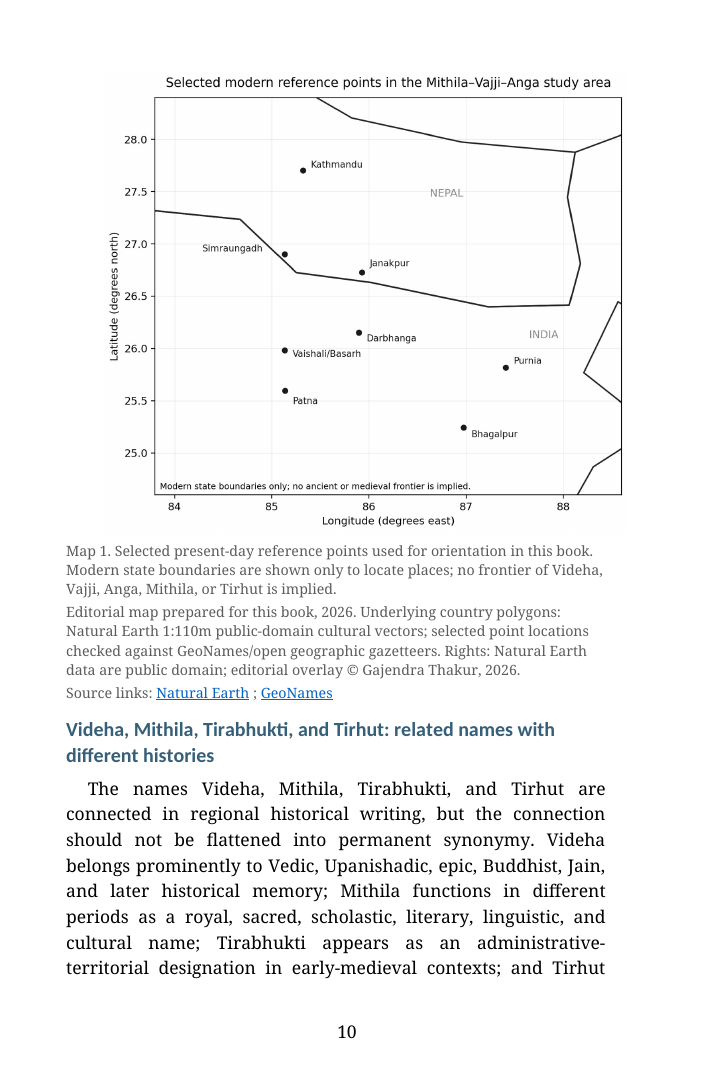
Mithila · Vajji · Anga
Chapter-specific source notes
- Primary chapter witness. Gajendra Thakur, Decoding the Panji of Mithila — Volume V, formal Chapter 12, PDF pp. 121-139; formal Chapter 12. The HTML transcription is generated from the commit-pinned source PDF and retains the chapter boundary recorded in this edition.
- Internal structure. The repository source-heading inventory records 19 subordinate headings for this chapter: “1. The new field: Dharmapur Desh and southern Baluak Raghunathpur”; “Decoded source span and focus:”; “2. From Vachaspati to Vir: the controlling descent before the scholarly branch”; “3. Kavi Keshari Bhim: title as genealogical memory”; “4. Satyakavi Nityanand, Prabodh, Gangadhar, Dharmakar, and Shitikar”; “Decoded source span and focus:”; “5. The second Nityanand line: Anandakara, Rupan, Supan, Suryakar”; “6. Purushottam’s large son group and the Ravikar-Sudhakar continuation”; ….
- Digital editorial method. The page keeps the preserved source text distinct from generated navigational, concordance, visual, and provenance apparatus. The synthetic reconstruction is explanatory only and is not evidence for an individual lineage or a determination of social or marital status.