Decoding the Panji of Mithila · Volume V · Chapter 13
Katayi-Anhara Belepothia, Hemnagar: Hingu-Kamal, Matinath, Hira, Chiranjeev, Ugramani, Sundarmani, Devaraj Singh, and the Hemnagar-Khandwala Continuation
Chapter 13
Katayi-Anhara Belepothia, Hemnagar:
Hingu-Kamal, Matinath, Hira, Chiranjeev,
Ugramani, Sundarmani, Devaraj Singh, and
the Hemnagar-Khandwala Continuation
Decoded source span and focus:
• Source block decoded in this chapter
• This chapter begins at the heading “कटाइ - अन्हरा बेलेपोठिया , हेमनगर” with
the instruction “पाँछा देखूः - ”. It decodes the Hingu - Kamal continuation through
Harikrishna , Devdatt / Datt , Matinath , Gatiram , Tika Ram , Tula Ram ,
Madhurapati , Vidyapati , Janaklal , Raghunath , the Hemnagar branch of Matinath
through Hira , Shatanjiv , Chiranjeev , Ramjiv , Bhanjan , and then the Bhour
Khandwala - Hemnagar continuation through Devaraj Singh , Jayaraj Singh ,
Bateshnath Singh , Dinanath Singh , Dr. Jagannath , and Ramanath. It stops before the
next formal heading “असूरा - सुपटानी गंगोली.”
Decoded source span and focus:
• Method retained from earlier chapters
• The decoding method remains unchanged. Every name is read through descent , place ,
marriage , title , alias , and branch - continuity. The chapter therefore does not treat
Hemnagar as a mere residence. It reads Hemnagar as a working genealogical field
connected with Katai - Anhara , Belepothia , Bhandarisam , Sodarpur , Mahishi
Budhwal , Ruchouli Ekhara , Majhaura Karmah , Hati Sodarpur , Bhour Khandwala ,
Sarisav Sodarpur , Kako Belauch , Baliyas , and allied marriage houses.
1. The heading and the meaning of “पाँछा देखू”
The heading “कटाइ-अन्हरा बेलेपोठिया, हेमनगर” begins a new chapter, but
the phrase immediately following it, “पाँछा देखूः-”, tells the reader that this
section is not a simple fresh start. It is a continuation or backward-
looking supplement. The line resumes the earlier Hingu-Kamal branch
and brings forward the descendants and marriage links that must be read
after the preceding Raghunathpur material.
Decoding the Panji of Mithila - Volume V | 139
This is why the chapter begins with Hingu’s son Kamal. Kamal’s
descendants are named as Harikrishna, Devdatt, Matinath, and Gatiram.
The record does not restart from a completely new Biji figure. It resumes
a branch already opened earlier and places that branch within the Katai-
Anhara-Hemnagar field. The instruction “पाँछा देखू” prevents the reader
from treating the section as isolated.
The source then follows Devdatt, also marked by the alias-like form
Datt, into Tika Ram. Tika Ram’s son Tula Ram gives two sons,
Madhurapati and Vidyapati. The branch is linked with Talhanpur and
Buddhidev, and then with Pirokhati Surgan and Kavi Phekan. This
immediately shows that the Hemnagar section is not merely local. It is
tied to Talhanpur, Surgan, and poetic memory.
Decoded source span and focus:
• Source marker - Decoded meaning - Reading consequence
• कटाइ - अन्हरा बेलेपोठिया , हेमनगर - New heading after Dharmapur -
Raghunathpur - Opens the Hemnagar - related continuation.
• पाँछा देखूः - - Backward / cross - reference instruction - Warns that this is a resumed
branch , not an isolated genealogy.
• हिंगूसुत कमल - Branch resumed from Hingu - Connects Chapter 13 to the prior
Hingu - Kamal line.
• देवदत्त प्र0 दत्त - Alias or practical name marker - Keeps Devdatt / Datt together as
one identity.
• तुलाराम सुतौ मधुरापति , विद्यापति - Two - son continuation - Opens the
Talhanpur and Vidyapati branch.
2. Devdatt/Datt, Tika Ram, Tula Ram,
Madhurapati, and Vidyapati
The first active branch after Kamal is Devdatt , also written with the
marker “प्र0 दत्त.” His son is Tika Ram , and Tika Ram’s son is Tula Ram.
Tula Ram’s sons are Madhurapati and Vidyapati. This sequence should
be kept intact : Devdatt / Datt is not to be split into two persons , and
Tula Ram’s two sons should not be merged with later Vidyapati or
Madhurapati names elsewhere in the Panji.
Decoding the Panji of Mithila - Volume V | 140
Vidyapati’s line is connected with Talhanpur, Buddhidev, Pirokhati
Surgan, and Kavi Phekan. The title “कवि” attached to Phekan is
important. It continues the literary-scholarly register already visible in
the previous chapter through Kavi Keshari Bhim and Satya Kavi
Nityanand. The Panji preserves not only descent but also cultural
memory. A title like “कवि” helps identify prestige and role within the
lineage world.
The branch then gives Janaklal , Raghunath , and Vats Naroun
connections. A female marker , Dayavati , appears. Lali’s son
Singheshwar is linked with Deep Baheradhi and Tejanarayan. This is an
early example in the chapter of how a resumed line immediately
broadens into place and maternal / marriage markers. The compact
source line must therefore be unfolded into descent plus alliance.
3. Hemnagar proper: Matinath, Hira, Shatanjiv,
Chiranjeev, Ramjiv, and Bhanjan
The explicit “हेमनगर” passage begins with Matinath. Matinath’s
descendants are named as Hira, Shatanjiv, Chiranjeev, Ramjiv, and
Bhanjan. The branch is linked with Bhandarisam, Achyut, Gopal,
Sodarpur, Nand, and Rudranand. This establishes Hemnagar as a node
that connects Katai-Anhara to Bhandarisam and Sodarpur.
The line of Hira gives Ratneshwar, Baburam, Dullah, Ram, and
Ballabh, connected with Mahishi Budhwal and Mahesh’s son Bhavesh,
then with Ruchouli Ekhara and Kulai. A female marker Taravati appears,
followed by Bahina, Chandravadan, and Kundana. Their marriages
connect with Hati Sodarpur, Majhaura Karmah, and Oda Ekhara. Thus
Hira’s branch is not one vertical line; it is an alliance web.
The presence of Hati Sodarpur, Majhaura Karmah, and Oda Ekhara in
one passage shows how the Panji preserves marriage movement.
Taravati’s branch is especially important because the record gives “आद्या”
and “अपरा” links. The first connection goes to Hati Sodarpur through
Mishra Raghunath and Mahopadhyay Rameshwar. Another goes to
Majhaura Karmah through Chakrapani and Padmapani, and another to
Oda Ekhara through Bandhu’s son Bhola. These female-linked entries
are essential for marriage regulation.
Decoding the Panji of Mithila - Volume V | 141
Decoded source span and focus:
• Branch figure - Descendants or links - Genealogical role
• Matinath - Hira , Shatanjiv , Chiranjeev , Ramjiv , Bhanjan - Starts the explicit
Hemnagar branch.
• Hira - Ratneshwar , Baburam , Dullah , Ram , Ballabh - Links Hemnagar with Mahishi
Budhwal and Ruchouli Ekhara.
• Taravati - Bahina , Chandravadan , Kundana - Female / maternal marker organizing
marriage links.
• Taravati’s first link - Hati Sodarpur , Mishra Raghunath , Maho Rameshwar - Shows
Sodarpur marriage linkage.
• Taravati’s later links - Majhaura Karmah , Oda Ekhara - Expands the branch into
Karmah and Ekhara houses.
4. Chiranjeev’s branch : Vachan , Murli Dhar ,
Chalbali , Chitradhar , and Sunphool / Nanu
Chiranjeev’s branch is one of the densest sections in the chapter. His
descendants include Vachan, Murli Dhar, Chalbali, Chitradhar, and
Sunphool, with Sunphool also identified through the popular marker
Nanu. These are linked with Kanhouli Ekhara and Halayudh. The
appearance of Halayudh here should not be confused with the opening
Halayudh of the whole volume. Context, father, place, and branch must
control identity.
Sunphool’s sons include Ugramani, linked with Ekhara, Bandhu’s son
Narayandatt, Katai, and Subandhu. Ugramani’s sons include Panchmani,
also called Bhutkun, linked with Pawauli and Bhaiyanath. Another
Ugramani branch gives Krishnamani and Sundarmani, linked with
Chikni-vasi Sarisav Sodarpur, Mishra Jhadhula’s son Janakinath, and
Anilpur Karmah with Kirti.
The Ugramani passage is a classic case of branch multiplication
through aliases and place - links. Panchmani / Bhutkun must be charted
separately from Krishnamani and Sundarmani. Chikni - vasi Sarisav
Sodarpur is not a decorative phrase. It identifies the marriage or branch
field into which the descendants are tied. Anilpur Karmah adds another
field , showing that the Hemnagar line is spreading through Sarisav -
Sodarpur and Karmah networks.
Decoding the Panji of Mithila - Volume V | 142
5. The female bridge through Nunuday: Kamakhya,
Jagadamba, Sonavati
After the Ugramani-Sundarmani branch, the source names Nunuday
and gives Kamakhya, Jagadamba, and Sonavati. These are not
ornamental names. They organize marital connections. Kamakhya is
linked with Bhour Khandwala and Devaraj Singh’s son Jayaraj Singh.
This link produces Bateshnath Singh, Buddhinath Singh, and Dinanath
Singh, with Bindeshwari also named.
Jagadamba is linked with Khangud Sarisav , Bishuni’s grandson
Bhup , and Buchan / Fuchchi , and this line gives Kameshwar and
Maheshwar. This single female - linked entry takes the Hemnagar branch
into Khangud Sarisav and creates a new identifiable cluster. If the editor
omitted Jagadamba’s link , the later Kameshwar - Maheshwar line would
lose its genealogical route.
This passage illustrates a principle repeated throughout Volume V:
women’s names often carry the bridge between two houses. A male-line
chart alone would wrongly flatten the passage. The correct reading must
include Nunuday, Kamakhya, Jagadamba, Sonavati, and the houses into
which they connect.
6. Sundarmani, Ghurun, Rameshwar,
Kapileshwar/Dukhan, Rajeshwar/Lukhno
The branch then turns to Sundarmani. Sundarmani’s descendants
include Ghurun and Rameshwar, linked with Kako Belauch, Bhaiya’s
son Jaynath, Baliyas, and Raghuvir. Another Sundarmani branch gives
Kapileshwar, also called Dukhan, and Rajeshwar, also called Lukhno,
linked with Bhadgam Jajival, Virnarayan’s son Badrinath, Ruchouli
Ekhara, and Muktinath.
Kapileshwar / Dukhan’s sons are Param , Indreshwar , Naresh , Arun ,
and Nandu. They are linked with Shiva Hariam , Mushay , Kashinath ,
Baliyas , and Chhedan. Param connects with Dihiya Khangud Sarisav ,
Kamalnath , Radhanath , Hariam , and Vedanand. Indreshwar connects
with Shivnagar Parhat Baheradhi , Rudramani , Pramod Kumar ,
Simarwad Khaual , and Nagendranath / Khudru. Naresh links to Ramai
Hati Sodarpur through Vaidyanath and Amarnath.
Decoding the Panji of Mithila - Volume V | 143
This section shows why aliases must be preserved. Dukhan and
Lukhno are practical identifiers attached to Kapileshwar and Rajeshwar.
In a later marriage inquiry, a family might remember the popular name
rather than the formal name. The Panji retains both so that the line
remains recognizable in social memory.
Decoded source span and focus:
• Alias pair / branch - Connected names - Place - links
• Sunphool / Nanu - Ugramani - Kanhouli Ekhara , Halayudh , Katai
• Panchmani / Bhutkun - Bhaiyanath link - Pawauli
• Krishnamani and Sundarmani - Janakinath , Kirti - Chikni Sarisav Sodarpur , Anilpur
Karmah
• Kapileshwar / Dukhan - Param , Indreshwar , Naresh , Arun , Nandu - Shiva Hariam ,
Baliyas , Khangud Sarisav , Baheradhi
• Rajeshwar / Lukhno - Badrinath and Muktinath links - Bhadgam Jajival , Ruchouli
Ekhara
7. Bhour Khandwala Hemnagar: Devaraj Singh,
Jayaraj Singh, and the Singh branch
The next internal field is “भौर खण्डवला हेमनगर.” This heading carries the
branch into a Singh-labeled continuation. Devaraj Singh’s son is Jayaraj
Singh. Jayaraj’s sons include Bateshnath Singh, also known as Thaknu,
and Dinanath Singh. The line reconnects them to Katai through
Sunphool’s son Ugramani. Kamakhya’s descendants and Bindeshwari
are also preserved in this field.
From this point the branch becomes more modern in tone. Bateshnath
Singh’s descendants include Vaidyanath, Vishwanath, Badrinath,
Kedarnath, Dr. Jagannath, and Ramanath. The source attaches them to
Vishnupur-vasi Simarwad Khaual, Ratinath’s son Dwarikanath, Mahishi
Budhwal, and Harhar. The title “Dr.” before Jagannath is not a random
modern note; it shows that the Panji continued to absorb modern
educational and professional identity into its traditional grammar.
The branch then records Chandika and Ambika as female-linked
names. Vishwanath connects with Sihouli Mandar and Devakinandan
Singh. Dr. Jagannath connects with Sultanpur-desh Ramnagar-vasi
Rajendra Mishra. These final connections show how Hemnagar,
Decoding the Panji of Mithila - Volume V | 144
Khandwala, Mandar, Sultanpur, and Ramnagar are brought together
before the next Asura-Suptani Gangoli chapter begins.
8. Why Hemnagar must be read as a junction, not a
single village note
The Hemnagar material is a junction. It begins as a continuation of
Hingu’s son Kamal , passes through Devdatt / Datt and Matinath ,
expands through Hira and Taravati’s marital branches , moves through
Chiranjeev and Sunphool / Nanu , then enters the Ugramani -
Sundarmani line , and finally reaches Bhour Khandwala Hemnagar with
Devaraj Singh and Jayaraj Singh.
At each step the branch is identified by more than descent. It is
identified by place: Talhanpur, Surgan, Hati Sodarpur, Majhaura
Karmah, Oda Ekhara, Kanhouli Ekhara, Chikni Sarisav Sodarpur,
Anilpur Karmah, Khangud Sarisav, Kako Belauch, Baliyas, Bhadgam
Jajival, Ruchouli Ekhara, Shivnagar Parhat Baheradhi, Hati Sodarpur,
Bhour Khandwala, and Sultanpur-Ramnagar.
This is why a simple lineage chart would be insufficient. The chapter
needs a network reading. The source is recording who belongs to whom,
but it is also recording where each line enters the marriage field and
which aliases, titles, and modern markers help later readers identify the
correct family.
9. Main branches decoded in this chapter
Kamal branch: Harikrishna, Devdatt/Datt, Matinath, Gatiram.
Devdatt / Datt line : Tika Ram , Tula Ram , Madhurapati , Vidyapati ,
Janaklal , Raghunath , Singheshwar.
Hemnagar Matinath line: Hira, Shatanjiv, Chiranjeev, Ramjiv, Bhanjan.
Hira branch: Ratneshwar, Baburam, Dullah, Ram, Ballabh, Taravati,
Bahina, Chandravadan, Kundana.
Chiranjeev branch : Vachan , Murli Dhar , Chalbali , Chitradhar ,
Sunphool / Nanu , Ugramani.
Ugramani branch : Panchmani / Bhutkun , Krishnamani , Sundarmani ,
Kamakhya , Jagadamba , Sonavati.
Sundarmani branch : Ghurun , Rameshwar , Kapileshwar / Dukhan ,
Rajeshwar / Lukhno , Param , Indreshwar , Naresh.
Bhour Khandwala - Hemnagar branch : Devaraj Singh , Jayaraj Singh ,
Bateshnath Singh / Thaknu , Dinanath Singh , Vaidyanath ,
Vishwanath , Badrinath , Kedarnath , Dr. Jagannath , Ramanath.
Decoding the Panji of Mithila - Volume V | 145
10. Chapter conclusion: Hemnagar as a resumed
branch with modern continuity
Chapter 13 demonstrates the value of the source’s cross - reference
language. The phrase “पाँछा देखू” alerts the reader that the branch resumes
from earlier material. The chapter therefore begins with Hingu’s son
Kamal rather than inventing a new independent origin. From there , the
branch unfolds through Devdatt / Datt , Matinath , Hira , Chiranjeev ,
Ugramani , Sundarmani , and finally the Singh - labeled Hemnagar
continuation.
The chapter also shows how the Panji joins old and modern registers.
It preserves aliases such as Devdatt / Datt , Sunphool / Nanu , Panchmani
/ Bhutkun , Kapileshwar / Dukhan , Rajeshwar / Lukhno , and
Bateshnath Singh / Thaknu. It preserves women’s marriage bridges
through Taravati , Bahina , Chandravadan , Kundana , Nunuday ,
Kamakhya , Jagadamba , Sonavati , and others. It also accepts modern
titles such as Dr. without breaking its older mool - marriage grammar.
The next chapter should begin with the following heading: “असूरा-
सुपटानी गंगोली.” That section will continue the Asura-linked movement
after the Hemnagar-Khandwala branch and will again require the same
method: descent, place, marriage, title, alias, and branch-continuity.
Decoding the Panji of Mithila - Volume V | 146Source structure and verification apparatus
Editorial source apparatus. This apparatus is descriptive, not interpretive. It records the source-controlled structure used to verify that this page corresponds to formal Chapter 13 of Decoding the Panji of Mithila — Volume V. The chapter text above is preserved from PDF pp. 140-147; formal Chapter 13 in the commit-pinned authoritative source. It is not merged with a neighboring chapter, appendix, annexure, or independent front/back-matter unit. The internal headings below come from the repository’s source-heading inventory and are retained as navigational and audit evidence; showing them here does not turn those headings into separate publications or add claims that are absent from the source.
Internal source headings
- 1. The heading and the meaning of “पाँछा देखू”
- Decoded source span and focus:
- 2. Devdatt/Datt, Tika Ram, Tula Ram, Madhurapati, and Vidyapati
- 3. Hemnagar proper: Matinath, Hira, Shatanjiv, Chiranjeev, Ramjiv, and Bhanjan
- Decoded source span and focus:
- 4. Chiranjeev’s branch : Vachan , Murli Dhar , Chalbali , Chitradhar , and Sunphool / Nanu
- 5. The female bridge through Nunuday: Kamakhya, Jagadamba, Sonavati
- 6. Sundarmani, Ghurun, Rameshwar, Kapileshwar/Dukhan, Rajeshwar/Lukhno
- Decoded source span and focus:
- 7. Bhour Khandwala Hemnagar: Devaraj Singh, Jayaraj Singh, and the Singh branch
- 8. Why Hemnagar must be read as a junction, not a single village note
- 9. Main branches decoded in this chapter
- 10. Chapter conclusion: Hemnagar as a resumed branch with modern continuity
Source-text concordance
Katayi-Anhara · Belepothia · Hemnagar · Hingu-Kamal · Matinath · Hira · Chiranjeev · Ugramani · Sundarmani · Devaraj · Singh · Hemnagar-Khandwala · Continuation · Decoded · span · focus · block · begins · heading · मनगर · instruction · decodes · Hingu · Kamal · Harikrishna · Devdatt · Datt · Gatiram · Tika · Tula · Madhurapati · Vidyapati · Janaklal · Raghunath · branch · Shatanjiv · Ramjiv · Bhanjan · Bhour · Khandwala · Jayaraj · Bateshnath · Dinanath · Jagannath · Ramanath · stops · next · formal · Method · retained · earlier · chapters · decoding · remains · unchanged · Every · name · read · descent · place · marriage · title · alias · continuity · therefore · treat · mere · residence · reads · working · genealogical · field · connected · Katai · Anhara · Bhandarisam · Sodarpur · Mahishi · Budhwal · Ruchouli
Boundary verification. In the formal sequence this chapter follows Volume V Chapter 12, “Editorial principle” and precedes Volume V Chapter 14, “Asura-Suptani Gangoli and Singholi Mandar Danti: Brijmohan, Anand Mohan, Kamal Mohan, Babuji, Jagu, Gangadhar, Harijiv, and the Asura-Andhasur Continuation”. The chapter extractor begins at the verified formal Chapter 13 marker and stops at the next verified formal chapter marker; for a final chapter it stops before recognized book-level back matter. The concordance above is generated only from distinct terms already present in this chapter’s preserved source text. It is provided for discovery, comparison, and audit, not as an automated judgment about persons, lineages, status, kinship, marriage eligibility, or historical truth.
Illustrated research apparatus
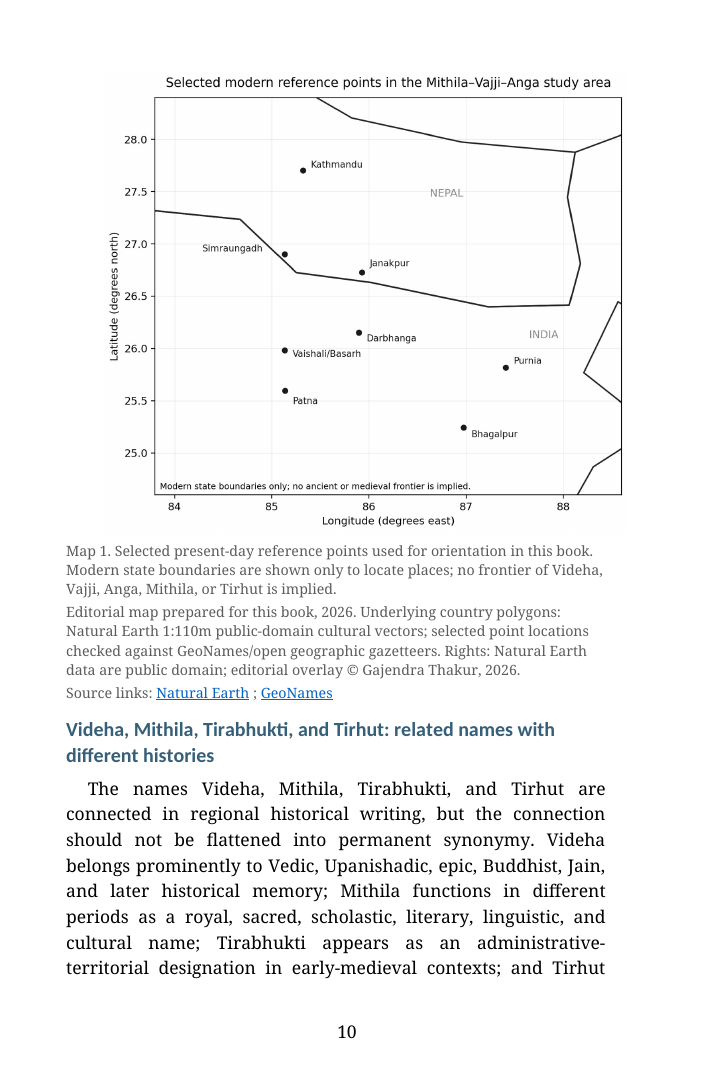
Mithila · Vajji · Anga
Chapter-specific source notes
- Primary chapter witness. Gajendra Thakur, Decoding the Panji of Mithila — Volume V, formal Chapter 13, PDF pp. 140-147; formal Chapter 13. The HTML transcription is generated from the commit-pinned source PDF and retains the chapter boundary recorded in this edition.
- Internal structure. The repository source-heading inventory records 13 subordinate headings for this chapter: “1. The heading and the meaning of “पाँछा देखू””; “Decoded source span and focus:”; “2. Devdatt/Datt, Tika Ram, Tula Ram, Madhurapati, and Vidyapati”; “3. Hemnagar proper: Matinath, Hira, Shatanjiv, Chiranjeev, Ramjiv, and Bhanjan”; “Decoded source span and focus:”; “4. Chiranjeev’s branch : Vachan , Murli Dhar , Chalbali , Chitradhar , and Sunphool / Nanu”; “5. The female bridge through Nunuday: Kamakhya, Jagadamba, Sonavati”; “6. Sundarmani, Ghurun, Rameshwar, Kapileshwar/Dukhan, Rajeshwar/Lukhno”; ….
- Digital editorial method. The page keeps the preserved source text distinct from generated navigational, concordance, visual, and provenance apparatus. The synthetic reconstruction is explanatory only and is not evidence for an individual lineage or a determination of social or marital status.