Decoding the Panji of Mithila · Volume V · Chapter 14
Asura-Suptani Gangoli and Singholi Mandar Danti: Brijmohan, Anand Mohan, Kamal Mohan, Babuji, Jagu, Gangadhar, Harijiv, and the Asura-Andhasur Continuation
Chapter 14
Asura-Suptani Gangoli and Singholi Mandar
Danti: Brijmohan, Anand Mohan, Kamal
Mohan, Babuji, Jagu, Gangadhar, Harijiv, and
the Asura-Andhasur Continuation
Decoded source span and focus:
• Source block decoded in this chapter
• This chapter begins with the formal heading “असूरा - सुपटानी गंगोली.” It decodes
the line of Brijmohan through Anand Mohan , Kamal Mohan , Harimohan , Upendra ,
Bibhutinath , Babuji , Krishna Mohan , Leel Mohan , Madan Mohan , and related
modern branches. It then takes the next internal heading “सिंहोली माण्डर दाँती
अपर असूरा अपरा अन्धासूर श्रीपुर अपरधैत , ” following Jagu , Ram ,
Gangadhar , Rishikesh , Godhai , Harijiv , Balbhadra , Nityanand , Jayanand ,
Kadamlal , and Nandkishor. The chapter stops before the next heading “ बीरवन
बठै ली.”
Decoded source span and focus:
• Method retained from earlier chapters
• The same method continues here : every name is read through descent , place , marriage
, title , alias , and branch - continuity. The heading “असूरा - सुपटानी गंगोली” is
not treated as a mere place - label. It is read as a branch field that connects Asura ,
Suptani , Gangoli , Sakma , Vishnupur , Kurma Khaual , Simarwad Khaual , Ahil
Hariam , Gangora Budhwal , Ratouli Darihara , and Banaili. The following Singholi -
Mandar - Danti - Andhasur heading is treated as a connected but distinct marriage -
and - descent field.
1. The Asura-Suptani Gangoli heading
The heading “असूरा-सुपटानी गंगोली” opens a compact but important
section. It comes immediately after the Hemnagar-Khandwala
continuation and resumes the Asura-linked movement in a new place-
field. The first figure named is Brijmohan, whose sons are Anand Mohan
and Kamal Mohan. The branch is immediately tied to Sakma, Vishnupur,
Kurma Khaual, and Jagatmani.
Decoding the Panji of Mithila - Volume V | 147
This beginning shows that the heading carries more than one
settlement. Asura is the branch field; Suptani and Gangoli add settlement
identity; Sakma, Vishnupur, and Kurma Khaual show the marriage and
branch geography in which the descendants are placed. A safe reading
must therefore preserve the whole cluster instead of reducing it to a
single village.
Anand Mohan’s descendants include Naveen Mohan, Dhirendra
Mohan, Kapil Mohan, and Sunil Mohan. Their link with Ramai-vasi
Simarwad Khaual and Paramanand continues the Khaual connection
already seen in earlier chapters. Naveen Mohan then gives Suman and
Raman, linked with Madanpur and Mahindrapur-Pandua through Prem
Sundar. This places the Asura-Suptani branch in a wider eastern network.
Decoded source span and focus:
• Opening figure - Descendants / links - Reading value
• Brijmohan - Anand Mohan , Kamal Mohan - Root of the Asura - Suptani Gangoli
block.
• Anand Mohan - Naveen Mohan , Dhirendra Mohan , Kapil Mohan , Sunil Mohan -
Connects to Simarwad Khaual and Paramanand.
• Naveen Mohan - Suman , Raman - Carries the branch toward Madanpur and
Mahindrapur - Pandua.
• Kamal Mohan - Santosh , Ashok - Opens the Ahil Hariam - Singheshwar connection.
• Harimohan - Keshav Mohan , Nirmal , Shashi Mohan - Continues into Raghunathpur
and later Katai / Jahanpur links.
2. Kamal Mohan, Harimohan, and the daughter
cluster
Kamal Mohan’s sons are Santosh and Ashok. They are linked with
Vishnupur-Sakma and Ahil Hariam through Singheshwar. Near this
point the source names Manjula, Sulochana, Sheela, and Vibha. These
female names should be treated as part of the branch architecture, not as
decorative additions. They help preserve the marital spread of the Asura-
Suptani line.
Harimohan’s descendants include Keshav Mohan, Nirmal, and Shashi
Mohan. Shashi Mohan is linked with Raghunathpur and Navkant. Shashi
Mohan’s son Ajay connects with Barah Kumbha and Vishwanath, while
Keshav Mohan’s son Dhiraj connects with Jahanpur-Katai through
Decoding the Panji of Mithila - Volume V | 148
Mishra Yashodhar. In a short space the branch moves from Asura-
Suptani to Raghunathpur, Barah Kumbha, Jahanpur, and Katai.
This illustrates the Panji’s compact method. A modern chart would
require several rows for these links, but the source compresses them into
a flowing name-sequence. The decoding must therefore unfold the
branch without losing the location markers that distinguish one Keshav,
one Shashi, or one Ajay from similarly named persons elsewhere.
3. Upendra, Bibhutinath, Satyendra, Jitendra, and
the modern continuation
The section then turns to Upendra’s son Bibhutinath. Bibhutinath is
linked with Matka-vasi Kaudi, and his sons include Satyendra and
Jitendra, linked with Daulatpur and Yadunath. Satyendra’s son Kumar
Bhaskar connects with Rahatmeena and Paramanand. These names show
a more modern register while the older Panji grammar remains
unchanged.
The source also names Chitra and Palashvati in Bibhutinath’s field,
with a marriage link to Mahesh’s son Kedarnath. Again, the female line
is central. Chitra and Palashvati are the bridge by which this branch
enters another house. To omit them would make the later connection
genealogically invisible.
This passage is important because it shows continuity from older
Asura-Suptani branch markers into modern naming practices. The Panji
does not stop with scholastic or premodern names. It absorbs Kumar
Bhaskar, Satyendra, Jitendra, and similar modern identities while still
organizing them through father, village, branch, and marriage.
4. Babuji and the Banaili-linked branch
The source next names Babuji’s descendants: Krishna Mohan, Leel
Mohan, Madan Mohan, and Shri Krishna Mohan. The line gives Rajesh
and Bhavesh, linked with Banaili and Manohar. Rajesh is connected with
Pategna and Gangora Budhwal through Pandit Shobhakant. This
reintroduces a learned marker through “पं0,” while the branch continues
to operate as a marriage-network.
Leel Mohan’s son Akhilesh is linked with Vishnupur, Ahil Hariam,
and Shyam Mishra. Akhilesh is further connected with Malghadi,
Rajanpura, Ratouli Darihara, and Buddhinath. Madan Mohan’s sons
Decoding the Panji of Mithila - Volume V | 149
include Mithilesh and Avadhesh, connected with Jahanpur and Shibu.
The Babuji branch therefore ties Asura-Suptani to Banaili, Pategna,
Gangora Budhwal, Ahil Hariam, Ratouli Darihara, and Jahanpur.
This is not only descent. It is social placement. “Banaili” and
“Gangora Budhwal” carry the memory of houses into which the line
connects. “Pandit Shobhakant” preserves a title-bearing identity.
“Rajanpura Ratouli Darihara” and “Jahanpur” continue the pattern of
branch movement across settlement fields.
5. The next internal heading: Singholi Mandar,
Danti, Asura, Andhasur, Shripur
After the Asura-Suptani Gangoli section, the source gives a second
heading: “सिंहोली माण्डर दाँती अपर असूरा अपरा अन्धासूर श्रीपुर अपरधैत.” This
heading is itself a compressed map. It does not name only one village. It
combines Singholi Mandar, Danti, Asura, Andhasur, Shripur, and an
“apardhait” or additional branch marker.
The branch begins with Jagu, whose sons are Ram and Laxman. They
are connected with Sodarpur and Baatu. Ram’s son is Gangadhar.
Gangadhar’s descendants include Rishikesh, Sudhapati, and Pranapati,
linked with Koiyar, Gyan, Vidyapati, Satlakha, and Bhavaditya. The
sequence shows a movement from Mandar-Danti-Asura into Sodarpur,
Koiyar, Satlakha, and other houses.
The source then follows Rishikesh , also marked through Gonu , into
Godhai. Godhai’s sons are Bhagirath and Ram. Their line connects with
Kako Belauch and Chake. Ram’s descendants include Jagannath ,
Jaykrishna , and Raghunath / Oukhi. These descendants are linked with
Tilai , Gopal , Darihara , Mishra Yaddu / Bhavi , Khaual , and Bhavdev.
The branch is therefore being placed by both paternal descent and
marriage geography.
Decoded source span and focus:
• Heading / branch - Named figures - Place - field
• सिंहोली माण्डर दाँती - Jagu , Ram , Laxman - Mandar - Danti with Sodarpur link.
• Gangadhar branch - Rishikesh , Sudhapati , Pranapati - Koiyar , Satlakha , Bhavaditya.
• Rishikesh / Gonu - Godhai - Karmah and Patona Khaual links.
• Godhai - Bhagirath , Ram - Kako Belauch and Chake.
• Ram branch - Jagannath , Jaykrishna , Raghunath / Oukhi - Tilai , Darihara , Khaual ,
Bhavdev.
Decoding the Panji of Mithila - Volume V | 150
6. Dharani’s descendants and the Harijiv-
Balbhadra line
The source then turns to Dharani’s descendants: Harijiv, Mansukh,
Vinayeshwar, Rameshwar, and Maheshwar. They are linked with
Talhanpur, Mishra Dayal, Divakar, Belonja Mandar, and Mishra
Shivnath. This passage must be read as a branch spread, not merely a list
of sons. The line is entering Talhanpur, Mandar, and allied houses.
Harijiv’s son Balbhadra is then connected with Raiyam Sodarpur
through Vidya and Mahesh. This is one of the key cross-links in the
chapter. Raiyam Sodarpur had appeared earlier in the book as a
significant Sodarpur field; its reappearance here shows that the Asura-
Andhasur branch is tied back into a familiar marriage network.
Another Harijiv branch gives Nityanand, Jayanand, and Kulanand,
linked with Kasiyam Baheradhi and Chaudhary Ramnarayan.
Balbhadra’s son Dayanath links with Balirajpur Hariam, Bhikhari, and
Chilka, and then with Bhour Khandwala and Gunjar. These names locate
the branch through Hariam, Baheradhi, Khandwala, and Sodarpur-related
houses.
7. Jayanand, Shyamlal, Kadamlal, and the Ambika-
Ahilya bridge
Jayanand’s sons are Shyamlal and Kadamlal. They connect with Oda
Ekhara through Bandhu’s son Narayandatt and with Belsam Budhwal
through Sonai. The source then gives Temarvati and follows Shyamlal’s
son Lakshminath. Lakshminath is linked with Hati Sodarpur through
Modnarayan, Dhruvnarayan, and Khadganarayan, and with Uchati
through Bhola.
Lakshminath’s descendants include Damodar , Apuchh or a similar
reading , and Madhav , linked with Pariyamb Budhwal , Pritinath , and
Janakinath. Kadamlal’s son Sadanand also links with Pariyamb Budhwal
through Pathak Shambhunath , and with Khandwala through Shyam. A
second Kadamlal line gives Jagdish , linked with Behat Khandwala ,
Shibu / Ghotan , Baigani Malaya , and Chaudhary Amritnath.
Decoding the Panji of Mithila - Volume V | 151
Jagdish’s son Nand Kishor is then linked with Badhiyam Pawauli ,
Bhaiya / Goga , and Badhgam Darihara. The female - linked names
Ambika , Satyabhama , and Ahilya appear. Satyabhama is connected
with Behat Khandwala , Chopanlal , Kumarnath , and Danmati , giving
Kamal Mohan , Anand Mohan , and Krishna Mohan. Ahilya is connected
with Mulhandi , Mangrauni Pali , Nawal Kishor , and Brajkishor. These
women carry the bridge from Nand Kishor’s line into Khandwala , Pali ,
and later Mohan branches.
8. Nandkishor and the transition to Birwan Batheli
The final lines of the chapter give Nandkishor’s sons Kamalkishor and
the Behat - Khandwala / Chopra - Bakhari connection. Kamalkishor is
linked with Kumarnath’s son Devanand , Alay , and Bhavesh. The source
also names Vimal and Nirmal. This brings the Singholi - Mandar - Danti
- Asura passage into another Khandwala and Chopra - Bakhari field ,
closing the chapter with a clear branch - continuity marker.
The next heading is “बीरवन बठै ली.” That heading begins a different
major scholarly block with Mahamahopadhyay markers. For this reason
the present chapter should stop before it. Chapter 14 has decoded the
Asura-Suptani Gangoli and Singholi-Mandar-Danti material; Chapter 15
should begin with Birwan Batheli.
9. Main branches decoded in this chapter
Asura-Suptani Gangoli branch: Brijmohan, Anand Mohan, Kamal
Mohan, Naveen Mohan, Dhirendra Mohan, Kapil Mohan, Sunil Mohan.
Kamal Mohan and Harimohan continuation: Santosh, Ashok, Manjula,
Sulochana, Sheela, Vibha, Keshav Mohan, Nirmal, Shashi Mohan, Ajay,
Dhiraj.
Upendra-Bibhutinath branch: Bibhutinath, Satyendra, Jitendra, Kumar
Bhaskar, Chitra, Palashvati.
Babuji branch: Krishna Mohan, Leel Mohan, Madan Mohan, Shri
Krishna Mohan, Rajesh, Bhavesh, Akhilesh, Mithilesh, Avadhesh.
Singholi - Mandar - Danti branch : Jagu , Ram , Laxman , Gangadhar ,
Rishikesh , Sudhapati , Pranapati , Godhai , Bhagirath , Jagannath ,
Jaykrishna , Raghunath / Oukhi.
Dharani-Harijiv branch: Harijiv, Mansukh, Vinayeshwar, Rameshwar,
Maheshwar, Balbhadra, Nityanand, Jayanand, Kulanand.
Jayanand-Kadamlal branch: Shyamlal, Kadamlal, Lakshminath,
Sadanand, Jagdish, Nand Kishor, Kamalkishor.
Decoding the Panji of Mithila - Volume V | 152
Female bridge-lines: Manjula, Sulochana, Sheela, Vibha, Chitra,
Palashvati, Ambika, Satyabhama, Ahilya.
10. Chapter conclusion: Asura-linked branches as a
bridge between old and modern fields
Chapter 14 shows how the Panji moves from one compact branch
heading to another without abandoning continuity. “असूरा-सुपटानी गंगोली”
continues the Asura-linked field through Brijmohan, Anand Mohan,
Kamal Mohan, Bibhutinath, and Babuji. The next heading, “सिंहोली माण्डर
दाँती अपर असूरा अपरा अन्धासूर श्रीपुर अपरधैत,” then expands the same wider
world through Jagu, Gangadhar, Harijiv, Jayanand, Kadamlal, and Nand
Kishor.
The chapter also shows the importance of modern names and female
bridges. Satyendra, Jitendra, Kumar Bhaskar, Rajesh, Akhilesh,
Mithilesh, and Avadhesh sit inside the same structure as Gangadhar,
Rishikesh, Harijiv, and Balbhadra. Manjula, Sulochana, Sheela, Vibha,
Chitra, Palashvati, Ambika, Satyabhama, and Ahilya carry the marriage
pathways by which the branch enters other houses.
The next chapter should begin with the heading “बीरवन बठै ली.” That
section opens a learned block with Mahamahopadhyay figures and
should be decoded as a new chapter in the same manner: descent, place,
title, marriage, alias, and branch-continuity.
Decoding the Panji of Mithila - Volume V | 153Source structure and verification apparatus
Editorial source apparatus. This apparatus is descriptive, not interpretive. It records the source-controlled structure used to verify that this page corresponds to formal Chapter 14 of Decoding the Panji of Mithila — Volume V. The chapter text above is preserved from PDF pp. 148-154; formal Chapter 14 in the commit-pinned authoritative source. It is not merged with a neighboring chapter, appendix, annexure, or independent front/back-matter unit. The internal headings below come from the repository’s source-heading inventory and are retained as navigational and audit evidence; showing them here does not turn those headings into separate publications or add claims that are absent from the source.
Internal source headings
- 1. The Asura-Suptani Gangoli heading
- Decoded source span and focus:
- 2. Kamal Mohan, Harimohan, and the daughter cluster
- 3. Upendra, Bibhutinath, Satyendra, Jitendra, and the modern continuation
- 4. Babuji and the Banaili-linked branch
- 5. The next internal heading: Singholi Mandar, Danti, Asura, Andhasur, Shripur
- Decoded source span and focus:
- 6. Dharani’s descendants and the Harijiv-Balbhadra line
- 7. Jayanand, Shyamlal, Kadamlal, and the Ambika-Ahilya bridge
- 8. Nandkishor and the transition to Birwan Batheli
- 9. Main branches decoded in this chapter
- 10. Chapter conclusion: Asura-linked branches as a bridge between old and modern fields
Source-text concordance
Asura-Suptani · Gangoli · Singholi · Mandar · Danti · Brijmohan · Anand · Mohan · Kamal · Babuji · Jagu · Gangadhar · Harijiv · Asura-Andhasur · Continuation · Decoded · span · focus · block · begins · formal · heading · decodes · line · Harimohan · Upendra · Bibhutinath · Krishna · Leel · Madan · related · modern · branches · takes · next · internal · अपरध · following · Rishikesh · Godhai · Balbhadra · Nityanand · Jayanand · Kadamlal · Nandkishor · stops · Method · retained · earlier · chapters · continues · every · name · read · descent · place · marriage · title · alias · branch · continuity · treated · mere · label · field · connects · Asura · Suptani · Sakma · Vishnupur · Kurma · Khaual · Simarwad · Ahil · Hariam · Gangora · Budhwal · Ratouli · Darihara · Banaili
Boundary verification. In the formal sequence this chapter follows Volume V Chapter 13, “Katayi-Anhara Belepothia, Hemnagar: Hingu-Kamal, Matinath, Hira, Chiranjeev, Ugramani, Sundarmani, Devaraj Singh, and the Hemnagar-Khandwala Continuation” and precedes Volume V Chapter 15, “Birwan Batheli: Mahamahopadhyay Batesh, Pashupati, Raghupati,”. The chapter extractor begins at the verified formal Chapter 14 marker and stops at the next verified formal chapter marker; for a final chapter it stops before recognized book-level back matter. The concordance above is generated only from distinct terms already present in this chapter’s preserved source text. It is provided for discovery, comparison, and audit, not as an automated judgment about persons, lineages, status, kinship, marriage eligibility, or historical truth.
Illustrated research apparatus
Mithila · Vajji · Anga
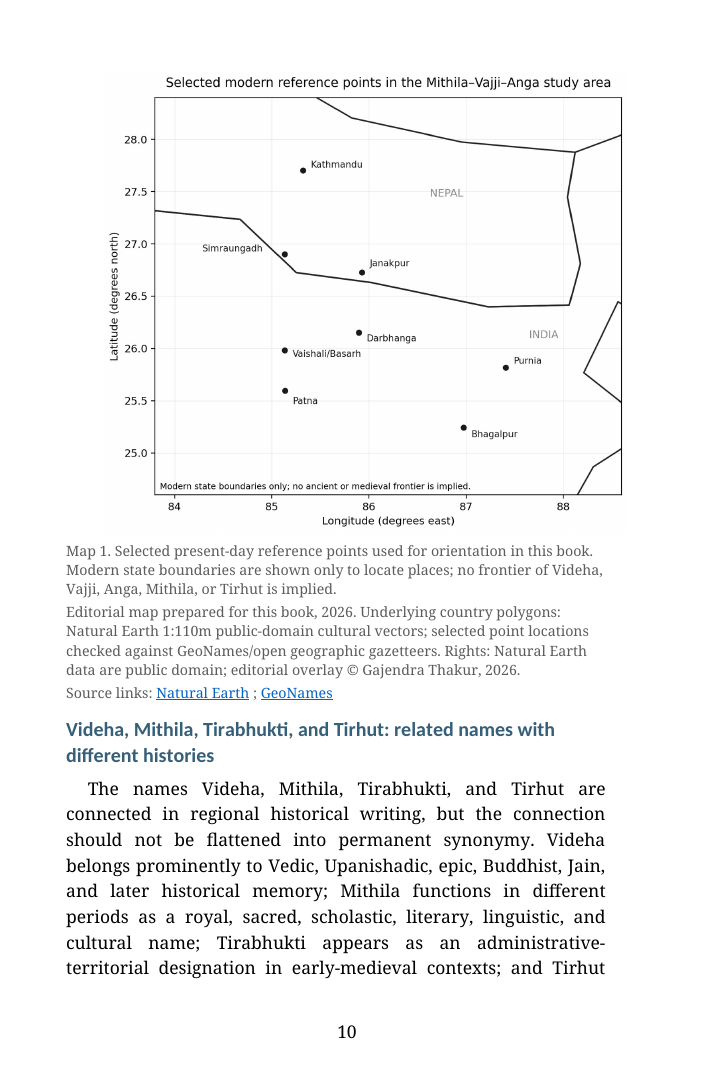
Chapter-specific source notes
- Primary chapter witness. Gajendra Thakur, Decoding the Panji of Mithila — Volume V, formal Chapter 14, PDF pp. 148-154; formal Chapter 14. The HTML transcription is generated from the commit-pinned source PDF and retains the chapter boundary recorded in this edition.
- Internal structure. The repository source-heading inventory records 12 subordinate headings for this chapter: “1. The Asura-Suptani Gangoli heading”; “Decoded source span and focus:”; “2. Kamal Mohan, Harimohan, and the daughter cluster”; “3. Upendra, Bibhutinath, Satyendra, Jitendra, and the modern continuation”; “4. Babuji and the Banaili-linked branch”; “5. The next internal heading: Singholi Mandar, Danti, Asura, Andhasur, Shripur”; “Decoded source span and focus:”; “6. Dharani’s descendants and the Harijiv-Balbhadra line”; ….
- Digital editorial method. The page keeps the preserved source text distinct from generated navigational, concordance, visual, and provenance apparatus. The synthetic reconstruction is explanatory only and is not evidence for an individual lineage or a determination of social or marital status.