Decoding the Panji of Mithila · Volume V · Chapter 20
Ratauli Darhiara, Jahanpur, Naili, Shrinagar, Ramai- Rahatmina-Bhadra: Kamalpani, Devdhar, Dharanidhar, the Poet-Line,
Chapter 20 — Ratauli Darhiara,
Jahanpur, Naili, Shrinagar, Ramai-
Rahatmina-Bhadra: Kamalpani,
Devdhar, Dharanidhar, the Poet-Line,
Baburam, Nandan, Meghnath, Gungu-
Manti, Ramai-Darhiara Ratauli, and the
Araria-Bairgachhi Continuation
1. Where Chapter 20 begins
Chapter 20 begins at the source heading “रतौली दरिहरा जहानपुर
ब पु नैली श्रीनगर, रमै रहटमीना भडरा.” The phrase creates a wide
Darhiara-centered field. Ratauli Darhiara is joined with
Jahanpur, Naili, Shrinagar, Ramai, Rahatmina, and Bhadra, so
the chapter must be read as a linked settlement-register rather
than as a single household note.
The chapter runs from this heading through the Kamalpani-
Devdhar-Dharanidhar descent, the poet-line of Balbhadra,
Rambhadra, Shankar, and Dharadhar, the Baburam-Nandan-
Meghnath continuation, the Gungu-Manti and Shrinagar
registers, the Ramai-Darhiara-Ratauli block, and the Araria-
Bairgachhi-Jahanpurpu continuation. It stops before the next
major source threshold, “रजौरा माण्डर नशिरा देशेफू लबडिया गोन्दवाडा
देश.”
2. Kamalpani, Devdhar, Dharanidhar, and the
first Darhiara descent
The opening person is कमलपाणि, placed from Darhiara. The
source names his children or branch-persons as देवधर, धरनीधर,
and माहवा. This is the root from which the chapter’s Darhiara-
Jahanpur field unfolds.
Decoding the Panji of Mithila - Volume V | 195
देवधर produces उदयकर , then the line moves through गोढ़े / गौढ़े
and बाभन. From Babhana come धृतिकर , गुणाकर , सोमेश्वर , भीमेश्वर
, and रजेश्वर. Someshwar produces बत्सेश्वर , सिद्धेश्वर , वीरे श्वर ,
and जीवेश्वर. Siddheshwar’s line gives सुपन , रूपन , and ईश्वर , and
Rupn carries the branch through भोगेगिरी and the Pali - Ramdatt
connection.
The compressed grammar here is typical of the source. A few
names carry several generations, and each external place-name
identifies the marriage or settlement channel by which the
lineage becomes socially visible.
3. Giri, Shaktu, Bhaktu, Jagatu, Madhav, and the
poetic branch
गिरी produces शक्तू, भक्तू, जगतू, and माधव, linked with
Sodarpur through Harinath. From Shaktu come होरे , शोरे , चान्द,
इन्द्र , महेन्द्र , and जीवेक. Indra’s son श्रीराम links with Hariamb
through Pitambar, and Shriram’s children include वंशमणि, बलभद्र ,
and हरिके श.
The line of बलभद्र is especially marked by poetic identity.
बलभद्र is called कवि बलभद्र ; his son is कवि रामभद्र ; Rambhadra’s
son is कवि शंकर; and Shankar’s son is कवि धराधर. The record
therefore preserves literary title as part of the genealogical
chain, not as a decorative comment.
Kavi Rambhadra links with Loam-Surgan and Maharaj Samar
Singh. Kavi Shankar connects with Pali through Banmali’s son
Vaidyanath and with Baliyas through Pathak Paraun. Kavi
Dharadhar links with Sodarpur through Shaktinath’s son
Kamdev and with Pali through Madhusudan. This cluster is one
of the clearest places where Chapter 20 joins descent, learned
reputation, and marriage geography.
Decoding the Panji of Mithila - Volume V | 196
4. Dharadhar’s sons and the Bhandod-
Gangadhar-Jagannath branch
Kavi Dharadhar’s sons are पीताम्बर, भनोड, गंगाधर, and जगन्नाथ.
The line attaches to Karmaha through Mahinath’s son Bachhai
and to Sakradh through Godhai. A second strand names
Madhukar and Pitambar with Bandhu-Pali, Behat-Khandwala,
Gangadhar, Bhatud, Budhwal, and Lakshmidhar.
The source then gives Chandra-vati’s sons through Bandhu:
गौरीनाथ, शंभुनाथ, and जानकीनाथ, connected with Pavoli and
Kamal’s grandson Hadi’s son Mahipani, with Budhwal and
Chintamani. Rudrani is also recorded as a child-line, confirming
that female-line memory remains structurally important.
5. Baburam, Nandan, Jhotan, Srinath, Dayanath,
and Megnath
बंधु ’s son बाबूराम is attached to Rauadh through Bhairavi’s son
Jaynarayan and is marked as resident in Rahatmina. His line is
connected with Sandahpur-Didhoy and Jaykrishna, while a
daughter-line records Vishesha through Rotpad-Belauch and
Rameshwar’s son Mansharam.
Baburam’s children include नन्दन, झोटन, श्रीनाथ, and दयानाथ.
The Nandan line reaches Oda-Ekhara, Satadh-Khaual, Pathak
Abhiram, Naiyam-Kujouli, Dharmanath, and Nanyapur-Alay. It
also records Musha-vati through Nagwad-Ghosot and
Shambhunath’s son Babue, producing Manmohan and
Jagmohan.
Nandan is especially expansive. His daughter-line joins Ojholi-
Belauch, Sanath, Baburaiya, Hireswari, Sahbajpur-Jagti-Pavoli,
Chaturi, Raghunath, Parkhand-Baheradhi, Mishra Rupnath,
Shyamlal, Sangram-Ekhara, Abhiram, Vaidyanath, Bel-Budhwal,
Bhanu, Naiyam-Kujouli, Bhairav, Chandīdatt, Mandar, Bhikhari,
Ullukujouli, and Khansi Sitaram.
Megnath’s branch includes Nunu Lal, Achkalal, Vaidyanath,
Shobhitlal, Panchanand, Abhinand, Bangat, Narsingh, Damodar,
Decoding the Panji of Mithila - Volume V | 197
and their associated links through Sundar-Sodarpur, Vishnudatt,
Takwal, Umapati, Usrauli-Alay, Ghananand, Bhatud, Sangram-
Ekhara, Ishwardatt, Madhusudan, Katka-Sodarpur, Jalpādatt,
Jalay, Babhuni, Parsanda, Krishna Ram, Siddhinath, Bhadam-
Jajiwal, Krishnamani, Mojilal, Naraul, Devi, Rakhwari-Hariam,
Modnath, Dwarikanath, Dih-Darhiara, Shankardatt, Sarisav-
Sodarpur, Vanshi, Harhar, and Simbarad-Darhiara.
6. The back-reference: Gaurinath, Gopinath,
Hemnath, Mayanath, and Kirtinath
The source then signals “पाँछा देखू,” asking the reader to return
to a connected back-line. This back-reference begins with
Bandhu’s son गौरीनाथ and Gaurinath’s son गोपीनाथ. Gopinath
links with Brahmpura and Gosain Harpati, and with Ughi-
Baliyas through Krishnanand’s son Harpati.
Gaurinath’s further sons are हेमनाथ, मयानाथ, and कीर्तिनाथ,
linked to Pavoli through Tengari’s son Sukhai and to Budhwal
through Kamal Nayan. Kirtinath produces Padumnath through
Didhoy and Hardatt, and also a later sons-set of Jiyalal, Amritlal,
Madanlal, and Rozanlal through Badhiam-Pavoli and Kamal’s
son Shyamlal. Kirtinath’s additional son Prannath links with
Belsam-Budhwal and Manorath’s son Modnath.
7. Nasira-deshe Gungu-Manti and the Shrinagar
strand
The next internal heading is “नशिरा देशेगु णगु मंती.” It opens
with Bhandod’s sons Harinath, Chhavan, another Harinath, and
Nidhinath, with Budhwal-Pathak Bachharu and Darhiara-
Ramakant connections. Bindavati’s children Hira, Moni, and
Rupika are carried through Behat-Khandwala, Rahua,
Harinarayan, Baliyas, Hirphool, Hati-Sodarpur, Ramai,
Rameshwar, Modnarayan, and Barjuk.
Chhavan’s son Khagesh links with Naraun and Pathak Hiru.
Khagesh’s son Amritnath connects with Phuldaha-Pali and
Kamal. Dhirnath’s son Srinath links with Baigani-Alay,
Decoding the Panji of Mithila - Volume V | 198
Chaudhary Bhikhi, Khakhadi, Parhat-Sakradh, and Kamalakant,
while Dhirnath’s son Lotan connects with Sodarpur and
Nandan.
Lotan’s sons Radhanath , Rajnath , Bhainath , and Pritinath
carry the chapter toward the Shrinagar note. Radhanath links
Padhpur - Panichobh , Ghanaram , Vishnudatt , Pachahi - Jajiwal
, Gangadatt , Kanhouli - Ekhara , Baburam , Buddhinath ,
Khandwala , Shyamnath , and Gangoli - Kshatrapati. The
Shrinagar sub - line records Amritlal , Anuplal / Garbhu ,
Swarup Lal / Chichan , Chunhai , Dular , Bodhu , Premnath ,
Indramani , Venidatt , Muni , Shivānand , Kamal , and Pachaudi.
8. Apar Kazi Jagmohan and Hemnagar
The short section “अपर काझी जगमोहन” identifies Pachaudi’s
son Jagmohan and links him with Hati-Sodarpur, Sarvan’s son
Chetnath, Rakhwari-Hariam, and Babhuni. Jagmohan’s sons are
Upendra, Shailendra, Surendra, and Manindra. Even where the
paragraph is brief, it functions as a bridge between the
Shrinagar strand and the later Hemnagar material.
The Hemnagar note begins from Radhanath and names Gulab
and Ati Rupa, then gives daughter-lines into Khangud-Sarisav,
Ranitola-Sirsia, Ahil-Hariam, Vishnupur, and Keshinath’s son
Vanshmani. Ramnath’s sons Indramohan, Kamalmohan, and
Harimohan are joined to Badhiam-Pavoli through Lochan’s son
Yaddu and to Narsam-Baliyas through Mishra Brahmadatt’s son
Babunath.
The Hemnagar cluster continues through Pritinath , Santalal ,
Nandlal , Shyam Sundar , Chhedi , Dukhan / Satyadev , Bhuplal ,
Prandhan , Govind Datt , Manmohan , Kamakhya , Jyotishi
Kalar , Vaiyakaran Chhatradhari of Ramnagar - Rahta , and
Siddhinath. These entries again show the interweaving of
ordinary descent , professional title , and marriage geography.
Decoding the Panji of Mithila - Volume V | 199
9. Ramai-Darhiara Ratauli: Murari,
Garudadhwaj, Harinandan, Ganesh, and Shulpani
The heading “रमैदरिहरा रतौली” turns to Shaktu’s son, Jive’s son,
मुरारी. Murari links with Ekhara through Krishna Pati, and his
son Garudadhwaj links with Baheradhi through Pagu.
Garudadhwaj’s continuation records Sundari and Undan,
Mahishi-Pali, Keshav, and Harinandan.
Harinandan’s sons are गणेश and नारायण. Ganesh produces
Harikrishna, Lakshmipati, Shulpani, Govind, and Gunanand,
and the line is linked to Naraun-Ramdev and Tilay-Rai Basudev.
Harikrishna produces Bhaiya and Harinarayan, with Malangia-
Kujouli and Babu links.
Shulpani’s son Kudhāi and Ramratan link through Bhram-
Jajiwal, Saday, Mahesh, Surgan, and Dharani. The daughter-line
through Sohouni connects Behat-Khandwala and Ratneshwar,
producing Buddhinath, Bhatari, and Khel Pati. Kudhāi’s son
Bhola links with Malangia-Kujouli, Ram’s son Chhoti, S.
Sodarpur, Bhairav, Behat-Khandwala, Judaun’s son Bhanjan,
Pariyamb-Budhwal, and Chaturbhuj. This section shows a dense
passage from old descent to wide regional marriage ties.
10. Loknath, Modnath, Somnath, and the Babu-
Jyotishi branch
The Ramai-Darhiara-Ratauli block also contains Ram’s son
Loknath. Loknath is linked with Hasouli-Sodarpur through
Dani’s son Jyotishi Giripati and with Sihouli-Mandar through
Kalidas. Another Ram branch gives Harinath and Umanath,
linked with Nagwad-Ghosot and Ganesh’s son Sitaram, and with
Hasouli-Sodarpur through Ghanghor’s son Pathak Siddhinath.
Loknath produces Modnath and Somnath / Dular , joined with
Nagwad - Ghosot , Radhagachh - Bodhgram , Ganesh’s son
Virnarayan , Badgam - Darhiara , and Mahadev. Modnath’s
daughter - line goes to Tetarihar - Sodarpur and Yadunandan’s
son Bechu , and to Hati - Pali through Bhaiya’s son Chhaba.
Decoding the Panji of Mithila - Volume V | 200
Modnath’s sons Babhuni and Jyotishi Madhusudan carry the
line to Suptani - Gangoli , Chhatrapati , and Dular.
11. Araria-Bairgachhi to Jahanpurpu-Ratauli-
Darhiara
The next internal heading is “अररिया बैरगाछी सॅ जहानपुरपु -
रतौली दरिहरा.” It starts with Mansukh and names Udhe ,
Vishnupati , and Ukaru. Thakru’s sons are Padmanam and
Achyut , linked to Hariam and Madhukar. Padmanam produces
Paramanand , then Sundar and Bhagirath , then Jaydev ,
Mahadev , Pinak , and Garib.
Pinak’s son Rameshwar connects with Behat-Khandwala,
Gangadhar’s son Girish, and later with Hridyanath and
Ratneshwar. Rameshwar’s sons are Keshinath, Rupnath,
Mathuranath, and Gokhulnath, with Budhwal-Pathak
Madhukar, Khagesh, Dih-Darhiara, Prannath, Baghwas-Sarisav,
Chhoti, Buddhinath, Mahua-Khaual, Jyotishi Ankhi, Gopinath,
Khangud-Sarisav, Shrinagar, and Pathak links.
Rupnath produces Shashinath , and Shashinath produces
Premnath , while Premnath produces Batuk / Umanath. The
source marks Shri Krishna as a notable jurist with LL.B. and
carries the branch through Vivek Kumar , Vishnupur - Ahil -
Hariam , Yashodhar , Girijanand , Puddendaha , Sakuri - Pali ,
and Chaturanan. This modern professional marker continues
the pattern seen in earlier chapters : Panji retains education and
law within lineage grammar.
12. Haridatt, Kamaladatt, Mahendra, Upendra,
Surendra, and the Gungu-Vanti continuation
Vanshi’s son Haridatt / Harharadatt is recorded as Chhotu’s
father of Kamaladatt , with Hati - Pali , Gidu , Khandwala , and
Dhirnath links. Haridatt also produces Mahendra , Upendra ,
and Surendra , linked with Mahiya - Sodarpur and Manmohan.
The child - line includes Subhadra and Sushila , while marriage -
links enter Chopar - Bakhari , Tetarihar - Sodarpur , Madhav ,
Decoding the Panji of Mithila - Volume V | 201
Padmanand , Taranand , Ramanand , Ramai , Oda - Ekhara , and
Yadunath.
The source then brings back “गुणगु वंती.” Eklal’s son Ruchidatt
links with Sarisav and Narayan Datt’s grandson Bhairav’s son
Bechu. Dular’s son Babujan connects with Ekma-Khandwala,
Bhaiya Ram, Mandar, Dharani, and the daughter-lines Mohvati,
Hemvati, and Ramvati through Jagor-Sodarpur, Devn,
Buddhinath, Raiyam-Sodarpur, Judaun, Bhram-Jajiwal, Tarapati,
Kalanath, and Parshanath.
Babujan’s sons are Bhainath, Babulal, Pyarelal, Kulanand,
Tirthanand, and Rudranand. Through Bhainath and Rashmohan
the branch reaches Sadra-Behat-Khandwala, Thakur Krishna
Gopal, Tilak Datt, Pariyamb-Budhwal, Kashinath, and the child-
line Harshvati. Babulal’s son Baldev links with Tilay, Banaili, Rai
Kanhaiya Singh, Rai Kumar Singh, and the related daughter-
lines Lalvati, Sundarvati, and Prabhavati.
13. Rashmohan, Harimohan, Baldev, Chakradhar,
and the modern scholarly end of the chapter
The chapter closes by following Shri Rashmohan. His sons are
Krishnamohan, Rajendra Mohan, Vijendra Mohan,
Chandramohan, Harimohan, and Ravindra Mohan, linked with
Parwaha-Kanhouli-Ekhara, Jhalwari, Nityanand, Sukhet-
Sodarpur, and related daughter-lines Sunayana, Aparna, and
Arna.
Rashmohan’s son Avadh Mohan leads to Vasukinath , then to
Harimohan / Vanshi and the sons Murari Mohan , Tripurari
Mohan , Giridhari Mohan , Surendra Mohan , and the B.A. -
marked Brajmohan of Puddendaha. The line then passes
through Murbari / Suryamohan , Mithub , Phulbari , Suryanand ,
Tripurari Mohan of Patuaha , Mahanand , Giridhari Mohan ,
Bhaskar , Sahwajpur , and Triveninath.
Baldev’s sons Vaidyanath , Jagannath , Bindunath , Gopinath ,
and Shambhunath connect through Nadwar - Karmaha ,
Decoding the Panji of Mithila - Volume V | 202
Mandhan , Govardhan , Deshual - Khandwala , and Harshdatt.
Chakradhar’s sons Vibhutinath , Radhakant , Shyamakant ,
Sonakant , and the learned modern branch through Dr. Prof.
Prabhukant / Munna , M.A. , Ph.D. , Bablū / Indrakant , Engineer
Kumar Anand , Madhukant / Bablū , Abhinav / Tuntun ,
Indukant , railway service , and associated marriage - lines form
the modern scholarly end of this chapter.
14. Branch summary
Opening field: Ratauli-Darhiara, Jahanpur, Naili, Shrinagar,
Ramai, Rahatmina, and Bhadra.
Root line : Kamalpani → Devdhar / Dharanidhar / Mahwa →
Udaykar , Babhana , Dhritikar , Gunakar , Someshwar ,
Bhimeshwar , Rajeshwar , Siddheshwar , Rupn.
Poet-line: Kavi Balbhadra → Kavi Rambhadra → Kavi
Shankar → Kavi Dharadhar.
Baburam - Nandan - Meghnath branch : Baburam →
Nandan , Jhotan , Srinath , Dayanath ; Nandan and
Meghnath carry extensive Sodarpur , Kujouli , Darhiara ,
Jajiwal , and Karmahā links.
Back - reference line : Gaurinath → Gopinath ; Hemnath ,
Mayanath , Kirtinath ; Kirtinath → Padumnath and later
Jiyalal - Amritlal - Madanlal - Rozanlal branch.
Gungu - Manti / Shrinagar line : Bhandod → Harinath ,
Chhavan , Harinath , Nidhinath ; Lotan → Radhanath ,
Rajnath , Bhainath , Pritinath ; Shrinagar adds Amritlal ,
Anuplal , Swarup Lal , Premnath , Venidatt , Pachaudi.
Ramai - Darhiara - Ratauli line : Murari → Garudadhwaj →
Harinandan → Ganesh / Narayan ; Ganesh → Harikrishna ,
Lakshmipati , Shulpani , Govind , Gunanand.
Araria - Bairgachhi line : Mansukh → Udhe / Vishnupati /
Ukaru ; Padmanam → Paramanand → Sundar / Bhagirath →
Jaydev / Mahadev → Pinak / Garib.
Modern learned markers: Kavi titles, Jyotishi titles, LL.B.,
professor, Ph.D., engineer, and railway service appear inside
the same genealogical grammar.
Decoding the Panji of Mithila - Volume V | 203
Next threshold: “रजौरा माण्डर नशिरा देशेफू लबडिया गोन्दवाडा
देश.”
15. Conclusion: the Darhiara field as a literary,
legal, and modern genealogical bridge
Chapter 20 is one of the most layered sections of the Volume II
Panji material. It begins as a Darhiara-Jahanpur-Naili-Shrinagar-
Ramai field, then repeatedly opens subfields: the poet-line, the
Nandan-Meghnath branch, the Gungu-Manti line, Shrinagar,
Kazi-Jagmohan, Hemnagar, Ramai-Darhiara-Ratauli, and Araria-
Bairgachhi.
Its most striking feature is the continuity between classical
and modern status. The Panji records Kavi Balbhadra, Kavi
Rambhadra, Kavi Shankar, and Kavi Dharadhar in the same
lineage-language that later records jurists, professors, engineers,
Jyotishis, graduates, and railway service. The text never
separates social prestige from descent and marriage. Prestige
becomes part of the record only when it is placed inside the
chain of father, son, daughter, wife, village, and branch.
The next chapter should therefore begin at “रजौरा माण्डर नशिरा
देशेफू लबडिया गोन्दवाडा देश,” where the source leaves the Ratauli-
Darhiara-Jahanpur-Ramai field and turns toward the Rajora-
Mandar-Nasira-Phulbariya-Gondwara register.
Decoding the Panji of Mithila - Volume V | 204Source structure and verification apparatus
Editorial source apparatus. This apparatus is descriptive, not interpretive. It records the source-controlled structure used to verify that this page corresponds to formal Chapter 20 of Decoding the Panji of Mithila — Volume V. The chapter text above is preserved from PDF pp. 196-205; formal Chapter 20 in the commit-pinned authoritative source. It is not merged with a neighboring chapter, appendix, annexure, or independent front/back-matter unit. The internal headings below come from the repository’s source-heading inventory and are retained as navigational and audit evidence; showing them here does not turn those headings into separate publications or add claims that are absent from the source.
Internal source headings
- 1. Where Chapter 20 begins
- 2. Kamalpani, Devdhar, Dharanidhar, and the first Darhiara descent
- 3. Giri, Shaktu, Bhaktu, Jagatu, Madhav, and the poetic branch
- 4. Dharadhar’s sons and the Bhandod-Gangadhar-Jagannath branch
- 5. Baburam, Nandan, Jhotan, Srinath, Dayanath, and Megnath
- 6. The back-reference: Gaurinath, Gopinath, Hemnath, Mayanath, and Kirtinath
- 7. Nasira-deshe Gungu-Manti and the Shrinagar strand
- 8. Apar Kazi Jagmohan and Hemnagar
- 9. Ramai-Darhiara Ratauli: Murari, Garudadhwaj, Harinandan, Ganesh, and Shulpani
- 10. Loknath, Modnath, Somnath, and the Babu-Jyotishi branch
- 11. Araria-Bairgachhi to Jahanpurpu-Ratauli-Darhiara
- 12. Haridatt, Kamaladatt, Mahendra, Upendra, Surendra, and the Gungu-Vanti continuation
- 13. Rashmohan, Harimohan, Baldev, Chakradhar, and the modern scholarly end of the chapter
- 14. Branch summary
- 15. Conclusion: the Darhiara field as a literary, legal, and modern genealogical bridge
Source-text concordance
Ratauli · Darhiara · Jahanpur · Naili · Shrinagar · Ramai · Rahatmina-Bhadra · Kamalpani · Devdhar · Dharanidhar · Poet-Line · Baburam · Nandan · Meghnath · Gungu · Manti · Ramai-Darhiara · Araria-Bairgachhi · Continuation · begins · heading · रहटम · phrase · creates · wide · Darhiara-centered · field · joined · Rahatmina · Bhadra · must · read · linked · settlement-register · rather · single · household · note · runs · Devdhar-Dharanidhar · descent · Balbhadra · Rambhadra · Shankar · Dharadhar · Baburam-Nandan · Gungu-Manti · registers · Ramai-Darhiara-Ratauli · block · Araria · Bairgachhi-Jahanpurpu · stops · next · major · threshold · first · opening · person · कमलप · placed · names · children · branch-persons · root · chapter’s · unfolds · Decoding · produces · उदयकर · line · moves · Babhana · come · Someshwar · Siddheshwar’s · gives · Rupn · carries · branch
Boundary verification. In the formal sequence this chapter follows Volume V Chapter 19, “Rajanpura Pu Darhiara Koilakh, Sarouni, and Dharmapur- Deshe Hemnagar: Kanhaiya, Dwarikanath, Lakshman, Prayagdatt,” and precedes Volume V Chapter 21, “Rajora Mandar Nasira- Deshe Phulbadiya-Gondwara: Mahamahopadhyay Batesh, Pashupati, Raghupati, Ratipati, Yagyapati, Pothia”. The chapter extractor begins at the verified formal Chapter 20 marker and stops at the next verified formal chapter marker; for a final chapter it stops before recognized book-level back matter. The concordance above is generated only from distinct terms already present in this chapter’s preserved source text. It is provided for discovery, comparison, and audit, not as an automated judgment about persons, lineages, status, kinship, marriage eligibility, or historical truth.
Illustrated research apparatus
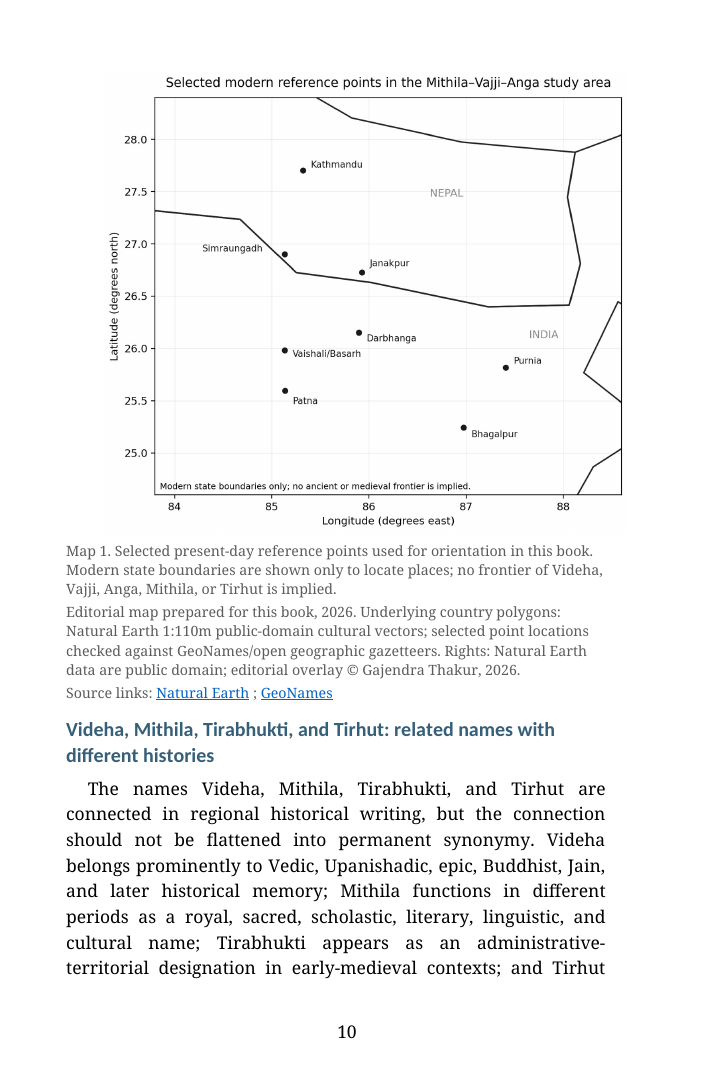
Mithila · Vajji · Anga
Chapter-specific source notes
- Primary chapter witness. Gajendra Thakur, Decoding the Panji of Mithila — Volume V, formal Chapter 20, PDF pp. 196-205; formal Chapter 20. The HTML transcription is generated from the commit-pinned source PDF and retains the chapter boundary recorded in this edition.
- Internal structure. The repository source-heading inventory records 15 subordinate headings for this chapter: “1. Where Chapter 20 begins”; “2. Kamalpani, Devdhar, Dharanidhar, and the first Darhiara descent”; “3. Giri, Shaktu, Bhaktu, Jagatu, Madhav, and the poetic branch”; “4. Dharadhar’s sons and the Bhandod-Gangadhar-Jagannath branch”; “5. Baburam, Nandan, Jhotan, Srinath, Dayanath, and Megnath”; “6. The back-reference: Gaurinath, Gopinath, Hemnath, Mayanath, and Kirtinath”; “7. Nasira-deshe Gungu-Manti and the Shrinagar strand”; “8. Apar Kazi Jagmohan and Hemnagar”; ….
- Digital editorial method. The page keeps the preserved source text distinct from generated navigational, concordance, visual, and provenance apparatus. The synthetic reconstruction is explanatory only and is not evidence for an individual lineage or a determination of social or marital status.