Decoding the Panji of Mithila · Volume V · Chapter 21
Rajora Mandar Nasira- Deshe Phulbadiya-Gondwara: Mahamahopadhyay Batesh, Pashupati, Raghupati, Ratipati, Yagyapati, Pothia
Chapter 21 — Rajora Mandar Nasira-
Deshe Phulbadiya-Gondwara:
Mahamahopadhyay Batesh, Pashupati,
Raghupati, Ratipati, Yagyapati, Pothia
Sultanpur, Palasi, Belbadi Jhotan Jha,
and Shripur-Deshe Kodhila
1. Where Chapter 21 begins
Chapter 21 begins at the new source heading “ रजौरा माण्डर
नशिरा देशेफू लबडिया गोन्दवाडा देश.” This heading brings together
Rajora, Mandar, Nasira-desh, Phulbadiya, and Gondwara-desh
as one linked register. The source is not merely naming
settlements; it is announcing a new field in which descent,
learned titles, marriage routes, and later sub-settlements must
be read together.
The chapter opens with the learned Mahamahopadhyay line
of बटे श and then unfolds through पशुपति, रघु पति, आडनि, रतिपति,
कृ ष्णपति, शिवपति, गुणपति, इन्द्रपति, वाचस्पति, दुखडि, मधुकर, पुरुषू, मुकु न्द,
श्रीधर, and the later Padpur, Hansa, Pothia Sultanpur, Palasi,
Belbadi, and Shripur-Kodhila continuations. It stops before the
next formal threshold, “अथ सतलखा सतौलि ग्रामारम्भः.”
2. Mahamahopadhyay Batesh and the four
learned descendants
The first named ancestor is म॰म॰उ॰ बटे श. The abbreviation
marks a high scholastic title, so the source begins this chapter
with a learned line, not only with a territorial one. Batesh is
followed by म॰ पशुपति, म॰ रघु पति, आडनि, and म॰ रतिपति. The
repetition of learned-title abbreviations shows that the family’s
social memory preserves scholarship as a lineage-marker.
Pashupati produces कृ ष्णपति, linked with Alay through Ram.
Another Pashupati line gives म॰ शिवपति, म॰ गु णपति, and म॰
Decoding the Panji of Mithila - Volume V | 205
इन्द्रपति, connected with Sodarpur through म॰म॰ विश्वनाथ.
Indrapati’s son वाचस्पति is also marked by the personal name
दुखडि and is linked with Tarouni-Karmaha and Barah.
Dukhadi produces शंकर, मधुकर, रतिकर, and मतिकर, connected
with Balaini-Pali and Ravi. Another Dukhadi line produces
रघु राम and नोनेक, linked with Ekhara and Vagishwar. The
daughters Sukhama, Upama, and Shobha are also recorded;
Shobha’s marriage to Nagwad-Ghosot and Mahamahopadhyay
Govind preserves the daughter-line as an authority-bearing
bridge.
3. Madhukar, Purushu, Mukund, Shridhar, and
the first expansion beyond the learned core
Madhukar produces उमापति, गौरीपति, and कु लपति, connected
with Babhaniyam and Shankar. Another Madhukar branch
gives पुरुषू and छितरू, connected with Baheradhi and Amaru.
Purushu produces मुकु न्द and श्रीधर, and the line then touches
Alay, Bhim, Hariam, Govind’s son Gadu, Lohana-Sakradh,
Ratnapati, and daughter-lines through Gangavati, Mangala, and
Devamaya.
The Narhari-related note is compressed but important: it links
Narhari’s daughter-line with Naraun, Harijiv, Balbhadra, Ratan,
Sodarpur, Govind’s son Digambar, and the children Indrani,
Sarvani, and Bhavani. Through Bhainsdiyar, Mahishi-Budhwal,
Pathak Kamal Nayan, and Shyam, the same line produces
Khadganath, Shomnath, and Pritinath. The passage shows how a
learned root quickly becomes a wide marriage-geography.
4. Padpur-pu vasi and the Janardan-Vanshidhar-
Murlidhar-Vidyanath branch
The source then turns to “ पद्मपुर पु वासी,” naming जनार्दन and
his sons वंशीधर, मुरलीधर, and विद्यानाथ. Their connections move
through Begani-Alay, Yogi’s son Harinath, Sakradh, Krishna, and
the daughter-line through Dullahini, Alay, Thakurdatt, and
Tilakdatt, producing Phokan.
Decoding the Panji of Mithila - Volume V | 206
Vanshidhar’s son लक्ष्मीनाथ is tied to Behat - Khandwala and
Thakur Khelpati , and also to Hati - Pali and Baukai. The Khadika
- Lakshminath line produces Bhuvaneshwar , linked with Deuri -
Khandwala , Baburaiya’s son Rijanath , Rajora - Mandar ,
Rudramani , and the Khonamani children. Bhuvaneshwar’s son
Rameshwar then links the branch to Chikni , Bhakharouli -
Kujouli , Kishori’s son Nityanand / Bande , Rajanpura -
Darhiara , Sukhsen , Madhukar , Baghwas - Sarisav , Shivnagar ,
Paramanand , Darhiara , and Murlidhar.
5. Hansa: Chaturbhuj, Ratnapati, Jayanu,
Ramkrishna, and the Laxminarayan-Shivshankar
line
The Hansa section begins with बाछनि’s son चतुर्भूज , linked
with Gangor and Chandrapati’s son Godhai , and with Darhiara -
Bhikhu. Chaturbhuj produces रत्नपति / खूनी , linked with Ojholi -
Belauch and Jagannath’s son Ramchandra , and with Sodarpur -
Chandrapati. Ratnapati’s son Jayanu links with Pachahi - Jajiwal
and Dhanpati’s son Bhavdev , and then with Pali - Harinath.
Jayanu’s sons are भोला and रामकृ ष्ण, and Ramkrishna’s line
enters Surgan, Vanshi’s grandson Ramkrishna, Madhukar,
Panichobh, Babu, and Narayani. Ramkrishna’s children include
झूमक, झड़ूला, ज्यो0 लेखनाथ, रे वतीनाथ, and तेजनाथ. Through Gangor,
Jagannath, Bhikhari, Gosain, Darhiara, Patiram, Bhanjan,
Jhadula, Kunjabihari, Bhor-Khandwala, Lakshminarayan,
Shivshankar, Khangud-Sarisav, Chakradhar, and Pritinath, the
Hansa passage stretches into a large cross-settlement chain.
Laxminarayan / Lakshman and Shivshankar continue the
record into Nagwad - Ghosot , Durbhil , Kishori , Ruchouli -
Ekhara , Dharbharan , Jahānpur , Ekma - Khandwala ,
Harshmani , Gudar , Ratauli - Darhiara , Artinath , and the
Jyotishi Lekhnath branch through Babuā , Satyanarayan , Oda -
Ekhara , Babulal , Grihinath , Jarhatiya - Pali , and Bhainath.
Decoding the Panji of Mithila - Volume V | 207
6. The second Batesh-Pashupati-Shivapati-
Yagyapati line
The source returns to म॰म॰ बटे श through the line बटे श →
पशुपति → शिवपति → यग्यपति. Yagyapati is linked with Badh - Alay
and Buddhinath / Budhe , and produces महो अफे ल , वेणी , नरहरि ,
and शशिधर. The record then separates the Pali - Rudra and Pali -
Ravi connections , showing multiple marriage or branch lines
from the same Yagyapati field.
Mahamahopadhyay Narhari produces महेश and जीवेश , tied to
Sodarpur - Madhav. Mahesh produces म॰ मतिनाथ , म॰ रामनाथ ,
and सिद्धिनाथ , linked with Pali - Narpati and the child - line
Devaki. Another Mahesh line produces Raja , linked with Ekhara
and Raghu. Raja gives Devanand / Dewai , Sadai , and Bhawai ,
linked with Pachahi - Jajiwal , Kashi’s son Kanh , Bhamar , and
Hariraha.
Dewai’s sons Dhani, Govind, and Anant link with Budhwal,
Kamdev’s son Shubhankar, Sodarpur, and Mahamahopadhyay
Madhav. The Durga line records Mahamahopadhyay Jaydhani’s
sons Khagesh and Ganesh, linked with Majhiyam-Karmaha,
Chaudhary Hari, Khaual, and Vaidyanath. Khagesh then
branches into Sanphool, Hirphool, Jeevan, Dhirnath, Horil, and
Somnath, carrying Ahpur-Karmaha, Harishwar, Naraun,
Gangadatt, Samauli-Pali, Dharmpati, Darhiara, Bhagirath, and
Alay-Chaudhary Bengali links.
7. Pothia Sultanpur: Ganesh, Batahu, Dullah,
Chetnath, Harik, and the many sons of Batahu
The “पोठिया सुलतानपुर” block begins from Ganesh and names
बतहू and दुल्ल. Batahu and Dullah are linked with Ahiyari-Pali,
Vir’s son Chilka, Konsam-Mandar, and Sonai. Another Ganesh
son, Chetnath, links with Rajepavoli, Parshuram’s son Kumar,
Ekhara, Devaki, and the Samari children. Harik, another Ganesh
son, links with Ghosot and Paltun’s son Gauri.
Decoding the Panji of Mithila - Volume V | 208
The Batahu branch is wide. Batahu’s daughter-lines move
through Katma-Babhaniyam, Nanu, Bali-Sodarpur, Chaturbhuj,
Hati-Sodarpur, Mishra Nanhaku’s son Bhikshuk, and Naktuk.
Another daughter-line connects Sakuri-Sarisav and Paran. There
are further links through Bhuvaneshwari, Sarisav-Sodarpur,
Madhusudan’s son Chandrapati, Rauadh, Dharmapati, Chetnath,
and Jalay-Sadhu.
Batahu’s sons include बिहारी , नन्दीपति , राजकु मार , वंशमणि ,
खडगमणि , झोटन / दुभनी , and भवानीदत्त / पोचाई. Through Bihari the
source reaches Jalay - Sadhu. Through Nandipati and Rajkumar
it reaches Naiyam - Kujouli , Dharadhar’s son Mushan , Usrauli -
Alay , Pathak Medhakar , and a daughter - line through
Chandravati and Thakur Shambhunath. Through Vanshmani
and Khadgamani it reaches Kokilbad - Didhoy , Lai , Bhanjan ,
Belauch , Dewai , Singhāshram , Sanphool , Rajeshwari ,
Kankalal / Ghuturuk , Jalay , Pathak Siddhinath , Neyam -
Kujouli , Kamal , Alay , and Naroun.
8. Palasi: Lal, Hiyalal, Kalitnath, Tilaknath,
Pritamlal, Tulsidatt, and Aghorinath
The Palasi section continues the Batahu-Nandipati field. It
begins with Nandipati’s sons or branch-persons Lala and
Hiyalal, linked with Sidma, Bhor-Khandwala, Thakkan’s son
Nanu, Ahil-Hariam, and Khedan. Lala’s son Kalitnath links with
Oda-Ekhara, Chaturi’s son Parichetadani, Sodarpur, and Mishra
Mikhiya; Lala’s son Tilaknath links with Belauch, Karu’s son
Buddhinath.
Hiyalal’s line runs through Mahiya , Kare / Anand , Budhwal ,
Devak , Hridaynath , Sarisav - Sodarpur , Shambhunath ,
Pritamlal , Radhi - Pali , Mansukh’s son Baburaiya , Panichobh ,
and Dukhia. Tulsidatt produces Valitnath / Ghutan , Chitranath ,
and Nawatilal. A back - reference notes Nandipati’s sons Genalal
, Tofalal , and Mannulal through Didhoy and Garib’s son
Chaturbhuj.
Decoding the Panji of Mithila - Volume V | 209
Genalal produces Manohar Lal and Sundar Lal through
Tarouni-Karmaha and Vokan’s son Datt. Tofalal links with Hati-
Sodarpur and Mishra Hiya, while Mannulal links with Sangram-
Ekhara and Parshi. Parshmani’s son Aghorinath links with
Belsam-Budhwal and then to Ramai, where Aghorinath
produces Jaydev and Sukdev through Majhaur-Karmaha and
Maujilal.
9. Palasi Rajkumar and Belbadi Jhotan Jha
A second Palasi block begins with Sri Rajkumar. Rajkumar’s
sons are Parshmani, Bhikhari, Doman, Jagatmani, Amritnath,
Motilal, and Bhavilal. Their connections move through Pavoli,
Tota, Andoli-Jalay, Manjan, Buddhinath, Naraun, Jhalru,
Khandwala, Raman, Nand Kumar, Jalay, Chudamani, Digho, and
Bhikhani. This cluster shows how one Rajkumar line becomes
several scattered branch-lines.
The Belbadi Jhotan Jha note begins from Dabhra-Alay and
Doman’s daughter-line into Kokan, Krishnamani, and Kokil,
linked with Didhoy-Shankardatt. Jhotan’s son Mandhan links
with Behat-Pali and Devdatt, while Neyam-Kujouli supplies
Bechu. Jhotan’s son Pyarelal links with Mahishi-Budhwal and
Nayan Sukh’s son Krishnadatt. Jhotan also produces Raja and
Chaturbhuj, with the note that the latter has two marriages.
10. Shripur-deshe Kodhila and the closing before
Satlakha
The chapter closes with “श्रीपुर देशेकोढिला.” Here Raja’s son
Gangadhar / Gadaruk links with Brahmpura and Devi. Jyotishi
Gadaru’s son Ganesh leads to Batadu’s son Bhavanidatt , then to
Thakur Datt , who links with Rakhwari - Hariam , Kailu’s son
Anand , Kusmal , and Bhanjan.
Thakurdatt / Chhoti gives Digambar and Tirthmani , linked
with Mahishi - Budhwal and Khadganath. The source also
records Sahashram - Darhiara and Mishra Socha , then adds a
direction that the Alay - Mandar - Jagatpur material should be
Decoding the Panji of Mithila - Volume V | 210
seen later. This note closes Chapter 21’s field and prepares the
next chapter’s new beginning at Satlakha - Satauli.
11. Branch summary
Opening field: Rajora-Mandar, Nasira-desh, Phulbadiya, and
Gondwara-desh.
Learned root : Mahamahopadhyay Batesh → Pashupati /
Raghupati / Adani / Ratipati ; Pashupati → Krishnapati and
the Shivapati - Gunapati - Indrapati line.
Dukhadi branch : Vachaspati / Dukhadi → Shankar ,
Madhukar , Ratikar , Matikar ; Madhukar → Umapati ,
Gauripati , Kulpati ; Purushu → Mukund , Shridhar.
Padpur and Hansa branches : Janardan → Vanshidhar ,
Murlidhar , Vidyanath ; Bachhani → Chaturbhuj → Ratnapati
→ Jayanu → Bhola / Ramkrishna.
Second Batesh line : Batesh → Pashupati → Shivapati →
Yagyapati ; Yagyapati → Afel , Veni , Narhari , Shashidhar ;
Narhari → Mahesh / Jivesh.
Pothia Sultanpur : Ganesh → Batahu , Dullah , Chetnath ,
Harik ; Batahu expands into Bihari , Nandipati , Rajkumar ,
Vanshmani , Khadgamani , Jhotan , Bhavanidatt.
Palasi and Belbadi: Nandipati-Palasi and Rajkumar-Palasi
branches; Belbadi Jhotan Jha through Mandhan, Pyarelal,
Raja, and Chaturbhuj.
Closing threshold : Shripur - deshe Kodhila ends with
Gangadhar / Gadaru , Thakurdatt , Digambar , and Tirthmani
before Satlakha - Satauli begins.
12. Conclusion: a learned register becoming a
settlement register
Chapter 21 begins with a strong learned identity:
Mahamahopadhyay Batesh and a chain of titled descendants.
Yet the chapter does not remain a scholastic list. It repeatedly
moves from title to descent, from descent to place, from place to
daughter-line, and from daughter-line to another settlement.
This is precisely the Panji method: prestige is preserved only
Decoding the Panji of Mithila - Volume V | 211
when it is inserted into an intelligible lineage and marriage
network.
The chapter also shows how one opening heading can contain
several sub-registers. Rajora-Mandar and Nasira-desh lead to
Padpur, Hansa, Pothia Sultanpur, Palasi, Belbadi, and Shripur-
Kodhila. Each sub-register has its own internal root, but all
remain tied to the same broader chapter-field. The next chapter
should begin at “अथ सतलखा सतौलि ग्रामारम्भः,” where the source
leaves the Rajora-Mandar-Nasira-Phulbadiya-Gondwara field
and begins the Satlakha-Satauli gram-start.
Decoding the Panji of Mithila - Volume V | 212Source structure and verification apparatus
Editorial source apparatus. This apparatus is descriptive, not interpretive. It records the source-controlled structure used to verify that this page corresponds to formal Chapter 21 of Decoding the Panji of Mithila — Volume V. The chapter text above is preserved from PDF pp. 206-213; formal Chapter 21 in the commit-pinned authoritative source. It is not merged with a neighboring chapter, appendix, annexure, or independent front/back-matter unit. The internal headings below come from the repository’s source-heading inventory and are retained as navigational and audit evidence; showing them here does not turn those headings into separate publications or add claims that are absent from the source.
Internal source headings
- 1. Where Chapter 21 begins
- 2. Mahamahopadhyay Batesh and the four learned descendants
- 3. Madhukar, Purushu, Mukund, Shridhar, and the first expansion beyond the learned core
- 4. Padpur-pu vasi and the Janardan-Vanshidhar-Murlidhar-Vidyanath branch
- 5. Hansa: Chaturbhuj, Ratnapati, Jayanu, Ramkrishna, and the Laxminarayan-Shivshankar line
- 6. The second Batesh-Pashupati-Shivapati-Yagyapati line
- 7. Pothia Sultanpur: Ganesh, Batahu, Dullah, Chetnath, Harik, and the many sons of Batahu
- 8. Palasi: Lal, Hiyalal, Kalitnath, Tilaknath, Pritamlal, Tulsidatt, and Aghorinath
- 9. Palasi Rajkumar and Belbadi Jhotan Jha
- 10. Shripur-deshe Kodhila and the closing before Satlakha
- 11. Branch summary
- 12. Conclusion: a learned register becoming a settlement register
Source-text concordance
Rajora · Mandar · Nasira · Deshe · Phulbadiya-Gondwara · Mahamahopadhyay · Batesh · Pashupati · Raghupati · Ratipati · Yagyapati · Pothia · Sultanpur · Palasi · Belbadi · Jhotan · Shripur-Deshe · Kodhila · begins · heading · brings · together · Nasira-desh · Phulbadiya · Gondwara-desh · linked · register · merely · naming · settlements · announcing · field · descent · learned · titles · marriage · routes · later · sub-settlements · must · read · opens · line · unfolds · Padpur · Hansa · Shripur-Kodhila · continuations · stops · next · formal · threshold · सतलख · four · descendants · first · named · ancestor · abbreviation · marks · high · scholastic · title · territorial · followed · repetition · learned-title · abbreviations · shows · family’s · social · memory · preserves · scholarship · lineage-marker · produces · Alay · Another · gives · Decoding
Boundary verification. In the formal sequence this chapter follows Volume V Chapter 20, “Ratauli Darhiara, Jahanpur, Naili, Shrinagar, Ramai- Rahatmina-Bhadra: Kamalpani, Devdhar, Dharanidhar, the Poet-Line,” and precedes Volume V Chapter 22, “Satlakha-Satauli Gramaramabh: Chakrapani, Prithvidhar, Purushottam, Harikar, Shrikar, Ruchikar, Ratnakar, Maan,”. The chapter extractor begins at the verified formal Chapter 21 marker and stops at the next verified formal chapter marker; for a final chapter it stops before recognized book-level back matter. The concordance above is generated only from distinct terms already present in this chapter’s preserved source text. It is provided for discovery, comparison, and audit, not as an automated judgment about persons, lineages, status, kinship, marriage eligibility, or historical truth.
Illustrated research apparatus
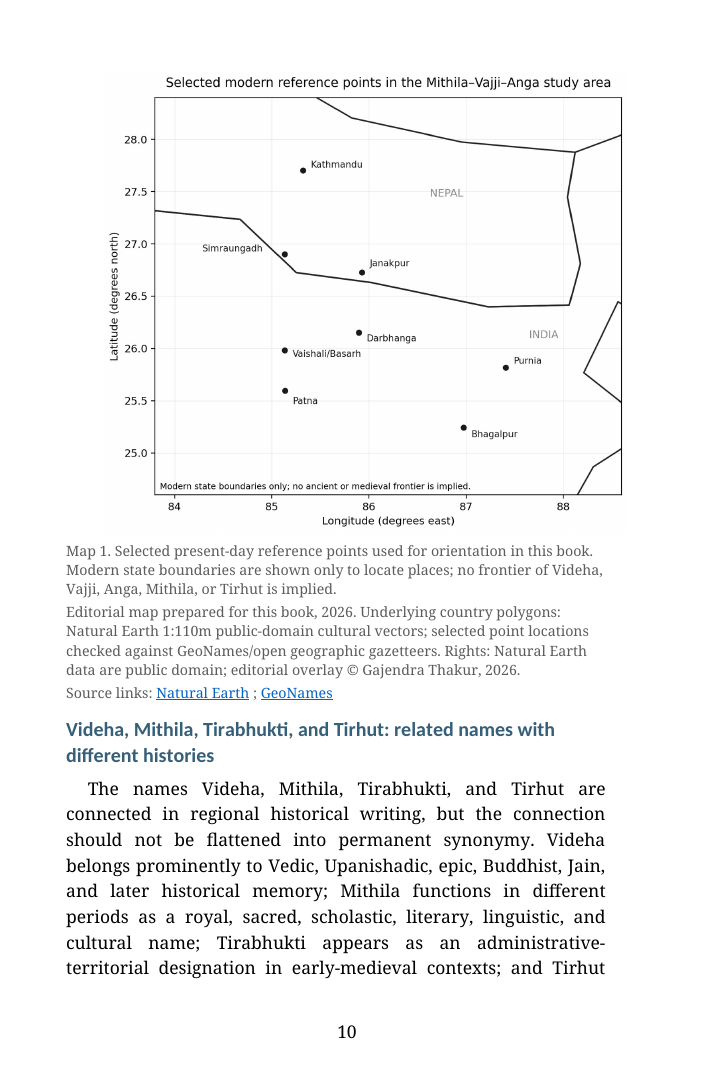
Mithila · Vajji · Anga
Chapter-specific source notes
- Primary chapter witness. Gajendra Thakur, Decoding the Panji of Mithila — Volume V, formal Chapter 21, PDF pp. 206-213; formal Chapter 21. The HTML transcription is generated from the commit-pinned source PDF and retains the chapter boundary recorded in this edition.
- Internal structure. The repository source-heading inventory records 12 subordinate headings for this chapter: “1. Where Chapter 21 begins”; “2. Mahamahopadhyay Batesh and the four learned descendants”; “3. Madhukar, Purushu, Mukund, Shridhar, and the first expansion beyond the learned core”; “4. Padpur-pu vasi and the Janardan-Vanshidhar-Murlidhar-Vidyanath branch”; “5. Hansa: Chaturbhuj, Ratnapati, Jayanu, Ramkrishna, and the Laxminarayan-Shivshankar line”; “6. The second Batesh-Pashupati-Shivapati-Yagyapati line”; “7. Pothia Sultanpur: Ganesh, Batahu, Dullah, Chetnath, Harik, and the many sons of Batahu”; “8. Palasi: Lal, Hiyalal, Kalitnath, Tilaknath, Pritamlal, Tulsidatt, and Aghorinath”; ….
- Digital editorial method. The page keeps the preserved source text distinct from generated navigational, concordance, visual, and provenance apparatus. The synthetic reconstruction is explanatory only and is not evidence for an individual lineage or a determination of social or marital status.