Decoding the Panji of Mithila · Volume V · Chapter 22
Satlakha-Satauli Gramaramabh: Chakrapani, Prithvidhar, Purushottam, Harikar, Shrikar, Ruchikar, Ratnakar, Maan,
Chapter 22 — Satlakha-Satauli
Gramaramabh: Chakrapani,
Prithvidhar, Purushottam, Harikar,
Shrikar, Ruchikar, Ratnakar, Maan,
Murari, Jaydev, Ratnapani, Kouskidatt,
Mushtauli-Phulwadi-Chakradhar, and
Satlakha-Dharmapur-Barahkona-Tirasi
1. Where Chapter 22 begins
Chapter 22 begins at the formal source heading “ अथ सतलखा
सतौलि ग्रामारम्भः.” The word ग्रामारम्भः marks a new village-
beginning, so the chapter must be read as a fresh register, not as
a continuation of the preceding Rajora-Mandar and Shripur-
Kodhila material. The source begins with Satlakha and Satauli,
then places Chakrapani at the root of the new field.
The opening chain is direct and compressed : सतलखा सॅ वीजी
चक्रपाणि ; then पृथ्वीधर , पुरुषोत्तम , कृ ष्ण , हरिकर , श्रीकर , and रूचिकर.
The line then divides through रूचिकर into मनीश्वर and प्रतीकर.
From मनीश्वर comes सीधू , from सीधू comes रत्नाकर , and from
रत्नाकर the register becomes a wide six - branch field : हरिकर ,
गुणाकर , भाष्कर , दिवाकर , चंद्राकर , and शंकर.
2. Chakrapani to Ratnakar: the core Satlakha
descent
The descent begins with चक्रपाणि and moves through पृथ्वीधर,
पुरुषोत्तम, कृ ष्ण, हरिकर, श्रीकर, and रूचिकर. The repetition of “ए सुत”
in the source expresses a father-son chain rather than a loose
association. The important turn comes when रूचिकर produces
two sons, मनीश्वर and प्रतीकर, and the text then follows मनीश्वर
through सीधू to रत्नाकर.
Decoding the Panji of Mithila - Volume V | 213
Ratnakar is linked with Budhwal and Madhukar. His sons are
named as हरिकर, गुणाकर, भाष्कर, दिवाकर, चंद्राकर, and शंकर. The
source immediately divides them into two marital or branch
fields: some are linked with Pali and Durgaditya, while three are
linked with Belauch and Dharaditya. This gives the chapter its
first major pattern: the Satlakha root spreads through named
sons, but each son becomes legible only through an attached
place and विवाह-दौ reference.
3. Divakar, Gaurishwar, Mane, Murari, and the
early daughter-bridge pattern
The Divakar branch records Pagu, Gaurishwar, Dham, and
Prithvidhar, with a Panichobh-Shrikar link. Gaurishwar then
produces माने , जागे , and काशिका, and the Gangoli-Harikar link
appears. Mane produces मुंशी and गोविन्द, connected with
Babhaniyam and Gonu. From here the line moves to Murari and
a cluster of daughter or branch names: विष्णुपति, भवानी, कागव, हरि,
and शिरी, linked to Sodarpur and Andu.
Bhavani then connects to वासुदेव, मोहन, and मनोहर through
Karmaha and Jivanath. Mohan produces नारो and देवकी,
connected with Pali-Gopi. Naro’s line produces बन्धु , परशुराम,
ऋषिके श, महेश, and गणेश, linked to Babhaniyam and Jhau. The
source then treats Bandhu’s son Jyotishi Kalar, Samauli-Pali,
Devn’s son Bhim, Garh-Mandar, Ruchikar, and the later children
Shankar, Kulmani, and Lokachhonka. This cluster shows the
Satlakha field becoming a marriage-mapped web rather than a
single male line.
4. Shankar, Babu-jan, Hemnath, Kirtnath, and the
Raghupati-Jaydev branch
Jyotishi Kalar’s son Shankar is followed by Babu-jan, linked
with Kaka-Sodarpur, Kamal’s son Dullah, Brahmoli-Panichobh,
and Kishani. Another Shankar branch names बाबूनाथ, हेमनाथ,
and कीर्तिनाथ, linked with Neyam-Kujouli, Chaudhary Lala’s son
Raghunandan, Sodarpur, and Medhakar. Hemnath and Kirtnath
Decoding the Panji of Mithila - Volume V | 214
then create further links through Malangiya-Kujouli, Bachharu,
Rudradev, Sarisav, Bodhan, Fatul, Chitradhar, Shrishtidhar,
Lakshmidhar, Thambdhar, Hati-Sodarpur, Rameshwar, Barju,
Simbarwad-Khaual, and Ghatak Dayaram.
The source then returns to Mane’s line through Murari.
Mane’s son Murari produces Raghupati, Raghupati produces
Jaydev, and Jaydev is linked with Pali-Madhav. Jaydev’s son
Krishnadev connects with Ekhara, Lakshmidhar’s son
Gangadhar, Sarisav, and Balbhadra. Krishnadev’s son Lala is
linked with Mahishi-Budhwal, Kamdev’s son Mahai, Khori-
Sodarpur, and Yadunath. Lala produces बालकृ ष्ण and जयकृ ष्ण,
opening the next long branch of the Satlakha register.
5. Balakrishna, Ratnapani, Kouskidatt, Teknath,
and the Kouski-Datt continuation
Balakrishna and Jayakrishna are connected with Dumra-
Budhwal, Dharu’s son Nandan, Dahibhat, and Chaudhary
Gatiram. Balakrishna produces रत्नपाणि and कौस्कीदत्त. Ratnapani
is linked through Mahishi-Budhwal to Gangadhar’s son Shulpani
and through Sarisav to Balakrishna; his daughter-line includes
Godavari, Rajura-Mandar, Jaydatt, Mangaloni-Pali, and other
marriage routes. Ratnapani also produces Teknath, who links
with Sakuri-Gangoli, Purandar’s son Paran, Naroun, Parshuram,
Manihaas-Didhoy, Thakur Bachan, Ghoghan, Neyam-Kujouli,
Dukhia, and the sons Sri Narayan and Udit Narayan.
Kouskidatt is another major continuation. His sons are इन्द्रपति
and मोहन लाल. Through Sundar - Sodarpur , Dharu , Bhanjan ,
Punaach - Baheradhi , and Paran , the line records Hemvati and
her daughter - marriage route through Hati - Sodarpur and
Rameshwar’s son Abhi , producing Kanhaiya , Premlal , Jhumak
Lal , and Shyamlal. Another Kouskidatt daughter - line reaches
Nandkumar / Hridaylal / Mohan through Ekma - Khandwala and
Anant Ram , then Majhiyam - Karmaha and Khedu. The named
daughters Rupalata and Dilvati show how the record keeps
female lines as bridges between households.
Decoding the Panji of Mithila - Volume V | 215
6. Indrapati, Lalitnath, Kantnath, Mohanlal,
Rahatmina, and Hridaynath
Indrapati’s branch is divided between daughter-lines and
sons. His sons Lalitnath and Kantnath are linked with Garh-
Belauch, Duwaridatt, Harpati, Samauli-Pali, Horil, Babuni, and
the child-line through Vadani. Kantnath is linked to Phooldaha-
Pali, Chandīdatt, Maujilal, while Mohanlal connects with Alay,
Khushan, Vishnudatt, Nanyapur-Bisfi, and Bhola.
The Rahatmina note begins from Mohanlal’s sons Rajnath and
Khadganath , linked with Jagati - Pavoli , Saburdatt , Karmaha ,
Mishra Gangadatt , and the Dulahi line. Nandkumar’s sons are
Chandranath and Premnarayan ; Chandranath produces
Modnath / Sarnath and Babuān. Through Sangram - Ekhara ,
Bhavnath , Jagati - Pavoli , Tena , Lal , Ratikant , Mahishi -
Budhwal , Chaudhary Kirti , Ojholi - Belauch , and Saburdatt ,
the line remains geographically broad. Hridaynath’s branch
then names Babu / Kalar , Narayandatt , Budhikar , Dwarikanath
, Vidyanath , Siddhinath , Badrinath , Amritnath , and Pratham
Lal , tying Satlakha to Haripur - Pali , Dhenupavoli , Parasanda ,
Sodarpur , Sakuri - Belauch , and Karmaha.
7. Mushtauli-Satlakha-Phulwadi-Chakradhar: a
back-page continuation
The source next gives the heading “ मुशतौलि सतलखा फू लवाडी
चक्रधर प्र0 (पिछे पृष्ठ पर).” This is an internal continuation, not a
wholly new chapter-field. It asks the reader to read backwards
or across pages, a common Panji technique when a branch has
overflowed from its earlier position.
This continuation starts with Bhavani’s son Manohar , whose
sons are Bhavesh and Keshav. Through Sodarpur , Srinath’s son
Krishnapati , Mandar , Govind , Pavoli , Mohan , Karmaha ,
Ramdev , and Bhavesh’s son Ramchandra , the line returns into
Nilambar , Ankhi , Vacha , Motikant , and Chakradhar / Mush.
The record then follows Vacha’s branches into Gopal ,
Decoding the Panji of Mithila - Volume V | 216
Nawatilal , Achamitalal , Maniklal , Kaniklal , Rupalal , Mohanlal
, and Sugan , with connections to Rauadh , Satlakha - Belauch ,
Kako - Belauch , Katma - Babhaniyam , Bhadaam - Jajiwal ,
Harakhouli - Mandar , Panichobh , Khangud - Sarisav , and
Rajanpura - Darhiara.
8. Satlakha-Dharmapur-Barahkona-Tirasi
The last internal block of this chapter is “ सतलखा धर्मपुर पु
देशेवरहकोना तिरासी छई देशे .” It begins with Bhavesh’s son
Santoshī, linked with Pavoli and Ramchandra. Santoshī
produces Vishnudatt, Vishnudatt produces Babu-nath, and
Babu-nath is linked with Sodarpur-Shubhankar. Babu-nath’s son
Thitharu links with Hasauli-Sodarpur and Dani’s son Bhola.
Thitharu’s son Ravinath links with Ojholi - Belauch ,
Sonphool’s son Ramdatt , Ullukujouli , Mansukh , and the Tota
children. Ravinath’s sons or descendants include Mayanath ,
Lakshminath , Bholanath , and Dayanath ; Dayanath produces
Shaleshwar and Umesh , linked with Tirasi , Virpur - Panichobh ,
and Madhusudan. The modern note names Gunjan Jha , LIC
Development Officer , and a branch through Pada - Behat -
Khandwala , Thakur Giranand , Swarupanand / Bechu. This
closes the Satlakha chapter before the source turns to Jagatpur -
Mandar and Chuna.
9. Branch summary
Opening root: Satlakha-Satauli begins with Chakrapani and a
direct descent through Prithvidhar, Purushottam, Krishna,
Harikar, Shrikar, Ruchikar, Manishwar, Sidhu, and
Ratnakar.
Ratnakar branch: Harikar, Gunakar, Bhaskar, Divakar,
Chandrakar, and Shankar, with branch links to Pali-
Durgaditya and Belauch-Dharaditya.
Divakar-Mane-Murari field: Gaurishwar, Mane, Jage,
Kashika, Munshi, Govind, Murari, Bhavani, Vasudev, Mohan,
Naro, and Bandhu.
Decoding the Panji of Mithila - Volume V | 217
Raghupati - Jaydev field : Murari → Raghupati → Jaydev →
Krishnadev → Lala → Balakrishna / Jayakrishna.
Ratnapani and Kouskidatt field: Ratnapani, Teknath,
Kouskidatt, Indrapati, Mohanlal, Nandkumar, Hridaynath,
Dwarikanath, Vidyanath, Siddhinath.
Internal back-reference: Mushtauli-Satlakha-Phulwadi-
Chakradhar continues Bhavani-Manohar-Bhavesh-Keshav
and then Vacha-Gopal-Chakradhar branches.
Final internal block: Satlakha-Dharmapur-Barahkona-Tirasi
runs through Santoshī, Vishnudatt, Babu-nath, Thitharu,
Ravinath, Dayanath, Shaleshwar, Umesh, and the modern
Gunjan Jha note.
10. Conclusion: Satlakha as a compact but highly
connected register
Chapter 22 looks compact in the source, but it is structurally
dense. It begins with a clean ancestral chain and then rapidly
divides into son-branches, daughter-marriage lines, professional
or title-marked identities, and place-ties across Pali, Belauch,
Gangoli, Sodarpur, Karmaha, Kujouli, Budhwal, Rahatmina,
Mushtauli, Phulwadi, Barahkona, and Tirasi.
The most important feature of this chapter is the movement
from a formal “gramārambha” to several internal sub-registers.
The Panji does not separate them as modern chapters would; it
binds them by descent, marriage, and place. The next chapter
should begin at “जगतपुर पु माण्डर-चुना चु पुर पु बेलबाडी,” where the
source leaves the Satlakha-Satauli cluster and opens the
Jagatpur-Mandar-Chuna-Belbadi field.
Decoding the Panji of Mithila - Volume V | 218Source structure and verification apparatus
Editorial source apparatus. This apparatus is descriptive, not interpretive. It records the source-controlled structure used to verify that this page corresponds to formal Chapter 22 of Decoding the Panji of Mithila — Volume V. The chapter text above is preserved from PDF pp. 214-219; formal Chapter 22 in the commit-pinned authoritative source. It is not merged with a neighboring chapter, appendix, annexure, or independent front/back-matter unit. The internal headings below come from the repository’s source-heading inventory and are retained as navigational and audit evidence; showing them here does not turn those headings into separate publications or add claims that are absent from the source.
Internal source headings
- 1. Where Chapter 22 begins
- 2. Chakrapani to Ratnakar: the core Satlakha descent
- 3. Divakar, Gaurishwar, Mane, Murari, and the early daughter-bridge pattern
- 4. Shankar, Babu-jan, Hemnath, Kirtnath, and the Raghupati-Jaydev branch
- 5. Balakrishna, Ratnapani, Kouskidatt, Teknath, and the Kouski-Datt continuation
- 6. Indrapati, Lalitnath, Kantnath, Mohanlal, Rahatmina, and Hridaynath
- 7. Mushtauli-Satlakha-Phulwadi-Chakradhar: a back-page continuation
- 8. Satlakha-Dharmapur-Barahkona-Tirasi
- 9. Branch summary
- 10. Conclusion: Satlakha as a compact but highly connected register
Source-text concordance
Satlakha-Satauli · Gramaramabh · Chakrapani · Prithvidhar · Purushottam · Harikar · Shrikar · Ruchikar · Ratnakar · Maan · Murari · Jaydev · Ratnapani · Kouskidatt · Mushtauli-Phulwadi-Chakradhar · Satlakha-Dharmapur-Barahkona-Tirasi · begins · formal · heading · सतलख · word · marks · village · beginning · must · read · fresh · register · continuation · preceding · Rajora-Mandar · Shripur · Kodhila · material · Satlakha · Satauli · places · root · field · opening · chain · direct · compressed · line · divides · comes · becomes · wide · branch · core · descent · moves · repetition · expresses · father-son · rather · loose · association · important · turn · produces · sons · text · follows · Decoding · linked · Budhwal · Madhukar · named · immediately · marital · fields · Pali · Durgaditya · three · Belauch · Dharaditya · gives · first · major
Boundary verification. In the formal sequence this chapter follows Volume V Chapter 21, “Rajora Mandar Nasira- Deshe Phulbadiya-Gondwara: Mahamahopadhyay Batesh, Pashupati, Raghupati, Ratipati, Yagyapati, Pothia” and precedes Volume V Chapter 23, “Jagatpur Pu Mandar- Chuna-Chu Pur Pu Belbadi: Nardev, Arjun, Gopal, Harikar, Jagannath, Vishwambhar, Rajora-Mandar”. The chapter extractor begins at the verified formal Chapter 22 marker and stops at the next verified formal chapter marker; for a final chapter it stops before recognized book-level back matter. The concordance above is generated only from distinct terms already present in this chapter’s preserved source text. It is provided for discovery, comparison, and audit, not as an automated judgment about persons, lineages, status, kinship, marriage eligibility, or historical truth.
Illustrated research apparatus
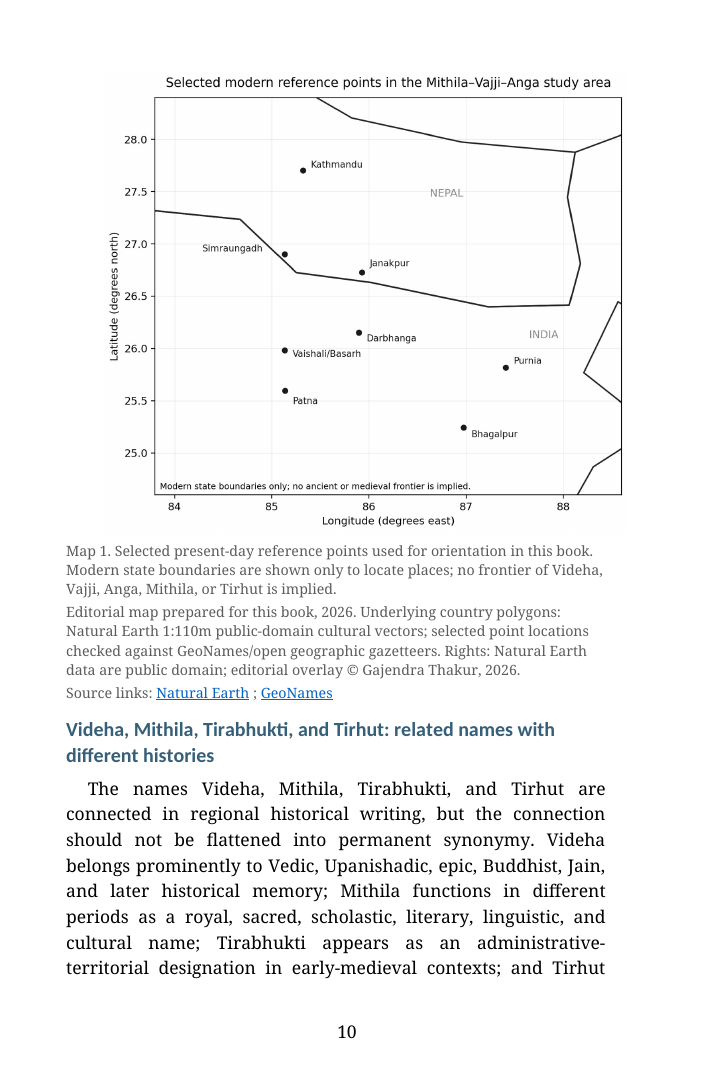
Mithila · Vajji · Anga
Chapter-specific source notes
- Primary chapter witness. Gajendra Thakur, Decoding the Panji of Mithila — Volume V, formal Chapter 22, PDF pp. 214-219; formal Chapter 22. The HTML transcription is generated from the commit-pinned source PDF and retains the chapter boundary recorded in this edition.
- Internal structure. The repository source-heading inventory records 10 subordinate headings for this chapter: “1. Where Chapter 22 begins”; “2. Chakrapani to Ratnakar: the core Satlakha descent”; “3. Divakar, Gaurishwar, Mane, Murari, and the early daughter-bridge pattern”; “4. Shankar, Babu-jan, Hemnath, Kirtnath, and the Raghupati-Jaydev branch”; “5. Balakrishna, Ratnapani, Kouskidatt, Teknath, and the Kouski-Datt continuation”; “6. Indrapati, Lalitnath, Kantnath, Mohanlal, Rahatmina, and Hridaynath”; “7. Mushtauli-Satlakha-Phulwadi-Chakradhar: a back-page continuation”; “8. Satlakha-Dharmapur-Barahkona-Tirasi”; ….
- Digital editorial method. The page keeps the preserved source text distinct from generated navigational, concordance, visual, and provenance apparatus. The synthetic reconstruction is explanatory only and is not evidence for an individual lineage or a determination of social or marital status.