Decoding the Panji of Mithila · Volume V · Chapter 23
Jagatpur Pu Mandar- Chuna-Chu Pur Pu Belbadi: Nardev, Arjun, Gopal, Harikar, Jagannath, Vishwambhar, Rajora-Mandar
Chapter 23 — Jagatpur Pu Mandar-
Chuna-Chu Pur Pu Belbadi: Nardev,
Arjun, Gopal, Harikar, Jagannath,
Vishwambhar, Rajora-Mandar
Sheshansh, Khawaspur, and Bakhri-
Harshdatt Jha
1. Where Chapter 23 begins
Chapter 23 begins at the heading “ जगतपुर पु माण्डर-चुना चु पुर पु
बेलबाडी.” This is the point where the source leaves the Satlakha-
Satauli cluster and opens a new field around Jagatpur, Mandar,
Chuna, Chu-pur, and Belbadi. The register begins with नरदेव,
described as वीजी, and immediately divides into अर्जून and गोपाल.
The early marriage marker connects this opening with नान्यपुर
आलय and शूलपाणि.
The placement of Jagatpur and Mandar in the heading is
significant. The source does not give a modern prose
introduction; it announces the territorial and branch-field first,
then builds the genealogy. The chapter therefore has to be read
as a village and marriage network, not only as a list of male
descendants.
2. Nardev, Arjun, Gopal, Harikar, and the
Mitugune line
The first movement is from नरदेव to अर्जून and गोपाल. Gopal
produces हरिहर and नरसिंह, with the Bharmagadh-Khandwala
and Parameshwar connection. The text then follows मिश्र हरिहर
into शिश, हरिकर, and मितूगु णेका, and from there to Alay and
Gunedau. This establishes the branch as a mixed line of descent
and alliance, where each son is tied to place and marriage.
The Mitugune branch is especially important because it
creates a daughter-line through रतिकर, रामकर, and ज्ञानकर,
Decoding the Panji of Mithila - Volume V | 219
connected with Budhwal and Shubhankar’s son Kanha. Another
line moves through Deyam, Punahari, and Narasimh. A further
daughter-line through नरपति, वसाओन, शोरे , होरे , and लवे connects
to Takwal, Jor, and Kanha. This is a typical Panji technique:
daughters are not marginal; they are the bridges through which
remote households become part of the same chart.
3. Bhagirath, Bhavdev, Jagannath, Manohar, and
Vishwambhar
From the Lave branch the source moves to दशरथ, भगीरथ, राघव,
and Manwal, with a Panisara-Shivai connection. मिश्र भगीरथ
then gives सुरथ, सोमदेव, and भवदेव, linked again to Panisara and
Shivdev. Bhavdev’s line leads to अनन्त and जगन्नाथ, and from
Jagannath the source produces मनोहर and रूचिकर. The Bachaout-
Karmaha-Ramkar-Shiv connection and the Neyam-Alay-
Chaudhary Haldhar connection show that the Jagatpur-Mandar
branch is already moving outward from its heading-place.
Mishra Manohar produces रामकृ ष्ण and विश्वम्भर. Ramakrishna
and Vishwambhar become central in this chapter. Ramakrishna
is linked with Padmapur-Panichobh and Bhikhu’s son Babu,
while Vishwambhar produces Raghunath and Parashuram. The
Panji makes these lines visible through spouses, maternal
descent, and settlement markers: Garh-Mandar, Madhav,
Hasauli-Sodarpur, Belasam-Budhwal, Parshanda, and Kako-
Belauch all appear in this section.
4. Raghunath, Parashuram, Bachnu, Nandlal, and
the Radhanath-Hemnath line
The Vishwambhar branch divides into Raghunath and
Parashuram. Raghunath is connected through Mahishi-Budhwal
and Chaudhary Bandi to Narayandatt and Parshanda-Jagannath.
Parashuram produces बचनू and नन्दलाल; the Nikhuti, Ray Gopal,
Ray Ganga, Jajiwal, and Mohani connections show a broad
marital field. Savitri’s children are also preserved, and the
Decoding the Panji of Mithila - Volume V | 220
source records Sohawni, Kamala, and Kanaka as daughter-
bridges.
From Bachnu the text moves to Umanath, Hemnath,
Ramanath, and Rajmaya, then through Mishra Shivdev,
Bhairavi, Badgam-Darhiara, and Bandhu. Hemnath’s line gives
Radhanath, Ratinath, and Thakuri, tied to Rakhwari-Hariam and
Batoran. Radhanath then produces Wajitlal, Triloknath, and
Munilal. The wives and daughter-lines through Raiyam-
Sodarpur, Karmaha, Sarisav-Sodarpur, Patauna-Khaual, and
Badhiyam-Pavoli are part of the genealogical argument, because
they show how the branch stayed socially active across several
settlement networks.
5. Rajora-Mandar Sheshansh: Bochhai,
Jhumkalal, Thakurdatt, Dullah, and Bhainath
After the main Jagatpur - Mandar block , the source gives
“रजौरा माण्डर शेषांश , ” literally a remainder or residual portion of
the Rajora - Mandar material. This is not a new village -
beginning but an attached continuation. It begins with बोचाई
and झूमकलाल , then moves to Mahishi - Budhwal , Chaudhary
Khedan , and Chaudhary Anathi , followed by Kodhila and
Thakur Datt / Chhoti / Bhadramani.
The remainder continues with Digambar, Sadanand,
Vedamani, Yogamani, Raghumani, and several Sarisav-Sodarpur
and Simbarwad-Khaual connections. Dullah’s branch then gives
Fakir, Baburaiya, Bhainath, Ranklal, and related daughter-lines.
The Haradi-Sakaradhi, Dadhari-Panichobh, Madhukarpatti-
Darhiara, Belauch, Ramnagar, Malangiya-Kujouli, Hati-
Sodarpur, Alay, and Jhauwa-Panichobh links show that the
Rajora-Mandar remainder is a repair-and-completion section
added to preserve branches that might otherwise be lost.
Decoding the Panji of Mithila - Volume V | 221
6. Khawaspur back-reference and the Domana
line
The next internal note reads “खवासपुर पु पीछे देखें धनी सुतसु
डोमनः.” The instruction “पीछे देखें ” tells the reader that the line
must be read by looking back to an earlier page or earlier
branch. The branch is attached through Dhani’s son Domana.
Domana is linked with Jarhatiya-Pali, Mishra Hingu’s son
Haridas, Belauch-Mandar, and Mishra Lakshman.
Domana’s daughter - line includes Gana and Babanudau , with
Sodarpur - Raiyam and Nandan. Gana produces Gangadatt and
Chudamani , linked with Khori - Sodarpur and Mahinath.
Gangadatt produces Manoranjan and Chandīdatt ; Manoranjan
produces Teknath / Kalar , then Eklaal and Rajnath. The section
closes with Mathuranath , Gangora - Budhwal , Lala , and Katayi
- Bhavanidatt. This is a compact back - reference that restores a
Khawaspur - related thread within the Jagatpur - Mandar
chapter.
7. Bakhri Harshdatt Jha
The last internal block is “बखरी हर्षदत्त झा.” It starts from
Chudamani’s son Harshdatt , who is linked with Pachahi -
Jajiwal and Ratti’s grandson Manbodh’s son Vishnudatt / Jhontu.
Harshdatt produces Parashmani and Bhaiya , and the source
also records Sudahi , Shukla Jagan , Achamit Lal , Ajbalal , Uchati
, and Sanath.
The Bakhri section is brief but important because it closes the
chapter with a named individual, Harshdatt Jha, and then maps
his sons into Karmaha, Kanha, Analpur-Karmaha, Poshan, Kirti,
Pandoli, and Khadgi. It is a small branch-completion, but it
follows the same logic as the rest of the chapter: descent is only
fully legible when the place and विवाह-दौ links are read together.
Decoding the Panji of Mithila - Volume V | 222
8. Branch summary
Opening field: Jagatpur, Mandar, Chuna, Chu-pur, and
Belbadi begin with Nardev and his sons Arjun and Gopal.
Gopal line: Harirar, Narasimh, Harikar, Mitugune, Ratikar,
Ramkar, Gyankar, Narapati, and the Takwal-Jor-Kanha links.
Bhavdev-Jagannath line: Bhagirath, Somdev, Bhavdev,
Anant, Jagannath, Manohar, Ruchikar, Ramakrishna, and
Vishwambhar.
Vishwambhar line: Raghunath and Parashuram;
Parashuram produces Bachnu and Nandlal, with Hemnath,
Radhanath, Wajitlal, Triloknath, and Munilal continuing the
line.
Rajora - Mandar remainder : Bochhai , Jhumkalal ,
Thakurdatt , Bhadramani , Digambar , Dullah , Fakir ,
Baburaiya , Bhainath , Ranklal , and Gopinath / Bangat.
Khawaspur back-reference: Dhani’s son Domana, Gana,
Gangadatt, Manoranjan, Chandīdatt, Teknath, Eklaal,
Rajnath, and Mathuranath.
Bakhri-Harshdatt Jha: Chudamani, Harshdatt, Parashmani,
Bhaiya, Achamit Lal, Ajbalal, Jinilal, Nunulal, and the
Karmaha-Pandoli links.
9. Conclusion: a chapter of remainders, repairs,
and linked settlements
Chapter 23 is shorter than some earlier registers, but it
performs an important structural function. It gathers the
Jagatpur-Mandar-Chuna-Belbadi branch and then adds residual
or back-referenced materials through Rajora-Mandar
Sheshansh, Khawaspur, and Bakhri Harshdatt Jha. These small
continuations are essential in Panji reading because a family
line may be completed several headings after it first appears.
The chapter also shows why Volume V must decode descent,
place, marriage, title, and branch-continuity together. Without
the place-links, the names would be an opaque list. With the
place-links, the record becomes a map of how Jagatpur, Mandar,
Belbadi, Rajora, Khawaspur, Bakhri, Sodarpur, Karmaha,
Decoding the Panji of Mithila - Volume V | 223
Budhwal, Kujouli, Panichobh, and Darhiara remained
connected. The next chapter should begin at “अथ सोदरपुर पु मानी
ग्रामारम्भः,” where the source opens a fresh village-beginning.
Decoding the Panji of Mithila - Volume V | 224Source structure and verification apparatus
Editorial source apparatus. This apparatus is descriptive, not interpretive. It records the source-controlled structure used to verify that this page corresponds to formal Chapter 23 of Decoding the Panji of Mithila — Volume V. The chapter text above is preserved from PDF pp. 220-225; formal Chapter 23 in the commit-pinned authoritative source. It is not merged with a neighboring chapter, appendix, annexure, or independent front/back-matter unit. The internal headings below come from the repository’s source-heading inventory and are retained as navigational and audit evidence; showing them here does not turn those headings into separate publications or add claims that are absent from the source.
Internal source headings
- 1. Where Chapter 23 begins
- 2. Nardev, Arjun, Gopal, Harikar, and the Mitugune line
- 3. Bhagirath, Bhavdev, Jagannath, Manohar, and Vishwambhar
- 4. Raghunath, Parashuram, Bachnu, Nandlal, and the Radhanath-Hemnath line
- 5. Rajora-Mandar Sheshansh: Bochhai, Jhumkalal, Thakurdatt, Dullah, and Bhainath
- 6. Khawaspur back-reference and the Domana line
- 7. Bakhri Harshdatt Jha
- 8. Branch summary
- 9. Conclusion: a chapter of remainders, repairs, and linked settlements
Source-text concordance
Jagatpur · Mandar · Chuna-Chu · Belbadi · Nardev · Arjun · Gopal · Harikar · Jagannath · Vishwambhar · Rajora-Mandar · Sheshansh · Khawaspur · Bakhri · Harshdatt · begins · heading · जगतप · डर-च · point · leaves · Satlakha · Satauli · cluster · opens · field · around · Chuna · Chu-pur · register · described · immediately · divides · early · marriage · marker · connects · opening · placement · significant · give · modern · prose · introduction · announces · territorial · branch-field · first · builds · genealogy · therefore · read · village · network · list · male · descendants · Mitugune · line · movement · produces · Bharmagadh-Khandwala · Parameshwar · connection · text · follows · Alay · Gunedau · establishes · branch · mixed · descent · alliance · tied · place · especially · important · creates · daughter-line · Decoding
Boundary verification. In the formal sequence this chapter follows Volume V Chapter 22, “Satlakha-Satauli Gramaramabh: Chakrapani, Prithvidhar, Purushottam, Harikar, Shrikar, Ruchikar, Ratnakar, Maan,” and precedes Volume V Chapter 24, “Sodarpur Pu Mani Gramaramabh: Vishwanath, Gopinath, Batesh, Pashupati, Rameshwar, Ratnakar, Gondi, Krishn, Yagyapati,”. The chapter extractor begins at the verified formal Chapter 23 marker and stops at the next verified formal chapter marker; for a final chapter it stops before recognized book-level back matter. The concordance above is generated only from distinct terms already present in this chapter’s preserved source text. It is provided for discovery, comparison, and audit, not as an automated judgment about persons, lineages, status, kinship, marriage eligibility, or historical truth.
Illustrated research apparatus
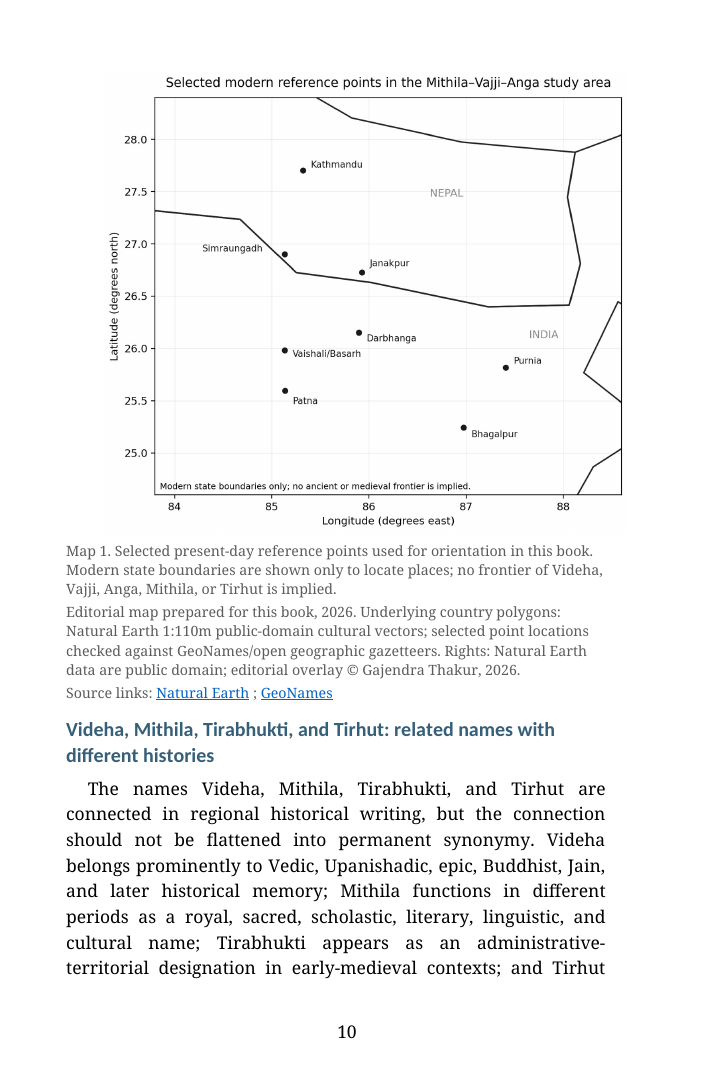
Mithila · Vajji · Anga
Chapter-specific source notes
- Primary chapter witness. Gajendra Thakur, Decoding the Panji of Mithila — Volume V, formal Chapter 23, PDF pp. 220-225; formal Chapter 23. The HTML transcription is generated from the commit-pinned source PDF and retains the chapter boundary recorded in this edition.
- Internal structure. The repository source-heading inventory records 9 subordinate headings for this chapter: “1. Where Chapter 23 begins”; “2. Nardev, Arjun, Gopal, Harikar, and the Mitugune line”; “3. Bhagirath, Bhavdev, Jagannath, Manohar, and Vishwambhar”; “4. Raghunath, Parashuram, Bachnu, Nandlal, and the Radhanath-Hemnath line”; “5. Rajora-Mandar Sheshansh: Bochhai, Jhumkalal, Thakurdatt, Dullah, and Bhainath”; “6. Khawaspur back-reference and the Domana line”; “7. Bakhri Harshdatt Jha”; “8. Branch summary”; ….
- Digital editorial method. The page keeps the preserved source text distinct from generated navigational, concordance, visual, and provenance apparatus. The synthetic reconstruction is explanatory only and is not evidence for an individual lineage or a determination of social or marital status.