Decoding the Panji of Mithila · Volume V · Chapter 30
Tripurau Pu Li Naraun Gramaramabh: Dakra-Dihiya, Vishweshwar, Gaurishwar, Mahamahopadhyay Harishwar, Saraswati Ram,
Chapter 30
Tripurau Pu Li Naraun Gramaramabh: Dakra-Dihiya, Vishweshwar,
Gaurishwar, Mahamahopadhyay Harishwar, Saraswati Ram,
Dharadhar, Gangadhar, Raghudev, Ruchidev, Lakshmipati, Rudrapati,
and the Saraswati Family Migration Note
1. The Tripurau-Naraun opening and the Dakra-Dihiya
setting
The chapter opens with “अथ त्रिपुरौ पु ली नरउन ग्रामारम्भः,” marking a
new village register after the Sulhani-Naraun close. The source immediately
locates the family in a Haveli-deshe setting near “ डकरा डिहिया,” while also
noting the later Tirhut country association with Dahora and Raje. This
makes the chapter both genealogical and locational: it begins with descent,
but it ends by explaining the family’s movement from one learned seat to
another.
The opening descent proceeds from Dalu’s son Madhukar to
Vishweshwar, whose sons are Gaurishwar and Graheshwar. Gaurishwar is
tied to Veerpur-Panichobh through Dharai, while the Jhont-Pali-Darhiara
and Hardatt link is also recorded. The line therefore connects Naraun,
Panichobh, Darhiara, and Pali before the learned Saraswati branch is
introduced.
2. Mahamahopadhyay Harishwar and the rise of the
Saraswati branch
Gaurishwar’s son is Mahamahopadhyay Harishwar, connected with
Baheradhi, Narhari, Virkhu, Belauch, and Rudraditya. The source then gives
Harishwar’s sons as Avilamb, Saraswati Batu, Purushottam, and Gunakar.
This is the point at which the chapter changes from a plain line of descent
into a scholarly register, repeatedly using titles such as Mahamahopadhyay,
Mahopadhyay, and Saraswati.
Avilamb Saraswati Batu gives Saraswati Ram, connected with Karmaha,
Mahidhar, Kashi, and the Lakhima issue. Saraswati Ram gives
Mahopadhyay Dharadhar, linked with Chandot, Pali, None, and Harikesh.
Through this chain the text encodes both intellectual rank and the inter-
village marriage network that carried the family’s standing outward.
Decoding the Panji of Mithila - Volume V | 253
3. Gangadhar, Raghudev, Ruchidev, Lakshmipati, Rudrapati,
and Gunanand
The next layer lists the sons or branches of Mahamahopadhyay Saraswati
Ram: Mahopadhyay Gangadhar, Mahopadhyay Raghudev, and
Mahopadhyay Ruchidev, with links to Budhawal, Harkhu, and the Rukmini
issue. Another group connects Mohan, Mahopadhyay Bachhai,
Mahopadhyay Pranpati, Lakshman, and Mahopadhyay Narayan with
Pandoli-Darhiara, Gonu, and Mangu.
The chapter then follows Krishna Dev and Vaidyanath through Darhiara,
Ramnath, Raghuni, and the Bahuda issue. Mahamahopadhyay Gangadhar
gives Mahesh and Gauripati; Mahopadhyay Mahesh gives Lakshmipati. The
Saraswati line then continues through Lakshmipati to Saraswati Rambhadra
and Saraswati Rudrapati, and from Rudrapati to Saraswati Gunanand,
Bholanath, Shridhar, and Abhayanath. The source also records a learned
marriage link with Vyakaran Ramchandra.
4. The displacement note: Dakra-Dihiya to Raje and Dahora
The chapter’s closing “द्रष्टव्य” note is unusually important because it is
not merely a name-list. It states that in the first decade of the twentieth
century the Saraswati family shifted from Dihiya, also called Dakra, in
eastern Mithila, and settled in the present Madhubani district at Raje and
Dahora.
The note further says that before this displacement the family had lived
for roughly three hundred years in the Dihiya area and had earned fame
throughout eastern Mithila through learning and intellectual distinction. It
also preserves a physical memory of the family’s old settlement: the
Saraswati Pokhar, dug by them, still remained known by that name. Thus
Chapter 30 preserves genealogy, migration, and landscape memory together.
5. Main branches decoded in this chapter
Opening descent : Dalu , Madhukar , Vishweshwar , Gaurishwar ,
Graheshwar , Dharai , Hardatt , and the early Dakra - Dihiya / Haveli
context.
Harishwar line: Mahamahopadhyay Harishwar, Avilamb, Saraswati
Batu, Purushottam, Gunakar, Saraswati Ram, and Mahopadhyay
Dharadhar.
Scholarly branch: Mahopadhyay Gangadhar, Mahopadhyay Raghudev,
Mahopadhyay Ruchidev, Mahopadhyay Bachhai, Mahopadhyay
Pranpati, Lakshman, Mahopadhyay Narayan, Krishna Dev, Vaidyanath,
and Lakshmipati.
Decoding the Panji of Mithila - Volume V | 254
Saraswati continuation: Saraswati Rambhadra, Saraswati Rudrapati,
Saraswati Gunanand, Bholanath, Shridhar, Abhayanath, and the
Vyakaran Ramchandra link.
Migration memory : the twentieth - century relocation from Dihiya /
Dakra to Raje and Dahora , and the remembered Saraswati Pokhar at the
old settlement.
6. Chapter close and next threshold
The chapter closes with the explanatory note about the Saraswati family’s
settlement history and the still-remembered Saraswati Pokhar. The next
formal heading in the source is “ अथ नगवाड घोसोत ग्रामारम्भः,” which
should begin Chapter 31.
Decoding the Panji of Mithila - Volume V | 255Source structure and verification apparatus
Editorial source apparatus. This apparatus is descriptive, not interpretive. It records the source-controlled structure used to verify that this page corresponds to formal Chapter 30 of Decoding the Panji of Mithila — Volume V. The chapter text above is preserved from PDF pp. 254-256; formal Chapter 30 in the commit-pinned authoritative source. It is not merged with a neighboring chapter, appendix, annexure, or independent front/back-matter unit. The internal headings below come from the repository’s source-heading inventory and are retained as navigational and audit evidence; showing them here does not turn those headings into separate publications or add claims that are absent from the source.
Internal source headings
- 2. Mahamahopadhyay Harishwar and the rise of the Saraswati branch
- 3. Gangadhar, Raghudev, Ruchidev, Lakshmipati, Rudrapati, and Gunanand
- 4. The displacement note: Dakra-Dihiya to Raje and Dahora
- 5. Main branches decoded in this chapter
- 6. Chapter close and next threshold
Source-text concordance
Tripurau · Naraun · Gramaramabh · Dakra-Dihiya · Vishweshwar · Gaurishwar · Mahamahopadhyay · Harishwar · Saraswati · Dharadhar · Gangadhar · Raghudev · Ruchidev · Lakshmipati · Rudrapati · Family · Migration · Note · Tripurau-Naraun · opening · setting · opens · नरउन · marking · village · register · Sulhani-Naraun · close · immediately · locates · Haveli-deshe · near · noting · later · Tirhut · country · association · Dahora · Raje · makes · genealogical · locational · begins · descent · ends · explaining · family’s · movement · learned · seat · another · proceeds · Dalu’s · Madhukar · whose · sons · Graheshwar · tied · Veerpur-Panichobh · Dharai · Jhont-Pali-Darhiara · Hardatt · link · recorded · line · therefore · connects · Panichobh · Darhiara · Pali · branch · introduced · rise · Gaurishwar’s · connected · Baheradhi · Narhari · Virkhu · Belauch · Rudraditya
Boundary verification. In the formal sequence this chapter follows Volume V Chapter 29, “Sulhani Naraun Gramaramabh: Mahidhar, Udayakar, Ratnakar,” and precedes Volume V Chapter 31, “Nagwad Ghosot Gramaramabh: Vasudev, Divakar, Buddhikar,”. The chapter extractor begins at the verified formal Chapter 30 marker and stops at the next verified formal chapter marker; for a final chapter it stops before recognized book-level back matter. The concordance above is generated only from distinct terms already present in this chapter’s preserved source text. It is provided for discovery, comparison, and audit, not as an automated judgment about persons, lineages, status, kinship, marriage eligibility, or historical truth.
Illustrated research apparatus
Mithila · Vajji · Anga
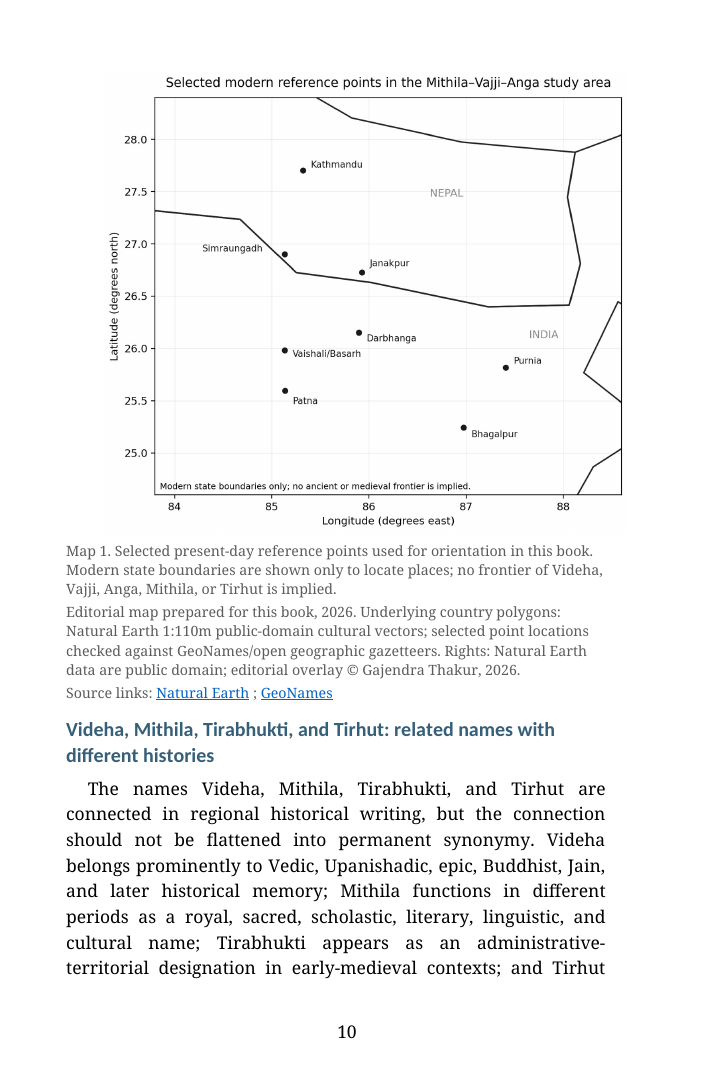
Chapter-specific source notes
- Primary chapter witness. Gajendra Thakur, Decoding the Panji of Mithila — Volume V, formal Chapter 30, PDF pp. 254-256; formal Chapter 30. The HTML transcription is generated from the commit-pinned source PDF and retains the chapter boundary recorded in this edition.
- Internal structure. The repository source-heading inventory records 5 subordinate headings for this chapter: “2. Mahamahopadhyay Harishwar and the rise of the Saraswati branch”; “3. Gangadhar, Raghudev, Ruchidev, Lakshmipati, Rudrapati, and Gunanand”; “4. The displacement note: Dakra-Dihiya to Raje and Dahora”; “5. Main branches decoded in this chapter”; “6. Chapter close and next threshold”.
- Digital editorial method. The page keeps the preserved source text distinct from generated navigational, concordance, visual, and provenance apparatus. The synthetic reconstruction is explanatory only and is not evidence for an individual lineage or a determination of social or marital status.