Decoding the Panji of Mithila · Volume V · Chapter 31
Nagwad Ghosot Gramaramabh: Vasudev, Divakar, Buddhikar,
Chapter 31
Nagwad Ghosot Gramaramabh: Vasudev, Divakar, Buddhikar,
Govind, Lakshminath, Vidyapati, Damodar, Ramnath, Agamacharya
Devanath, Gopinath, Madhusudan, Janardan, Haridas, Shubhankar,
Fakir, Ishanchandra Thakur, Lakshmidhar-Chitradhar, Dayashankar,
Harishchandra, Bank Bihari, and Prembihari
1. The Nagwad-Ghosot opening: Vasudev and the learned
sons
The chapter begins with “अथ नगवाड घोसोत ग्रामारम्भः , ” after the
Tripurau - Naraun / Saraswati - family note. The register first identifies
Nagwad - Ghosot with an older Gadwa - country and Jayanagar - Bengal
memory , then places the line under Biji Vasudev. Vasudev’s sons are
recorded as Divakar , Vibhakar , Prajnakar , Harikar , Trilochan , and None.
The opening therefore works on two levels : it fixes a village start , and it
also preserves a broad eastern / Bengal - linked horizon.
From Divakar the source follows Khedu, then Pritikar and Ruchikar,
connected with Pandua and Shyamakant. Pritikar’s son is Mahopadhyay
Buddhikar, who is linked with Bisphi and Vishweshwar. Buddhikar’s sons
Rudra and Ravikar then connect the line with Darhiara and Gunishwar.
These early names show the chapter’s dominant pattern: learned rank is
joined to repeated marital passages across Darhiara, Sarisav, Mandar,
Belauch, Budhwal, and Khaual.
2. Mahamahopadhyay Govind and the large title-bearing
cluster
The central prestige of the opening cluster appears through Thakur
Keshav and the highly titled line of Mahamahopadhyay Govind. The source
lists Lakshminath, called Thakuru; Mahamahopadhyay Vidyapati;
Mahamahopadhyay Damodar; Mahamahopadhyay Ramnath;
Mahamahopadhyay Agamacharya Devanath; Tarkapanchanan;
Mahamahopadhyay Gopinath; the Kantakoddharak Mahamahopadhyay
Madhusudan; and Mahamahopadhyay Janardan. This passage is less a
simple pedigree than a learned roll-call, encoding the intellectual identity of
the Nagwad-Ghosot family.
Lakshminath / Thakuru is then connected to Kamdev , Godhai , Shivdev ,
and Pashupati through Darhiara , Bhaktu , Lakhu , Belauch , and Ritu.
Godhai gives Narayan and Krishnadas ; Krishnadas gives Haridas and
Kalidas. Haridas becomes a major node , leading to Kamalpani and also to
Decoding the Panji of Mithila - Volume V | 256
Padmapani , Shubhankar , Raghunath , and further daughters or marriage
links with Mandar , Lohna - Sakaradhi , and other places.
3. Haridas, Shubhankar, Fakir, and the Ishanchandra Thakur
branch
Thakur Haridas connects through Kamalpani to Khaual and Aniruddha ,
and through other branches to Shubhankar , Raghunath , and the
Sadupadhyay line of Mahesh , Ganesh , and Dhanesh. Shubhankar’s son
Raghav , called Nanu , is connected with Murajpur - Khaual and Jayram ;
the daughters Dhairyavati , Dhiravati , and Gunavati are married into
Darhiara , Madhyanagar - Lohna - Sakaradhi , and Devgram - Sarisav.
Raghav’s son Thakur Fakir then keeps the Soḍarpur / Siddhinath link active.
The source then turns to the Bengal-country Jayanagar line of
Ishanchandra Thakur. Through Fakir’s descendants and Gokulnath,
Kantinath, Padmanath, and the Rukmini and Sarvani branches, the register
moves between Mandar, Supatani-Gangoli, Sarouni, Rakhwari-Hariam, and
Musaili-Mandar. This is a typical Panji expansion: the core paternal line is
preserved, but the daughters and their marriage places are equally important
for reconstructing the family map.
4. Baneshwar, Virnarayan, Lakshmidhar-Chitradhar, and
Dayashankar
The Sadupadhyay - Ganesh branch continues through Baneshwar ,
Virnarayan , Ramakant , Madhukar , and Krishnamani. Baneshwar’s son
Prandhar is linked with Simarwad - Sodarpur , Mahadev , Vishwanath ,
Sarouni , and Ganapati ; from Prandhar come Amritnath and Hridaynath.
The daughter lines include Dayavati / Puntana , Bhutka , Purnima , Ratauli -
Darhiara , Jafarpur , and Badhiyam - Pawali.
Virnarayan’s son Lakshmidhar , also called Chitradhar , is another
important pivot. His marriages and descendants connect Badgam - Darhiara ,
Tilay , Rai Jahad Singh , Kanhouli - Darhiara , Raiyam - Sodarpur , Ratauli -
Darhiara , and the Modnath - Dular line. The line then moves to Chandra
Shekhar , Dayashankar , Kalishankar , Shashibhushan , Chudamani /
Gendu , Sheshmani / Puchu , and Lekhmani / Satish Shrimant. Through
these names the chapter becomes a bridge from older Mahamahopadhyay
memory into modern professional identities.
5. Harishchandra, Bank Bihari, Prembihari, and the modern
professional register
The later part of the chapter follows Harishchandra , Prabhat Chandra ,
Jyotish Chandra , and Prafulla Chandra ; it also records links with Asarna ,
Decoding the Panji of Mithila - Volume V | 257
Kurma - Khaual , Gangora - Budhwal , Asura - Badgam - Darhiara , Balha -
Baliyas , Arihana - Digaudh - Gangoli , and Farsadangi - Ratauli - Darhiara.
Lekhmani / Satish Chandra gives Naresh Chandra , Dinesh Chandra , and
Bhavesh Chandra , with modern educational markers such as M.A. , B.Ed. ,
and B.A. appearing in the line of Prakash Chandra , Pankaj , Sanjay , Sunil
Chandra , and Sushil Chandra.
Kalishankar gives Bank Bihari , and Bank Bihari gives Prembihari ,
Vipin Bihari / Godo , Upendranath , and Jitendranath. The branch then
includes Jyotindranath , Dhirendranath , the historian - scholar headmaster
M.A. Thakur Prembihari , M.A. Virendranath , Ashok Kumar , Ajay , and
engineering / professional references. The chapter closes by preserving both
ancestral titles and modern academic / legal / administrative identities within
one continuous Nagwad - Ghosot register.
6. Main branches decoded in this chapter
Opening line: Vasudev, Divakar, Vibhakar, Prajnakar, Harikar,
Trilochan, None, Khedu, Pritikar, Ruchikar, Buddhikar, Rudra, and
Ravikar.
Learned cluster : Mahamahopadhyay Govind , Lakshminath / Thakuru ,
Mahamahopadhyay Vidyapati , Damodar , Ramnath , Agamacharya
Devanath , Tarkapanchanan , Gopinath , Madhusudan , and Janardan.
Haridas - Shubhankar line : Haridas , Kamalpani , Padmapani ,
Shubhankar , Raghunath , Sadupadhyay Mahesh , Ganesh , Dhanesh ,
Raghav / Nanu , and Fakir.
Jayanagar - Bengal and Sadupadhyay continuation : Ishanchandra
Thakur , Gokulnath , Kantinath , Padmanath , Baneshwar , Prandhar ,
Amritnath , Hridaynath , Virnarayan , Lakshmidhar / Chitradhar , and
Chandra Shekhar.
Modern continuation : Dayashankar , Kalishankar , Harishchandra ,
Prabhat Chandra , Jyotish Chandra , Prafulla Chandra , Lekhmani /
Satish , Naresh Chandra , Dinesh Chandra , Bhavesh Chandra , Bank
Bihari , Prembihari , Virendranath , Ashok Kumar , and Ajay.
7. Chapter close and next threshold
Chapter 31 closes after the Bank Bihari - Prembihari and Vipin Bihari /
Ashok - Ajay continuation. The next formal heading in the source is “ अथ
आसी एकहरा ग्रामारम्भः , ” which should begin Chapter 32.
Decoding the Panji of Mithila - Volume V | 258Source structure and verification apparatus
Editorial source apparatus. This apparatus is descriptive, not interpretive. It records the source-controlled structure used to verify that this page corresponds to formal Chapter 31 of Decoding the Panji of Mithila — Volume V. The chapter text above is preserved from PDF pp. 257-259; formal Chapter 31 in the commit-pinned authoritative source. It is not merged with a neighboring chapter, appendix, annexure, or independent front/back-matter unit. The internal headings below come from the repository’s source-heading inventory and are retained as navigational and audit evidence; showing them here does not turn those headings into separate publications or add claims that are absent from the source.
Internal source headings
- 2. Mahamahopadhyay Govind and the large title-bearing cluster
- 3. Haridas, Shubhankar, Fakir, and the Ishanchandra Thakur branch
- 4. Baneshwar, Virnarayan, Lakshmidhar-Chitradhar, and Dayashankar
- 5. Harishchandra, Bank Bihari, Prembihari, and the modern professional register
- 6. Main branches decoded in this chapter
- 7. Chapter close and next threshold
Source-text concordance
Nagwad · Ghosot · Gramaramabh · Vasudev · Divakar · Buddhikar · Govind · Lakshminath · Vidyapati · Damodar · Ramnath · Agamacharya · Devanath · Gopinath · Madhusudan · Janardan · Haridas · Shubhankar · Fakir · Ishanchandra · Thakur · Lakshmidhar-Chitradhar · Dayashankar · Harishchandra · Bank · Bihari · Prembihari · Nagwad-Ghosot · opening · learned · sons · begins · Tripurau · Naraun · Saraswati · family · note · register · first · identifies · older · Gadwa · country · Jayanagar · Bengal · memory · places · line · Biji · Vasudev’s · recorded · Vibhakar · Prajnakar · Harikar · Trilochan · None · therefore · works · levels · fixes · village · start · preserves · broad · eastern · linked · horizon · follows · Khedu · Pritikar · Ruchikar · connected · Pandua · Shyamakant · Pritikar’s · Mahopadhyay · Bisphi · Vishweshwar · Buddhikar’s · Rudra
Boundary verification. In the formal sequence this chapter follows Volume V Chapter 30, “Tripurau Pu Li Naraun Gramaramabh: Dakra-Dihiya, Vishweshwar, Gaurishwar, Mahamahopadhyay Harishwar, Saraswati Ram,” and precedes Volume V Chapter 32, “Asi Ekhara Gramaramabh: Nasira-Deshe Pada, Vishwanath, Nandan, Bhanjan, Bhairam, Kanhuram, Shambhunath, Kuli,”. The chapter extractor begins at the verified formal Chapter 31 marker and stops at the next verified formal chapter marker; for a final chapter it stops before recognized book-level back matter. The concordance above is generated only from distinct terms already present in this chapter’s preserved source text. It is provided for discovery, comparison, and audit, not as an automated judgment about persons, lineages, status, kinship, marriage eligibility, or historical truth.
Illustrated research apparatus
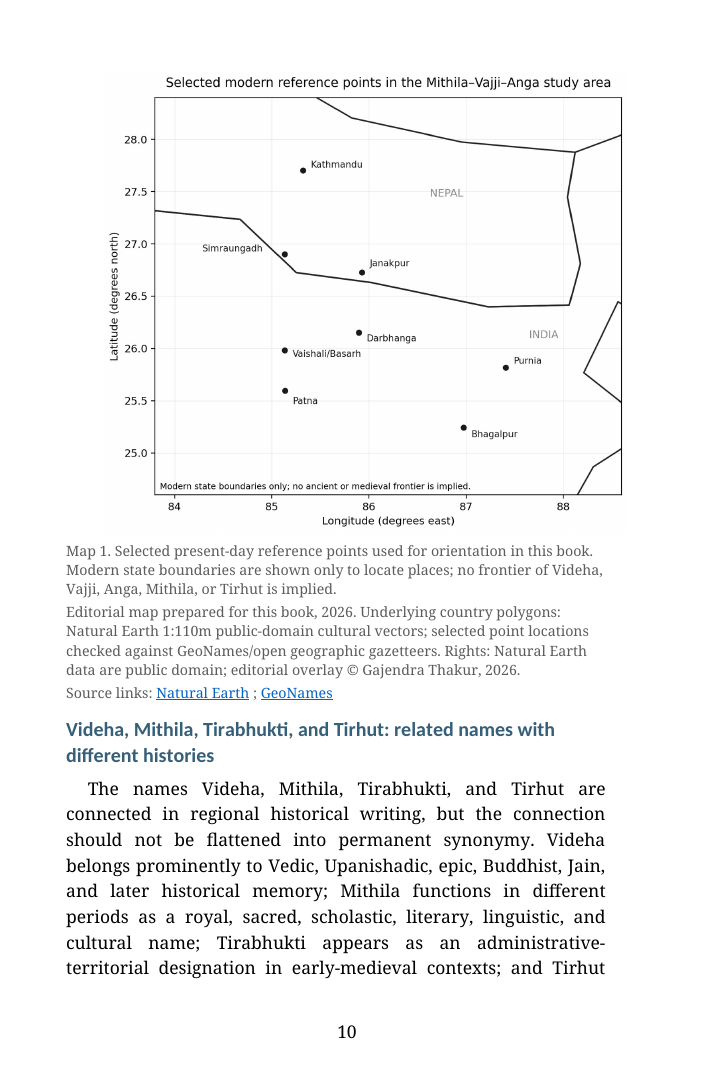
Mithila · Vajji · Anga
Chapter-specific source notes
- Primary chapter witness. Gajendra Thakur, Decoding the Panji of Mithila — Volume V, formal Chapter 31, PDF pp. 257-259; formal Chapter 31. The HTML transcription is generated from the commit-pinned source PDF and retains the chapter boundary recorded in this edition.
- Internal structure. The repository source-heading inventory records 6 subordinate headings for this chapter: “2. Mahamahopadhyay Govind and the large title-bearing cluster”; “3. Haridas, Shubhankar, Fakir, and the Ishanchandra Thakur branch”; “4. Baneshwar, Virnarayan, Lakshmidhar-Chitradhar, and Dayashankar”; “5. Harishchandra, Bank Bihari, Prembihari, and the modern professional register”; “6. Main branches decoded in this chapter”; “7. Chapter close and next threshold”.
- Digital editorial method. The page keeps the preserved source text distinct from generated navigational, concordance, visual, and provenance apparatus. The synthetic reconstruction is explanatory only and is not evidence for an individual lineage or a determination of social or marital status.