Decoding the Panji of Mithila · Volume V · Chapter 36
Shandilya-Gotre Brahmpura Pu Sako(b)ra-Kobara, Masuria- Alay: Delhan, Kanh, Ram, Vishweshwar, Shrinath, Dharmnath, Vidyadhar, Yashodhar, Chintamani, Narhari, Dharmeshwar, Jaydev, Rupnarayan, Harikrishna, Krishnanand, Acharya
Chapter 36
Shandilya-Gotre Brahmpura Pu Sako(b)ra-Kobara, Masuria-
Alay: Delhan, Kanh, Ram, Vishweshwar, Shrinath, Dharmnath,
Vidyadhar, Yashodhar, Chintamani, Narhari, Dharmeshwar,
Jaydev, Rupnarayan, Harikrishna, Krishnanand, Acharya
Buddhinath, and the Kanhouli-Parwaha Threshold
1. The Shandilya-Gotra Brahmpura opening
The source opens this chapter not with the usual “ अथ” formula , but
with a strong gotra - and - village declaration : “ शाण्डिल्य गोत्रे ब्र ह्मपुरा पु
सॅ कोबरा (कोहबरा) मसुरिसु या.” This places the register in the Shandilya
gotra and associates it with Brahmpura , Kobara or Kohbara , Masuria ,
and Alay. The first named line is an Alay - resident and Jatahar -
associated Brahmpura line beginning from Viji Delhan.
Delhan has Kanh and Ram. The Ram branch leads to Vishweshwar,
and Vishweshwar leads to Shrinath. Shrinath is the first broad branching
point: the sons listed are Dharmnath, Lakshminath, Ratinath, Pritinath,
Devanath, and Shitinath. Their placement with Naraun through Vasudev
shows that the text is not merely a village list; it is mapping gotra,
residence, and marriage circuits together.
2. Dharmnath, Vidyadhar, and the learned extension
The Dharmnath branch gives the learned axis of the chapter.
Dharmnath leads to Harikar and Hore; Mahamahopadhyay Hore leads to
Ved, and Ved leads to Mahamahattaka Vamadev, also called Vidyadhar.
Vidyadhar is linked with Sakuri through Madan. The titles around Hore,
Ved, Vamadev, and Vidyadhar mark this as a scholastic segment inside
the genealogical record.
Vidyadhar has Maheshwar and Javeshwar, with Javeshwar also
carrying the name Deve. Javeshwar leads through Varju-Raodh and
Shrinath. Varju then has Ratinath, Matikar, and Karunakar. Matikar’s
sons are Keshav, Chand, Pathak Yashodhar, and others in the Andoli-
Decoding the Panji of Mithila - Volume V | 267
Jalay connection. Through this chain the chapter moves from Brahmpura
and Alay into Sakuri, Kusal, Pihwal, and Jalay-linked fields.
3. Yashodhar, Chintamani, Narhari, Dharmeshwar, and
Jaydev
Pathak Yashodhar leads to Chintamani, and Chintamani leads to
Narhari. Narhari has Babu and Dharmeshwar. Dharmeshwar then has
Jaydev and Bholai, linked with Bhor-Takwal through Matikar’s son
Vishwanath. This section turns the learned descent into a fuller
household branch.
Jaydev leads to Ramdatt, also called Babusonai, and to Hira Ram, also
called Harikrishna, along with Raja Kamalnayan. Ramdatt’s line is
attached to Rampur-Narwal through Mishra Khedu, and then to the next
branch through Paduma. Ramdatt is followed by Rupnarayan, and a
related continuation gives Darpanarayan and Mohan, associated with
Shaktirampur-Naraun through Ratnapati’s son Aniruddh and with
Andoli-Jalay through Bouku.
4. Rupnarayan, Darpanarayan, Mohan, and Harikrishna
Rupnarayan’s line gives Shivcharan, linked with Satlakha through
Mahesh’s grandson Raghunath and son Kunai. Darpanarayan’s son
Virnarayan is attached to Nasira-deshe Mohadipur and to Valiyas
through Haridev. Virnarayan leads to Ramnarayan, Chilka, and
Kevalanand in a Mandar-linked branch.
Mohan’s line gives Horil, also called Premnarayan, linked with
Belauch through Hridayram. Harikrishna, also called Hira Ram, has
Jyotirvid Ramkrishna and Krishnanand through the Varahi-Nikhuati
connection. Krishnanand leads to Harpati and Gopal through Budhwal,
and Harpati leads to Shivnath and Matinath through Logahi-Valiyas. The
register therefore preserves both learned designations and clustered
village-marriage affiliations.
5. Krishnamani, Gopal, Parashmani, and Acharya
Buddhinath
Shivnath leads to Krishnamani through Oda-Ekhara. Krishnamani’s
continuation includes Banmalik through Tarauni-Karmaha, and another
branch through Dukhmochan and Manmohan linked with Katai and
Choudhary Ranglal’s son Adhikalal. This passage records a wide
circulation through Ekhara, Karmaha, Katai, and other allied places.
Decoding the Panji of Mithila - Volume V | 268
Gopal’s sons are Chitrapati, Teknath, Poshan, and Yodhan. Chitrapati
leads to Parashmani, Jagmohan, and Rudramani. Parashmani leads to
Chandramani through Sinhauli-Mandar, while Jagmohan leads to
Harakhamani, Vanshamani, Shishtamani, Janakamani or Gulli,
Vedamani or Kullu, and Sahasramani. Janakamani, also called Gulli,
produces Acharya Buddhinath, linked with Sukhet-Sakaradhi through
Gunanand’s grandson Eknath and son Revati. The wording “आचार्य
पाठक बु द्धिनाथ गोशाईं सुत” strengthens his learned and familial identity.
6. Dinanath, Sahasramani, and the closing threshold
The closing part of the chapter adds Vedamani, also called Phullu,
whose son is Dinanath, linked with Katai through Shankardatt. It also
notes Jyotirvid Sahasramani’s son Vishwanath, linked with Rampur-
Narwal through Kokan’s son Chamkalal. Manmohan’s sons Aniruddh,
Kapileshwar, Bhuvaneshwar, and Shaleshwar are connected with Tatail-
Sakaradhi through Rohinidatt’s son Adhikalal and with Mandarisam
through Bhanudatt.
The chapter closes with Parashmani’s son Chandramani and
Chandramani’s son Vaidyanath, linked with Majhaura-Karmaha through
Teknath’s son Chanchal and with Jagat-Pali through Ishwardatt.
Immediately after this, the source gives the heading “ कन्हौली परवाहा,”
which should begin the next chapter.
7. Main branches decoded in this chapter
Opening Shandilya-Brahmpura descent: Delhan, Kanh, Ram,
Vishweshwar, Shrinath, Dharmnath, Lakshminath, Ratinath,
Pritinath, Devanath, and Shitinath.
Learned Dharmnath line: Harikar, Hore, Mahamahopadhyay Hore,
Ved, Mahamahattaka Vamadev or Vidyadhar, Maheshwar,
Javeshwar, Varju, and Shrinath.
Yashodhar-Narhari line: Pathak Yashodhar, Chintamani, Narhari,
Babu, Dharmeshwar, Jaydev, Bholai, Ramdatt or Babusonai, Hira
Ram or Harikrishna, and Raja Kamalnayan.
Later Gosain and Pathak branches: Rupnarayan, Darpanarayan,
Mohan, Harikrishna, Ramkrishna, Krishnanand, Harpati, Shivnath,
Krishnamani, Gopal, Chitrapati, Parashmani, Jagmohan, Acharya
Buddhinath, Dinanath, Sahasramani, and Vaidyanath.
8. Chapter close and next threshold
Chapter 36 explains a compact but distinguished Shandilya - Gotra
Brahmpura - Kobara / Masuria - Alay line. It preserves scholastic titles ,
Decoding the Panji of Mithila - Volume V | 269
Gosain and Pathak identities , and a broad circulation through Sakuri ,
Kusal , Pihwal , Jalay , Bhor - Takwal , Rampur - Narwal , Shaktirampur
- Naraun , Belauch , Budhwal , Logahi - Valiyas , Oda - Ekhara , Tarauni
- Karmaha , Sinhauli - Mandar , Sukhet - Sakaradhi , Katai , and
Majhaura - Karmaha. The next source heading is “ कन्हौली परवाहा , ” the
threshold for Chapter 37.Source structure and verification apparatus
Editorial source apparatus. This apparatus is descriptive, not interpretive. It records the source-controlled structure used to verify that this page corresponds to formal Chapter 36 of Decoding the Panji of Mithila — Volume V. The chapter text above is preserved from PDF pp. 268-271; formal Chapter 36 in the commit-pinned authoritative source. It is not merged with a neighboring chapter, appendix, annexure, or independent front/back-matter unit. The internal headings below come from the repository’s source-heading inventory and are retained as navigational and audit evidence; showing them here does not turn those headings into separate publications or add claims that are absent from the source.
Internal source headings
- 2. Dharmnath, Vidyadhar, and the learned extension
- 3. Yashodhar, Chintamani, Narhari, Dharmeshwar, and Jaydev
- 4. Rupnarayan, Darpanarayan, Mohan, and Harikrishna
- 5. Krishnamani, Gopal, Parashmani, and Acharya Buddhinath
- 6. Dinanath, Sahasramani, and the closing threshold
- 7. Main branches decoded in this chapter
- 8. Chapter close and next threshold
Source-text concordance
Shandilya-Gotre · Brahmpura · Sako · ra-Kobara · Masuria · Alay · Delhan · Kanh · Vishweshwar · Shrinath · Dharmnath · Vidyadhar · Yashodhar · Chintamani · Narhari · Dharmeshwar · Jaydev · Rupnarayan · Harikrishna · Krishnanand · Acharya · Buddhinath · Kanhouli-Parwaha · Threshold · Shandilya-Gotra · opening · opens · usual · formula · strong · gotra · village · declaration · places · register · Shandilya · associates · Kobara · Kohbara · first · named · line · resident · Jatahar · associated · beginning · Viji · branch · leads · broad · branching · point · sons · listed · Lakshminath · Ratinath · Pritinath · Devanath · Shitinath · placement · Naraun · Vasudev · shows · text · merely · list · mapping · residence · marriage · circuits · together · learned · extension · gives · axis · Harikar · Hore · Mahamahopadhyay · Mahamahattaka · Vamadev
Boundary verification. In the formal sequence this chapter follows Volume V Chapter 35, “Devhar Devhar Mul-Mu Gramaramabh: Jaykar, Sagar, Matikar,” and precedes Volume V Chapter 37, “Kanhouli Parwaha: Ruchikar, Anandkar, Mitrakar, Jasai, Rajiv,”. The chapter extractor begins at the verified formal Chapter 36 marker and stops at the next verified formal chapter marker; for a final chapter it stops before recognized book-level back matter. The concordance above is generated only from distinct terms already present in this chapter’s preserved source text. It is provided for discovery, comparison, and audit, not as an automated judgment about persons, lineages, status, kinship, marriage eligibility, or historical truth.
Illustrated research apparatus
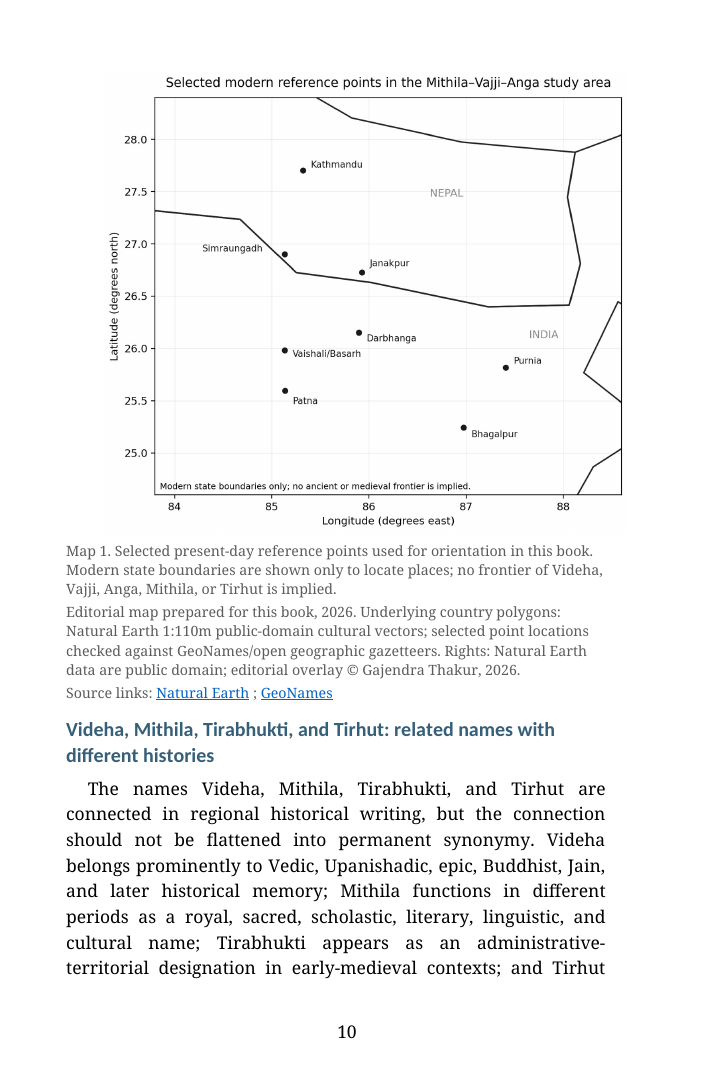
Mithila · Vajji · Anga
Chapter-specific source notes
- Primary chapter witness. Gajendra Thakur, Decoding the Panji of Mithila — Volume V, formal Chapter 36, PDF pp. 268-271; formal Chapter 36. The HTML transcription is generated from the commit-pinned source PDF and retains the chapter boundary recorded in this edition.
- Internal structure. The repository source-heading inventory records 7 subordinate headings for this chapter: “2. Dharmnath, Vidyadhar, and the learned extension”; “3. Yashodhar, Chintamani, Narhari, Dharmeshwar, and Jaydev”; “4. Rupnarayan, Darpanarayan, Mohan, and Harikrishna”; “5. Krishnamani, Gopal, Parashmani, and Acharya Buddhinath”; “6. Dinanath, Sahasramani, and the closing threshold”; “7. Main branches decoded in this chapter”; “8. Chapter close and next threshold”.
- Digital editorial method. The page keeps the preserved source text distinct from generated navigational, concordance, visual, and provenance apparatus. The synthetic reconstruction is explanatory only and is not evidence for an individual lineage or a determination of social or marital status.