Decoding the Panji of Mithila · Volume V · Chapter 37
Kanhouli Parwaha: Ruchikar, Anandkar, Mitrakar, Jasai, Rajiv,
Chapter 37
Kanhouli Parwaha: Ruchikar, Anandkar, Mitrakar, Jasai, Rajiv,
Hariram, Vyakaran Halayudh, Baburam, Nityanand, Kalanand,
Shardanand, Ramanand, Kripanand, Vibhuti, and the Ekhara-
Sangram Threshold
1. The Kanhouli-Parwaha opening
The source begins this segment with the compact heading “कन्हौली
परवाहा.” Unlike many previous entries, it does not open with a full “अथ
... ग्रामारम्भः” formula. Even so, the internal structure is clear: the chapter
begins with Mahopadhyaya Ruchikar and moves through Anandkar,
Bhanuharu, and the Gangor connection with Chandrakar, while also
preserving a Pali association through Garveshwar.
The next named branch comes through Dhamu and the learned sons
Mahopadhyaya Mitrakar, Mahopadhyaya Sthit, and Dinkar. Mitrakar is
linked with Vijayanpur-Darhiara through Pritishamma, and another link
joins Gadh-Jamugam with Jiveshwar. The text then moves to the
Sadupadhyaya Mitrakar line, where Keshav, Madhav, Lav-Kush, Ratanu,
and Mahadev are named.
2. Kusha, Jasai, Rajiv, and Hariram
Within the Sadupadhyaya Mitrakar continuation, Kusha gives Ravi,
Vishnu, Jane, Paran, and Jasai. Jasai is tied with Pali through Harikar’s
son Gunakar and with Mandar through Murari. Jasai’s sons Gopal and
Raghav are linked with Karmaha through Barah’s grandson Ravi and son
Paukhudau. Another Jasai branch gives Shiv, Ram, Lakhan, and
Bhaduwal through the Mandar connection of Chandrapati’s son
Shambhu.
Raghav leads to Rajiv. Rajiv’s sons are Nandan, Yadu, and Hariram,
connected with Darhiara through Chhotai. The register then gives the
important Hariram line: Hariram has Vyakaran Halayudh and Vyakaran
Decoding the Panji of Mithila - Volume V | 270
Chakrayudh, both associated with Sodarpur through Bhavdev. This
scholastic vocabulary is significant because the register explicitly marks
the grammatical learning of the Halayudh-Chakrayudh branch.
3. Vyakaran Halayudh and the Baburam branch
The Halayudh descent is distributed into a numbered set of marriage
and lineage links. Halayudh’s children and descendants are connected
with Bandhav, Prem, Bhushan, Behat-Khandwala, Satlakha, Khandwala,
Budhwal, Pandua, Rakshwari-Hariam, Sakaradhi, Mandar, Katai, and
Bhandarisam. The source then summarizes the Halayudh offspring as
Bandhavadi, residents of Chandi-pur in Nasira or Haveli country.
Baburam’s branch gives Shyami, Buddhinath, Ammi, Chanan, and
Lochana. Ammi leads to Doman Lal and then to Nityanand. Nityanand
continues through Kalanand, Padmanand, and Ramanand, and the
daughter-lines preserve Singheshwari, Phulwati, Janaki, Parvati, and
Phuchanwati. These marriage lines extend the chapter into Tarauni-
Karmaha, Alay, Jahanpur, Deshual-Khandwala, Hati-Sodarpur, and
Rajanpura-Darhiara.
4. Shardanand, Ramanand, Kripanand, and the professional-
modern register
Padmanand leads to Shardanand and Lilanand. The source identifies
Dr. Professor Shardanand as a psychology specialist with M.A. and
Ph.D. credentials, a notable modern marker in the lineage. His son Anant
is connected with Behat-Khandwala through Lekhmani’s son Rudranand,
and later daughter-lines carry links to Deori-Khandwala, Dhamdaha,
Chunapur, Barahi-Nikhuati, and Kursa-Kanta.
Ramanand’s children are Durganand, Umanand, Kripanand,
Jhulanand, and Rajanand. The line then names Durganand’s descendants
Vinodanand, Promodanand, Kumodanand, and Vidyanand, followed by
Kripanand’s sons Vivekanand, Vishuddhanand, and Vidyanand. The text
marks Vivekanand as an M.A. commerce officer, Vishuddhanand as a
B.A. police officer, Vidyanand as LL.B., and Jhulanand as district judge.
It also names Dr. Professor Rajanand, M.A. and Ph.D., as a historian.
This is one of the clearest places where the Panji carries forward a
traditional lineage into modern educational and professional identities.
Decoding the Panji of Mithila - Volume V | 271
5. Rudranand, Lal, Vibhuti, Chhotkani, and the closing
descent
The later section returns to Rudranand, Giranand, and Lal. Lal’s sons
include Giranand, Kalikanand, and the Hemnagar-resident Mathuranand,
Vedanand, Tirthanand, and Kulanand. Kulanand is linked with Rahua
and Baghwas-Sarisav through Baldev’s son Sahdev. The line then gives
Bachchu and the teacher Vibhuti, linked with Bodhgram through
Chandrashekhar’s son Dayashankar.
The closing passage includes Baburam’s son Lochan, Lochan’s son
Chhotkani, and Chhotkani’s sons Sadanand and Panchanand or Kunkun.
Sadanand leads to Jivanand, Ramji or Raghunandan, and Baldev.
Jivanand’s daughter-lines include Bhuvaneshwari, Tarini, Guni Day, and
Uma, and Jivanand’s sons Narayanji, Subodh, and Prabodh continue into
Bodhgram-Nagwad-Ghosot through Dayashankar’s son Shashibhushan.
Raghunath or Raghogji leads to Shivnandan and Devanandan; Baldev
leads to Govind; Panchanand or Kunkun gives further daughter-lines
before the next heading appears.
6. Main branches decoded in this chapter
Opening learned line: Mahopadhyaya Ruchikar, Anandkar,
Bhanuharu, Chandrakar, Garveshwar, Dhamu, Mitrakar, Sthit,
Dinkar, Jiveshwar, Keshav, Madhav, Lav-Kush, Ratanu, and
Mahadev.
Jasai-Rajiv-Hariram branch: Kusha, Ravi, Vishnu, Jane, Paran, Jasai,
Gopal, Raghav, Shiv, Ram, Lakhan, Rajiv, Nandan, Yadu, Hariram,
Vyakaran Halayudh, and Vyakaran Chakrayudh.
Halayudh and Baburam continuation: Bandhav, Prem, Bhushan,
Manik, Baburam, Kochai, Kauski Datt, Shyami, Buddhinath, Ammi,
Chanan, Lochana, Doman Lal, Nityanand, Kalanand, Padmanand,
and Ramanand.
Modern professional continuation: Dr. Professor Shardanand, Anant,
Lilanand, Ramanand, Durganand, Kripanand, Vivekanand,
Vishuddhanand, Vidyanand, District Judge Jhulanand, Dr. Professor
historian Rajanand, Rudranand, Lal, Vibhuti, Jivanand,
Raghunandan, Baldev, and Govind.
7. Chapter close and next threshold
Chapter 37 decodes Kanhouli-Parwaha as a bridge between the
learned grammatical line of Halayudh and Chakrayudh, the Baburam-
Nityanand descendants, and a striking modern professional register of
Decoding the Panji of Mithila - Volume V | 272
professors, engineers, administrative officers, legal officers, police
service, and a district judge. The next source heading is “ अथ एकहरा
संग्राम ग्रामारम्भः,” the threshold for Chapter 38.Source structure and verification apparatus
Editorial source apparatus. This apparatus is descriptive, not interpretive. It records the source-controlled structure used to verify that this page corresponds to formal Chapter 37 of Decoding the Panji of Mithila — Volume V. The chapter text above is preserved from PDF pp. 271-274; formal Chapter 37 in the commit-pinned authoritative source. It is not merged with a neighboring chapter, appendix, annexure, or independent front/back-matter unit. The internal headings below come from the repository’s source-heading inventory and are retained as navigational and audit evidence; showing them here does not turn those headings into separate publications or add claims that are absent from the source.
Internal source headings
- 2. Kusha, Jasai, Rajiv, and Hariram
- 3. Vyakaran Halayudh and the Baburam branch
- 4. Shardanand, Ramanand, Kripanand, and the professional-modern register
- 5. Rudranand, Lal, Vibhuti, Chhotkani, and the closing descent
- 6. Main branches decoded in this chapter
- 7. Chapter close and next threshold
Source-text concordance
Kanhouli · Parwaha · Ruchikar · Anandkar · Mitrakar · Jasai · Rajiv · Hariram · Vyakaran · Halayudh · Baburam · Nityanand · Kalanand · Shardanand · Ramanand · Kripanand · Vibhuti · Ekhara · Sangram · Threshold · Kanhouli-Parwaha · opening · begins · segment · compact · heading · Unlike · many · previous · entries · open · full · formula · Even · internal · structure · clear · Mahopadhyaya · moves · Bhanuharu · Gangor · connection · Chandrakar · preserving · Pali · association · Garveshwar · next · named · branch · comes · Dhamu · learned · sons · Sthit · Dinkar · linked · Vijayanpur-Darhiara · Pritishamma · another · link · joins · Gadh-Jamugam · Jiveshwar · text · Sadupadhyaya · line · Keshav · Madhav · Lav-Kush · Ratanu · Mahadev · Kusha · Within · continuation · gives · Ravi · Vishnu · Jane · Paran
Boundary verification. In the formal sequence this chapter follows Volume V Chapter 36, “Shandilya-Gotre Brahmpura Pu Sako(b)ra-Kobara, Masuria- Alay: Delhan, Kanh, Ram, Vishweshwar, Shrinath, Dharmnath, Vidyadhar, Yashodhar, Chintamani, Narhari, Dharmeshwar, Jaydev, Rupnarayan, Harikrishna, Krishnanand, Acharya” and precedes Volume V Chapter 38, “Ekhara Sangram Gramaramabh: Dom Tekari, Chaturvedadhyarya Kamdev, Yajnik Parashuram, Shridhar,”. The chapter extractor begins at the verified formal Chapter 37 marker and stops at the next verified formal chapter marker; for a final chapter it stops before recognized book-level back matter. The concordance above is generated only from distinct terms already present in this chapter’s preserved source text. It is provided for discovery, comparison, and audit, not as an automated judgment about persons, lineages, status, kinship, marriage eligibility, or historical truth.
Illustrated research apparatus
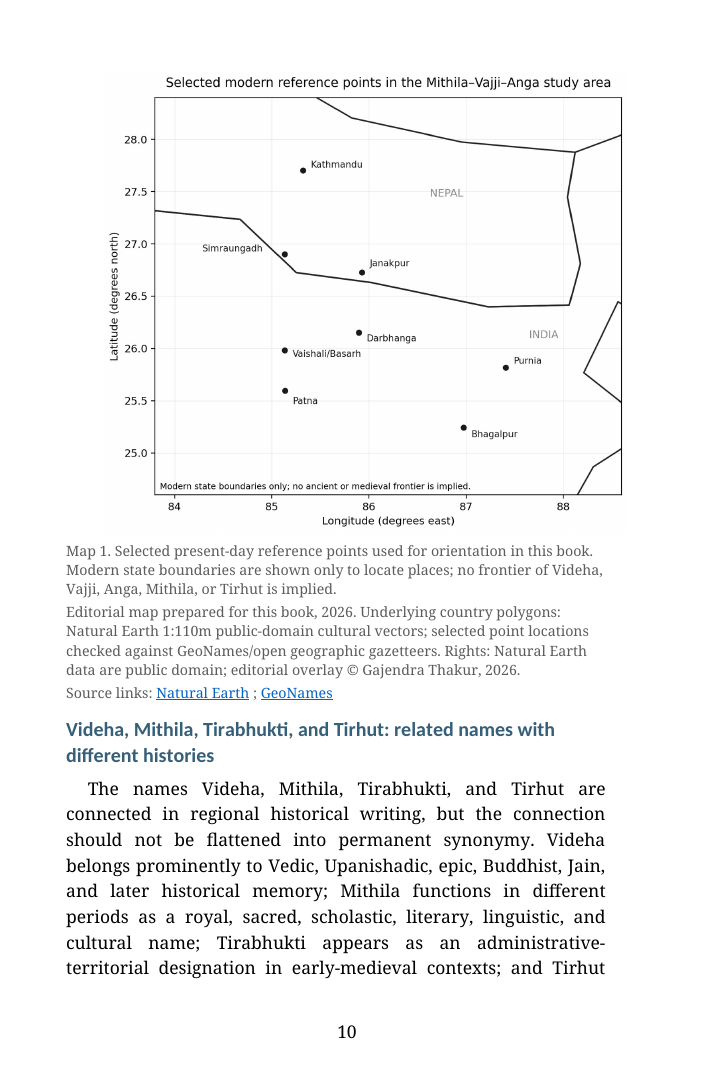
Mithila · Vajji · Anga
Chapter-specific source notes
- Primary chapter witness. Gajendra Thakur, Decoding the Panji of Mithila — Volume V, formal Chapter 37, PDF pp. 271-274; formal Chapter 37. The HTML transcription is generated from the commit-pinned source PDF and retains the chapter boundary recorded in this edition.
- Internal structure. The repository source-heading inventory records 6 subordinate headings for this chapter: “2. Kusha, Jasai, Rajiv, and Hariram”; “3. Vyakaran Halayudh and the Baburam branch”; “4. Shardanand, Ramanand, Kripanand, and the professional-modern register”; “5. Rudranand, Lal, Vibhuti, Chhotkani, and the closing descent”; “6. Main branches decoded in this chapter”; “7. Chapter close and next threshold”.
- Digital editorial method. The page keeps the preserved source text distinct from generated navigational, concordance, visual, and provenance apparatus. The synthetic reconstruction is explanatory only and is not evidence for an individual lineage or a determination of social or marital status.