Decoding the Panji of Mithila · Volume V · Chapter 38
Ekhara Sangram Gramaramabh: Dom Tekari, Chaturvedadhyarya Kamdev, Yajnik Parashuram, Shridhar,
Chapter 38
Ekhara Sangram Gramaramabh: Dom Tekari,
Chaturvedadhyarya Kamdev, Yajnik Parashuram, Shridhar,
Balbhadra, Shrirang, Santosh, Ratneshwar, Ruchikar, Harinath,
Gangeshwar, Theghanand, Ramanand, Vasudev, Umapati,
Abhiram, Nena, Panchanand, and Mahinarayan
1. The Ekhara-Sangram opening and the Dom Tekari
memory
The chapter opens with “अथ एकहरा संग्राम ग्रामारम्भः,” but
immediately frames the lineage through Dom Tekari and the learned
figure Chaturvedadhyarya Kamdev. The register names the ritual and
scholarly sons Yajakarta or Yajnik Parashuram, Dikshant, Som, Tripathi,
and Krishna, and then narrows the descent through Parashuram into
Shridhar and Balbhadra.
Balbhadra’s sons Shrirang, Banmali, and Udyotakar form the first
branching point. Shrirang leads to Ram and Vaman. Vaman is associated
with Kaligram and with a Mahamahopadhyaya Ram-Vilav-Panchak line
at Belauch, while Ram gives Santosh and Paritosh. Through Paritosh the
text records Harihar and Narayan, and Narayan continues into Dev and
Bhave, Ekhara residents connected with Bhareha.
2. Ratneshwar, Ruchikar, Lakshmikar, and the
Sadupadhyaya line
Dev gives Ratneshwar, and Ratneshwar’s children are Divakar,
Ruchikar, the Kanhouli-resident Shuchikar, Matikar, and Harikar.
Ruchikar gives Lakshmikar and Anandkar, with links extending to
Simunam-Karmaha and Sakaradhi. A marriage link through Parana or
Chanda connects the line with Dharmadhikaranik Mahamahopadhyaya
Upadhyaya Narsingh.
The Sadupadhyaya Lakshmikar branch then produces
Mahamahopadhyaya Harinath. Harinath’s sons are Maheshwar ,
Halleshwar , Gunishwar , and Bhadreshwar. The line then moves through
Greshwar to Gangeshwar and Vagishwar , and Gangeshwar produces
Decoding the Panji of Mithila - Volume V | 273
Theghanand. The learned titles and the repeated Upadhyaya /
Sadupadhyaya markers make this section one of the most scholastic parts
of the Ekhara - Sangram chapter.
3. Theghanand, Ramanand, Vasudev, and Umapati
Theghanand’s children are Paran, Hari, Shri Hari, and Harikesh. The
source then gives Ramanand, who opens a broad learned branch through
Mahamahopadhyaya Harihar, Mahamahopadhyaya Vasudev, Mukund,
Murari, Madhusudan, Shankar, Mahesh, and Divakar. Vasudev gives
Umapati and Murari, and Umapati leads into Mahopadhyaya Kangav,
Mahopadhyaya Shridhar, and Mahopadhyaya Mahadev.
Through the Kakarod-Utimpura and Kujouli connections, Mahai’s
descendants are Harinandan, Narayan, Lakshman, Ghanshyam, and Ram.
Ram then gives Jaishiv, Lochan, Bhramar, and Gunjar. This keeps the
chapter moving between learned titles, village settlement markers, and
repeated marriage affiliations with Mandar, Alay, and other already
established Panji zones.
4. Bhramar, Abhiram, Nehal alias Vishweshwar, and Nena
Bhramar gives Abhiram, Mahesh, Lakshminath, Manbodh, and
Buddhinath. Abhiram’s son Nehal, also styled Vishweshwar, is joined to
Pali through Bhavdev’s son Vidyakar. Nehal’s son Nena is then linked
through Belasam-Budhwal and Behat-Khandwala. The Nena line is one
of the important internal pivots of this chapter.
Nena gives Lakshminath or Moti and Ajwanath or Mannu. The
Mannu branch records daughters and marriage links with Majhaura-
Karmaha and Gangor. Through Murlidhar the text records Satyanarayan
and then Jaynarayan. Jaynarayan’s sons are Nityanand, Panchanand,
Sheshnarayan, and Mahinarayan, connecting Jahanpur-Ekma-Khandwala
and Ratauli-Darhiara into the Ekhara-Sangram structure.
5. Bahora Nena Jha and the modern family register
The source pauses to identify “धर्मपुर पु देशे बहोरा नेना झा.” Nena’s
wife Vilashvati is named, along with the daughters Jambavati, Kantavati,
and Dukhani. Another Nena branch gives Bhorilal, connected with
Bhanupur-Panichobh and Badgam-Darhiara. The register then returns to
the descendants of Panchanand and Sheshnarayan.
Panchanand gives Dilip, Santosh, and Ashutosh. Dilip’s son Dhiraj is
marked as an income-tax inspector. Santosh gives Pranav, and the line
names Meenakshi, B.A. Ashok, Himanshu, and links to Ramai, Ratauli-
Decoding the Panji of Mithila - Volume V | 274
Harihara, and Pokharia-Raiyam-Ghoshiyam. Sheshnarayan gives
Ravinarayan and Deepak, while Mahinarayan is explicitly described as a
respected headmaster with M.A. and B.Ed. qualifications. His children
and descendants include Jyotish, Sanjay, Suman, Rajesh, Ranjan,
Anurag, Harsh, and Sakshi.
6. Main branches decoded in this chapter
Opening ritual-learned line: Chaturvedadhyarya Kamdev, Yajnik
Parashuram, Dikshant, Som, Tripathi, Krishna, Shridhar, Balbhadra,
Shrirang, Vaman, Santosh, Paritosh, Harihar, Narayan, Dev, and
Ratneshwar.
Ratneshwar-Sadupadhyaya line: Divakar, Ruchikar, Shuchikar,
Matikar, Harikar, Lakshmikar, Anandkar, Sadupadhyaya
Lakshmikar, Mahamahopadhyaya Harinath, Maheshwar,
Halleshwar, Gunishwar, Bhadreshwar, Gangeshwar, Vagishwar, and
Theghanand.
Ramanand-Vasudev line: Ramanand, Mahamahopadhyaya Harihar,
Mahamahopadhyaya Vasudev, Mukund, Murari, Madhusudan,
Shankar, Mahesh, Divakar, Umapati, Mahopadhyaya Shridhar,
Mahopadhyaya Mahadev, and the Ram-Bhramar descent.
Nena-Mahinarayan continuation: Abhiram, Nehal or Vishweshwar,
Nena, Lakshminath or Moti, Mannu, Murlidhar, Satyanarayan,
Jaynarayan, Nityanand, Panchanand, Sheshnarayan, Mahinarayan,
Dhiraj, Santosh, Pranav, Ravinarayan, Deepak, Jyotish, Sanjay,
Suman, Rajesh, Ranjan, Anurag, Harsh, and Sakshi.
7. Chapter close and next threshold
Chapter 38 decodes Ekhara-Sangram as a lineage that begins with
Dom Tekari’s ritual-scholarly memory and then moves through a dense
sequence of Upadhyaya, Mahamahopadhyaya, grammatical, and modern
professional identifiers. The chapter closes with Mahinarayan’s respected
headmaster line and its modern descendants. The next source heading is
“एकहरा संग्राम सिरसिया ग्रामारम्भः,” which should begin Chapter 39.Source structure and verification apparatus
Editorial source apparatus. This apparatus is descriptive, not interpretive. It records the source-controlled structure used to verify that this page corresponds to formal Chapter 38 of Decoding the Panji of Mithila — Volume V. The chapter text above is preserved from PDF pp. 274-276; formal Chapter 38 in the commit-pinned authoritative source. It is not merged with a neighboring chapter, appendix, annexure, or independent front/back-matter unit. The internal headings below come from the repository’s source-heading inventory and are retained as navigational and audit evidence; showing them here does not turn those headings into separate publications or add claims that are absent from the source.
Internal source headings
- 2. Ratneshwar, Ruchikar, Lakshmikar, and the Sadupadhyaya line
- 3. Theghanand, Ramanand, Vasudev, and Umapati
- 4. Bhramar, Abhiram, Nehal alias Vishweshwar, and Nena
- 5. Bahora Nena Jha and the modern family register
- 6. Main branches decoded in this chapter
- 7. Chapter close and next threshold
Source-text concordance
Ekhara · Sangram · Gramaramabh · Tekari · Chaturvedadhyarya · Kamdev · Yajnik · Parashuram · Shridhar · Balbhadra · Shrirang · Santosh · Ratneshwar · Ruchikar · Harinath · Gangeshwar · Theghanand · Ramanand · Vasudev · Umapati · Abhiram · Nena · Panchanand · Mahinarayan · Ekhara-Sangram · opening · memory · opens · एकहर · immediately · frames · lineage · learned · figure · register · names · ritual · scholarly · sons · Yajakarta · Dikshant · Tripathi · Krishna · narrows · descent · Balbhadra’s · Banmali · Udyotakar · form · first · branching · point · leads · Vaman · associated · Kaligram · Mahamahopadhyaya · Ram-Vilav-Panchak · line · Belauch · gives · Paritosh · text · records · Harihar · Narayan · continues · Bhave · residents · connected · Bhareha · Lakshmikar · Sadupadhyaya · Ratneshwar’s · children · Divakar · Kanhouli-resident · Shuchikar · Matikar · Harikar
Boundary verification. In the formal sequence this chapter follows Volume V Chapter 37, “Kanhouli Parwaha: Ruchikar, Anandkar, Mitrakar, Jasai, Rajiv,” and precedes Volume V Chapter 39, “Ekhara Sangram Sirsia Gramaramabh: Bhorilal Jha, Choa Lal,”. The chapter extractor begins at the verified formal Chapter 38 marker and stops at the next verified formal chapter marker; for a final chapter it stops before recognized book-level back matter. The concordance above is generated only from distinct terms already present in this chapter’s preserved source text. It is provided for discovery, comparison, and audit, not as an automated judgment about persons, lineages, status, kinship, marriage eligibility, or historical truth.
Illustrated research apparatus
Mithila · Vajji · Anga
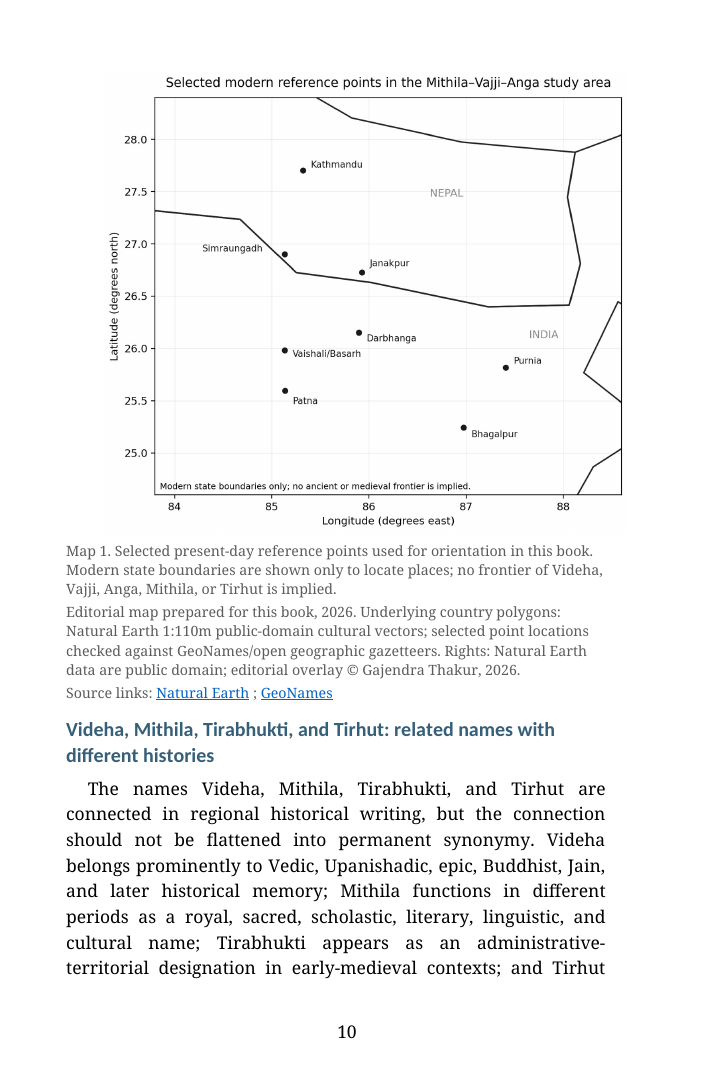
Chapter-specific source notes
- Primary chapter witness. Gajendra Thakur, Decoding the Panji of Mithila — Volume V, formal Chapter 38, PDF pp. 274-276; formal Chapter 38. The HTML transcription is generated from the commit-pinned source PDF and retains the chapter boundary recorded in this edition.
- Internal structure. The repository source-heading inventory records 6 subordinate headings for this chapter: “2. Ratneshwar, Ruchikar, Lakshmikar, and the Sadupadhyaya line”; “3. Theghanand, Ramanand, Vasudev, and Umapati”; “4. Bhramar, Abhiram, Nehal alias Vishweshwar, and Nena”; “5. Bahora Nena Jha and the modern family register”; “6. Main branches decoded in this chapter”; “7. Chapter close and next threshold”.
- Digital editorial method. The page keeps the preserved source text distinct from generated navigational, concordance, visual, and provenance apparatus. The synthetic reconstruction is explanatory only and is not evidence for an individual lineage or a determination of social or marital status.