Decoding the Panji of Mithila · Volume V · Chapter 39
Ekhara Sangram Sirsia Gramaramabh: Bhorilal Jha, Choa Lal,
Chapter 39
Ekhara Sangram Sirsia Gramaramabh: Bhorilal Jha, Choa Lal,
Sona Lal, Achmit Lal, Ajwalal, Bhupal Lal, Achkalal, Banmali,
Shivanand, Bhavani Kant, Madhurapati, Lalbihari, Mahopadhyaya
Shrinath, Vachaspati, Chandeshwar, and the Closing Register
Decoding the Panji of Mithila - Volume V | 275
1. The Sirsia opening from Bhorilal Jha
The final section opens with “एकहरा संग्राम सिरसिया ग्रामारम्भः.” It
identifies Bhorilal Jha in the Shri Pur Desh-Majlishpur frame and
connects him back to the earlier Ekhara-Sangram sequence through
Nehal alias Vishweshwar, Nena, and Bhorilal. Bhorilal’s sons are listed
as Choa Lal, Sona Lal, Achmit Lal, Ajwalal, and Bhupal Lal.
The opening cluster establishes the marriage and residential links
through Sarisav-Sodarpur, Savas-Kusamal, and related houses.
Dayavati’s daughters, including Ajanavati, preserve the female-line
memory before the text moves into the male continuations of Choa Lal
and Sona Lal.
2. Choa Lal, Sona Lal, Achkalal, Banmali, and Shivanand
Choa Lal gives Achkalal and Anup Lal. Achkalal is joined with
Rajora-Mandar and Tarauni-Karmaha through Manranjan, Rajnath, and
Khekhai. Sona Lal gives Banmali and Shivanand, connected with Deuri-
Khandwala and the Chandradatt line. The chapter then brings in the
Vasudev-Umapati-Shridhar continuation and names Ramkrishna,
Shrikrishna, Parashuram, and Aniruddha.
Aniruddha’s children are Kamalakant, Ramakant or Karu, and
Bhavani Kant. Bhavani Kant gives Sabhapati and Kala, and another
Bhavani Kant line gives Madhurapati alias Bachha. The latter is joined
with Udanpur-Jajiwal and Budhwal, and the text introduces Medhakar,
Sudhakar, and Saheb before returning to Madhurapati’s sons Harpati,
Gunpati, and Lalbihari.
3. Lalbihari, Lakshmidatt, and Mahopadhyaya Shrinath
Through Mangalavati the Lalbihari line gives Lakshmidatt,
Hulashdatt, Panchanand, and Bhikshuk. Lakshmidatt then gives
Mahopadhyaya Shrinath. The entry anchors Shrinath with Pariyam-
Budhwal and Badhiyam-Pawauli, and records the Lakshmeshvari line
with Siddhavati, Pitambar, Amika, Muni, and Panchamani.
Mahopadhyaya Shrinath gives Tejnath alias Apuchh, linked with
Hariam, Bhadam-Jajiwal, and the Bhagvati line. Another Shrinath line
gives Mahopadhyaya Babua, while Apuchh gives Vachaspati. This
portion is important because it brings the final chapter back into the high-
scholastic Mahopadhyaya register before closing the volume.
Decoding the Panji of Mithila - Volume V | 276
4. Vachaspati, Chandeshwar, Suresh, Umesh, and the final
descendants
Vachaspati gives Nageshwar, Kusheshwar, and Mahopadhyaya
Chandeshwar. Another Vachaspati line gives Suresh and Umesh,
connected with Mangrauni-Pali and Shrinath-Achkalal. The chapter then
names Shastri Chandrashekhar, Ishanath, and the Sarisav-Sodarpur and
Mahua-Khaual connections.
Hulash gives Parashnath alias Parshi and Yadunath. Parashnath’s sons
are Bhagirath and Jaydev, while Jaydev gives Rameshwar, Kameshwar,
and Brajeshwar. The closing lines carry the descent through Kusheshwar,
Mukhiya Suresh, Dharmacharya Mahopadhyaya Chandeshwar, and
Jaydev’s son Rameshwar, whose line reaches Amarnath and his daughter
linked with Dhamdaha-Kujouli.
5. Main branches decoded in this chapter
Bhorilal opening: Nehal or Vishweshwar, Nena, Bhorilal Jha, Choa
Lal, Sona Lal, Achmit Lal, Ajwalal, Bhupal Lal, and the Dayavati
daughter-line.
Choa Lal and Sona Lal branches: Achkalal, Anup Lal, Banmali,
Shivanand, Chandradatt, Ramkrishna, Shrikrishna, Parashuram,
Aniruddha, Kamalakant, Ramakant or Karu, and Bhavani Kant.
Madhurapati-Lalbihari branch: Madhurapati alias Bachha, Harpati,
Gunpati, Lalbihari, Lakshmidatt, Hulashdatt, Panchanand, Bhikshuk,
Mahopadhyaya Shrinath, Tejnath alias Apuchh, Mahopadhyaya
Babua, and Vachaspati.
Closing scholarly branch: Nageshwar, Kusheshwar, Mahopadhyaya
Chandeshwar, Suresh, Umesh, Shastri Chandrashekhar, Ishanath,
Parashnath alias Parshi, Yadunath, Bhagirath, Jaydev, Rameshwar,
Kameshwar, Brajeshwar, Mukhiya Suresh, Dharmacharya
Mahopadhyaya Chandeshwar, and Amarnath.
6. Volume close
This chapter closes the available source text for Volume V. It begins
as a focused Sirsia continuation of the Ekhara-Sangram chapter, but it
also gathers several major markers of the whole work: residential
movement, marriage mapping, female-line preservation, Mahopadhyaya
learning, administrative and social titles, and modern family
continuations. Since no further heading follows in the supplied source,
the chapter functions as the closing register for the present cumulative
draft.
Decoding the Panji of Mithila - Volume V | 277
Decoding the Panji of Mithila - Volume V | 278Source structure and verification apparatus
Editorial source apparatus. This apparatus is descriptive, not interpretive. It records the source-controlled structure used to verify that this page corresponds to formal Chapter 39 of Decoding the Panji of Mithila — Volume V. The chapter text above is preserved from PDF pp. 276-279; formal Chapter 39 in the commit-pinned authoritative source. It is not merged with a neighboring chapter, appendix, annexure, or independent front/back-matter unit. The internal headings below come from the repository’s source-heading inventory and are retained as navigational and audit evidence; showing them here does not turn those headings into separate publications or add claims that are absent from the source.
Internal source headings
- 2. Choa Lal, Sona Lal, Achkalal, Banmali, and Shivanand
- 3. Lalbihari, Lakshmidatt, and Mahopadhyaya Shrinath
- 4. Vachaspati, Chandeshwar, Suresh, Umesh, and the final descendants
- 5. Main branches decoded in this chapter
- 6. Volume close
Source-text concordance
Ekhara · Sangram · Sirsia · Gramaramabh · Bhorilal · Choa · Sona · Achmit · Ajwalal · Bhupal · Achkalal · Banmali · Shivanand · Bhavani · Kant · Madhurapati · Lalbihari · Mahopadhyaya · Shrinath · Vachaspati · Chandeshwar · Closing · Register · Decoding · opening · final · section · opens · एकहर · identifies · Shri · Desh-Majlishpur · frame · connects · back · earlier · Ekhara-Sangram · sequence · Nehal · alias · Vishweshwar · Nena · Bhorilal’s · sons · listed · cluster · establishes · marriage · residential · links · Sarisav-Sodarpur · Savas-Kusamal · related · houses · Dayavati’s · daughters · including · Ajanavati · preserve · female-line · memory · text · moves · male · continuations · gives · Anup · joined · Rajora-Mandar · Tarauni-Karmaha · Manranjan · Rajnath · Khekhai · connected · Deuri · Khandwala · Chandradatt · line · brings · Vasudev-Umapati-Shridhar
Boundary verification. In the formal sequence this chapter follows Volume V Chapter 38, “Ekhara Sangram Gramaramabh: Dom Tekari, Chaturvedadhyarya Kamdev, Yajnik Parashuram, Shridhar,” and precedes Volume V Chapter 40, “Cross-Analysis, Reference Apparatus, and Consolidated Reading Tables”. The chapter extractor begins at the verified formal Chapter 39 marker and stops at the next verified formal chapter marker; for a final chapter it stops before recognized book-level back matter. The concordance above is generated only from distinct terms already present in this chapter’s preserved source text. It is provided for discovery, comparison, and audit, not as an automated judgment about persons, lineages, status, kinship, marriage eligibility, or historical truth.
Illustrated research apparatus
Mithila · Vajji · Anga
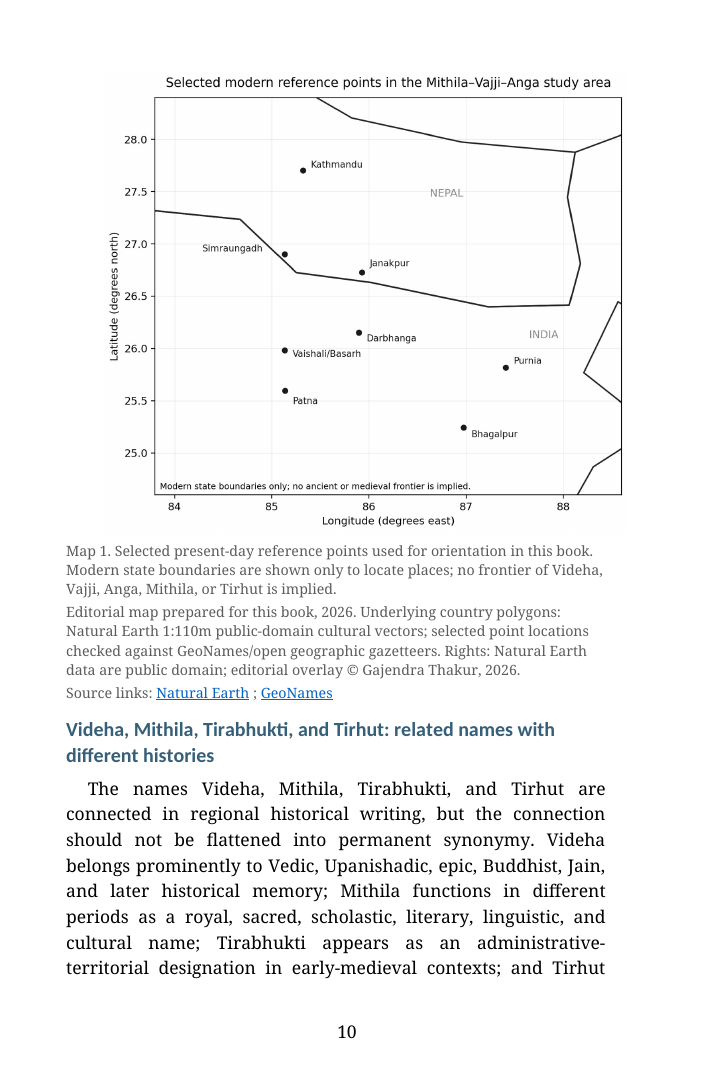
Chapter-specific source notes
- Primary chapter witness. Gajendra Thakur, Decoding the Panji of Mithila — Volume V, formal Chapter 39, PDF pp. 276-279; formal Chapter 39. The HTML transcription is generated from the commit-pinned source PDF and retains the chapter boundary recorded in this edition.
- Internal structure. The repository source-heading inventory records 5 subordinate headings for this chapter: “2. Choa Lal, Sona Lal, Achkalal, Banmali, and Shivanand”; “3. Lalbihari, Lakshmidatt, and Mahopadhyaya Shrinath”; “4. Vachaspati, Chandeshwar, Suresh, Umesh, and the final descendants”; “5. Main branches decoded in this chapter”; “6. Volume close”.
- Digital editorial method. The page keeps the preserved source text distinct from generated navigational, concordance, visual, and provenance apparatus. The synthetic reconstruction is explanatory only and is not evidence for an individual lineage or a determination of social or marital status.