Decoding the Panji of Mithila · Volume VI · Chapter 3
The Ethics of Decoding: Record, Stigma, and Historical Justice Opening
Chapter 3
The Ethics of Decoding: Record, Stigma,
and Historical Justice
Opening
Before this book decodes a single Dushan entry in detail, it
must decide how such entries should be read. Dushan Panji is
not a neutral list of names. It contains words that once carried
fear, shame, hierarchy, social discipline, and family anxiety.
Some entries refer to unknown lineage; some refer to Devadasi
or Dasi connections; some refer to Dalit, artisan, pastoral,
Muslim, Yavani, widow, path-patita, Gurupatni, Mahapatra,
and other socially charged categories. If these words are
repeated without method, the book would become a new
instrument of injury. If they are hidden, the history would
again be buried. The task of decoding therefore begins with
ethics.
The ethical rule is simple but demanding: the record must be
preserved, but its old stigma must not be renewed. The book
will read every entry as evidence of social history, not as a
verdict on persons, families, communities, or descendants. The
source belongs to the past; the responsibility belongs to the
present reader.
1. Why Ethics Must Come before Decoding
A Dushan entry is powerful because it joins name, lineage,
place, relationship, and social category. In a society organized
through marriage eligibility and genealogical memory, such a
record could affect honor, alliance, and status. This is why
Dushan Panji cannot be treated like an ordinary index. It is an
archive of social pressure. It records where a line was
considered ruptured, uncertain, or marked by a relationship
outside the expected frame.
© Gajendra Thakur | 26
Decoding the Panji of Mithila, Volume VI
The source itself recognizes this sensitivity. It defines Dushan
Panji as the record of “वंशमे आएल क्षरण,” a lineage rupture or
erosion. It also says that such matters usually become
discussable only after time has passed, so that a related line
may be protected from immediate consequences. That
observation is not a small detail. It shows that the Panji
tradition knew the danger of premature public exposure. If the
old record itself understood delay, restraint, and consequence,
a modern book must be even more careful.
Ethics must therefore precede interpretation. The reader
should know from the beginning that decoding does not mean
accusation. It means understanding how a record functioned,
what social rules it assumed, how those rules were crossed, and
how later generations were absorbed back into ordinary
society.
2. Record Is Not Verdict
The first rule is that record is not verdict. A Dushan entry
tells us that a Panjikar or genealogical tradition marked
something as socially significant. It does not automatically tell
us the full life of the persons named. It does not tell us their
consent, suffering, love, compulsion, economic condition,
political context, or local reputation. It does not tell us whether
the older label was fair. It tells us how the record classified the
event.
This distinction is crucial. The book will use source terms
because they are part of the evidence. But it will not translate
them into moral judgment. A word such as अज्ञात, चर्मकारिणी, यवनी,
विधवा, दासी, देवदासी, रजक, गोप, यादव, तैलिक, धीवर, ताँती, महापात्र, गुरुपत्नी, पथ
पतिता, or निषिद्धकु ल must be read first as an archival marker. The
human meaning of the person is larger than the marker.
To decode ethically is to separate three levels: the event that
may have occurred, the label used by the source, and the
© Gajendra Thakur | 27
Decoding the Panji of Mithila, Volume VI
modern interpretation. Confusion among these levels produces
cruelty. Clarity among them produces history.
3. Preserving Old Words without Repeating Old
Cruelty
A historian cannot erase old vocabulary merely because it is
uncomfortable. If the word is removed, the structure of the
record becomes invisible. But the historian also cannot repeat
old vocabulary as if the old hierarchy remains morally valid.
The solution is disciplined preservation: keep the source term,
explain its function, and surround it with humane
interpretation.
This manuscript therefore follows a double rule. It preserves
the exact old labels when they are necessary for decoding; at
the same time, it explicitly refuses to use those labels as insults.
When a community term appears, the chapter will ask: What
relationship-route is being recorded? Is the connection through
mother, wife, daughter, descendant, unknown origin, marriage,
or migration? Is the category a caste label, a religious label, a
status label, a profession label, or a moral-social label? What
does the entry show about the operation of the Panji system?
This approach keeps the archive intact without allowing the
archive to become a weapon. The aim is not to purify the past
by editing it. The aim is to repair the present by interpreting it
responsibly.
4. No Present-Day Condemnation
No Dushan entry should be used to condemn a living person,
family, village, community, or descendant group. The cases
belong to a historical archive. Their value is in what they reveal
about Mithila’s social structure: anxiety about lineage, the
importance of maternal descent, inter-community contact,
women’s hidden roles, migration, branch formation, and the
gradual fading of stigma. Their value is not in providing
material for gossip or humiliation.
© Gajendra Thakur | 28
Decoding the Panji of Mithila, Volume VI
The source itself offers a model of social forgetting and
reintegration. In the post-table explanation, a marked line may
become fully reabsorbed after generational distance. The
example of sixth-generation purification shows that Dushan
was not always imagined as endless condemnation. If the
record itself could imagine absorption, the modern reader has
no right to revive permanent stigma.
The ethical reader must therefore refuse two temptations:
the temptation to suppress the record because it is difficult, and
the temptation to expose it cruelly because it is sensational. The
correct path is neither concealment nor spectacle. It is
accountable explanation.
5. Women Must Not Be Read as Sources of
Pollution
Many Dushan entries pass through women: mother, wife,
daughter, widow, Devadasi, Dasi, Rajaki, Yavani, Charmakarini,
daughter of a named man, or mother whose origin is unknown.
Older social systems often treated women as carriers of lineage
anxiety. A modern reading must not repeat that structure. The
woman in the entry is not a stain. She is a historical person,
often the only visible trace of a relationship that formal
genealogy would otherwise erase.
This book will therefore read female-line references as
evidence of women’s historical presence. Terms such as माता,
मातृक, सुता, पुत्री, पत्नी, कन्या, and दौहित्र are not marginal details. They
are the grammar by which the Panji preserves relationships.
When the source names Anandaa, Vallabha, Medha, Daulat
Jahan, Hadini Rudramati, Sohago, or unnamed mothers and
daughters, it gives us the possibility of writing women back into
Mithila’s social history.
The ethical rule is that women must not be reduced to “cause
of Dushan.” They are agents, bridges, kinship links, and
memory-bearers. Even where the old source treats the
© Gajendra Thakur | 29
Decoding the Panji of Mithila, Volume VI
relationship as a rupture, the modern book must also see the
social world that relationship made visible.
6. Community Labels Must Be Historicized
Dushan Panji includes references to Dalit, artisan, pastoral,
occupational, Muslim, and Yavani-linked lines. These labels
must be handled with exactness and dignity. They are not to be
softened into vague phrases, because doing so would hide the
evidence. But they are also not to be repeated as social insults.
Each label must be situated: what did the Panji need to know,
what relationship was being recorded, and what kind of
boundary was being crossed?
For example, a reference to a Chamar or Charmakarini
connection is not only a caste marker. It may be a mother-line,
daughter-line, wife-line, or descendant-line. A reference to a
Rajak or Rajaki connection may show the same. A Yavani or
Muslim-linked entry may show religious boundary crossing,
but it may also show the practical reality of intimacy and
kinship in a region where communities lived near one another.
A Gop or Yadav entry may connect pastoral identity, caste
location, and marriage route. A Dasi or Devadasi entry may
open the history of servitude, ritual economy, gender, and
lineage memory.
The point is not to flatten difference. The point is to explain
difference without humiliating the people named by difference.
7. Unknownness Is Evidence, Not Emptiness
The category अज्ञात appears repeatedly in the Dushan
material. It may refer to unknown mother, unknown maternal
line, unknown family, unknown caste-line, unknown marital
origin, or unknown village placement. It should not be treated
as a blank. Unknownness is itself historical evidence. It tells us
that the Panji system required identification, and that in certain
cases identification could not be supplied or could not be
accepted.
© Gajendra Thakur | 30
Decoding the Panji of Mithila, Volume VI
An unknown mother is not an absent mother. An unknown
lineage is not a nonexistent lineage. The term records the limits
of the official genealogical frame. In some cases, the unknown
may be caused by migration; in others by inter-community
marriage; in others by social concealment; in others by gaps in
memory or documentation. The book must keep these
possibilities open unless the source narrows them.
This rule is especially important because unknownness often
attaches to women. The ethical reader must not turn archival
silence into accusation. Silence is a problem to interpret, not a
license to blame.
8. The Book’s Interpretive Method
Every Dushan entry will be decoded through a consistent
method. First, identify the case number and Panji reference.
Second, read the mool and moolgram sequence. Third, identify
the named persons and the direction of descent. Fourth,
identify the relationship-route: mother-line, daughter-line,
wife-line, descendant-line, unknown origin, migration route, or
community-marked marriage. Fifth, identify the old category of
Dushan. Sixth, distinguish the original event from the later
consequence. Seventh, ask what the entry reveals about
Mithila’s social world.
This method prevents moral panic. It slows the reader down.
It makes the archive legible. Instead of asking, “Who is
polluted?” the method asks, “What relationship is recorded?
What rule is being invoked? What memory is being preserved?
What later absorption is visible?”
The method also allows comparison. When similar
categories recur across many cases, the book can show
patterns: repeated unknown maternal lines, repeated female-
line transmission, repeated Rajak or Charmakarini references,
repeated Yavani entries, repeated widow-related entries,
repeated migration markers, and repeated signs of
reintegration after time.
© Gajendra Thakur | 31
Decoding the Panji of Mithila, Volume VI
9. Historical Justice and the Repair of Memory
Historical justice does not mean judging the past by a
simplistic present. It means refusing to let the past remain
trapped in its own cruelty. A Dushan entry may have been
produced inside a hierarchy, but a modern book can read it in a
way that exposes hierarchy rather than reproducing it. This is
the work of repair.
Repair begins by acknowledging that the old system had real
consequences. Families may have suffered. Women may have
been blamed. Communities may have been marked. Panjikars
may have been pressured. Records may have been hidden
because they were dangerous. None of this should be
romanticized.
Repair also requires acknowledging that the same archive
preserves counter-evidence against rigid myths of purity. The
97 entries reveal inter-community contact, maternal
complexity, migration, remarriage, absorption, and social
change. The book therefore reads Dushan Panji not as a
shameful appendix to Mithila’s history, but as one of the keys to
understanding that history honestly.
10. What This Book Will Not Do
This book will not use Dushan Panji to rank families. It will
not use it to declare present-day purity or impurity. It will not
turn old labels into modern insults. It will not treat women as
sources of blame. It will not erase Dalit, artisan, Muslim,
pastoral, occupational, or servant communities from the
record. It will not hide Gangesha or other major figures when
the source connects them to difficult material. It will not claim
certainty where the source records uncertainty.
The book will also not pretend that all entries are equally
clear. Some entries are fragmentary. Some are compressed.
Some depend on abbreviations, mool sequences, and
relationship terms. Some require comparison with other Panji
forms. Where the evidence is limited, the book will say so.
© Gajendra Thakur | 32
Decoding the Panji of Mithila, Volume VI
The purpose is not to produce scandal. The purpose is to
produce understanding.
11. What This Book Will Do
This book will explain Dushan Panji as a structured archive.
It will decode the grammar of entries. It will identify
relationship-routes. It will bring hidden women and maternal
lines into view. It will situate caste and community labels
historically. It will examine Muslim and Yavani connections
without sensationalism. It will examine widowhood and
remarriage as social history. It will read Gangesha and the
Tattvachintamani record without surrendering either
intellectual history or social history. It will explain the sixth-
generation logic of absorption. It will finally ask how Panji
should be preserved and read today.
Above all, it will insist that difficult truth is not the enemy of
Mithila. A society becomes weaker when it survives by myth. It
becomes stronger when it can read its own archive with
courage and compassion.
12. Ethical Rules for the Rest of the Volume
Treat every Dushan entry as archival evidence, not as
present-day condemnation.
Preserve source terms when necessary, but explain them
historically and humanely.
Do not use old community labels as insults or present social
verdicts.
Identify the relationship-route before interpreting the social
category.
Read women as historical persons and memory-bearers, not
as sources of pollution.
Treat अज्ञात as evidence of unresolved identification, not as
emptiness or blame.
Distinguish event, source label, later consequence, and
modern interpretation.
© Gajendra Thakur | 33
Decoding the Panji of Mithila, Volume VI
Protect living descendants from renewed stigma.
Use other Panji materials to clarify Dushan entries whenever
possible.
Allow the source’s own logic of generational absorption to
challenge permanent stigma.
Conclusion: Decoding without Cruelty
Dushan Panji must be read because hidden records continue
to shape memory even when they are not openly discussed. But
it must be read with discipline. A careless reading repeats the
injury of older labels. A careful reading transforms the archive
into social knowledge.
The ethical aim of this volume is therefore not to cleanse the
past, not to condemn the past, and not to weaponize the past.
Its aim is to understand how the Panji system remembered
what society tried to forget, and to do so in a way that restores
dignity to the persons, women, communities, and descendants
whose traces survive in the record.
Only after this ethical foundation can the book proceed to
the grammar of Panji entries and the detailed decoding of the
97 Dushan cases.
Chapter 3 Source Notes
Source note 1: The structure of this volume defines Chapter 3 as
the chapter that sets the interpretive rules of the volume: how
not to read the records as present-day condemnation, and how
to read them as evidence of social mobility, inter-community
relationships, widow remarriage, non-Brahmin and Muslim
connections, and the instability of purity claims.
Source note 2: The Dushan source defines Dushan Panji as
the record of “वंशमे आएल क्षरण.” Chapter 3 uses that definition
to distinguish archival marking from modern moral
judgment.
Source note 3: The same introductory source says Dushan
matters become easier to discuss after time has passed, so
© Gajendra Thakur | 34
Decoding the Panji of Mithila, Volume VI
that the related lineage may be protected from immediate
consequences. Chapter 3 uses this as an ethical rule of
restraint.
Source note 4: The compiler’s note states that the Dushan
material caused anger and Panchayat-level reactions, yet the
text could not be altered and was transliterated word-for-
word from Mithilakshar into Devanagari. Chapter 3 uses this
to balance source fidelity with modern responsibility.
Source note 5: The later post-table explanation of sixth-
generation absorption will be treated in detail in Chapter 22;
Chapter 3 introduces it only as an ethical reminder that
Dushan was not necessarily permanent condemnation.
© Gajendra Thakur | 35
Decoding the Panji of Mithila, Volume VISource structure and verification apparatus
Editorial source apparatus. This apparatus is descriptive, not interpretive. It records the source-controlled structure used to verify that this page corresponds to formal Chapter 3 of Decoding the Panji of Mithila — Volume VI. The chapter text above is preserved from PDF pp. 27-37; formal Chapter 3 in the commit-pinned authoritative source. It is not merged with a neighboring chapter, appendix, annexure, or independent front/back-matter unit. The internal headings below come from the repository’s source-heading inventory and are retained as navigational and audit evidence; showing them here does not turn those headings into separate publications or add claims that are absent from the source.
Internal source headings
- Opening
- 1. Why Ethics Must Come before Decoding
- 2. Record Is Not Verdict
- 3. Preserving Old Words without Repeating Old Cruelty
- 4. No Present-Day Condemnation
- 5. Women Must Not Be Read as Sources of Pollution
- 6. Community Labels Must Be Historicized
- 7. Unknownness Is Evidence, Not Emptiness
- 8. The Book’s Interpretive Method
- 9. Historical Justice and the Repair of Memory
- 10. What This Book Will Not Do
- 11. What This Book Will Do
- 12. Ethical Rules for the Rest of the Volume
- Conclusion: Decoding without Cruelty
- Chapter 3 Source Notes
Source-text concordance
Ethics · Decoding · Record · Stigma · Historical · Justice · Opening · book · decodes · single · Dushan · entry · detail · must · decide · entries · read · neutral · list · names · contains · words · carried · fear · shame · hierarchy · social · discipline · family · anxiety · refer · unknown · lineage · Devadasi · Dasi · connections · Dalit · artisan · pastoral · Muslim · Yavani · widow · path-patita · Gurupatni · Mahapatra · socially · charged · categories · repeated · without · method · become · instrument · injury · hidden · history · buried · task · therefore · begins · ethical · rule · simple · demanding · preserved · renewed · every · evidence · verdict · persons · families · communities · descendants · belongs · past · responsibility · present · reader · Come · powerful
Boundary verification. In the formal sequence this chapter follows Volume VI Chapter 2, “What Is Dushan Panji? The “Black Book” and the Meaning of Dushan Opening” and precedes Volume VI Chapter 4, “The Panji System before Fragmentation Purpose of This Chapter”. The chapter extractor begins at the verified formal Chapter 3 marker and stops at the next verified formal chapter marker; for a final chapter it stops before recognized book-level back matter. The concordance above is generated only from distinct terms already present in this chapter’s preserved source text. It is provided for discovery, comparison, and audit, not as an automated judgment about persons, lineages, status, kinship, marriage eligibility, or historical truth.
Illustrated research apparatus
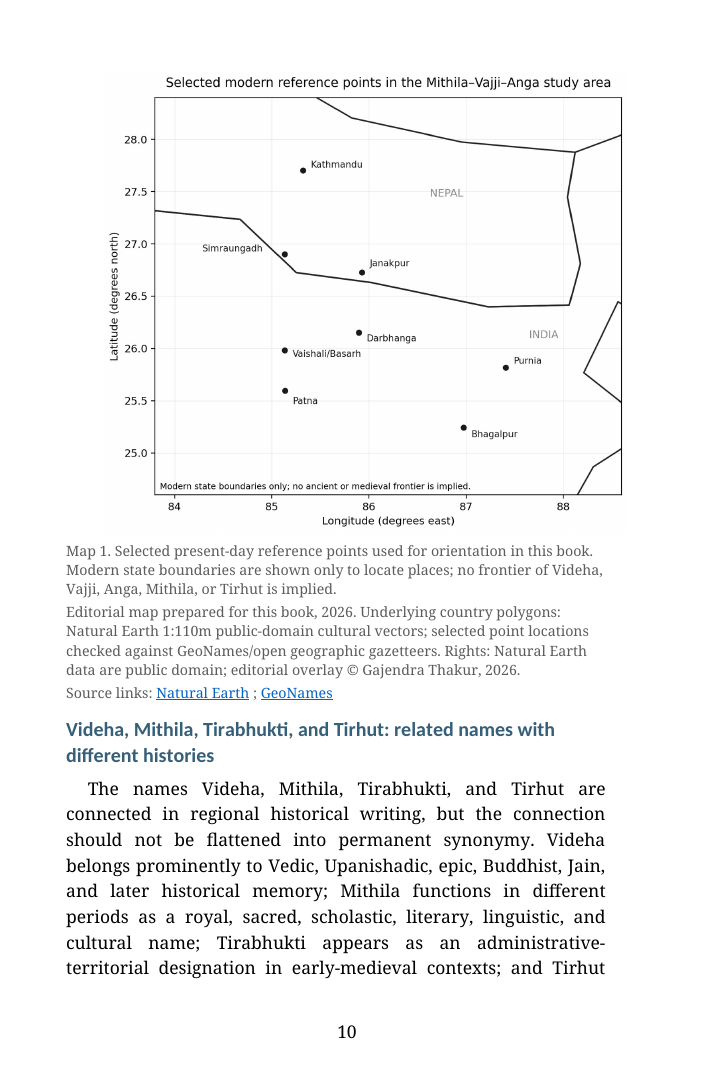
Mithila · Vajji · Anga
Chapter-specific source notes
- Primary chapter witness. Gajendra Thakur, Decoding the Panji of Mithila — Volume VI, formal Chapter 3, PDF pp. 27-37; formal Chapter 3. The HTML transcription is generated from the commit-pinned source PDF and retains the chapter boundary recorded in this edition.
- Internal structure. The repository source-heading inventory records 15 subordinate headings for this chapter: “Opening”; “1. Why Ethics Must Come before Decoding”; “2. Record Is Not Verdict”; “3. Preserving Old Words without Repeating Old Cruelty”; “4. No Present-Day Condemnation”; “5. Women Must Not Be Read as Sources of Pollution”; “6. Community Labels Must Be Historicized”; “7. Unknownness Is Evidence, Not Emptiness”; ….
- Digital editorial method. The page keeps the preserved source text distinct from generated navigational, concordance, visual, and provenance apparatus. The synthetic reconstruction is explanatory only and is not evidence for an individual lineage or a determination of social or marital status.