Decoding the Panji of Mithila · Volume VI · Chapter 4
The Panji System before Fragmentation Purpose of This Chapter
Chapter 4

The Panji System before
Fragmentation
Purpose of This Chapter
    This chapter restores the older shape of Panji before the later
branch divisions made the system appear fragmented. The
structure of this volume places this discussion before
Harisinghdev and before the technical chapters on Uthedh, gotra,
pravara, mool, and the Dushan table. That order is important. A
reader should first understand that Panji was a unified memory-
system, and only then see how it became a set of specialized books,
offices, titles, permissions, and ranked social instruments.
    The main argument is simple: later hierarchy was
historical, not eternal. The Panji system became divided,
classified, and socially ranked over time. The divisions were not
meaningless; they helped organize marriage eligibility, descent,
gotra, village memory, and branch identity. But once these
classifications hardened, they could also produce prestige,
exclusion, dependency, and social damage. Dushan Panji must
therefore be read against the older whole system, not as an
isolated book of blame.

Before Fragmentation: One Archive with Many
Functions
    The source opens by saying that Panji is of seven kinds: मूल,
शाखा, गोत्र, पत्र, दूषण, उतेढ़, and अस्वाजन्यपत्र. This sevenfold list is not
merely a catalogue. It shows that the Panji world had already
become functionally specialized. Yet the functions belong to
one larger archive. Mool Panji remembered root-identity.
Shakha Panji organized branch-lines. Gotra Panji preserved
ritual-ancestral classification. Patra Panji followed descendants

                          © Gajendra Thakur | 36
                Decoding the Panji of Mithila, Volume VI

and moolgram. Dushan Panji recorded lineage rupture. Uthedh
Panji calculated sapinda distance. Aswajanya or Siddhanta-
related writing gave the practical decision that a proposed
marriage could proceed.
    Before these functions were separated into more
specialized books, their social purpose was integrated. The
system asked several questions at once: Who is this person?
From which mool does the family descend? What is the gotra?
What is the village-memory? Which branch is being followed?
Who are the paternal and maternal ancestors? Is there
prohibited kinship? Has any remembered irregularity affected
the line? Can this marriage be approved? In that older frame,
genealogy, ritual rule, administrative decision, and social
memory were not separate disciplines.
    This is why Panji should not be reduced to a marriage
register. Marriage was the most urgent practical use, but the
record carried more than marriage. It preserved old villages,
migration, learning, offices, titles, relations between lineages,
women who entered genealogical memory through marriage or
maternity, and difficult facts that respectable society later
preferred to conceal. The word archive is therefore more
accurate than register. A register lists; an archive remembers.

The Source Statement on Madhav Singh and
Branch Books
    The key source sentence for this chapter concerns
Darbhanga ruler Madhav Singh. It says that the Darbhanga
king ordered the preparation of branch books, and that before
this order the Mool Panji was made in a common form. After
that, separate Shakha Panjis began to be prepared for Soti, Jog,
and Panjibaddha purposes. The same note also names Up-Tip
or Sotipura, Nagaram or Pachhwari Par, Gotra Panji, and Patra
Panji as records written in Mithilakshar.
   This is a major historical clue. It means that the later branch
organization was not the beginning of Panji. It was a later

                       © Gajendra Thakur | 37
                Decoding the Panji of Mithila, Volume VI

arrangement within an older genealogical order. A common
Mool Panji points to a time when root-identity had not yet been
reorganized into separate ranked or functional branch books.
The later Shakha books did not create genealogy; they sorted it.
They turned a broad memory-system into a more differentiated
system of branch recognition.
    The consequence was double. On one side, branch books
made the system more usable. As families multiplied, migrated,
and formed local clusters, one common record could become
unwieldy. Branch organization helped Panjikars navigate a
growing archive. On the other side, branch formation could
support ranking. Once a branch category became socially
charged, genealogy no longer only located a person; it could
elevate or reduce a person in the eyes of society.

Mool Panji as the Older Root-Frame
     Mool Panji stands at the root of the system. In ordinary
speech, mool is often treated as a place-name, but in Panji logic
it is more than geography. It is the remembered root of a
lineage: the point from which later descent, migration, village-
settlement, and branch formation are understood. A mool can
function as both place and genealogical signature.
    The source's statement that earlier Mool Panji was prepared
in a common form suggests that root-identity once operated as
a shared base. It did not yet require the same degree of branch
separation. Families could be traced through common root
memory before later social and administrative classification
required more divided record-keeping. This older root-frame
matters because Dushan entries frequently mention mool
sequences. Without knowing that mool is a genealogical root
and not merely a village label, the Dushan table becomes
opaque.
    Mool also explains how geography becomes genealogy. A
family may move away from its older village. It may settle
elsewhere. Its descendants may become locally identified by a

                       © Gajendra Thakur | 38
                Decoding the Panji of Mithila, Volume VI

later residence. But the Panji preserves the older root so that
scattered people remain connected to the same memory. In this
sense, mool resists the erasure caused by migration. It says: the
family may now live elsewhere, but the line still remembers
where it is genealogically rooted.

Shakha Panji and the Historical Rise of Branch
Identity
    Shakha means branch. A branch is not the root; it is a line
growing out of the root. When a mool becomes large, one root-
name can no longer carry all practical information.
Descendants multiply. Marriages create new links. Some
families settle in new regions. Some acquire office, learning, or
patronage. Some become associated with particular localities.
At that point, branch identity becomes administratively useful.
    The source associates the formal production of separate
Shakha Panjis with Madhav Singh's order. This does not mean
that branches did not exist earlier in social memory; families
naturally branch as generations pass. It means that branch
memory became a formal record category. Once that happened,
branch could be used not only for navigation but also for
classification. The book of memory became a book of sorting.
    This is the beginning of fragmentation in the sense relevant
to this volume. Fragmentation does not mean that Panji
collapsed. It means that the one genealogical universe became
distributed across several book-forms, each with its own
function and social weight. A later reader who sees only one
fragment can mistake it for the whole. The corrective method
of this book is to put the fragments back into relation.

Soti, Jog, and Panjibaddha as Signs of Internal
Classification
   The source says that after the order, separate Shakha Panjis
were made for Soti, Jog, and Panjibaddha purposes. These

                       © Gajendra Thakur | 39
                Decoding the Panji of Mithila, Volume VI

terms require careful handling because they belong to the
internal classification vocabulary of the Panji system. For the
present chapter, their importance lies in what they reveal
structurally: the archive had begun to classify Maithil Brahmin
society into internal groups for record use.
    Such classification was not automatically immoral. A
complex marriage system needed clear information. If the
archive did not distinguish branches, lines, and statuses, a
Panjikar could not reliably decide eligibility. But the same
classification could become socially dangerous when it became
a basis for hierarchy. Then the practical record became a rank-
producing record. A category first used to organize information
could later be used to organize prestige.
    This is why the architecture of the volume places this
chapter before the later critique of hierarchy and social
damage. The social damage did not arise from memory alone. It
arose when memory, ranking, marriage control, and
institutional authority fused into a rigid system. To critique that
outcome responsibly, the reader must first see how the branch
structure emerged from the older common record.

Gotra, Patra, Dushan, Uthedh, and Aswajanya
inside the Same Ecology
    Once the Panji system is seen as an ecology, the seven
named forms become easier to understand. Gotra Panji records
gotra and ancient mool. Patra Panji records descendant
knowledge and later includes moolgram. Dushan Panji records
lineage rupture or defect. Uthedh Panji gives knowledge of
sapinda-nivritti and mentions six ancestors. Aswajanya or
Siddhanta-related writing gives the practical marriage decision
by showing that the proposed bride and groom are not
prohibited kin.
   These books are different, but they answer connected
questions. Gotra alone cannot decide marriage. Mool alone
cannot decide marriage. Branch alone cannot decide marriage.

                       © Gajendra Thakur | 40
                Decoding the Panji of Mithila, Volume VI

A Dushan mark alone cannot decide marriage. Sapinda
calculation alone may not be enough if the maternal or marital
route is obscure. The Panjikar needed to synthesize all these
layers. The system worked because it was relational, not
because one label contained the whole truth.
    This ecological reading is especially important for Dushan
Panji. A Dushan entry may appear as a small note about a
mother, wife, daughter, caste label, Muslim connection, widow,
unknown lineage, or community-marked marriage. But that
note has meaning only when joined to mool, gotra, branch,
descent, and marriage eligibility. Isolating Dushan from the rest
of Panji turns evidence into stigma. Reconnecting it to the
whole system turns stigma back into historical information.

Panji as Social Technology
    A modern reader may call Panji a genealogy, but that is only
one part of its function. Panji was also a social technology. It
stored information in a form that could be used to make
decisions. It enabled a family to ask: is this marriage permitted?
It enabled a Panjikar to answer by comparing ancestry, mool,
gotra, maternal connection, branch, and sapinda distance. It
gave written force to social memory.
    This technology had three powers. First, it could protect. It
prevented close-kin marriage and preserved long genealogical
memory. Second, it could connect. It kept scattered descendants
tied to old roots and allowed lineages to remember migration.
Third, it could control. Because marriage, status, and social
recognition depended on Panjikar knowledge, the archive
could become an instrument of dependency and hierarchy.
    The same structure therefore contains both value and
danger. Without Panji, much of Mithila's long genealogical
memory would have vanished. With Panji, memory survived,
but it could also be used to judge, rank, exclude, or humiliate. A
serious reading must hold both facts together. The aim is not to

                       © Gajendra Thakur | 41
                Decoding the Panji of Mithila, Volume VI

romanticize Panji and not to condemn it simplistically, but to
decode how it worked.

Why Later Hierarchy Was Historical, Not
Eternal
    The central claim of the structure of this volume for this
chapter is that later hierarchy was historical, not eternal. This
claim matters because genealogical systems often present later
arrangements as if they were timeless. Once a rank is written,
descendants may imagine that the rank always existed. Once a
branch is honored, people may think the honor belongs to cosmic
order rather than to social history. Panji evidence itself
complicates such claims.
    The note on Madhav Singh shows change. Before his order,
Mool Panji existed in common form; afterward, separate
branch books began to be made for Soti, Jog, and Panjibaddha
purposes. This is not a minor administrative detail. It proves
that the system had a before and an after. Branch distinction
had a history. The arrangement could be made, remade, and
interpreted. It was not beyond time.
    Dushan Panji also challenges eternal hierarchy. Its entries
show that lineages touched unknown women, Dalit and artisan
communities, Muslim-linked women, widows, servants,
migrants, and other socially difficult routes. If purity were
eternal, such entries would either not exist or would erase the
descendants permanently. But the source also preserves
generational absorption, including the possibility of a later
descendant being recorded as fully purified. The archive
therefore remembers both rupture and reintegration.

Fragmentation and the Danger of Partial
Reading
   Fragmentation creates a reading danger. A person who
reads only the branch book may see rank without root. A
person who reads only Gotra Panji may see ritual ancestry

                       © Gajendra Thakur | 42
                Decoding the Panji of Mithila, Volume VI

without social history. A person who reads only Dushan Panji
may see defect without the wider marriage logic. A person who
reads only Uthedh may see calculation without memory. Each
partial reading can produce error.
     This is why the corrective work of this volume must be
structural. It cannot merely translate Dushan entries into
modern prose. It must show the full record-world in which
those entries operate. A Dushan note is not a loose accusation.
It is an index to a relationship route. It points backward to mool
and gotra, sideways to marriage and maternal connection, and
forward to descendants and social absorption.
    The danger of partial reading is also ethical. If a Dushan
entry is detached from its Panji ecology, it can be weaponized
against living descendants. If it is placed back inside the whole
system, it becomes evidence of social history: movement,
interdependence, vulnerability, gendered memory, and the
instability of rigid purity claims.

How This Chapter Prepares the Next Stage
    This chapter prepares the next three structural chapters of the
volume. Chapter 5 will turn to Harisinghdev, the Panjikars, and the
official beginning of the system. Chapter 6 will explain Uthedh,
Sapinda, Swajana, and marriage eligibility. Chapter 7 will give the
grammar of Gotra, Pravara, Mool, and Moolgram. These chapters
belong together because they build the reader's equipment before
the Dushan table is decoded.
    The reader should now carry one principle forward:
Dushan Panji is not an isolated black book. It is one part of a
larger Panji ecology. Its meaning depends on the system before
fragmentation, the later branch order, the marriage decision
process, and the ethical responsibility of interpretation. Only
with that whole frame can the 97 Dushan entries be read
without confusion or cruelty.

                       © Gajendra Thakur | 43
                      Decoding the Panji of Mithila, Volume VI

Conclusion: Reuniting the Fragments
   The Panji system before fragmentation was a unified
archive of memory, identity, descent, and permission. Later it
became a network of specialized books: Mool, Shakha, Gotra,
Patra, Dushan, Uthedh, and Aswajanya or Siddhanta-related
records. Specialization made the system powerful, but it also
made misunderstanding possible. When one part is isolated
from the others, Panji can become myth, rank, stigma, or
accusation. When the parts are reunited, Panji becomes history.
    For this volume, the lesson is decisive. The Dushan record
must be decoded as part of the whole Panji system. Its entries
reveal rupture, but also memory. They reveal stigma, but also
absorption. They reveal hierarchy, but also evidence against
the fantasy of closed purity. The next chapter will therefore
move from the pre-fragmentation system to institutional
authority: Harisinghdev, the Panjikars, and the official
beginning of the Panji order.

Chapter 4 Source Notes
The sevenfold division of Panji into Mool, Shakha, Gotra, Patra,
Dushan, Uthedh, and Aswajanya/Siddhanta-related records
follows the opening definition in the Dushan Panji source.
The discussion of Madhav Singh, the earlier common Mool Panji,
and the later separate Shakha Panjis for Soti, Jog, and
Panjibaddha purposes follows the source statement on branch-
book preparation.
The definitions of Gotra Panji, Patra Panji, Dushan Panji, and
Uthedh Panji follow the source's concise descriptions: gotra and
ancient mool; moolgram and descendant knowledge; lineage
rupture; and sapinda-nivritti through six ancestors.
The chapter's claim that later hierarchy was historical, not eternal, follows the structure
of Chapter 4 and the source's description of a shift from common Mool Panji to
separate branch books.

                              © Gajendra Thakur | 44
                     Decoding the Panji of Mithila, Volume VI

The ethical method - reading Dushan Panji inside the full Panji ecology rather than as
an isolated stigma-book - follows the interpretive rules established in Chapters 2 and 3
of this manuscript.

                              © Gajendra Thakur | 45
               Decoding the Panji of Mithila, Volume VI
Source structure and verification apparatus
Editorial source apparatus. This apparatus is descriptive, not interpretive. It records the source-controlled structure used to verify that this page corresponds to formal Chapter 4 of Decoding the Panji of Mithila — Volume VI. The chapter text above is preserved from PDF pp. 37-47; formal Chapter 4 in the commit-pinned authoritative source. It is not merged with a neighboring chapter, appendix, annexure, or independent front/back-matter unit. The internal headings below come from the repository’s source-heading inventory and are retained as navigational and audit evidence; showing them here does not turn those headings into separate publications or add claims that are absent from the source.
Internal source headings
- Purpose of This Chapter
- Before Fragmentation: One Archive with Many Functions
- The Source Statement on Madhav Singh and Branch Books
- Mool Panji as the Older Root-Frame
- Shakha Panji and the Historical Rise of Branch Identity
- Soti, Jog, and Panjibaddha as Signs of Internal Classification
- Gotra, Patra, Dushan, Uthedh, and Aswajanya inside the Same Ecology
- Panji as Social Technology
- Why Later Hierarchy Was Historical, Not Eternal
- Fragmentation and the Danger of Partial Reading
- How This Chapter Prepares the Next Stage
- Conclusion: Reuniting the Fragments
- Chapter 4 Source Notes
Source-text concordance
System · Fragmentation · Purpose · restores · older · shape · later · branch · divisions · made · appear · fragmented · structure · places · discussion · Harisinghdev · technical · chapters · Uthedh · gotra · pravara · mool · Dushan · table · order · important · reader · first · understand · unified · memory · became · specialized · books · offices · titles · permissions · ranked · social · instruments · main · argument · simple · hierarchy · historical · eternal · divided · classified · socially · time · meaningless · helped · organize · marriage · eligibility · descent · village · identity · classifications · hardened · produce · prestige · exclusion · dependency · damage · must · therefore · read · whole · isolated · book · blame · Archive · Many · Functions · opens · saying · seven · kinds · sevenfold
Boundary verification. In the formal sequence this chapter follows Volume VI Chapter 3, “The Ethics of Decoding: Record, Stigma, and Historical Justice Opening” and precedes Volume VI Chapter 5, “Harisinghdev, the Panjikars, and the Official Beginning of the System”. The chapter extractor begins at the verified formal Chapter 4 marker and stops at the next verified formal chapter marker; for a final chapter it stops before recognized book-level back matter. The concordance above is generated only from distinct terms already present in this chapter’s preserved source text. It is provided for discovery, comparison, and audit, not as an automated judgment about persons, lineages, status, kinship, marriage eligibility, or historical truth.
Illustrated research apparatus
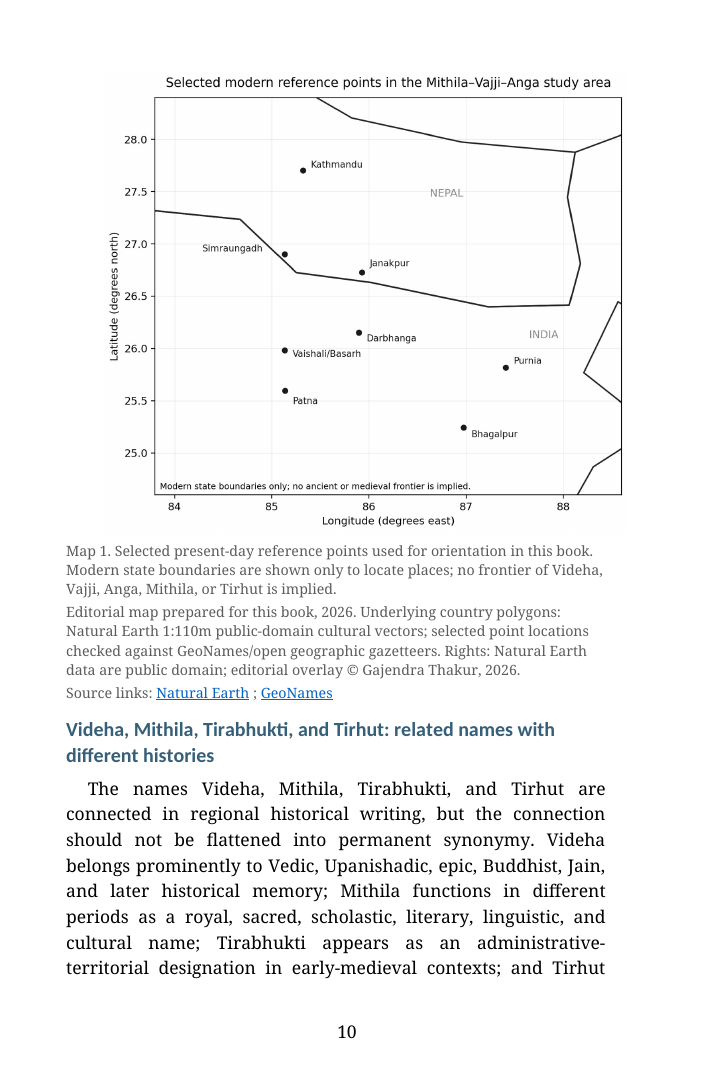
Mithila · Vajji · Anga
Chapter-specific source notes
- Primary chapter witness. Gajendra Thakur, Decoding the Panji of Mithila — Volume VI, formal Chapter 4, PDF pp. 37-47; formal Chapter 4. The HTML transcription is generated from the commit-pinned source PDF and retains the chapter boundary recorded in this edition.
- Internal structure. The repository source-heading inventory records 13 subordinate headings for this chapter: “Purpose of This Chapter”; “Before Fragmentation: One Archive with Many Functions”; “The Source Statement on Madhav Singh and Branch Books”; “Mool Panji as the Older Root-Frame”; “Shakha Panji and the Historical Rise of Branch Identity”; “Soti, Jog, and Panjibaddha as Signs of Internal Classification”; “Gotra, Patra, Dushan, Uthedh, and Aswajanya inside the Same Ecology”; “Panji as Social Technology”; ….
- Digital editorial method. The page keeps the preserved source text distinct from generated navigational, concordance, visual, and provenance apparatus. The synthetic reconstruction is explanatory only and is not evidence for an individual lineage or a determination of social or marital status.