Decoding the Panji of Mithila · Volume VI · Chapter 5
Harisinghdev, the Panjikars, and the Official Beginning of the System
Chapter 5
 Harisinghdev, the Panjikars, and the Official Beginning of
                        the System

Opening
    The official beginning of the Panji system is inseparable
from the name of Maharaj Harisinghdev. In the memory
preserved by the source material, he is not merely a king
mentioned in passing. He is the ruler under whose inspiration
the scattered, private, family-held knowledge of descent was
brought into a regulated public order. To understand Dushan
Panji, therefore, one must first understand why Panji needed
an official beginning at all. A Dushan entry is not an isolated
accusation. It is a notation inside a larger system that first
learned how to ask: who is related to whom, through which
line, from which mool, under which gotra, and with what
marital right?
    The source places Harisinghdev in the Karnata line of
Mithila and connects his reign with the institutionalization of
Panji among Brahmins, Karna Kayasthas, and Kshatriyas. It
says that, under his inspiration, learned men of Mithila decided
in Shaka 1248, corresponding to 1326 CE, to give the Panji
system its current organized form. This detail matters because
the Panji system was not presented as a casual village
notebook. It was a socially authorized archive, linked with rule,
scholarship, marriage, descent, and the power to certify
eligibility.
    In this chapter every term in that statement must be
unpacked: Harisinghdev, Karnata, Panjikar, Paricheta,
Aswajana letter, Siddhanta letter, Swajana, mool, gotra,
pravara, biji purush, and the official decision to preserve
lineage through trained record-keepers. Once these terms
become clear, the reader can see why Dushan Panji became
possible. Only a system that had first defined legitimate

                      © Gajendra Thakur | 46
                Decoding the Panji of Mithila, Volume VI

relationship could later record the cases that appeared to cross
or disturb that legitimacy.

From Family Memory to Public Archive
    Before the official Panji system, families were expected to
remember their own descent. Such memory was not a
decorative matter. It was necessary for marriage, ritual,
inheritance, social standing, and the avoidance of prohibited
kinship. A family had to know the father’s line, the mother’s
line, the grandmother’s line, the village of origin, the gotra, and
the broader circle of persons with whom marriage would be
treated as forbidden. In a small society this may have been
manageable. In a wide region with migration, settlement,
multiple branches, and repeated inter-village marriage, private
memory gradually became unreliable.
    The source describes this older condition through the idea
of परिचय, or identity-knowledge. परिचय means more than a name.
It means the structured knowledge by which a person is placed
inside a lineage: whose child, whose grandchild, from which
mool, under which gotra, connected to which maternal and
paternal ancestors, and resident in which settlement. When the
source says that people once kept their own यावतो परिचय, it
means they preserved as much genealogical and marital
identity as was necessary for social and ritual decisions.
    Over time this habit declined. The source explains that, by
the late thirteenth and early fourteenth century, even learned
men were no longer reliably preserving group genealogical
records. This created danger. A marriage might occur between
persons who were too closely related by gotra, sapinda, or
family descent. In Panji language, such a forbidden person was
स्वजना: one’s own relation, a person within the prohibited circle.
The central practical question before marriage was therefore:
is the proposed bride स्वजना or अस्वजना? If she is swajana, the

                       © Gajendra Thakur | 47
               Decoding the Panji of Mithila, Volume VI

marriage is prohibited. If she is aswajana, the marriage may
proceed.
    The need for a public archive arose from this crisis. A
society that had become too wide for memory required
specialists who could gather, preserve, verify, and certify
descent. Panji, in this sense, was the transformation of private
memory into public record.

Harisinghdev in the Source Tradition
    Maharaj Harisinghdev is presented in the source as a ruler
of the Karnata dynasty of Mithila. The Karnata dynasty,
according to the same source passage, descends from
Nanyadev. Harisinghdev is described as born in 1294 CE, placed
on the throne in 1307 CE, and later forced to flee to Nepal after
defeat by Ghiyasuddin Tughlaq in 1324-25 CE. Whether the
reader approaches this statement as dynastic history, Panji
tradition, or historical memory, its function in this book is
clear: Harisinghdev stands at the point where lineage
knowledge became an institution.
    The source does not make him the writer of every Panji
book. Rather, it makes him the royal inspirer and
administrative patron of a system. That distinction is
important. A king’s role was to create authority, continuity, and
enforceable trust. The actual work of collection, recording, and
certification belonged to appointed learned men. This division
between royal authority and scholarly record-keeping explains
how Panji could become both a social document and an official
instrument.
   The source names three appointments in connection with
Harisinghdev’s system: Gunakar Jha for Maithil Brahmins,
Shankardatt for Karna Kayasthas, and Vijayadatt for
Kshatriyas. The detail is crucial because it shows that the Panji
order was not imagined as a single caste-only register in its
earliest official framing. It was a wider genealogical mechanism

                      © Gajendra Thakur | 48
                Decoding the Panji of Mithila, Volume VI

for communities whose marriage and descent practices
required formal verification.
    For Volume VI, this means that Dushan Panji must not be
treated as an accidental appendix. It belongs to a broader
institutional culture in which marriage eligibility, descent, and
social status were documented with great seriousness. Dushan
Panji is the difficult side of that same seriousness.

Who Were the Panjikars?
    The Panjikar was the specialist entrusted with Panji
knowledge. The word may be translated loosely as genealogical
registrar, but that translation is incomplete. A registrar records;
a Panjikar also interprets. A registrar files names; a Panjikar
connects names, mools, gotras, maternal lines, and
generational distances. A registrar may not decide ritual
eligibility; a Panjikar had to decide whether a proposed
marriage was permitted under the inherited rules of the
system.
    The Panjikar’s function rested on trust. The source later
criticizes the decline of Panjikar truthfulness, the rise of self-
interest, and the birth of the Bikaua class. That criticism only
makes sense because the original Panjikar was expected to be
selfless, reliable, and truthful. The Panjikar’s authority came
not merely from possession of a book but from the confidence
that the record had been preserved honestly and applied
without purchase, pressure, or factional bias.
   A related word is परिचेता, a collector or identifier of lineage.
The source explains that appointed persons moved from family
to family, asked the principal people of each household for
their known ancestry, and recorded what could be known.
Some families knew six generations. Others knew more. Some
knew only two or three. The task was not to invent missing
ancestors but to collect what was known and place it in a
systematic relation with gotra, mool, pravara, ancient
residence, and present branch.

                       © Gajendra Thakur | 49
                 Decoding the Panji of Mithila, Volume VI

    This is the first rule for reading Panji: the archive is built
out of remembered and collected identity. It is powerful, but it
is not magic. It records what the community, the household,
and the Panjikar could gather, verify, and transmit. Dushan
Panji therefore must be read as a record of social knowledge,
not as a divine verdict.

The Aswajana or Siddhanta Letter
    The most practical product of the Panji system was the
अस्वजन पत्र, also called the सिद्धान्त पत्र. The source explains that a
marriage should be fixed only after the appointed Panjikar has
examined the right and written that the proposed bride and
groom are not swajana. In plain language, the Siddhanta letter
was a certificate of marriage eligibility. It said: these two
persons are not within the prohibited kinship circle according
to the rules being applied.
    The word सिद्धान्त means decision, conclusion, or settled
determination. In this context it is not an abstract philosophy. It
is a written decision that a particular marriage may proceed.
The word अस्वजन means not one’s own prohibited kin. The letter
therefore does not simply praise the match; it clears the match
from the suspicion of forbidden closeness. It converts
genealogical information into a practical permission.
    The entire Panji apparatus exists around this need. Gotra
identifies descent from an ancient named ancestor. Pravara
identifies the line of revered seers invoked in ritual and used in
marriage restriction. Mool identifies the ancient source-village
or lineage-root. Moolgram preserves the village connected with
a lineage’s early known settlement. Biji purush identifies the
earliest known ancestor from whom a branch is traced. Uthedh
checks the relevant generations in the marriage decision.
Together these pieces answer one question: do the bride and
groom stand too near each other in the system of kinship?

                        © Gajendra Thakur | 50
               Decoding the Panji of Mithila, Volume VI

    Dushan Panji becomes intelligible only against this
background. If the system produced a letter saying who is
aswajana, it also needed a memory of cases that produced
difficulty: unknown mother, prohibited maternal line, mixed
social origin, widow remarriage, Devadasi line, Yavani
connection, Dalit or artisan connection, or other recorded
irregularity. Dushan Panji is not separate from the Siddhanta
world; it is its shadow record.

Gotra, Mool, Pravara, and Biji Purush as
Administrative Units
    It is tempting to read gotra, mool, pravara, and biji purush
as purely religious vocabulary. In Panji they are also
administrative units. They allow information to be sorted.
Without such categories, the Panjikar would face thousands of
names without structure. With these categories, each person
can be placed in a grid: gotra, mool, branch, village, ancestor,
father, mother, spouse, offspring, and marriage eligibility.
    Gotra is the broad descent-sign. In Maithil usage, it
identifies the ancient male ancestor after whom a line is
named. Pravara narrows or ritualizes the identity through a set
of ancestral seers. Mool points to the lineage-root, often linked
with an older village or origin-point. Moolgram, when
recorded, locates the branch in remembered geography. Biji
purush, literally the seed-person or founding male ancestor,
gives the line a first known human point from which
descendants can be traced.
    The source describes the collection process by saying that
the ancient residence, gotra, pravara, Veda, and branch were
written down. This is a full identity profile. It is not only a
name-list. Such a profile makes it possible to distinguish two
persons with the same name, to connect families living in
different villages, and to identify whether a proposed marriage
repeats a hidden relation through the maternal or paternal
line.

                      © Gajendra Thakur | 51
                Decoding the Panji of Mithila, Volume VI

   This is why Dushan entries often look compressed. They
presume that the reader already understands the grid. A
sequence of names and mools is not random. It is a coded map.
The later chapters of this volume will therefore decode each
Dushan case by restoring the invisible grammar behind the
record.

Royal Authority and Scholarly Responsibility
   The Panji system required two kinds of authority. First, it
required royal authority. Without royal recognition, a
Panjikar’s decision could have remained only private advice.
With royal recognition, the decision became part of a public
order. The source’s phrase that appointed Panjikars worked
under royal command means that the record had an official
dignity. It could be demanded, consulted, and used in marriage
decisions across households and villages.
    Second, the system required scholarly authority. The
Panjikar needed knowledge of dharmashastra, local custom,
gotra, pravara, mool, and the practical reading of old entries. A
king could order the system, but he could not personally
interpret every lineage. That work belonged to the learned
specialists. The Panji archive thus stands at the meeting point of
rule and learning: राजाज्ञा and शास्त्रबोध.

    This meeting point explains both the strength and danger of
Panji. Its strength was continuity. A marriage decision could
draw upon centuries of accumulated information. Its danger
was monopoly. Whoever controlled the book controlled
eligibility, rank, and sometimes humiliation. When the source
later laments internal stratification, decline of truthfulness, and
the rise of exploitative classes, it is pointing to the misuse of an
authority originally justified by social necessity.
   For a modern reader, this means we must neither
romanticize nor dismiss the institution. Panji preserved a
remarkable quantity of historical information. At the same

                       © Gajendra Thakur | 52
               Decoding the Panji of Mithila, Volume VI

time, it could become an instrument of exclusion. Volume VI
reads Dushan Panji with both truths in view.

Why Harisinghdev Matters for Dushan Panji
    Harisinghdev matters to Dushan Panji because he
represents the transition from memory to rule. Dushan Panji
could not exist as a meaningful category unless there was first a
recognized standard from which a case could be judged
irregular. The official Panji system created such standards:
mool, gotra, swajana, aswajana, sapinda, branch, and marriage
eligibility. Dushan entries are the records of cases where these
standards faced difficulty.
    This does not mean that every Dushan entry should be read
as moral failure. The word dushan belongs to the old
classificatory language of the archive. A modern decoding must
ask what the entry reveals historically: a marriage across caste,
a widow’s remarriage, a child born through a maternal line
later treated as doubtful, a Muslim or Yavani connection, a
Devadasi or Dasi line, a remembered daughter’s offspring, or
an unknown ancestor. The institutional system gave these cases
a place in the record. The ethical historian gives them
explanation.
    The Harisinghdev chapter therefore prepares the reader for
the hardest part of the book. Later chapters will name
communities and persons recorded under stigmatizing
categories. The reader must remember that those categories
were produced by an official system of marriage eligibility. The
task here is not to intensify stigma but to understand how the
system recorded it, how time dissolved it, and how actual
Mithila society proved more mixed and mobile than purity
ideology admitted.
   In this sense Harisinghdev is not merely a dynastic name.
He is the symbolic beginning of the archive that made the Black
Book legible.

                      © Gajendra Thakur | 53
                Decoding the Panji of Mithila, Volume VI

The Date 1326 CE and the Meaning of an Official
Beginning
    The source gives Shaka 1248, corresponding to 1326 CE, as
the year in which the learned men of Mithila decided to place
the Panji system in its current form. A date in a genealogy text
is never merely chronological. It gives authority to the record. It
says: this system is not an afterthought; it has a remembered
beginning in public decision.
    The phrase current form should be read carefully. It does
not mean that people had no lineage knowledge before 1326
CE. The source itself refers to older practices of keeping परिचय
and to earlier group writings. The date marks institutional
consolidation. What had existed in household memory, group
notes, and lineage awareness was gathered into a more durable
administrative system.
   This is why the Panji system could later absorb multiple
kinds of books: Mool Panji, Gotra Panji, Patra Panji, Shakha
Panji, Uthedh Panji, Dushan Panji, and Aswajana or Siddhanta
documents. The official beginning did not create every later
sub-book at once. It created the logic by which such books
became necessary and meaningful.
    For Dushan Panji, the date gives the archive historical
depth. The so-called Black Book is not a gossip-list from a recent
quarrel. It belongs to a long record-keeping civilization. Its
entries must therefore be treated with the seriousness given to
difficult historical evidence.

Conclusion: The Beginning of a Difficult Archive
    Chapter 5 has shown that the Panji system was born from
the need to preserve identity beyond the limits of memory.
Harisinghdev’s remembered role was to give public authority
to that preservation. Panjikars gathered descent. Parichetas
identified families. Gotra, pravara, mool, and biji purush

                       © Gajendra Thakur | 54
                Decoding the Panji of Mithila, Volume VI

organized the data. The Siddhanta or Aswajana letter converted
genealogical knowledge into a marriage decision.
    Dushan Panji emerged from this same world. It is not a
separate scandal-book outside Panji. It is the difficult register
within Panji’s own logic. If the system asked who may marry
whom, it also had to remember the cases that made the answer
complicated. Unknown descent, cross-community marriage,
widow remarriage, daughter-line descent, Devadasi or Dasi
lineage, Yavani connection, and artisan or Dalit connection all
entered the record because the system was forced to face real
society.
    The official beginning of Panji therefore leads directly to the
moral beginning of this volume. To decode Dushan Panji is to
read the archive honestly, explain every technical term,
preserve the record, and release descendants from the burden
of old classificatory shame. The Black Book is black only if it is
hidden. Once decoded, it becomes one of Mithila’s most difficult
but most revealing historical mirrors.

Chapter 5 Source Notes
  Source note 1: The account of Maharaj Harisinghdev as a ruler
  of the Karnata line, connected with Nanyadev's dynasty and
  with the official beginning of Panji-Prabandh, follows the
  Harisinghdev section in the Dushan Panji source.
  Source note 2: The appointments of Gunakar Jha for Maithil
  Brahmins, Shankardatt for Karna Kayasthas, and Vijayadatt
  for Kshatriyas follow the same source passage on the
  institutional beginning of the Panji system.
  Source note 3: The decision in Shaka 1248 / 1326 CE follows the
  source statement that the learned men of Mithila, under
  Harisinghdev's inspiration, resolved to place lineage-
  knowledge under appointed specialists rather than leave it
  only to private family memory.

                       © Gajendra Thakur | 55
              Decoding the Panji of Mithila, Volume VI

Source note 4: The explanation of the Panjikar as the appointed
verifier of marital eligibility follows the source explanation
that marriage should be fixed only when the appointed
Panjikar writes that the proposed bride and groom are not
स्वजना.

Source note 5: The explanation of अस्वजन पत्र / सिद्धांत पत्र follows
the same source passage, where the letter certifies that the
proposed marriage is permitted under the inherited rules of
kinship and marriage eligibility.
Source note 6: The description of Panji as a gathered record of
births, marriages, and lineage-identity follows the source
explanation that the collected परिचय, with each new birth and
marriage added, became Panji, and those entered in it became
पञ्जीबद्ध.

Source note 7: The discussion of later distortion, branch
division, social hierarchy, and the contrast with Harisinghdev's
initial scientific genealogical frame follows the later source
statement contrasting Harisinghdev's system with the later
Madhav Singh-era branch arrangement.
Source note 8: The chapter's ethical reading follows the
controlling method of this rebuilt manuscript: old
classificatory terms are archive-language and must not be
reused as present-day moral condemnation.

                     © Gajendra Thakur | 56
                Decoding the Panji of Mithila, Volume VI
Source structure and verification apparatus
Editorial source apparatus. This apparatus is descriptive, not interpretive. It records the source-controlled structure used to verify that this page corresponds to formal Chapter 5 of Decoding the Panji of Mithila — Volume VI. The chapter text above is preserved from PDF pp. 47-58; formal Chapter 5 in the commit-pinned authoritative source. It is not merged with a neighboring chapter, appendix, annexure, or independent front/back-matter unit. The internal headings below come from the repository’s source-heading inventory and are retained as navigational and audit evidence; showing them here does not turn those headings into separate publications or add claims that are absent from the source.
Internal source headings
- From Family Memory to Public Archive
- Harisinghdev in the Source Tradition
- Who Were the Panjikars?
- The Aswajana or Siddhanta Letter
- Gotra, Mool, Pravara, and Biji Purush as Administrative Units
- Royal Authority and Scholarly Responsibility
- Why Harisinghdev Matters for Dushan Panji
- The Date 1326 CE and the Meaning of an Official Beginning
- Conclusion: The Beginning of a Difficult Archive
- Chapter 5 Source Notes
Source-text concordance
Harisinghdev · Panjikars · Official · Beginning · System · Opening · inseparable · name · Maharaj · memory · preserved · material · merely · king · mentioned · passing · ruler · whose · inspiration · scattered · private · family-held · knowledge · descent · brought · regulated · public · order · understand · Dushan · therefore · must · first · needed · entry · isolated · accusation · notation · inside · larger · learned · related · line · mool · gotra · marital · right · places · Karnata · connects · reign · institutionalization · Brahmins · Karna · Kayasthas · Kshatriyas · says · decided · Shaka · corresponding · give · current · organized · form · detail · matters · presented · casual · village · notebook · socially · authorized · archive · linked · rule · scholarship · marriage · power · certify · eligibility
Boundary verification. In the formal sequence this chapter follows Volume VI Chapter 4, “The Panji System before Fragmentation Purpose of This Chapter” and precedes Volume VI Chapter 6, “Uthedh, Sapinda, Swajana, and the Logic of Marriage Eligibility Opening”. The chapter extractor begins at the verified formal Chapter 5 marker and stops at the next verified formal chapter marker; for a final chapter it stops before recognized book-level back matter. The concordance above is generated only from distinct terms already present in this chapter’s preserved source text. It is provided for discovery, comparison, and audit, not as an automated judgment about persons, lineages, status, kinship, marriage eligibility, or historical truth.
Illustrated research apparatus
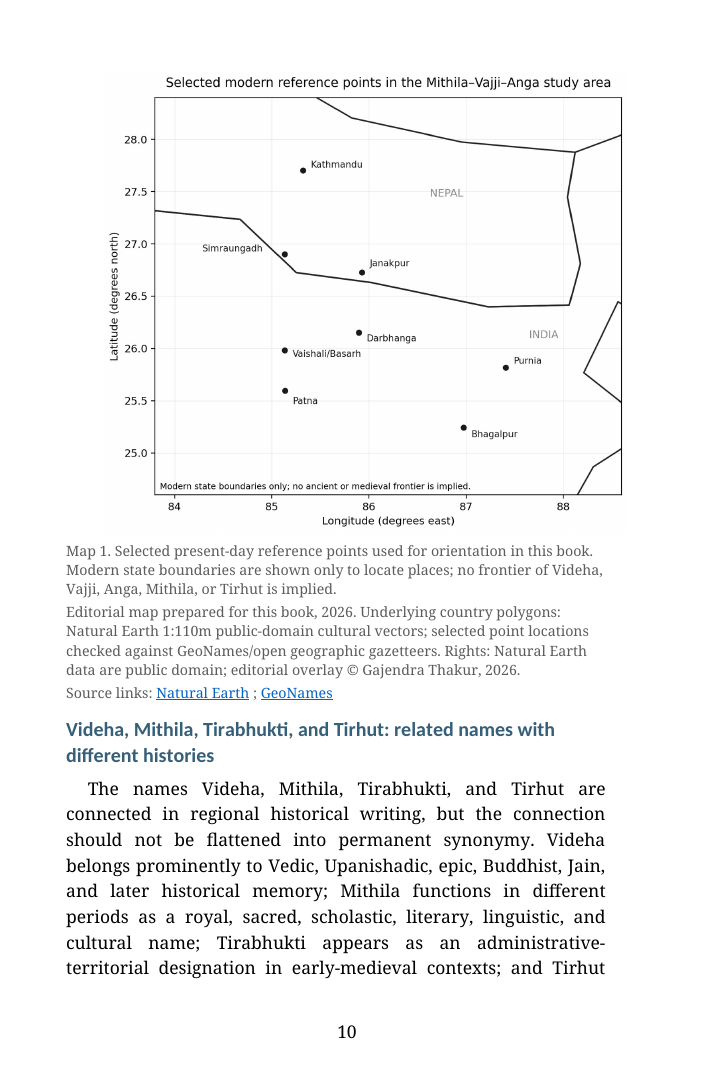
Mithila · Vajji · Anga
Chapter-specific source notes
- Primary chapter witness. Gajendra Thakur, Decoding the Panji of Mithila — Volume VI, formal Chapter 5, PDF pp. 47-58; formal Chapter 5. The HTML transcription is generated from the commit-pinned source PDF and retains the chapter boundary recorded in this edition.
- Internal structure. The repository source-heading inventory records 10 subordinate headings for this chapter: “From Family Memory to Public Archive”; “Harisinghdev in the Source Tradition”; “Who Were the Panjikars?”; “The Aswajana or Siddhanta Letter”; “Gotra, Mool, Pravara, and Biji Purush as Administrative Units”; “Royal Authority and Scholarly Responsibility”; “Why Harisinghdev Matters for Dushan Panji”; “The Date 1326 CE and the Meaning of an Official Beginning”; ….
- Digital editorial method. The page keeps the preserved source text distinct from generated navigational, concordance, visual, and provenance apparatus. The synthetic reconstruction is explanatory only and is not evidence for an individual lineage or a determination of social or marital status.