Decoding the Panji of Mithila · Volume VI · Chapter 6
Uthedh, Sapinda, Swajana, and the Logic of Marriage Eligibility Opening
Chapter 6

Uthedh, Sapinda, Swajana, and the
Logic of Marriage Eligibility
Opening
Chapter 6 turns from the public beginning of Panji to the
technical logic that made the system necessary. The earlier
chapter showed that the Panjikar became important because
marriage could no longer safely depend on private memory
alone. This chapter asks what that memory had to measure.
The answer is: gotra, pravara, mool, swajana, aswajana,
sapinda distance, and the written decision that a proposed
marriage was valid.
This chapter requires the discussion of seven generations, five
maternal generations, six paternal generations, gotra, pravara,
mool, swajana, aswajana, and the Siddhanta letter. These are not
ornamental words. They are the operating grammar of the Panji
system. Without them, Dushan Panji looks like a list of names and
humiliating labels. With them, it becomes a record of how a society
measured kinship, danger, permission, prohibition, and later
repair.
The source states the principle directly: for marriage, the
complete identity of the bride and groom was necessary.
Sapinda consideration was not only a marriage matter; it also
mattered for ritual duties such as shraddha and periods of
impurity. Thus lineage information was a religious, social, and
administrative necessity. Panji arose because that necessity had
to be remembered with accuracy over time.

What Is Uthedh?
The term उतेढ़ refers to the removal, distance, or exclusion of
sapinda proximity. In the sevenfold classification of Panji, उतेढ़

                       © Gajendra Thakur | 57
                Decoding the Panji of Mithila, Volume VI

पञ्जी is the book through which knowledge of sapinda nivritti is
obtained. The source says that six ancestors are recorded for
this purpose. In other words, Uthedh Panji is not a decorative
supplement. It is one of the practical instruments by which the
community decided whether two persons were too close in
lineage to marry.
The word must be understood in relation to movement across
generations. A family may be connected to another family, but
the question for marriage is not merely whether there is any
connection. The technical question is whether the connection
falls within the prohibited range. Uthedh is the record by which
that distance is checked. It translates memory into rule.
This is also why Dushan Panji repeatedly marks maternal lines,
daughters, unknown mothers, widows, and unions outside the
standard frame. A disturbance in known descent is not only a
moral category in the old vocabulary; it is a problem for
calculation. If a mother is unknown, if a maternal house is not
traceable, if a daughter-line crosses a known boundary, or if a
widow-related birth enters a line, then marriage eligibility can
become uncertain for later generations.

Sapinda: Kinship as Measured Nearness
Sapinda means kinship within a recognized ritual and
genealogical nearness. The source passage on marriage rules
states that, according to Manu and Yajnavalkya, marriage-right
existed only when the proposed bride was not of the same
gotra, not of the same pravara, not sapinda of the mother, not
sapinda of the father, not the offspring of paternal or maternal
grandparents, and not within another prohibited close relation.
The exact force of these rules belongs to dharmashastra, but
Panji made the rules usable in ordinary life.
For the historian, the important point is that Panji is not merely
a memory of pride. It is also a memory of prohibition. A lineage
register tells a family who it is; an Uthedh register tells a family

                       © Gajendra Thakur | 58
                 Decoding the Panji of Mithila, Volume VI

where it must not marry. Both functions are essential. The
same archive that creates identity also creates distance.
This explains the intensity of the old vocabulary. When the text
says that one who lacks marriage-right is स्वजना, it means that
the person belongs within the prohibited circle of kinship for
that proposed alliance. The severity of the old phrasing should
not be reproduced as modern cruelty. It should be read as
evidence of a rule-system that feared unrecognized closeness
because it endangered the religious and social validity of
marriage.

Swajana and Aswajana
स्वजन means one's own people, but in the technical context of
marriage it means more than affection or community. It means
kin within a prohibited range. अस्वजन therefore means not-
swajana: a person outside the prohibited range and therefore
potentially marriageable. This is why the source says that each
marriage became fixed only when the appointed Panjikar
examined the right and wrote that a particular bride and
groom were not swajana.
The अस्वजन पत्र or सिद्धांत पत्र was the written form of this decision.
It did not simply bless a marriage. It recorded that the marriage
had passed a test. In the older order, marriage was not merely a
private arrangement between two families. It became a
decision mediated by archive, memory, and an appointed
specialist.
This point is crucial for decoding Dushan Panji. A Dushan entry
often appears to record an irregular event in the past. But its
practical importance is future-facing. Once a rupture,
unknownness, or boundary-crossing enters a lineage, later
marriage decisions must know how that event affects eligibility.
The record is therefore retrospective and prospective at the
same time. It preserves what happened and guides what may
happen later.

                        © Gajendra Thakur | 59
                Decoding the Panji of Mithila, Volume VI

The Six Checks of Marriage Eligibility
The source passage presents a compact set of checks. For the
purposes of this volume, they may be organized as follows. The
exact wording of each rule belongs to the source's Maithili
explanation, but the practical function can be stated in plain
English: a proposed alliance must be tested for sameness of
gotra, sameness of pravara, maternal sapinda, paternal
sapinda, grandparental descent, and prohibited close kinship.
These six checks show why the Panji system required a layered
archive rather than a single list. Gotra alone was not enough.
Pravara alone was not enough. Mool alone was not enough.
Maternal connection, paternal descent, village-linked memory,
and known or unknown lines all mattered. This is why the later
chapters of this book must decode each Dushan entry with
more than one question. The question is never simply: Who
married whom? The deeper question is: What did that
relationship do to the calculable identity of the line?

Why the Siddhanta Letter Was Necessary
The source says that the principal rule of Panji-Prabandh was
that without सिद्धांत a marriage would be considered अशास्त्रीय.
This statement reveals the seriousness of the institution. The
letter was not a later decorative certificate. It was the point at
which collected memory became a decision.
In a small settlement where everyone remembers several
generations, marriage eligibility can be discussed orally. In a
large region, after migration, branch formation, inter-village
settlement, and decay of memory, oral discussion becomes
fragile. The source itself explains that by the late thirteenth
century even learned persons were no longer maintaining the
older group records adequately. This failure created the need to
bring lineage identity under appointed scholarly supervision.
Thus the Siddhanta letter stands at the meeting point of
memory and authority. The family supplies memory; the
Panjikar examines it against the archive; the letter transforms

                       © Gajendra Thakur | 60
                Decoding the Panji of Mithila, Volume VI

the examination into social permission. This is why Panji is a
legal-social record as well as a genealogical record.

Maternal Lines and the Hidden Half of
Eligibility
A purely patriarchal reading of Panji misses the logic of
marriage eligibility. The source's marriage checks explicitly
include the mother's sapinda relation. Later Dushan entries
repeatedly return to मातृक, unknown mother, mother's line,
daughter-line, and women's social identity. These are not
accidental appearances. They are structurally necessary.
If the mother's line is unknown, the marriage calculation
becomes uncertain. If a daughter from a marked or unknown
relationship enters another line, her children may carry a
memory that has to be recorded for future eligibility. If a
widow's later union produces children, the archive must decide
how those descendants are to be placed. If a woman is recorded
only by community label, the historian must ask why the
formal genealogical system preserved her as a category rather
than as a fully named person.
This is one of the reasons Dushan Panji becomes a women's
archive even when it does not intend to be one. The visible
structure is male descent. The hidden logic is often maternal.
Chapter 17 will bring named women and hidden mothers
forward, but the technical foundation belongs here: without
maternal lines, the calculation of swajana and aswajana is
incomplete.

Uthedh and the Sixth-Generation Question
The source's opening definition of Uthedh says that six
ancestors are recorded for sapinda removal. Elsewhere, the
Dushan explanation gives an example in which a line becomes
पूर्णतः शुद्ध by the sixth generation. These two ideas must be read
together with care. They show that the archive did not merely

                       © Gajendra Thakur | 61
                Decoding the Panji of Mithila, Volume VI

preserve stigma forever. It also preserved the possibility of
distance, fading, and reintegration.
This does not mean that suffering vanished for real people. It
means that the formal logic of the archive recognized time as a
social force. A recorded rupture could be carried, measured, and
eventually rendered less dangerous for future marriage decisions.
That is why Chapter 22 of the structure of this volume will return
to the sixth-generation question in full.
For now, the reader should note the method. Dushan Panji has
two faces. One face records irregularity; the other calculates
how irregularity moves through time. Uthedh belongs to the
second face. It is the book of distance.

A Working Table for Chapter 6
The following table gives the practical vocabulary of this
chapter. It is not a replacement for the later appendices, but it
gives the reader a working map before the difficult entries
begin.
Term                   Plain meaning               Function in Panji
                                                   decoding

उतेढ़                   Removal or distance from Shows how many
                       sapinda proximity        generations or ancestors
                                                must be checked before a
                                                line can be considered
                                                outside the prohibited
                                                range.

सपिण्ड                 Ritual-genealogical         Marks close kinship that
                       nearness                    can prohibit marriage and
                                                   affect other rites such as
                                                   shraddha and ashaucha.

स्वजन                  One’s own kin within the    Identifies a person with
                       prohibited range            whom marriage-right does
                                                   not exist for the proposed
                                                   alliance.

अस्वजन                 Not within the prohibited   Forms the basis for the
                       kin range                   written decision that a
                                                   bride and groom may
                                                   marry.

                       © Gajendra Thakur | 62
                Decoding the Panji of Mithila, Volume VI

Term                   Plain meaning                 Function in Panji
                                                     decoding

सिद्धांत पत्र          Decision letter or settled    The Panjikar’s written
                       certificate                   confirmation that the
                                                     proposed couple is not
                                                     swajana and that
                                                     marriage-right exists.

गोत्र                  Descent-sign from an          First major check against
                       ancient named ancestor        prohibited sameness and
                                                     close lineage.

प्रवर                  Line of revered ancient       A second check against
                       ancestors invoked in          sameness in marriage
                       ritual identity               eligibility.

मूल                    Root lineage or root-         Connects family memory
                       village identity              to older settlement,
                                                     branch, and descent
                                                     clusters.

मातृक                  Maternal line or mother’s     Necessary for maternal
                       house                         sapinda calculation and
                                                     for decoding unknown
                                                     mother or daughter-line
                                                     cases.

दूषण                   Recorded rupture,             Signals an event that later
                       erosion, or irregularity in   marriage decisions may
                       lineage                       need to remember,
                                                     measure, or eventually
                                                     absorb.

How Chapter 6 Prepares the Dushan Decoding
The entry-by-entry chapters will decode 97 cases. Many of those
cases are painful because they contain old labels for women,
Dalit and artisan communities, Muslim or Yavani connections,
widows, Devadasis, Dasis, unknown mothers, and prohibited
lines. But the technical grammar of Chapter 6 prevents careless
reading. A Dushan entry is not merely an insult. It is a signal
inside an eligibility system.
When an entry says that a mother is unknown, the reader must
ask: how does unknownness affect maternal sapinda
knowledge? When an entry marks a daughter of a Rajak,
Chamar, Yadav, Gop, Dhivar, Teli, Hadi, Tanti, or Yavani
connection, the reader must ask: how is the relationship

                       © Gajendra Thakur | 63
                    Decoding the Panji of Mithila, Volume VI

carried into later descent? When an entry says that a woman is
a widow or path-patita, the reader must ask: what does the
record need later descendants to know?
The purpose of such questions is not to revive stigma. The
purpose is to understand the old record precisely enough to
prevent new cruelty. A vague reading allows old labels to float
freely. A disciplined reading anchors them in the exact logic of
mool, gotra, sapinda, swajana, aswajana, and time.

Conclusion: Marriage Right as Information
System
Chapter 6 has shown that the Panji system was not only a
memory of descent. It was an information system for marriage-
right. Gotra, pravara, mool, sapinda, swajana, aswajana,
Uthedh, and Siddhanta letter were parts of a single mechanism.
The mechanism could preserve identity, prevent prohibited
unions, and also record the irregular events that later families
needed to know.
This helps explain why Dushan Panji survived. A society may
wish to hide uncomfortable events, but a marriage archive
cannot simply forget them while those events still affect
eligibility. At the same time, the archive's own logic allowed
time and generational distance to reduce the force of stigma.
Dushan Panji therefore contains both severity and release.
The next chapter, as required by this volume, will give the
reader the grammar of Panji entries: Gotra, Pravara, Mool,
Moolgram, Biji Purush, sut, suta, sutau, dauhitra, maternal line,
daughter-line notation, and abbreviated marks. Only after that
grammar is clear can the 97 Dushan entries be decoded
responsibly.

Chapter 6 Source Notes
Source note 1: This chapter follows the structure of Chapter 6, which calls for
discussion of seven generations, five maternal generations, six paternal generations,
gotra, pravara, mool, swajana, aswajana, and the Siddhanta letter.

                            © Gajendra Thakur | 64
                Decoding the Panji of Mithila, Volume VI

Source note 2: The definition of उतेढ़ पञ्जी follows the Dushan
Panji opening classification, where Uthedh Panji is said to give
knowledge of sapinda removal and six ancestors are mentioned
for this purpose.
Source note 3: The discussion of marriage-right follows the
source passage explaining that, according to Manu and
Yajnavalkya, a valid bride should not be of the same gotra,
same pravara, maternal sapinda, paternal sapinda,
grandparental descent, or another prohibited close relation.
Source note 4: The explanation of sapinda as a matter relevant
beyond marriage follows the source statement that sapinda
consideration also applied to rites such as shraddha and
ashaucha.
Source note 5: The definitions of स्वजन and अस्वजन in this chapter
follow the source explanation that a person without marriage-
right was called swajana for that proposed alliance, and that
the Panjikar certified that a bride and groom were not swajana.
Source note 6: The account of the अस्वजन पत्र / सिद्धांत पत्र follows
the source passage explaining that each marriage was fixed
only after an appointed Panjikar examined eligibility and wrote
the decision.
Source note 7: The claim that Panji became necessary when
oral or family-level record keeping weakened follows the
source account of the decline of group records by the late
thirteenth century and the subsequent decision in Shaka 1248 /
1326 CE to place lineage record under appointed learned
authorities.
Source note 8: The chapter's ethical caution follows the method
of this rebuilt manuscript: old technical categories are
explained as archival and historical terms, not reused as
present-day condemnation.

                       © Gajendra Thakur | 65
                   Decoding the Panji of Mithila, Volume VI
Source structure and verification apparatus
Editorial source apparatus. This apparatus is descriptive, not interpretive. It records the source-controlled structure used to verify that this page corresponds to formal Chapter 6 of Decoding the Panji of Mithila — Volume VI. The chapter text above is preserved from PDF pp. 58-67; formal Chapter 6 in the commit-pinned authoritative source. It is not merged with a neighboring chapter, appendix, annexure, or independent front/back-matter unit. The internal headings below come from the repository’s source-heading inventory and are retained as navigational and audit evidence; showing them here does not turn those headings into separate publications or add claims that are absent from the source.
Internal source headings
- Opening
- What Is Uthedh?
- Sapinda: Kinship as Measured Nearness
- Swajana and Aswajana
- The Six Checks of Marriage Eligibility
- Why the Siddhanta Letter Was Necessary
- Maternal Lines and the Hidden Half of Eligibility
- Uthedh and the Sixth-Generation Question
- A Working Table for Chapter 6
- How Chapter 6 Prepares the Dushan Decoding
- Conclusion: Marriage Right as Information System
- Chapter 6 Source Notes
Source-text concordance
Uthedh · Sapinda · Swajana · Logic · Marriage · Eligibility · Opening · turns · public · beginning · technical · made · system · necessary · earlier · showed · Panjikar · became · important · longer · safely · depend · private · memory · alone · asks · measure · answer · gotra · pravara · mool · aswajana · distance · written · decision · proposed · valid · requires · discussion · seven · generations · five · maternal · paternal · Siddhanta · letter · ornamental · words · operating · grammar · Without · Dushan · looks · like · list · names · humiliating · labels · becomes · record · society · measured · kinship · danger · permission · prohibition · later · repair · states · principle · directly · complete · identity · bride · groom · consideration · matter · mattered · ritual · duties
Boundary verification. In the formal sequence this chapter follows Volume VI Chapter 5, “Harisinghdev, the Panjikars, and the Official Beginning of the System” and precedes Volume VI Chapter 7, “Gotra, Pravara, Mool, Moolgram: The Grammar of Panji Entries Opening”. The chapter extractor begins at the verified formal Chapter 6 marker and stops at the next verified formal chapter marker; for a final chapter it stops before recognized book-level back matter. The concordance above is generated only from distinct terms already present in this chapter’s preserved source text. It is provided for discovery, comparison, and audit, not as an automated judgment about persons, lineages, status, kinship, marriage eligibility, or historical truth.
Illustrated research apparatus
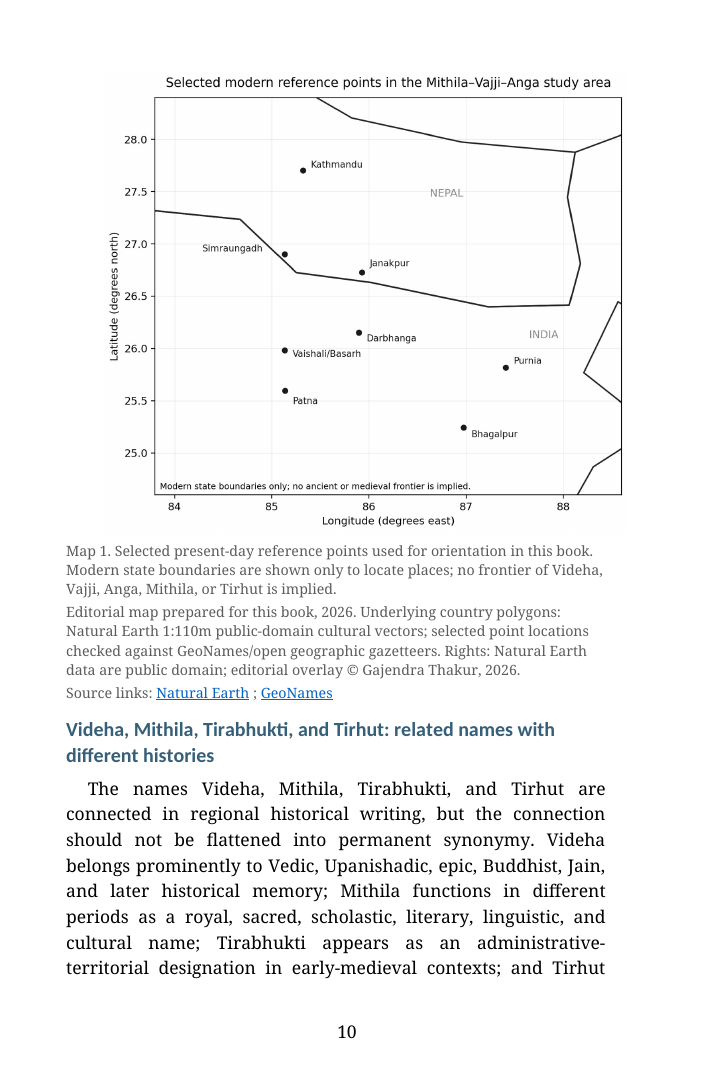
Mithila · Vajji · Anga
Chapter-specific source notes
- Primary chapter witness. Gajendra Thakur, Decoding the Panji of Mithila — Volume VI, formal Chapter 6, PDF pp. 58-67; formal Chapter 6. The HTML transcription is generated from the commit-pinned source PDF and retains the chapter boundary recorded in this edition.
- Internal structure. The repository source-heading inventory records 12 subordinate headings for this chapter: “Opening”; “What Is Uthedh?”; “Sapinda: Kinship as Measured Nearness”; “Swajana and Aswajana”; “The Six Checks of Marriage Eligibility”; “Why the Siddhanta Letter Was Necessary”; “Maternal Lines and the Hidden Half of Eligibility”; “Uthedh and the Sixth-Generation Question”; ….
- Digital editorial method. The page keeps the preserved source text distinct from generated navigational, concordance, visual, and provenance apparatus. The synthetic reconstruction is explanatory only and is not evidence for an individual lineage or a determination of social or marital status.