Decoding the Panji of Mithila · Volume VI · Chapter 7
Gotra, Pravara, Mool, Moolgram: The Grammar of Panji Entries Opening
Chapter 7

Gotra, Pravara, Mool, Moolgram: The
Grammar of Panji Entries
Opening
This volume places this chapter before the Dushan table is
decoded because no entry can be read correctly without grammar.
A Panji line may look like a series of names, village words,
numbers, and relationship markers. In fact it is a compressed
sentence. Its grammar tells the reader who belongs to which
descent field, which place functions as the lineage-root, which
relation is paternal, which is maternal, which marriage creates the
problem, and which part of the line must be checked against other
Panji books.
Chapter 6 explained the logic of marriage eligibility. Chapter 7
now explains the grammar through which that logic becomes
readable. The terms गोत्र, प्रवर, मूल, मूलग्राम, बीजी पुरुष, सुत, सुता, दौहित्र,
मातृक, पत्नी, and related marks are not decorative. They are the
working parts of the Panji sentence. Without them, Dushan
Panji appears chaotic. With them, each entry becomes an
analyzable record.

Why Panji Entries Are Compressed
A Panji entry was not written like modern prose. It was written
for trained readers, Panjikars, family representatives, and
people already familiar with the conventions of lineage
notation. A long social history had to be stored in a narrow
written space. Therefore the entry often compresses a full story
into a few signs: a mool name, a reference number, a person, a
relation, another mool, a daughter, a mother, a wife, an
unknown line, or a community label.

                           © Gajendra Thakur | 66
                Decoding the Panji of Mithila, Volume VI

The compression creates danger for modern readers. A reader
may mistake a mool for a village of present residence, a
mother-line for a father-line, a daughter-line for a wife-line, or
a technical label for a moral insult. This chapter prevents that
mistake by giving the basic grammar of the entry before the
book enters the 97 cases.

Gotra: The Broad Descent Field
In the source explanation, gotra is treated as वंश-बोधक: a marker
of descent. It is a large field, not a small household. The source
says that in Maithil Brahmin society the gotras are paternal and
each gotra is connected with an ancient known ancestor or
sage-name. The same source lists twenty gotras and then places
mools under them. Thus gotra is the wide frame within which a
mool and its branches are read.
For decoding, gotra asks the first question: what broad descent
field is being invoked? If two persons share the same gotra, the
marriage logic of Chapter 6 becomes immediately relevant. If a
mool appears under more than one gotra, the reader must not
assume too quickly. The source itself notes that some mools
occur in more than one gotra. Therefore gotra is both a rule-
field and a caution-field.
A Dushan entry may not always state the gotra explicitly,
because the mool name or the larger Panji context may already
imply it for the trained reader. The modern reader should
therefore avoid isolating a single line from the broader register.
A Panji entry is often readable only when gotra, mool, branch,
and relationship vocabulary are kept together.

Pravara: Ritual Descent and Eligibility
Pravara is a second layer of descent grammar. The source
explains pravara through Vedic and ritual usage and relates it
to rishi-lineage. In the marriage logic already discussed, same
pravara is one of the restrictions. Therefore a Panji reader must

                       © Gajendra Thakur | 67
                Decoding the Panji of Mithila, Volume VI

understand pravara not as a decorative scholastic label, but as
part of eligibility.
For the purposes of Dushan Panji, pravara matters because an
irregular or forbidden marriage is never judged by one sign
alone. The archive checks multiple fields: gotra, pravara,
maternal sapinda, paternal sapinda, and other descent
relations. A Dushan entry is therefore not a casual accusation.
It is an entry located inside a technical system of restrictions,
permissions, memory, and time.

Mool: Root, Lineage-Anchor, and Identification
Mool is one of the most important words in Panji. It does not
merely mean a village name in the ordinary geographical
sense. It is the root-marker of a lineage. In many entries, the
mool is the first key that tells the reader where to place the
person within the genealogical map. Sarisab, Soderpur, Pali,
Darhara, Mandar, Khandbala, Khaual, Budhwal, Panichobh,
and many other names operate in this way.
The source explains that during the collection of family
information, the old residence of the ancestors became central.
The place stated as the ancient residence of the forefathers
became the person’s mool. In this sense, mool is geography
transformed into genealogy. The mool is not simply where
someone lives now; it is the remembered root through which a
dispersed family is attached to a lineage.
This grammar is vital for Dushan entries. When an entry says
“Sarisab,” “Soderpur,” or “Pali,” the word may be doing
genealogical work. It may identify the root-line of the person,
not just a locality. If the reader reads it as a casual place-name,
the entry loses its structure.

Moolgram: When Place Becomes Memory
Moolgram is the village-root attached to the mool. The source
says that at the time of Panji-Prabandh, the place where the
person was living became the future village-name of the

                       © Gajendra Thakur | 68
               Decoding the Panji of Mithila, Volume VI

descendants, while the ancient residence named by the
informant became the mool. This explains why one family may
be physically spread across several villages but genealogically
held together by one moolgram.
The example given in the source is especially useful. A
Kashyap-gotra great family with many branches is described as
originally connected with Mandar. Yet two branches,
Mangrauni and Garh, had already become clear before Panji-
Prabandh. The register therefore began to attach the special
names Garh and Mangrauni with Mandar, while still proving
the two branches to be one larger lineage by mool and biji
purush. This example shows how Panji combines difference
and unity: different settlements, one root-line.
For Dushan decoding, moolgram prevents misreading. A
marked event may occur in one branch, but the genealogical
consequences may travel through many settlements because
the mool links them. Conversely, a shared place-name does not
always mean identical line unless gotra, mool, and biji purush
are checked together.

Biji Purush: The Earliest Known Ancestor
The source calls the earliest known ancestor of a lineage the
बीजी पुरुष. The word “biji” suggests seed or foundational origin.
This does not mean that the archive claims to know the first
biological human being of a family. It means that, for the
purpose of Panji, the earliest recognized ancestor becomes the
genealogical seed from which the recorded line is organized.
Biji Purush is therefore an archival ancestor. He provides a
starting point for the record. The family may remember more,
less, or differently, but the Panji system needs a stable point
from which descent can be organized, branches can be
attached, and marriage eligibility can be calculated. Without a
biji purush, the lineage would float without an anchor.
Later Chapter 24 will return to Biji Purush and Vamshavali
logic in fuller detail. Here the point is grammatical: when a

                      © Gajendra Thakur | 69
                Decoding the Panji of Mithila, Volume VI

Panji entry connects a person to a mool and a biji purush, it is
not merely naming. It is placing the person inside a structured
descent sentence.

Sut, Suta, Sutau: Son, Daughter, and the
Gendered Grammar of Descent
Panji entries often use compressed relationship words. सुत or
सुतः marks a son. सुता marks a daughter. सुतौ can indicate sons or
a paired/dual form in the Sanskritic register. These terms allow
a long descent statement to be written in a very short form. A
line such as “X-suta” or “Y-sut” must be read as a relationship,
not as part of the person’s personal name.
The distinction between son and daughter is especially
important in Dushan Panji. Many entries turn on the daughter-
line, wife-line, or mother-line rather than on the formal male
line. A daughter may carry the point at which the marked
relation enters a lineage. A son may carry the continuation of
that line. If the reader misses the gendered relationship term,
the whole entry can be reversed.
The grammar of सुता is therefore one of the ways Dushan Panji
preserves women. It may preserve them harshly, through old
labels, but it preserves the fact that descent and social
consequence often passed through women whose names were
otherwise likely to disappear from formal histories.

Dauhitra: The Daughter’s Son as a Genealogical
Bridge
दौहित्र means daughter’s son. It is a small word with large
consequences. When a record turns through a daughter’s son,
the archive is acknowledging that lineage consequences can
travel through the female line even within a largely patrilineal
system. The daughter’s son becomes a bridge between a
maternal connection and a later recorded male line.

                       © Gajendra Thakur | 70
                Decoding the Panji of Mithila, Volume VI

This is why Dushan Panji cannot be understood as a simple list
of male descent. It is full of crossings: mothers, daughters,
wives, widows, dasi figures, devadasi lines, and daughters of
named or unnamed communities. The word दौहित्र gives a
technical grammar for one of those crossings.

Matrik and Mother-Line Reading
मातृक is one of the most important decoding terms in the Dushan
entries. It marks a maternal connection. When an entry says
“Ramk matrik,” “Jagannathk matrik,” or “Gangadhark matrik,”
the reader must follow the mother-line, not assume that the
named chain is simply paternal.
The source table repeatedly uses मातृक in Dushan cases, often
around unknown lineage, devadasi tradition, or community-
marked maternal connections. This shows that the mother-line
was not invisible to the Panji system. It was technically visible,
even when socially uncomfortable. The danger is that later
readers may ignore it because they assume genealogy is only
father-to-son. Dushan Panji disproves that assumption.
A maternal line can produce uncertainty, stigma, absorption, or
reintegration depending on the case and the generation-
distance. Therefore मातृक must be read slowly. It tells the reader
where the social question enters the descent chain.

Patni, Vivaha, and the Marital Route
पत्नी and विवाह mark marital routes. Some Dushan entries
concern a wife from a named community, an unknown family,
a widow, a devadasi or dasi connection, or a woman described
by a source label that later readers must handle with care. In
those cases the wife is not incidental. The marriage is the event
that changes the genealogical record.
A marital route differs from a maternal route. In a maternal
route, the marked connection may enter through a mother or
mother’s family. In a marital route, the marked connection

                       © Gajendra Thakur | 71
                Decoding the Panji of Mithila, Volume VI

enters through a wife or marriage event. In both cases, later
children and descendants become part of the question. The
grammar must therefore keep पत्नी, विवाह, सुता, सुत, and मातृक
distinct.

Numbers, Folios, and Reference Marks
Many entries contain numbers such as 178/1, 196/7, 238/05, or
similar marks. These should be treated as reference
coordinates, not as part of the narrative meaning. They help
locate the record inside the manuscript or Panji apparatus. The
modern decoder should preserve them exactly because they
permit checking, comparison, and future correction.
This book therefore keeps case numbers and reference marks
visible when the entry-by-entry section begins. The aim is not
to make the narrative elegant by removing technical clutter.
The aim is to make the archive accountable. A reader should be
able to see how an interpretation depends on the source line.

A Working Grammar Table
The following table gives the working grammar used in this
volume. It is not a final appendix; it is a reader’s tool before the
Dushan cases begin.
Term                   Technical sense               How to use it while
                                                     decoding

गोत्र                  Broad descent field; often    Check before marriage
                       linked with an ancient        interpretation; same gotra
                       rishi-name.                   can restrict eligibility.

प्रवर                  Ritual-rishi lineage          Do not ignore it; same
                       marker used in eligibility.   pravara can matter even
                                                     when mool differs.

मूल                    Root-lineage marker;          Read as lineage-anchor,
                       geography turned into         not merely present
                       genealogy.                    residence.

मूलग्राम               Ancient or root village       Useful for tracking
                       associated with the           dispersed branches and
                       lineage.                      older settlement memory.

                       © Gajendra Thakur | 72
                  Decoding the Panji of Mithila, Volume VI

Term                     Technical sense            How to use it while
                                                    decoding

बीजी पुरुष               Earliest known recorded    Archival starting point for
                         ancestor of a lineage.     descent, not necessarily
                                                    the first biological
                                                    ancestor.

शाखा                     Branch of a larger mool-   A branch may be separate
                         line.                      in record but connected
                                                    through older root and
                                                    ancestor.

सुत / सुतः               Son of.                    Marks male descent or
                                                    continuation; do not read
                                                    as part of a personal
                                                    name.

सुता                     Daughter of.               Often crucial in daughter-
                                                    line, marital, and Dushan
                                                    routes.

सुतौ                     Sons / paired male-        Read as compressed
                         descendant form in         descent grammar.
                         Sanskritic notation.

दौहित्र                  Daughter’s son.            Signals a female-line
                                                    bridge into a later male
                                                    line.

मातृक                    Maternal line or           Follow the mother-line; it
                         connection.                may be where the social
                                                    question enters.

पत्नी                    Wife.                      Marks marital route;
                                                    distinguish from mother-
                                                    line and daughter-line.

विवाह                    Marriage event.            Identifies the act through
                                                    which eligibility, dushan,
                                                    or absorption is assessed.

अज्ञात                   Unknown or unspecified.    Treat as archival
                                                    uncertainty, not proof of
                                                    nonexistence.

अन्तर्जातीय              Inter-community or inter- Use historically and
                         caste route in the source carefully; not as present-
                         vocabulary.               day abuse.

पत्र / सिद्धांत          Written eligibility        Connects family memory
                         decision.                  with Panjikar authority.

                         © Gajendra Thakur | 73
               Decoding the Panji of Mithila, Volume VI

How a Panji Sentence Works
A Panji line can now be read as a sentence with compressed
grammar. The mool tells where to place the line. The person-
name tells who is being followed. The relation-marker tells
whether the next person is a son, daughter, mother, wife,
daughter’s son, or other relation. The reference number tells
where the record sits in the archival apparatus. The community
or status label tells what the old record considered socially
significant. The generation-distance tells whether the effect
remains immediate, weakened, or absorbed.
This is why the entry-by-entry chapters will not merely
translate the lines. They will unpack them. A literal translation
alone would not be enough, because “X-suta,” “Y-matrik,” “Z-
patni,” or “unknown” does not become clear unless the
grammar of the line is explained.

The Ethical Consequence of Grammar
Grammar is also an ethical matter. If a reader misunderstands
the grammar, a person or lineage can be wrongly blamed. A
daughter-line may be mistaken for a father-line. A mother-line
uncertainty may be treated as moral failure. A source label may
be repeated as insult. A technical restriction may be read as
permanent pollution. Each of these mistakes would revive the
violence the book is trying to analyze.
Therefore this volume insists on grammatical precision before
moral conclusion. The old archive may contain harsh language,
but the modern reader must not add new harshness through
careless reading. The first duty is to understand what the line
actually says.

How Chapter 7 Prepares Chapters 8-10
Chapter 8 will use this grammar to explain the twenty gotras
and the 167 mools of Maithil Brahmins. Chapter 9 will then
show how mool and migration turn villages into genealogical
memory. Chapter 10 will finally introduce the full method for

                      © Gajendra Thakur | 74
                     Decoding the Panji of Mithila, Volume VI

reading the 97 Dushan entries. Thus Chapter 7 is the bridge
between the marriage logic of Chapter 6 and the case-decoding
method of Chapter 10.
The reader should now be able to look at a Dushan entry and
ask the right first questions: What is the gotra field? What is the
mool? Is there a moolgram clue? Who is son, daughter, wife,
mother, or daughter’s son? What is unknown? What is the
relation route? Which part is a reference mark? Which part is a
social label? Only after these questions can interpretation
begin.

Conclusion: Grammar before Judgment
Chapter 7 has argued that Panji entries are not chaotic
fragments. They are compressed genealogical sentences. Their
grammar includes descent, ritual eligibility, place-memory,
founding ancestor, gendered relation, maternal route, marital
route, reference mark, and social label. To decode Dushan Panji
without this grammar would be to read the archive blindly.
The next step, in this volume, is Chapter 8: The Twenty Gotras
and the 167 Mools of Maithil Brahmins. There the grammar
introduced here will be expanded into the larger map of gotra
and mool identity.

Chapter 7 Source Notes
Source note 1: This chapter follows the structure of Chapter 7, which calls for a
decoding manual explaining gotra, pravara, mool, moolgram, biji purush, sut, suta,
sutau, dauhitra, maternal line, daughter-line notation, and abbreviated marks.
Source note 2: The discussion of gotra follows the source
explanation that Maithil Brahmin gotra is वंश-बोधक, that it is
paternal in the Panji frame, and that twenty gotras are listed
before their mools.
Source note 3: The discussion of pravara follows the source
passage explaining pravara through Vedic and rishi-lineage
usage and distinguishing tripravara and panchapravara
families.

                             © Gajendra Thakur | 75
                  Decoding the Panji of Mithila, Volume VI

Source note 4: The discussion of mool, moolgram, and biji
purush follows the source passage explaining that the ancient
residence named by the informant became the mool and that
the earliest known ancestor became the बीजी पुरुष.

Source note 5: The Mandar, Garh, and Mangrauni example
follows the source example of a Kashyap-gotra family with
multiple branches whose unity was established through shared
mool and biji purush.
Source note 6: The discussion of सुता, मातृक, and related female-
line grammar follows the Dushan table’s repeated use of
daughter-line and mother-line expressions such as भीमसुता,
के शवसुता, रामक मातृक, जगन्नाथक मातृक, रतनूक मातृक, and गंगाधरक मातृक.

Source note 7: The ethical cautions in this chapter follow the
rebuilt manuscript’s method: old source terms are preserved
for historical accuracy but must not be repeated as present-day
stigma.
Source structure and verification apparatus
Editorial source apparatus. This apparatus is descriptive, not interpretive. It records the source-controlled structure used to verify that this page corresponds to formal Chapter 7 of Decoding the Panji of Mithila — Volume VI. The chapter text above is preserved from PDF pp. 67-77; formal Chapter 7 in the commit-pinned authoritative source. It is not merged with a neighboring chapter, appendix, annexure, or independent front/back-matter unit. The internal headings below come from the repository’s source-heading inventory and are retained as navigational and audit evidence; showing them here does not turn those headings into separate publications or add claims that are absent from the source.
Internal source headings
- Opening
- Why Panji Entries Are Compressed
- Gotra: The Broad Descent Field
- Pravara: Ritual Descent and Eligibility
- Mool: Root, Lineage-Anchor, and Identification
- Moolgram: When Place Becomes Memory
- Biji Purush: The Earliest Known Ancestor
- Sut, Suta, Sutau: Son, Daughter, and the Gendered Grammar of Descent
- Dauhitra: The Daughter’s Son as a Genealogical Bridge
- Matrik and Mother-Line Reading
- Patni, Vivaha, and the Marital Route
- Numbers, Folios, and Reference Marks
- A Working Grammar Table
- How a Panji Sentence Works
- The Ethical Consequence of Grammar
- How Chapter 7 Prepares Chapters 8-10
- Conclusion: Grammar before Judgment
- Chapter 7 Source Notes
Source-text concordance
Gotra · Pravara · Mool · Moolgram · Grammar · Entries · Opening · places · Dushan · table · decoded · entry · read · correctly · without · line · look · like · series · names · village · words · numbers · relationship · markers · fact · compressed · sentence · tells · reader · belongs · descent · field · place · functions · lineage-root · relation · paternal · maternal · marriage · creates · problem · part · must · checked · books · explained · logic · eligibility · explains · becomes · readable · terms · related · marks · decorative · working · parts · appears · chaotic · analyzable · record · written · modern · prose · trained · readers · Panjikars · family · representatives · people · already · familiar · conventions · lineage · notation · long · social · history · stored
Boundary verification. In the formal sequence this chapter follows Volume VI Chapter 6, “Uthedh, Sapinda, Swajana, and the Logic of Marriage Eligibility Opening” and precedes Volume VI Chapter 8, “The Twenty Gotras and the 167 Mools of Maithil Brahmins”. The chapter extractor begins at the verified formal Chapter 7 marker and stops at the next verified formal chapter marker; for a final chapter it stops before recognized book-level back matter. The concordance above is generated only from distinct terms already present in this chapter’s preserved source text. It is provided for discovery, comparison, and audit, not as an automated judgment about persons, lineages, status, kinship, marriage eligibility, or historical truth.
Illustrated research apparatus
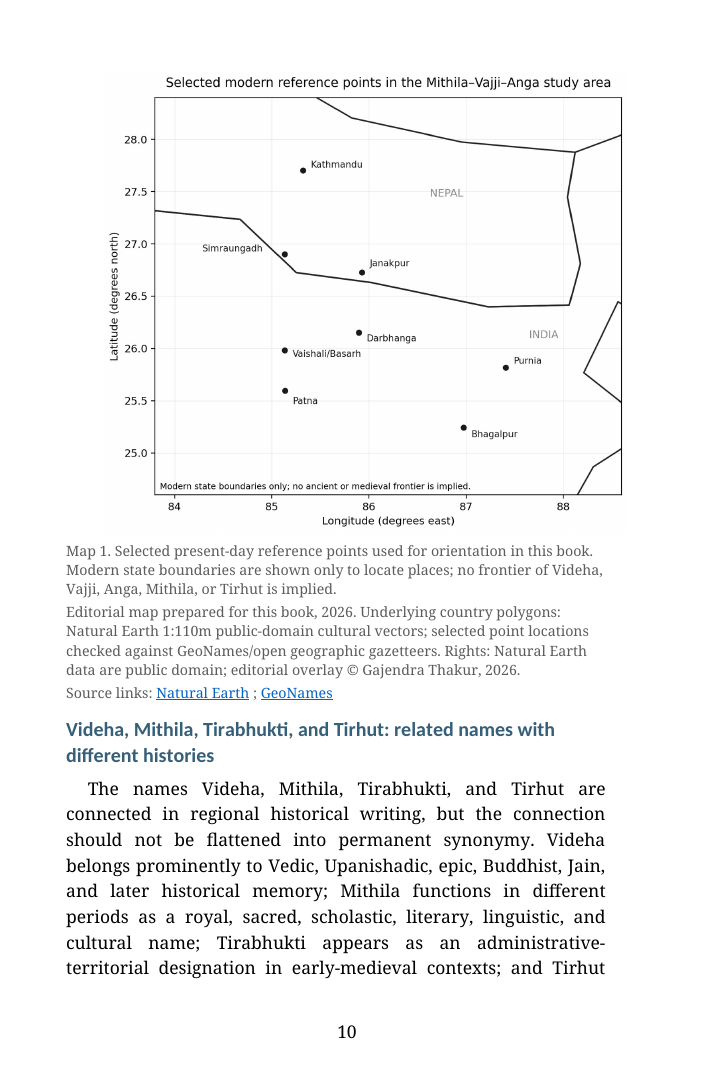
Mithila · Vajji · Anga
Chapter-specific source notes
- Primary chapter witness. Gajendra Thakur, Decoding the Panji of Mithila — Volume VI, formal Chapter 7, PDF pp. 67-77; formal Chapter 7. The HTML transcription is generated from the commit-pinned source PDF and retains the chapter boundary recorded in this edition.
- Internal structure. The repository source-heading inventory records 18 subordinate headings for this chapter: “Opening”; “Why Panji Entries Are Compressed”; “Gotra: The Broad Descent Field”; “Pravara: Ritual Descent and Eligibility”; “Mool: Root, Lineage-Anchor, and Identification”; “Moolgram: When Place Becomes Memory”; “Biji Purush: The Earliest Known Ancestor”; “Sut, Suta, Sutau: Son, Daughter, and the Gendered Grammar of Descent”; ….
- Digital editorial method. The page keeps the preserved source text distinct from generated navigational, concordance, visual, and provenance apparatus. The synthetic reconstruction is explanatory only and is not evidence for an individual lineage or a determination of social or marital status.