Decoding the Panji of Mithila · Volume VI · Chapter 8
The Twenty Gotras and the 167 Mools of Maithil Brahmins
Chapter 8 — The Twenty Gotras and
the 167 Mools of Maithil Brahmins
Chapter 8 proceeds by moving from the grammar of a single Panji
entry to the larger classificatory field inside which that entry
becomes meaningful. Chapter 7 showed how gotra, pravara, mool,
moolgram, biji purush, son-line, daughter-line, and maternal
notation function as grammar. This chapter now describes the
map on which that grammar operates: the twenty gotras, the 167
mools, the principal 34/35 mools, and the difference between
formal and popular pronunciation.
The purpose is not to create pride in hierarchy. The purpose is
to give readers a reliable decoding frame. Dushan Panji cannot
be interpreted entry by entry unless the reader understands
© Gajendra Thakur | 76
Decoding the Panji of Mithila, Volume VI
that a name such as सरिसव, पाली, खौआल, दरिहरा, सोदरपुर, बुधवाल, करमहा,
माण्डर, or काश्यप is never merely a word. In Panji, a name may
carry gotra, mool, ancestral village, later branch, marriage
eligibility, and memory of migration.
Why Gotra and Mool Must Be Read Together
The source describes gotra as वंश-बोधक: a marker of descent. It
also explains that each gotra is connected with an ancient
known ancestor and that gotra and gotrapatya indicate a blood-
related lineage concept. But gotra alone is too broad for
practical Panji use. Many families share the same gotra. The
mool narrows the field by anchoring a lineage in an ancient
place and ancestral memory.
Thus, in a Panji entry, gotra answers one kind of question:
“Which ancestral rishi-line or descent-field is this?” Mool
answers another: “Which ancient lineage-root within that gotra
does this person belong to?” Moolgram refines it further:
“Which remembered village or later branch-location now
identifies this stream of the mool?”
This layered structure is the reason a Dushan entry may appear
short but contain dense information. A single line can move
from gotra to mool, from mool to branch, from branch to a
named person, and from that person to a marriage or maternal
relation. Without the gotra-mool frame, the reader sees only a
list. With the frame, the reader sees an organized social map.
The Twenty Gotras
The source gives the Maithil Brahmin gotra system as
twentyfold. It also records that Maithil Brahmins were divided
into twenty gotras, 167 mools, and many moolgrams; from
those 167 mools, a group of 34 principal mools was first treated
as especially important, with the Khanam branch of the
Phanandah mool later counted as a thirty-fifth in the high-
lineage calculation.
The twenty gotras, as preserved in the source, are:
© Gajendra Thakur | 77
Decoding the Panji of Mithila, Volume VI
शाण्डिल्य
वत्स
सावर्ण
काश्यप
पराशर
भारद्वाज
कात्यायन
गर्ग
कौशिक
अलाम्बुकाक्ष
कृ ष्णात्रेय
गौतम
मौद्गल्य
वशिष्ठ
कौण्डिन्य
उपमन्यु
कपिल
विष्णुवृद्धि
तण्डी
जातुकर्ण
The order of names differs slightly between the compact
summary and the later gotra-panjika list, but the historical
point remains the same: Maithil Brahmin identity was not
organized by a single surname or village name. It was
organized through a layered system in which gotra, mool, and
moolgram worked together.
The 167 Mools and the Logic of Distribution
The source states that Maithil Brahmins were divided into 167
mools. A mool is not simply a village name in the modern
administrative sense. It is a genealogical root. In the source’s
explanation of moolgram, the mool means the ancient village
© Gajendra Thakur | 78
Decoding the Panji of Mithila, Volume VI
where the earliest remembered ancestor or Biji Purush of a
mool lived. Later, when branches of the same mool settled in
different places, Panjikars began to join those later village
names to the old mool name.
This is why the same mool can appear with multiple branch-
place associations. A person may be described by an ancient
mool and a later moolgram. The old name and the later name
do not cancel each other. They show two layers of memory: the
deep root and the historical branch.
The practical effect is important. When a Dushan entry uses a
mool name, it does not merely identify a place. It locates a
person inside a long chain of descent, migration, social rank,
marriage eligibility, and memory. For this reason, a modern
reader should not flatten the term mool into “village.” In Panji,
geography is genealogical.
Gotra-wise Mool Register Preserved in the
Source
The following register gives the gotra-wise mool lists as
preserved in the available source text. Where the source has
both a compact summary and a longer pronunciation table, this
chapter follows the more usable formal mool names and leaves
exhaustive formal-versus-popular pronunciation details for the
appendices.
1. शाण्डिल्य: दिर्घोष, सरिसव, महुवा, पर्वपल्ली, खण्डवला, गंगोली, यमुगाम, करियन,
मोहरी, सझूआल, मड़ार, पण्डोली, जजिवाल, दहिभत, तिलय, माहव, सिम्मूआल,
सिंहाश्रम, सोदरपुर, कड़रिया, अल्लारि, होइयार, तल्हनपुर, परिसरा, परसण्डा, वीरनाम,
उत्तमपुर, कोदरिया, छतिमन, बरे वा, मछु आल, गंगोर, भटौर, बुधौर, ब्रह्मपुर, कोइयार,
करहिवार, गंगुआल, घोषियाम, छतौनी, भिगुआल, ननौती, तपनपुर.
2. वत्स: पाली, हरिअम्ब, तिसूरी, राउढ़, टंकवाल, घुसौत, जजिवाल, पहद्दी, जल्लकी,
भन्दवाल, कोइयार, करहिवार, ननौर, डढ़ार, करमहा, बुधवाल, लाही, सौनी, सकौना,
फनन्दह, मोहरी, वंठवाल, तिसउँ त, बरुआली, पण्डोली, बहेराढ़ी, बरै वा, अलय, भण्डारिसम,
© Gajendra Thakur | 79
Decoding the Panji of Mithila, Volume VI
बभनियाम, उचति, तपनपुर, बिठु आल, नरवाल, चित्रपल्ली, जरहटिया, रतवाल, ब्रह्मपुरा,
सरौनी.
3. काश्यप: ओइनी, खौआल, संकराढ़ी, जगति, दरिहरा, माण्डर, बलियास, पचाउट, कटाई,
सतलखा, पण्डुआ, मालिछ, मेरन्दी, भदुआल, पकलिया, बुधवाल, पिभूया, मौरी, भूतहरी,
छादन, विस्फी, थरिया, दोस्ती, भरे हा, कु सुम्बाल, नरवाल, लगुरदह.
4. सावर्ण: सोन्दपुर, पनिचोभ, बरे बा, नन्दोर, मेरन्दी.
5. पराशर: नरउन, सुरगन, सकु री, सुइरी, सम्मूआल, पिहवाल, नदाम, महेशारि, सकरहोन,
सोइनी, तिलय, बरै वा.
6. भारद्वाज: एकहरा, विल्वपंचक, देयाम, कलिगाम, भूतहरी, गोढ़ार, गोधूलि.
7. कात्यायन: कुं जोली / कु जौली, ननौती, जल्लकी, वतिगाम.
8. गर्ग: वसहा, वसाम, ब्रह्मपुरा, सुरौर, बुधौर, उरौर.
9. कौशिक: निखूति.
10. अलाम्बुकाक्ष: वसाम, कटाई, ब्रह्मपुरा.
11. कृ ष्णात्रेय: लोहना, बुसवन, पदौनी.
12. गौतम: ब्रह्मपुर, उत्तिमपुर, कोइयार.
13. मौद्गल्य: रतवाल, मालिछ, दिर्घोष, कपिंजल, जल्लकी.
14. वशिष्ठ: कोथुआ, as preserved in the compact gotra-mool
summary.
15. कौण्डिन्य: एकहरा, परौन, with परसण्डा also appearing in the longer
gotra-panjika list.
16. उपमन्यु: Named as a gotra in the compact summary and in the
twenty-gotra list; the available excerpt does not give a detailed
mool list in the same way as the larger gotras.
17. कपिल: Named as a gotra in the compact summary and in the
twenty-gotra list; the available excerpt does not give a detailed
mool list in the same way as the larger gotras.
18. विष्णुवृद्धि: वुसवन / बुसवन.
© Gajendra Thakur | 80
Decoding the Panji of Mithila, Volume VI
19. तण्डी / तण्डि: कटाई, with परसण्डा also appearing in the longer
gotra-panjika list.
20. जातुकर्ण: देवहार, with कटाई and परसण्डा also appearing in the
longer gotra-panjika list.
Why Some Mools Repeat Across Gotras
A striking feature of the register is repetition. Names such as
ब्रह्मपुरा, कटाई, जल्लकी, भूतहरी, नरवाल, कोइयार, तिलय, मेरन्दी, and परसण्डा
appear in more than one gotra field. This does not mean the
system is careless. It means a mool-name can have to be read
with its gotra field. The same surface name may belong to
different gotra contexts. Therefore, a Panji reader must never
isolate a mool name from the gotra that governs it.
This also explains why Dushan Panji entries sometimes carry
several place or mool names in a chain. The record is not
repeating names for ornament. It is tightening identification. It
is telling the reader where to place the relationship in the wider
map of descent.
Formal and Popular Pronunciation
The source distinguishes मौलिक उच्चारण from लौकिक उच्चारण. This
distinction is crucial. The formal name is the archival form; the
popular form is the spoken or local form by which the same
mool may be recognized in everyday community speech. For
example, दिर्घोष appears with दिघवे , पर्वपल्ली with पवोलिवार / पवौलिवार,
खण्डवला with खड़ौरय, पाली with पलिवार, खौआल with खौवाड़य, दरिहरा with
दरिहरय / दलिहरे , कुं जोली with कु जिलवार, and विल्वपंचक with बेलौंचे .
This double register matters because many apparent
disagreements in Panji reading arise from pronunciation rather
than from historical contradiction. A reader unfamiliar with
spoken Maithil forms may treat पवौलीवार and पर्वपल्ली as separate
entities. A Panjikar or local genealogical reader may
understand them as linked forms. The chapter therefore treats
© Gajendra Thakur | 81
Decoding the Panji of Mithila, Volume VI
pronunciation not as a minor phonetic issue but as a key to
matching manuscript form, Panjikar usage, and family
memory.
Formal / मौलिक Popular / लौकिक Decoding caution
दिर्घोष दिघवे Do not treat the short
spoken form as a separate
mool.
पर्वपल्ली पवोलिवार / पवौलिवार The spoken form may look
like a different lineage to
outsiders.
खण्डवला खड़ौरय This form later becomes
socially important in rank
discussions.
पाली पलिवार The popular suffix can
obscure the older mool
form.
खौआल खौवाड़य A common example of
archival name and spoken
community form.
विल्वपंचक बेलौंचे The popular form is not
transparent from the
formal Sanskritic form.
कुं जोली / कु जौली कु जिलवार Useful for matching gotra-
mool table with later
branch memory.
The Principal 34/35 Mools
The source states that among the 167 mools, thirty-four were
treated as principal, and that the Khanam branch of the
Phanandah mool later became counted as a thirty-fifth among
the so-called higher lines. It then divides the principal mools
into three groups: first category, second category, and middle
mools. This classification is historically important, but it must
be handled carefully.
The book does not reproduce the classification in order to
endorse hierarchy. It reproduces it because the classification
shaped marriage decisions, social reputation, and later
distortions of Panji use. A modern ethical reader must know the
© Gajendra Thakur | 82
Decoding the Panji of Mithila, Volume VI
categories precisely enough to understand their historical
effect, while refusing to convert old ranking into present-day
insult.
Group Mools as preserved in Interpretive note
the source
First category / अयान्त श्रेष्ठ खड़ौरय, खौआड़य, बुधबाड़य, This group became one of
the centers of status-
मड़रय, दरिहरय, घुसौतय, ranking discourse.
तिसौतय, करमहय, नरौनय,
वभनियामय, हरिअम्मय,
सरिसवय, सोदरपुरिये .
Second category गंगोलिवार, पवौलिवार, These names show how
formal mool and popular
कु जौलिवार, अलेवार, pronunciation interact
वहिड़वार, सकड़िवार, with social classification.
पलिवार, विसेवार, फनेवार,
उचितवार, पंडुलवार, कटैवार,
तिलैवार.
Middle mools / मध्यम मूल दिघवे , बेलौंचै , एकहरे , पंचोभे , The label is a historical
category; it should not be
वलियासे , जजिवाल, used as present-day social
टकवाल, पण्डुए. judgment.
Later thirty-fifth फनन्दह मूलक खनाम The source notes later
inclusion of this branch in
शाखा. the so-called high-lineage
count.
Classification and Social Damage
The distinction between descriptive genealogy and social rank
is one of the most important points in this volume. Gotra and
mool began as ways to preserve descent, prevent prohibited
marriages, and make kinship searchable. But the same system
could also be converted into ranking. Once ranking entered the
archive, names began to carry pride, anxiety, and exclusion.
The source itself warns that the original purpose of Panji was
not to show smallness or greatness. In its explanation of
© Gajendra Thakur | 83
Decoding the Panji of Mithila, Volume VI
moolgram, it says that the system later came under orders and
pressures through which Panjikars were made to indicate
superiority and inferiority among mools. The chapter therefore
separates three things: archival identification, ritual eligibility,
and later social hierarchy. The first is necessary for decoding.
The second belongs to the historical marriage system. The third
must be studied critically, not reproduced as moral truth.
How Chapter 8 Helps Decode Dushan Panji
Dushan Panji entries often mention mools such as सरिसव, सकराढी,
पनिचोभ, दरिहरा, पाली, नरवाल, वलियास, घुसौत, सोदरपुर, अलय, माण्डर, सुरगन,
पचही, and पकलिया. These are not decorative place labels. They
help the reader reconstruct the lineage path by which a
marriage, maternal relation, or dushan category entered the
register.
For example, when an entry says that a person’s मातृक belongs
to a certain mool chain, the mool names give the route by
which maternal memory is being placed. When an entry says
सुता, the daughter-line must be read through the mool where
she is placed. When an entry includes an unknown or inter-
community connection, the mool-chain still matters because it
shows the Panji’s attempt to locate that rupture within a
genealogical frame rather than leave it outside history.
This is why the chapter comes before the Dushan-table method
chapter. The reader must first understand the map; only then
can the reader follow the cases. Dushan Panji is not a set of
isolated accusations. It is a record written inside the full
architecture of gotra, mool, moolgram, and descent.
A Caution on Numbers
The number 167 should be read as the system’s recognized
mool universe, not as a simple count of the names printed in
one compact passage. Some passages give a compact gotra-mool
summary; other passages give detailed formal and popular
© Gajendra Thakur | 84
Decoding the Panji of Mithila, Volume VI
pronunciations; still others give moolgram expansions under
particular mools. Therefore, the number belongs to the whole
Panji system, while any single table is a window into that
system. The appendices of this volume will later provide index-
style support so that readers can cross-check names without
overloading the body chapters.
Conclusion: Identity as a Layered Archive
Chapter 8 has shown that Maithil Brahmin Panji identity was
built through layers: gotra, pravara, mool, moolgram, Biji
Purush, branch, and popular pronunciation. A person was not
merely a name; the name stood inside a structured field. That
field could preserve memory, regulate marriage, and locate
kinship across centuries. It could also become the basis of
hierarchy and social harm.
For the purposes of this volume, the lesson is methodological
and ethical. Methodologically, every Dushan entry must be read
inside the gotra-mool map. Ethically, the same map must not be
turned into renewed ranking. The task is to understand how
Mithila remembered descent, not to revive the injuries that
later attached to that memory.
The next step, in this volume, is Chapter 9: Mool and Migration:
How Villages Became Genealogical Memory. Chapter 9 will
show how the mool names listed here moved into village
identity, branch formation, migration, and settlement history.
Chapter 8 Source Notes
Source note 1: This chapter follows the structure of Chapter 8,
which requires explanation of the twenty gotras, the 167 mools,
the main 34/35 mools, formal/popular pronunciation, and
classification.
Source note 2: The description of gotra as a descent marker
follows the source explanation that Maithil Brahmin gotra is
वंश-बोधक and linked to the ancient known ancestor of the
lineage.
© Gajendra Thakur | 85
Decoding the Panji of Mithila, Volume VI
Source note 3: The statement that the system contains twenty
gotras and 167 mools follows the source passage in the Genome
Mapping / Panji-Prabandh section.
Source note 4: The gotra-wise mool register follows the source’s
compact gotra-mool summary and the later gotra-panjika
section beginning with अथ गोत्र पंजी प्रारभ्यते .
Source note 5: The formal and popular pronunciation examples
follow the source’s paired columns of मौलिक उच्चारण and लौकिक
उच्चारण.
Source note 6: The classification of principal mools follows the
source’s list of the main 35 (34 plus Khanam branch of
Phanandah) and its threefold grouping.
Source note 7: The caution against hierarchy follows the
source’s explanation that the purpose of Panji was not
originally to show smallness or greatness, and that later
political and social pressures converted mool categories into
status claims.Source structure and verification apparatus
Editorial source apparatus. This apparatus is descriptive, not interpretive. It records the source-controlled structure used to verify that this page corresponds to formal Chapter 8 of Decoding the Panji of Mithila — Volume VI. The chapter text above is preserved from PDF pp. 77-87; formal Chapter 8 in the commit-pinned authoritative source. It is not merged with a neighboring chapter, appendix, annexure, or independent front/back-matter unit. The internal headings below come from the repository’s source-heading inventory and are retained as navigational and audit evidence; showing them here does not turn those headings into separate publications or add claims that are absent from the source.
Internal source headings
- Why Gotra and Mool Must Be Read Together
- The Twenty Gotras
- The 167 Mools and the Logic of Distribution
- Gotra-wise Mool Register Preserved in the Source
- Why Some Mools Repeat Across Gotras
- Formal and Popular Pronunciation
- The Principal 34/35 Mools
- Classification and Social Damage
- How Chapter 8 Helps Decode Dushan Panji
- A Caution on Numbers
- Conclusion: Identity as a Layered Archive
- Chapter 8 Source Notes
Source-text concordance
Twenty · Gotras · Mools · Maithil · Brahmins · proceeds · moving · grammar · single · entry · larger · classificatory · field · inside · becomes · meaningful · showed · gotra · pravara · mool · moolgram · biji · purush · son-line · daughter-line · maternal · notation · function · describes · operates · principal · difference · formal · popular · pronunciation · purpose · create · pride · hierarchy · give · readers · reliable · decoding · frame · Dushan · cannot · interpreted · unless · reader · understands · Gajendra · Thakur · name · करमह · never · merely · word · carry · ancestral · village · later · branch · marriage · eligibility · memory · migration · Must · Read · Together · marker · descent · explains · connected · ancient · known · ancestor · gotrapatya · indicate · blood · related
Boundary verification. In the formal sequence this chapter follows Volume VI Chapter 7, “Gotra, Pravara, Mool, Moolgram: The Grammar of Panji Entries Opening” and precedes Volume VI Chapter 9, “Mool and Migration: How Villages Became Genealogical Memory Opening”. The chapter extractor begins at the verified formal Chapter 8 marker and stops at the next verified formal chapter marker; for a final chapter it stops before recognized book-level back matter. The concordance above is generated only from distinct terms already present in this chapter’s preserved source text. It is provided for discovery, comparison, and audit, not as an automated judgment about persons, lineages, status, kinship, marriage eligibility, or historical truth.
Illustrated research apparatus
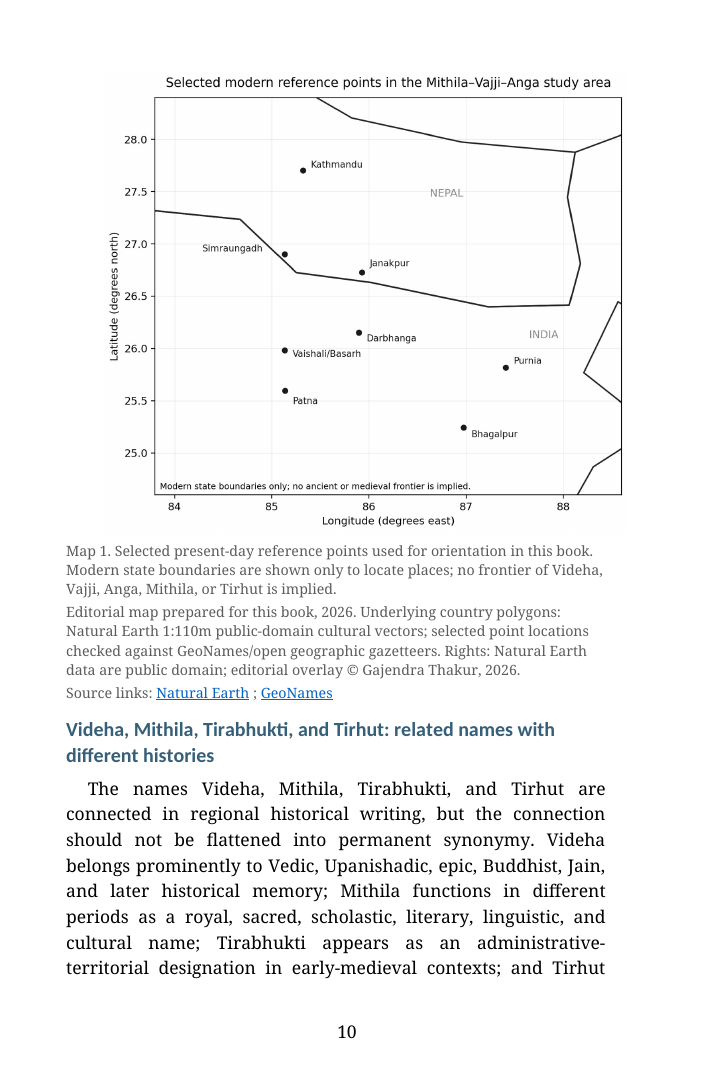
Mithila · Vajji · Anga
Chapter-specific source notes
- Primary chapter witness. Gajendra Thakur, Decoding the Panji of Mithila — Volume VI, formal Chapter 8, PDF pp. 77-87; formal Chapter 8. The HTML transcription is generated from the commit-pinned source PDF and retains the chapter boundary recorded in this edition.
- Internal structure. The repository source-heading inventory records 12 subordinate headings for this chapter: “Why Gotra and Mool Must Be Read Together”; “The Twenty Gotras”; “The 167 Mools and the Logic of Distribution”; “Gotra-wise Mool Register Preserved in the Source”; “Why Some Mools Repeat Across Gotras”; “Formal and Popular Pronunciation”; “The Principal 34/35 Mools”; “Classification and Social Damage”; ….
- Digital editorial method. The page keeps the preserved source text distinct from generated navigational, concordance, visual, and provenance apparatus. The synthetic reconstruction is explanatory only and is not evidence for an individual lineage or a determination of social or marital status.