Decoding the Panji of Mithila · Volume VI · Chapter 14
Muslim and Yavani Connections
Chapter 14 — Muslim and Yavani
                      Connections
1. Why This Chapter Must Be Read Carefully
The previous chapter examined Dalit and artisan connections
in Dushan Panji. This chapter turns to Muslim and Yavani-
linked entries. The ethical problem is similar but not identical.
In both cases, the record preserves relationships that later
social ideology often tried to hide. In the Muslim and Yavani
cases, however, the later reader may be tempted to read the
entries through modern communal categories. That would be a
mistake.
The Panji source does not speak in the vocabulary of modern
nationalism or modern communal politics. It speaks in an older
genealogical vocabulary. It marks women, mothers, daughters,
marriages, descendants, villages, mools, and lines of
connection. The word यवनी appears as an archival label inside
that vocabulary. The task of this book is not to repeat the label

                     © Gajendra Thakur | 131
                Decoding the Panji of Mithila, Volume VI

as accusation. The task is to understand what work the label
performed in the record.
A careful reading therefore begins with restraint. The entry
must first be treated as a line of evidence. Who is named?
Which mool is attached? Is the link maternal, marital, or
daughter-line? Does the entry speak of a mother, a wife, a
daughter, or the descendants of a named woman? Is the person
a named individual, such as दौलतिजहाँ or चाम्पो, or a category such
as यवनी? Only after these questions are asked can the historical
meaning be discussed.

2. The Meaning of यवनी as a Panji Label
The term यवनी in these entries should be read as a source label.
It is not a term to be revived as a present-day description of any
person or community. In older Sanskritic and regional usage,
यवन and यवनी could be used for people seen as outside the
orthodox Hindu genealogical fold, and in many later contexts it
became associated with Muslim identity. In Dushan Panji, the
important point is not philology alone; the important point is
genealogical function. The term marks a boundary-crossing
relationship that the Panji compiler considered necessary to
record.
The term appears with named women. That matters. The
record does not merely say that some abstract “Muslim
connection” existed. It preserves persons and routes: a mother,
a daughter, a wife, a descendant-line, or a named woman
whose presence affected the formal reading of a lineage. The
language of stigma is visible, but beneath it lies a memory of
social contact.
For that reason, the chapter uses “Yavani-linked” or “Muslim-
linked” when speaking analytically. It preserves the exact
Devanagari term only when the source vocabulary must be
shown. This distinction protects the historical record from

                      © Gajendra Thakur | 132
                 Decoding the Panji of Mithila, Volume VI

erasure while also protecting descendants and communities
from renewed stigma.

3. दौलतिजहाँ: A Named Woman inside the Record
One of the most important names in this group is दौलतिजहाँ . The
source records यवनी दौलतिजहाँ in connection with several lineage
names and mool sequences. The presence of a name changes
the reading. A named woman is not a mere category. She is a
person whose presence became genealogically consequential.
The table material places दौलतिजहाँ in relation to mool chains
such as सोदरपुर, पाली, सतलखा, गंगोली, नदाम, and other names. The
entry does not stand alone as a social rumor. It is embedded in
the same documentary grammar used throughout the Dushan
table: mool names, named men, maternal references, and lines
of descent. That means the entry was not added for ornament
or abuse. It was entered because, in the Panji system, descent
and marriage eligibility required memory of such links.
The name also shows that Muslim-linked memory was not
always anonymous. In many Dushan entries, women vanish
into labels: माता अज्ञात, दासी, देवदासी, चर्मकारिणी, रजकी. Here, however,
a named woman appears. The historian must not flatten her
back into a label. The presence of her name is a clue that the
record retained a personal memory even while surrounding
that memory with stigma.

4. चाम्पो यवनी and the Wife-Line Route
Another significant entry is चाम्पो यवनी. The source places this
term in a numbered Dushan case and later specifies शक्ति-पत्नी
चाम्पो यवनी. The wording is important: this is not simply a
maternal trace or a vague community label. It is a wife-line
reference. A woman named चाम्पो is linked to शक्ति as wife.

                        © Gajendra Thakur | 133
                  Decoding the Panji of Mithila, Volume VI

The wife-line route shows that the Dushan table is not only
concerned with birth. It is concerned with marriage as a
genealogical event. A marriage could reshape the status of
descendants, complicate later eligibility, and become a line that
Panjikars remembered. The Panji therefore records the relation
not because the woman was socially irrelevant, but because she
was genealogically central.
This is a recurring paradox in Dushan Panji. Women are often
marked through stigmatizing labels, but their role is
indispensable. The system can marginalize them in language
and still depend on them structurally. The record remembers
them because without them the line cannot be decoded.

5. Case 86: Yavani Daughter and the Daughter-
Line Route
The source also records a later case where the heading itself
refers to “यवनी दौलत जहाँ पुत्री.” The word पुत्री directs the reader to a
daughter-line route. The line is not merely about a named
woman as mother or wife; it also concerns a daughter whose
marriage or descent becomes part of the genealogical chain.
A daughter-line route is often especially revealing because
formal genealogies tend to privilege male descent. When the
Dushan table remembers a daughter, it usually does so because
marriage through that daughter created a consequential
descent path. In other words, a daughter may appear in the
record precisely where the archive cannot afford to forget her.
In this case, the presence of the daughter-line reinforces the
book’s larger argument: Dushan Panji is an archive of
boundaries, but it is also an archive of women. It preserves the
routes through which society actually reproduced itself, even
when those routes contradicted later narratives of purity.

                        © Gajendra Thakur | 134
               Decoding the Panji of Mithila, Volume VI

6. Afel and the Yavani Daughter
The source further records “अफे ल-यवनीपुत्रीसँ विवाह.” This is a
compact but powerful notation. It identifies a man, अफे ल, and
records marriage with a Yavani daughter. The entry again asks
to be read as a relationship-route, not as a slogan. The
important words are अफे ल, यवनीपुत्री, and विवाह.

This notation shows how Dushan Panji handles the movement
from woman to descendant-line. A woman marked by the
source as यवनी has a daughter; that daughter becomes the
spouse of a named man; the marriage produces genealogical
consequences. The Panji record preserves this sequence
because it mattered for later recognition and eligibility.
Modern readers may be tempted to ask whether such a
marriage was “accepted” or “rejected.” The Panji gives a more
complicated answer. It records the marriage under Dushan,
which means the relationship was marked as a rupture or stain
inside the system. But the very act of recording also prevents
total erasure. The line remains traceable. The descendant does
not disappear from history.

7. Muslim Connection as Evidence of Porous
Boundaries
The source note at the end of the Dushan material states plainly
that the record includes Brahmin marriages with other castes,
especially Dalit and Muslim connections, and also marriages
after the death of a husband. This note is crucial because it
confirms that the Muslim-linked entries are not isolated scribal
accidents. They belong to the larger problem the compiler
understood the Dushan table to preserve.
The table therefore reveals a society more porous than later
ideology allowed. The record may have used the language of
Dushan, but the facts it preserves show contact, intimacy,
marriage, and descent across religious and social boundaries.

                     © Gajendra Thakur | 135
                 Decoding the Panji of Mithila, Volume VI

Mithila’s formal order may have preferred separation; life did
not always obey that preference.
This does not mean the society was free of hierarchy. On the
contrary, the very existence of Dushan as a category shows that
boundary-crossing relationships were often stigmatized. But
the entries also show that boundary-crossing happened. The
archive preserves both facts: the crossing and the stigma.

8. What Not to Do with These Entries
The most dangerous misuse of these entries would be to turn
them into present-day accusation. A Dushan entry cannot be
used to shame a family, a village, a community, or a
descendant. The entry belongs to the history of the archive, not
to the moral policing of living people.
A second misuse would be to erase the entries in the name of
respectability. Erasure would repeat the old fear that made
Dushan Panji difficult to discuss. If the entries are hidden, the
historian loses evidence of how women, Muslim-linked
relationships, Dalit and artisan connections, widowhood,
migration, and absorption shaped actual social life.
A third misuse would be to read every Yavani entry as a simple
story of religious conversion or communal conflict. The table is
not written in that form. It is a genealogical record. The
minimum responsible reading is relational: mother, wife,
daughter, marriage, mool, descent, and later consequence.

9. The Grammar of Muslim-Linked Entries
The Muslim and Yavani-linked entries can be read through the
same grammar established earlier in the book. The following
table gives a controlled reading method for the main types of
notation found in this cluster.
Source form             Genealogical route        Responsible reading

यवनी दौलतिजहाँ          Named woman / Yavani-     Read as a named person
                        linked identity           preserved by the record,
                                                  not as an abstract
                                                  communal label.

                       © Gajendra Thakur | 136
                   Decoding the Panji of Mithila, Volume VI

Source form                Genealogical route        Responsible reading

दौलतिजहाँ / दौलति जहाँ     Named woman repeated      Trace the mool and
                           across lines              descent sequence before
                                                     drawing social
                                                     conclusions.

चाम्पो यवनी                Named woman with          Identify whether the entry
                           Yavani label              marks wife, mother, or
                                                     descendant-line.

शक्ति-पत्नी चाम्पो यवनी    Wife-line route           The relationship is
                                                     marital; the woman is
                                                     central to the genealogical
                                                     event.

यवनी दौलत जहाँ पुत्री      Daughter-line route       The daughter-line carries
                                                     genealogical consequence
                                                     and should not be
                                                     dismissed.

अफे ल-यवनीपुत्रीसँ विवाह   Marriage with Yavani      Read as a marriage event
                           daughter                  with later lineage effect.

यवनी दौलति जहॉंक सन्तान Descendant-line route        The Panji remembers
                                                     descendants rather than
                                                     erasing the connection.

Muslim connection in       Broad category of         Confirms that such entries
compiler’s note            boundary-crossing         were understood as part
                           marriages                 of Dushan’s difficult social
                                                     archive.

10. Named Women, Not Anonymous Boundaries
A striking feature of these entries is that several Muslim-linked
or Yavani-linked references involve names: दौलतिजहाँ , चाम्पो. This
must shape interpretation. A named woman has a place in
memory. Even if the formal register marks her through a
stigmatized label, the name resists total abstraction.
The same phenomenon appears elsewhere in Dushan Panji:
आनन्दा, वल्लभा, मेधा, रूद्रमति, सोहागो, and other women enter the
record because their relationships affect descent. दौलतिजहाँ and
चाम्पो belong to that same broader archive of named women.
Chapter 17 will return to this issue in greater depth, but this
chapter must already make the principle clear: women in

                           © Gajendra Thakur | 137
                Decoding the Panji of Mithila, Volume VI

Dushan Panji are not merely signs of male status. They are
actors in the genealogy.
The historian should therefore restore the dignity of the named
person while still preserving the accuracy of the source term.
This is not contradiction. It is the central discipline of ethical
decoding.

11. Porosity Does Not Mean Equality
The presence of Muslim-linked entries proves that boundaries
were crossed, but it does not prove that the society treated all
sides equally. The record’s very language shows hierarchy.
Dushan is not a neutral category. It marks rupture, anxiety, and
stigma. A responsible history must therefore avoid two false
extremes. It must not claim that Mithila was a perfectly closed
society, because the entries disprove that. It must also not claim
that boundary-crossing meant social equality, because the
record’s language disproves that too.
What Dushan Panji shows is a more difficult truth: life crossed
boundaries, and institutions tried to manage the consequences.
The Panji did not always erase the crossing. It classified it. It
gave it a place in memory, often a painful place, but a place
nonetheless.
This is why the book’s subtitle of decoding is important. To
decode is not to sanitize. To decode is to place each entry within
its proper relationship route, historical context, and ethical
limit.

12. The Modern Historical Meaning
For modern readers, the Muslim and Yavani entries matter for
three reasons. First, they show that religious boundaries in
Mithila were socially real but historically porous. Second, they
show that women were the principal routes through which
such porosity became visible in the archive. Third, they show
that genealogical memory can preserve facts that ideology later
tries to deny.

                      © Gajendra Thakur | 138
                Decoding the Panji of Mithila, Volume VI

These entries also help correct the idea that Panji is only an
archive of purity. It is equally an archive of impurity as defined
by the old system, an archive of contact, an archive of dispute,
and an archive of absorption. The system tried to maintain
order, but its own records show the complexity of lived society.
The word “difficult” is therefore more accurate than the word
“shameful.” Dushan Panji is difficult because it forces the
reader to confront contradiction. It records stigma, but it also
records connection. It reveals hierarchy, but it also reveals
intimacy. It shows boundary, but it also shows crossing.

13. Relation to the Coming Chapters
This chapter completes one side of the boundary-crossing
discussion. Chapter 13 examined Dalit and artisan connections.
Chapter 14 has examined Muslim and Yavani connections.
Chapter 15 will turn to widowhood, remarriage, and the hidden
social history of women. Chapter 16 will then examine the
special Gangesha record, where intellectual history and Dushan
memory intersect.
Together, Chapters 11 through 17 prepare the reader for the
entry-by-entry decoding of cases 1-97. Without these thematic
chapters, the table would appear as a list of names and stigmas.
With them, each entry can be read as a structured social
document.

Conclusion: A Record of Porous Boundaries
The Muslim and Yavani-linked entries do not weaken the
historical value of Panji. They deepen it. They show that the
archive did not preserve only the official story of Mithila’s
social order. It also preserved the difficult story: women
crossing boundaries, marriages recorded under stigma,
daughters carrying lineage consequence, and descendants
remaining within the documentary field.
The older system called such entries Dushan. A modern
scholarly reading must call them evidence: evidence of contact,

                      © Gajendra Thakur | 139
                    Decoding the Panji of Mithila, Volume VI

evidence of hierarchy, evidence of memory, and evidence that
Mithila’s society was never as sealed as later purity narratives
sometimes imagined.
To read these entries responsibly is to refuse both erasure and
accusation. The record must remain visible, but its old wound
must not be made into a new weapon.

Chapter 14 Source Notes
1. This chapter follows the structure of Chapter 14: entries
involving यवनी and Muslim names such as दौलतिजहाँ , their
genealogical treatment, and the argument that Dushan Panji
records porous social boundaries rather than isolated
communities.
2. Source base includes Dushan Panji entries naming यवनी
दौलतिजहाँ , दौलति जहाँ , चाम्पो यवनी, शक्ति-पत्नी चाम्पो यवनी, यवनी दौलत जहाँ पुत्री,
and अफे ल-यवनीपुत्रीसँ विवाह.

3. The chapter also uses the source’s later synthesis that refers
to यवनी दौलति जहॉंक सन्तान and the compiler’s note that Dushan
Panji contained written documentation of Brahmin relations
and marriages with other castes, especially Dalit and Muslim,
as well as widow-related marriages.
4. Ethical reading rule: all older labels are preserved as source
vocabulary only. They are not to be used as present-day
accusations against descendants, villages, families, or
communities.

                           © Gajendra Thakur | 140
                 Decoding the Panji of Mithila, Volume VI
Source structure and verification apparatus
Editorial source apparatus. This apparatus is descriptive, not interpretive. It records the source-controlled structure used to verify that this page corresponds to formal Chapter 14 of Decoding the Panji of Mithila — Volume VI. The chapter text above is preserved from PDF pp. 132-142; formal Chapter 14 in the commit-pinned authoritative source. It is not merged with a neighboring chapter, appendix, annexure, or independent front/back-matter unit. The internal headings below come from the repository’s source-heading inventory and are retained as navigational and audit evidence; showing them here does not turn those headings into separate publications or add claims that are absent from the source.
Internal source headings
- 1. Why This Chapter Must Be Read Carefully
- 2. The Meaning of यवनी as a Panji Label
- 3. दौलतिजहाँ: A Named Woman inside the Record
- 4. चाम्पो यवनी and the Wife-Line Route
- 5. Case 86: Yavani Daughter and the Daughter-Line Route
- 6. Afel and the Yavani Daughter
- 7. Muslim Connection as Evidence of Porous Boundaries
- 8. What Not to Do with These Entries
- 9. The Grammar of Muslim-Linked Entries
- 10. Named Women, Not Anonymous Boundaries
- 11. Porosity Does Not Mean Equality
- 12. The Modern Historical Meaning
- 13. Relation to the Coming Chapters
- Conclusion: A Record of Porous Boundaries
- Chapter 14 Source Notes
Source-text concordance
Muslim · Yavani · Connections · Must · Read · Carefully · previous · examined · Dalit · artisan · Dushan · turns · linked · entries · ethical · problem · similar · identical · cases · record · preserves · relationships · later · social · ideology · often · tried · hide · however · reader · tempted · modern · communal · categories · mistake · speak · vocabulary · nationalism · politics · speaks · older · genealogical · marks · women · mothers · daughters · marriages · descendants · villages · mools · lines · connection · word · appears · archival · label · inside · task · book · repeat · Gajendra · Thakur · Decoding · accusation · understand · work · performed · careful · reading · therefore · begins · restraint · entry · first · treated · line · evidence · named · mool · attached
Boundary verification. In the formal sequence this chapter follows Volume VI Chapter 13, “Dalit and Artisan Connections in Dushan Panji” and precedes Volume VI Chapter 15, “Widowhood, Remarriage, and the Hidden Social History of Women”. The chapter extractor begins at the verified formal Chapter 14 marker and stops at the next verified formal chapter marker; for a final chapter it stops before recognized book-level back matter. The concordance above is generated only from distinct terms already present in this chapter’s preserved source text. It is provided for discovery, comparison, and audit, not as an automated judgment about persons, lineages, status, kinship, marriage eligibility, or historical truth.
Illustrated research apparatus
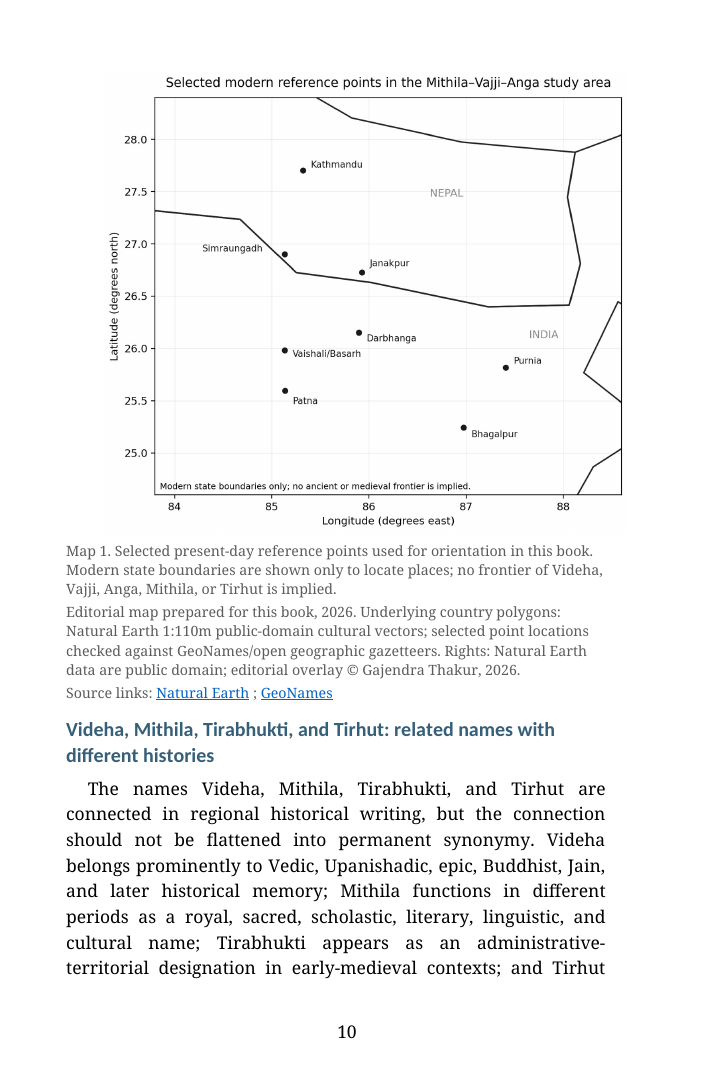
Mithila · Vajji · Anga
Chapter-specific source notes
- Primary chapter witness. Gajendra Thakur, Decoding the Panji of Mithila — Volume VI, formal Chapter 14, PDF pp. 132-142; formal Chapter 14. The HTML transcription is generated from the commit-pinned source PDF and retains the chapter boundary recorded in this edition.
- Internal structure. The repository source-heading inventory records 15 subordinate headings for this chapter: “1. Why This Chapter Must Be Read Carefully”; “2. The Meaning of यवनी as a Panji Label”; “3. दौलतिजहाँ: A Named Woman inside the Record”; “4. चाम्पो यवनी and the Wife-Line Route”; “5. Case 86: Yavani Daughter and the Daughter-Line Route”; “6. Afel and the Yavani Daughter”; “7. Muslim Connection as Evidence of Porous Boundaries”; “8. What Not to Do with These Entries”; ….
- Digital editorial method. The page keeps the preserved source text distinct from generated navigational, concordance, visual, and provenance apparatus. The synthetic reconstruction is explanatory only and is not evidence for an individual lineage or a determination of social or marital status.