Decoding the Panji of Mithila · Volume VI · Chapter 15
Widowhood, Remarriage, and the Hidden Social History of Women
Chapter 15 — Widowhood, Remarriage,
and the Hidden Social History of
Women
1. Why Widowhood Belongs in the Center of the
Book
Dushan Panji cannot be decoded only as a record of caste
boundary, mool boundary, gotra boundary, or religious
boundary. It must also be decoded as a record of gendered
boundary. Some of the most painful entries in the source are
not about a community label at all, but about a woman’s
marital condition: विधवा, वार्तिनी विधवा, पथ पतिता कन्या, or a child born
after a social rule had declared that the mother’s life should
have ended as a woman’s life.
These entries show that Panji was not only a register of descent.
It was a register of anxiety. The society wanted to know where
a child belonged, whose line should bear the mark, whether the
maternal route could be named, and whether a remarriage,
union, or birth after widowhood would be absorbed into
lineage memory. The resulting entry often speaks in the harsh
language of its time. A modern reader must not accept that
harshness as moral truth.
The widow-related entries therefore belong at the center of the
book’s ethical method. They require the reader to separate
three things: the fact recorded, the older label attached to the
fact, and the modern historical meaning of the fact. The fact
may be a marriage, a child, a maternal line, or a descendant
cluster. The old label may be condemnatory. The modern
meaning is different: it reveals how women continued to live,
form relationships, bear children, and enter memory despite
rules meant to silence them.

                        © Gajendra Thakur | 141
                 Decoding the Panji of Mithila, Volume VI

2. Widowhood as Social Condition, Not Personal
Fault
In the older social order, widowhood was not merely a private
bereavement. It became a public condition imposed upon a
woman’s body, movement, sexuality, dress, food, ritual
presence, and possibility of remarriage. Dushan Panji’s widow
entries must be read against that background. When the source
marks a woman as विधवा or वार्तिनी विधवा, it is not merely recording
that her husband died. It is recording the society’s concern that
she crossed, or was believed to have crossed, the boundary
assigned to widowhood.
The ethical rule is simple: widowhood cannot be treated as
fault. A woman did not become morally diminished because
her husband died. Nor did a later marriage or relationship
make her less human. The older record may have classified
such cases under Dushan because the genealogy system was
built to protect formal marriage rules and descent rules. But
the historian must read beyond that classification.
In this book, “widow-related Dushan” means an archival
category, not a judgment. It indicates that the Panji system
faced a question: what should be done when a woman’s life
produced a relationship or a child outside the narrow
widowhood code? The source answers through labels. This
volume answers through explanation.

3. The Vocabulary: विधवा, वार्तिनी विधवा, and पथ पतिता
The word विधवा is direct: a widow. But in the Dushan table, the
word does more than state marital condition. It signals that the
entry has become genealogically difficult because widowhood,
remarriage, or a later union affected how the descendant line
was remembered. The word is therefore both a social marker
and a genealogical trigger.
वार्तिनी विधवा is a more difficult source expression. It appears in
connection with a later case and is joined in the source

                       © Gajendra Thakur | 142
                  Decoding the Panji of Mithila, Volume VI

summary with the phrase परम पथ पतिता. The phrase must be
handled with great caution. It should be preserved as source
vocabulary only where necessary, but it should not be revived
as modern descriptive language. It tells us how the older record
condemned or classified the woman; it does not tell us her full
life, her agency, her suffering, or her circumstances.
पथ पतिता कन्या is another such label. It appears in cases where the
woman’s route into the record is treated as socially fallen. But a
responsible reader must ask: fallen according to whom? The
Panji label reflects the moral code of its own record-keeping
world. It does not exhaust the historical person.

4. Case 28: The Entry Marked विधवा
One of the relevant entries is explicitly headed विधवा. The entry
then places the case inside a chain of mools: सोदरपुर, माण्डर, गाउल,
वलियास, मोनारी, पाली, कु रिसमा, के उटराम, and पण्डोली. This is important
because the widow is not recorded in isolation. She is inserted
into a complex genealogical and geographical web.
The entry also contains names such as वेणी, जगन्नाथ, मेघ, वामन, and
the notation “माता अज्ञात.” In other words, the widow-related
entry is also connected with the problem of unknown
maternity. Widowhood and unknown maternal memory often
meet in the same archival zone because women’s relationships
were not always given stable public recognition.
Case 28 therefore teaches a method: do not stop at the label
विधवा. Read the whole chain. Ask what mool sequence is being
connected, which named men appear, where the mother is
unknown, and how the widow’s condition becomes the reason
for recording the line as difficult.

                        © Gajendra Thakur | 143
                   Decoding the Panji of Mithila, Volume VI

5. Case 94: वार्तिनी विधवा
A later entry is headed वार्तिनी विधवा and carries the reference
२२०/I. It moves through mool names including पाली, पवौली, माण्डर,
पाली again, पुरिसमा, and पंडौली, followed by names such as हरि, गोनि,
सुधाकर, बागे , दूवन, सर्वाय, and श्रीकर. The notation “दूवन-माता अज्ञात”
again joins widowhood with unknown maternal memory.
This entry should not be read as a small scandal. It should be
read as evidence of a social structure in which a widow’s later
life produced an administrative problem for genealogy. The
record wanted to mark the difference between ordinary
sanctioned descent and descent that passed through
widowhood, suspected union, remarriage, or an unapproved
maternal route.
But the very presence of names also shows that the line was not
simply erased. It was recorded. That is the paradox of Dushan
Panji. The system stigmatized certain lines, but by recording
them, it preserved the evidence of lives that formal
respectability might otherwise have hidden completely.

6. पथ पतिता कन्या and the Language of Social
Condemnation
The source contains the phrase पथ पतिता कन्या in relation to
marriage notation. This expression is severe. It belongs to the
source’s own moral vocabulary and must be treated as
evidence of social condemnation, not as a phrase the present
writer endorses. The point of decoding is not to repeat the old
accusation; it is to understand what kind of social fact required
such an accusation in the first place.
A phrase like पथ पतिता tells us that the woman’s status was being
judged through a patriarchal code of sexual and marital
control. The woman’s own voice is absent. We do not know her
circumstances, consent, compulsion, grief, economic pressure,

                          © Gajendra Thakur | 144
               Decoding the Panji of Mithila, Volume VI

family conflict, or agency. The record preserves the label but
not the full life.
Therefore, the correct historical reading is double: preserve the
label as archival evidence, and then refuse to let the label
become the woman’s entire identity. The label tells us what the
record feared. It does not tell us all that the woman was.

7. Remarriage after the Husband’s Death
The compiler’s note states that Dushan Panji included written
records of relationships and marriages with other castes and
Muslims, and also marriage after the husband’s death. This is
one of the most important sentences for Chapter 15. It confirms
that widow-related entries were not accidental or marginal.
They were a recognized category of difficult genealogical
memory.
From the point of view of formal hierarchy, remarriage after a
husband’s death could disturb the rules of ritual descent and
marital legitimacy. From the point of view of lived human
history, however, remarriage could mean survival,
companionship, protection, desire, family formation, or a
woman’s refusal to let widowhood become social death.
Dushan Panji records the institutional anxiety, but the modern
historian must also recover the human possibility. A widow’s
remarriage was not merely a “problem” for Panji. It was also
evidence that life continued despite the harshness of
widowhood norms.

8. Children after Widowhood
Children are central to the widow-related entries because Panji
is ultimately a system of descent. A union might be condemned,
but once a child existed, the record had to decide how to
remember that child. This is why widow-related entries often
move quickly from the woman’s status to the descendant line.
The phrase “सन्तानक लागिमे” in the later source summary is
especially important. It shows that the issue was not only the

                     © Gajendra Thakur | 145
               Decoding the Panji of Mithila, Volume VI

woman’s conduct, as the old order framed it, but the location of
descendants in the social map. Who would carry the mark? At
what generational distance could the mark fade? Which mool
chain would be affected? Which marriage alliances would later
be questioned?
This returns us to the larger logic of the book. Dushan Panji is
not only a book of blame. It is also a book of absorption. The
line may be marked, but it is still followed. It may be
stigmatized, but it is not always expelled from memory. In that
tension lies the historical value of the source.

9. The Cruelty of Widowhood and the Record of
Resistance
The source material outside the Dushan table also criticizes the
social consequences of the Panji order: internal stratification,
decline in public trust, emergence of transactional marriage
practices, child marriage, and a sharp rise in widowhood. It
also laments the absence of a visible reform movement in favor
of widow remarriage and against child marriage in Mithila.
This critique matters because it shows that the source itself is
not blind to social damage.
Widowhood in such a society was not merely an individual
sorrow. It was produced and intensified by child marriage, age
imbalance, rigid marriage rules, and the refusal to normalize
widow remarriage. If many widows were created by the
system, and if remarriage was condemned by the same system,
then widow-related Dushan entries must be read as evidence of
structural cruelty.
But the entries also record resistance. Some women entered
relationships; some lines continued through them; some
children were born; some families had to negotiate the facts.
The Panji system may have marked these women as
problematic, but it could not make them disappear.

                     © Gajendra Thakur | 146
                Decoding the Panji of Mithila, Volume VI

10. Women’s Names and Women’s Erasure
In many entries, women appear only through relational
phrases: mother, wife, daughter, widow, unknown mother, or
the daughter of someone else. This is not accidental. The
grammar of genealogy privileged male descent. Yet the
“problem” that forces an entry into Dushan often passes
through a woman. She is structurally marginalized and
structurally central at the same time.
This pattern should change how the reader understands the
entire archive. A woman may be unnamed, but the record often
turns around her. A mother may be called unknown, yet the
line is shaped by the absence of her name. A widow may be
stigmatized, yet the genealogy cannot proceed without
addressing her later life.
Chapter 15 therefore belongs with Chapters 11 and 12.
Unknown lineage, Devadasi or Dasi memory, and widow-
related entries are not separate marginal topics. Together they
form the female-line underside of Panji.

11. How to Decode Widow-Related Entries
The following method should be used whenever a widow-
related entry appears. First, preserve the exact source label but
translate its function carefully. Second, identify whether the
entry concerns marriage, birth, mother-line, wife-line,
daughter-line, or descendant-line. Third, note whether the
woman is named or unnamed. Fourth, trace the mool and
moolgram sequence. Fifth, identify whether the entry links
widowhood with unknown maternity, inter-community
relation, or generational absorption.
Sixth, avoid moralizing. The label is not the woman. Seventh,
distinguish archival stigma from historical fact. Eighth, ask
what the entry reveals about social practice rather than only
what it reveals about social prohibition. Ninth, protect present-
day descendants from misuse of the record. Tenth, read the

                      © Gajendra Thakur | 147
                 Decoding the Panji of Mithila, Volume VI

entry as part of the larger history of women in Mithila, not as
gossip.
This method will be especially important in the later entry-by-
entry chapters. A numbered case can look like a small table
entry, but when read carefully it may reveal widowhood,
maternal erasure, caste anxiety, marriage control, social
survival, and eventual absorption all at once.

12. What This Chapter Does Not Claim
This chapter does not claim that every widow-related entry was
an act of free choice. The source is too compressed to tell us
that. Some relationships may have involved social pressure,
dependency, exploitation, or compulsion. Others may have
involved remarriage, partnership, affection, or chosen survival.
The archive rarely tells us enough to decide.
This chapter also does not claim that the older society accepted
widow remarriage in a modern egalitarian sense. The very
classification of such entries under Dushan shows that the
older order often treated them as social and genealogical
disturbances.
What this chapter does claim is more precise: widow-related
Dushan entries are indispensable evidence for the hidden
social history of women. They show that widowhood did not
end human life, even when the social order tried to reduce a
widow’s life to ritual deprivation.

13. What This Chapter Does Claim
First, widowhood was a social institution, not merely a personal
condition. Second, Dushan Panji preserves evidence of that
institution’s cruelty. Third, the same entries also preserve
evidence of women’s continued life after widowhood. Fourth,
children and descendant lines forced the record to remember
what public morality wanted to silence.
Fifth, the labels विधवा, वार्तिनी विधवा, and पथ पतिता must be handled
as old source vocabulary, not as modern judgment. Sixth,

                       © Gajendra Thakur | 148
                Decoding the Panji of Mithila, Volume VI

widow-related entries belong to the same interpretive field as
unknown maternal lines, Devadasi or Dasi entries, daughter-
line descent, and inter-community connections.
Seventh, the ethical reading of Dushan Panji requires
compassion. Without compassion, the modern reader becomes
an echo of the old punitive system. With compassion, the same
archive becomes evidence for historical justice.

Conclusion: Widowhood as a Difficult Truth of
Panji
Chapter 15 has shown that widowhood and remarriage are not
side issues in Dushan Panji. They expose the gendered heart of
the archive. The record is difficult because it shows both the
harshness of the social order and the persistence of life inside
that order.
For the old system, a widow’s later life could become Dushan.
For the historian, it becomes evidence. It is evidence that
women were watched, judged, and classified. It is also evidence
that women lived beyond the categories assigned to them.
This is why Dushan Panji must be read, not hidden. If hidden,
the old labels remain poisonous whispers. If decoded ethically,
they become part of a larger truth: Mithila’s genealogy is not
only the story of fathers, mools, and gotras. It is also the story of
widows, unnamed mothers, stigmatized daughters, and women
whose lives forced the archive to remember them.

Chapter 15 Source Notes
1. This chapter follows the structure of Chapter 15: decoding
entries involving विधवा, वार्तिनी विधवा, remarriage, post-marital
unions, and children after widowhood, with the main argument
that Panji exposes both the cruelty of widowhood and the fact of
lived resistance.
2. Source base includes the Dushan entry marked विधवा, where
the case is placed inside a mool chain including सोदरपुर, माण्डर,

                      © Gajendra Thakur | 149
                  Decoding the Panji of Mithila, Volume VI

गाउल, वलियास, मोनारी, पाली, कु रिसमा, के उटराम, and पण्डोली, with related
names and the notation माता अज्ञात.

3. Source base also includes the later entry marked वार्तिनी विधवा,
reference २२०/I, and the later summary that refers to वार्तिनी विधवा
परम पथ पतिता and her descendants.

4. The chapter uses the source phrase पथ पतिता कन्या only as
archival vocabulary. It is not used as a present-day descriptive
judgment.
5. The compiler’s note that Dushan Panji preserves written
records of relations or marriages with other castes, Muslims,
and marriages after the husband’s death is used as the basis for
reading widow-related entries as a recognized archival
category.
6. Ethical reading rule: widowhood, remarriage, or birth after
widowhood must never be turned into present-day accusation.
The entry is evidence of historical social practice and
institutional anxiety, not a verdict on living descendants.

                         © Gajendra Thakur | 150
                 Decoding the Panji of Mithila, Volume VI
Source structure and verification apparatus
Editorial source apparatus. This apparatus is descriptive, not interpretive. It records the source-controlled structure used to verify that this page corresponds to formal Chapter 15 of Decoding the Panji of Mithila — Volume VI. The chapter text above is preserved from PDF pp. 142-152; formal Chapter 15 in the commit-pinned authoritative source. It is not merged with a neighboring chapter, appendix, annexure, or independent front/back-matter unit. The internal headings below come from the repository’s source-heading inventory and are retained as navigational and audit evidence; showing them here does not turn those headings into separate publications or add claims that are absent from the source.
Internal source headings
- 1. Why Widowhood Belongs in the Center of the Book
- 2. Widowhood as Social Condition, Not Personal Fault
- 3. The Vocabulary: विधवा, वार्तिनी विधवा, and पथ पतिता
- 4. Case 28: The Entry Marked विधवा
- 5. Case 94: वार्तिनी विधवा
- 6. पथ पतिता कन्या and the Language of Social Condemnation
- 7. Remarriage after the Husband’s Death
- 8. Children after Widowhood
- 9. The Cruelty of Widowhood and the Record of Resistance
- 10. Women’s Names and Women’s Erasure
- 11. How to Decode Widow-Related Entries
- 12. What This Chapter Does Not Claim
- 13. What This Chapter Does Claim
- Conclusion: Widowhood as a Difficult Truth of Panji
- Chapter 15 Source Notes
Source-text concordance
Widowhood · Remarriage · Hidden · Social · History · Women · Belongs · Center · Book · Dushan · cannot · decoded · record · caste · boundary · mool · gotra · religious · must · gendered · painful · entries · community · label · woman’s · marital · condition · child · born · rule · declared · mother’s · life · ended · show · register · descent · anxiety · society · wanted · know · belonged · whose · line · bear · mark · whether · maternal · route · named · union · birth · absorbed · lineage · memory · resulting · entry · often · speaks · harsh · language · time · modern · reader · accept · harshness · moral · truth · widow-related · therefore · belong · book’s · ethical · method · require · separate · three · things · fact · recorded
Boundary verification. In the formal sequence this chapter follows Volume VI Chapter 14, “Muslim and Yavani Connections” and precedes Volume VI Chapter 16, “Gangesha, Tattvachintamani, and the Dushan Record”. The chapter extractor begins at the verified formal Chapter 15 marker and stops at the next verified formal chapter marker; for a final chapter it stops before recognized book-level back matter. The concordance above is generated only from distinct terms already present in this chapter’s preserved source text. It is provided for discovery, comparison, and audit, not as an automated judgment about persons, lineages, status, kinship, marriage eligibility, or historical truth.
Illustrated research apparatus
Mithila · Vajji · Anga
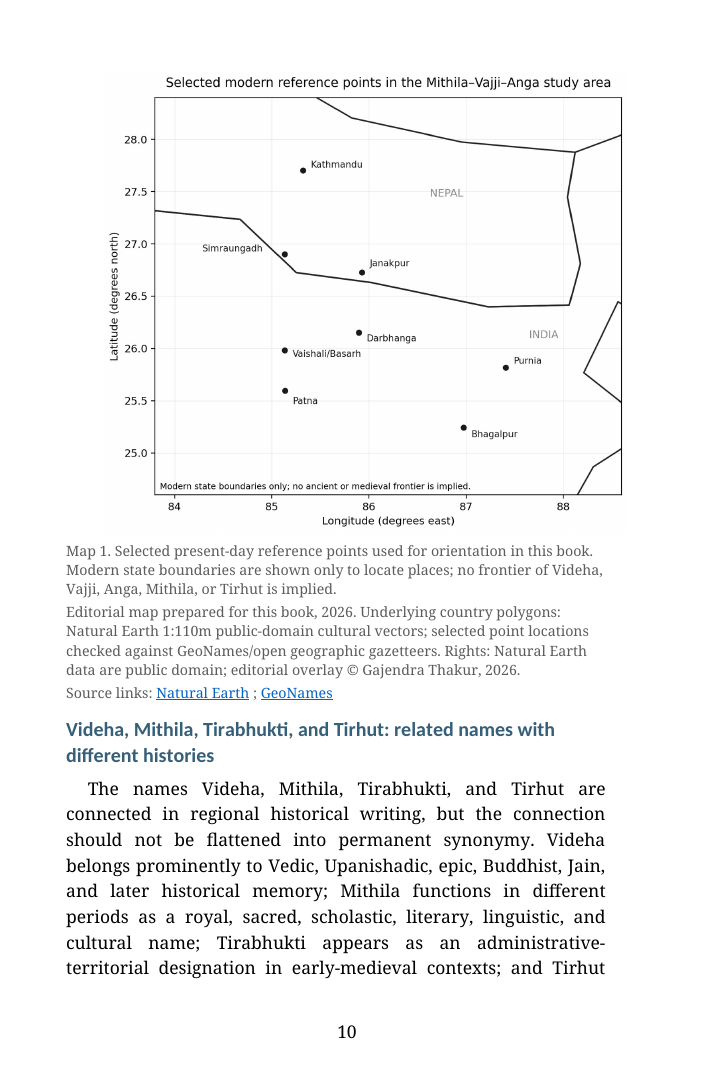
Chapter-specific source notes
- Primary chapter witness. Gajendra Thakur, Decoding the Panji of Mithila — Volume VI, formal Chapter 15, PDF pp. 142-152; formal Chapter 15. The HTML transcription is generated from the commit-pinned source PDF and retains the chapter boundary recorded in this edition.
- Internal structure. The repository source-heading inventory records 15 subordinate headings for this chapter: “1. Why Widowhood Belongs in the Center of the Book”; “2. Widowhood as Social Condition, Not Personal Fault”; “3. The Vocabulary: विधवा, वार्तिनी विधवा, and पथ पतिता”; “4. Case 28: The Entry Marked विधवा”; “5. Case 94: वार्तिनी विधवा”; “6. पथ पतिता कन्या and the Language of Social Condemnation”; “7. Remarriage after the Husband’s Death”; “8. Children after Widowhood”; ….
- Digital editorial method. The page keeps the preserved source text distinct from generated navigational, concordance, visual, and provenance apparatus. The synthetic reconstruction is explanatory only and is not evidence for an individual lineage or a determination of social or marital status.