Decoding the Panji of Mithila · Volume VI · Chapter 16
Gangesha, Tattvachintamani, and the Dushan Record
Chapter 16 — Gangesha,
Tattvachintamani, and the Dushan
Record
1. Why Gangesha Requires a Separate Chapter
Dushan Panji contains many entries that are socially difficult,
but the material concerning गंगेश is different in force. Here the
archive touches not only a family line but also the history of
Indian philosophy. The name गंगेश is not an ordinary name in
Mithila. It evokes the founder-figure of Navya-Nyaya and the
author of तत्त्वचिंतामणि, one of the great intellectual monuments of
the region.
For that reason, this chapter must avoid two equal errors. The
first error would be denial: to hide the Dushan record because
it seems uncomfortable. The second error would be
sensationalism: to use the Dushan record as if it were a weapon
against a philosopher, a lineage, or a community. Neither
method is scholarly. Neither method is ethical.
The correct method is patient decoding. The entry must be read
as an archival statement inside Panji logic. It must be placed
beside the related lines, the later explanatory note, the
vocabulary of maternal and marital connection, and the
general rule already established in this volume: old Dushan
labels are evidence of social classification, not present-day
moral verdicts.
2. The Source Entry: तत्त्वचिंतामणि कारक गंगेश
The Dushan table contains an entry marked by the phrase
तत्त्वचिंतामणि कारक गंगेश. The wording itself is significant. It does not
merely name a person; it identifies him through the work that
made him intellectually famous. In an ordinary genealogy, the
© Gajendra Thakur | 151
Decoding the Panji of Mithila, Volume VI
entry might have used only descent language. Here the table
remembers the scholar through the text: तत्त्वचिंतामणि.
The same cluster of lines also includes छादनगंगेशक, नाँई, रत्नाकरक-
मातृक (अज्ञात), गंगेश, and वल्लभा. The language is compressed, but
the compression is exactly what makes Panji difficult. Names,
mool references, maternal uncertainty, and a female name
appear close to one another, and the reader must not flatten
them into a single accusation.
The entry therefore teaches a central rule for the later case
chapters: when a famous person appears in Dushan Panji, fame
does not cancel the archive, and the archive does not cancel
fame. Both must be read together.
3. What तत्त्वचिंतामणि Means in This Context
तत्त्वचिंतामणि is not used here as a decorative title. In the source
entry, it functions as an identifier. It anchors the person named
गंगेश to a recognized scholarly achievement. That is why the
phrase तत्त्वचिंतामणि कारकगंगेश is so powerful. The archive
remembers not only descent but authorship.
This matters for Mithila because Panji is often imagined as a
ritual or marital archive, while intellectual history is imagined
as a separate world of books, commentaries, schools, and
debates. The Gangesha material shows that these worlds were
not separate. The same society that preserved gotra, mool, and
maternal-line anxieties also preserved the memory of
philosophical production.
To read the entry well is therefore to see a double archive: one
archive of family and social rule, another archive of intellectual
achievement. Dushan Panji places them on the same page.
© Gajendra Thakur | 152
Decoding the Panji of Mithila, Volume VI
4. The Phrase पितृ परोक्षे पञ्च वर्ष
A later note in the source material states, in substance, पितृ परोक्षे
पञ्च वर्ष व्यतीते गंगेशोत्पत्तिः. This phrase has often attracted attention
because it appears to raise a question about birth after the
father’s absence or death. But the phrase must be treated with
philological and archival caution.
First, it is a source phrase, not a modern biographical sentence.
Second, it belongs to a tradition of Panji notation, where
compressed phrases often carry more than one layer of
meaning. Third, it does not authorize a modern reader to turn a
birth, a mother, or a lineage into public stigma.
In the logic of this volume, the phrase is important because it
shows why the Dushan record exists at all. The system was
concerned with social eligibility, lineage continuity, maternal
route, and the status of descendants. The phrase belongs to that
system of concern.
5. वल्लभा, चर्मकारिणी, and the Female-Line Problem
The same cluster of material includes the name वल्लभा and the
category चर्मकारिणी. Later synthesis in the source explicitly states
that गंगेश’s वल्लभा, described as चर्मकारिणी, is connected with the
birth notation after five years. The text also says that Gangesha
and other such cases are preserved in the original Dushan Panji
material.
The ethical problem here is not small. Older society often
turned women’s relationships into marks upon descendants. A
woman named in such a record may be remembered not by
her full life but by a category attached to her. That is why this
chapter must read the entry through Chapter 12’s method:
female-line memory is indispensable, but it is often preserved
through a hostile vocabulary.
© Gajendra Thakur | 153
Decoding the Panji of Mithila, Volume VI
वल्लभा should not be reduced to a label. She is part of the record
because the social system needed to account for birth, descent,
and eligibility. But she is also part of the record because women
carried historical continuity in ways the formal male-line
genealogy could not avoid.
6. Why the Entry Does Not Diminish Gangesha
The presence of Gangesha in a Dushan record does not
diminish his intellectual stature. A philosopher’s arguments
stand or fall by their philosophical force, not by an archival
category attached to lineage history. तत्त्वचिंतामणि remains a
monument of thought because of its intellectual content.
At the same time, the entry does change the way one thinks
about intellectual history. It prevents a sanitized biography. It
reminds the reader that great thinkers lived inside real social
systems: systems of marriage rule, widowhood, maternal
memory, caste boundary, patronage, dispute, and record
keeping.
This is not a reduction of philosophy to genealogy. It is a
restoration of context. Gangesha did not write from outside
society. He belonged to a world in which books, ritual law,
social classification, and family memory were intertwined.
7. The Danger of Weaponizing the Entry
This chapter is written against weaponization. The Dushan
record should not be used to insult a philosopher, a family, a
mool, a village, or any descendant line. The source itself is old,
compressed, and socially charged. Its vocabulary belongs to a
hierarchical world. Modern readers must not repeat that
hierarchy as moral judgment.
Weaponization also damages scholarship. Once the entry is
used only as scandal, the real questions disappear: How did
Panji record intellectual figures? How did maternal uncertainty
enter a scholarly lineage? How did society manage a line after a
© Gajendra Thakur | 154
Decoding the Panji of Mithila, Volume VI
marked event? How long did a Dushan effect last? How did a
later period remember or forget it?
These questions are far more important than accusation. They
help decode the archive. They also protect the dignity of
persons named in old records and of persons who may belong
to later lines.
8. Why the Entry Cannot Be Hidden
The opposite danger is hiding the entry. Because Gangesha is
revered, some readers may feel that the Dushan material
should be omitted. That too would be wrong. A difficult archive
cannot be protected by erasure. Erasure leaves rumor in place
and prevents careful reading.
The better method is open, contextual, non-sensational
discussion. The entry should be printed, decoded, and
surrounded by explanation. The old vocabulary should be
identified as old vocabulary. The social logic should be
explained. The limits of the evidence should be made clear.
Only then can the reader understand why Dushan Panji
matters. It records not only obscure cases but also cases that
touch the highest intellectual memory of Mithila.
9. Gangesha and the Social History of Knowledge
The Gangesha entry shows that the history of knowledge is not
pure abstraction. Philosophical ideas may be abstract, but
philosophers are born into families, regions, languages,
institutions, and social rules. Mithila’s intellectual history was
sustained by households, teachers, students, manuscripts,
marriage networks, and memory systems.
The Panji archive therefore belongs beside the history of
scholastic texts. It cannot explain the arguments of तत्त्वचिंतामणि,
but it can explain the world in which such arguments were
preserved, transmitted, and remembered. It helps answer not
© Gajendra Thakur | 155
Decoding the Panji of Mithila, Volume VI
what Gangesha argued, but how a society remembered the
person associated with the argument.
This is why Dushan Panji must be read with both historical
courage and scholarly restraint. The archive gives evidence.
The historian must interpret it without turning evidence into
cruelty.
10. The Sixth-Generation Logic and the
Gangesha Case
Earlier chapters explained that Dushan was not always
permanent in the same way a modern stigma might be
imagined. The source itself contains examples where later
generations are described as restored or fully acceptable after
sufficient distance. This matters for the Gangesha material
because the entry should not be read as endless condemnation.
In Panji logic, the question is often genealogical distance: who
was connected to whom, through which mother or daughter,
and after how many generations the effect ceased for marriage
eligibility. The Gangesha material belongs to that logic of
descent and eligibility, not to modern social humiliation.
Therefore the proper question is not, “How can the archive
accuse Gangesha?” The proper question is, “How did the
archive classify and process a difficult descent situation in a
line connected with Gangesha?” That change of question
changes the whole reading.
11. What the Entry Reveals about Mithila
The entry reveals a Mithila that is more complex than its later
idealized image. It was a land of great philosophers and strict
genealogists, of refined debate and harsh social classification,
of women remembered through labels and men remembered
through books, of memory preserved and pain transmitted.
Such complexity should not embarrass Mithila. It should
deepen the study of Mithila. A civilization is not made serious
© Gajendra Thakur | 156
Decoding the Panji of Mithila, Volume VI
by hiding its difficult records. It is made serious by preserving
them, translating them, decoding them, and reading them with
justice.
Gangesha’s presence in Dushan Panji therefore becomes a test
of method. Can the reader honor intellectual greatness without
erasing social evidence? Can the reader preserve social
evidence without dishonoring human beings? This book
answers yes, but only through careful reading.
12. Method for Reading the Gangesha Material
The method for this entry should be explicit. First, preserve the
source terms exactly: तत्त्वचिंतामणि, गंगेश, वल्लभा, चर्मकारिणी, पितृ परोक्षे
पञ्च वर्ष. Second, identify the relationship route without
converting it into accusation. Third, distinguish the
philosopher’s intellectual contribution from the genealogical
issue recorded in the Panji.
Fourth, treat women’s names and categories as historical
evidence requiring empathy. Fifth, avoid making claims about
living persons or present-day lineages. Sixth, compare the entry
with the broader Dushan logic of generational distance and
eventual restoration. Seventh, keep the limits of interpretation
visible.
This method will be used again when the book reaches the
detailed case chapters. Chapter 16 therefore functions as a
rehearsal for the most delicate kind of decoding: a case where
intellectual fame, female-line memory, and Dushan vocabulary
meet.
13. What This Chapter Does Not Claim
This chapter does not claim to settle every biographical
question concerning Gangesha. It does not claim that the
compressed Panji note can be expanded into a full life story. It
does not claim that every later retelling of the entry is correct.
It does not use the entry as moral judgment.
© Gajendra Thakur | 157
Decoding the Panji of Mithila, Volume VI
It also does not treat the old word चर्मकारिणी as a present-day
insult. The word is preserved because the source uses it. The
interpretation belongs to the historian, and the historian must
refuse the cruelty of the old hierarchy even while preserving
the evidence of that hierarchy.
Finally, the chapter does not reduce तत्त्वचिंतामणि to biography.
The philosophical text remains a philosophical text. The
Dushan record adds social context; it does not replace
intellectual analysis.
14. What This Chapter Does Claim
This chapter claims, first, that the Gangesha material must be
included because it is part of the Dushan record. Second, it
claims that inclusion must be ethical, not sensational. Third, it
claims that the entry reveals the importance of female-line
memory in even the most prestigious intellectual histories.
Fourth, it claims that Panji is a social-information system: it
records not only purity claims but also exceptions, anxieties,
boundary crossings, and restoration. Fifth, it claims that
intellectual greatness and social difficulty can coexist in one
historical life and one historical archive.
Sixth, it claims that Mithila’s intellectual history becomes
richer, not poorer, when its difficult genealogical evidence is
read honestly.
Conclusion: Gangesha inside the Difficult
Archive
Chapter 16 has placed Gangesha where Dushan Panji places
him: inside a difficult archive. This placement should not
frighten the reader. It should teach the reader how to read. A
great philosopher can appear in a difficult genealogical record,
and the right response is neither denial nor scandal.
The right response is disciplined interpretation. The entry must
be decoded as Panji: through mool, maternal route, woman’s
© Gajendra Thakur | 158
Decoding the Panji of Mithila, Volume VI
name, source label, generational logic, and social consequence.
It must also be understood as intellectual history: the memory
of तत्त्वचिंतामणि belongs to Mithila’s highest scholarly tradition.
Gangesha, then, becomes not a problem for the book but a key
to the book. His entry shows why Dushan Panji cannot be
hidden. It is the place where Mithila’s pride and Mithila’s
difficult truth meet.
Chapter 16 Source Notes
1. This chapter follows the structure of Chapter 16: गंगेश,
तत्त्वचिंतामणि, and the Dushan record, with the instruction that this
case must be handled carefully as intellectual history rather than
gossip.
2. Source base includes the Dushan entry marked तत्त्वचिंतामणि
कारकगंगेश, with related names and notations including छादनगंगेशक,
रत्नाकरक-मातृक (अज्ञात), गंगेश, and वल्लभा.
3. Source base also includes the later explanatory line
connecting छादन, तत्त्वचिंतामणि कारक गंगेश, वल्लभा, चर्मकारिणी, and the
phrase पितृ परोक्षे पञ्च वर्ष व्यतीते गंगेशोत्पत्ति.
4. The chapter also uses the compiler’s note that the original
Dushan Panji material was transliterated word-for-word from
Mithilakshar into Devanagari and that the Gangesha material
appears in the source record.
5. Ethical reading rule: the Gangesha entry must not be used to
stigmatize a philosopher, woman, mool, village, or descendant
line. It is archival evidence, not a modern verdict.
© Gajendra Thakur | 159
Decoding the Panji of Mithila, Volume VISource structure and verification apparatus
Editorial source apparatus. This apparatus is descriptive, not interpretive. It records the source-controlled structure used to verify that this page corresponds to formal Chapter 16 of Decoding the Panji of Mithila — Volume VI. The chapter text above is preserved from PDF pp. 152-161; formal Chapter 16 in the commit-pinned authoritative source. It is not merged with a neighboring chapter, appendix, annexure, or independent front/back-matter unit. The internal headings below come from the repository’s source-heading inventory and are retained as navigational and audit evidence; showing them here does not turn those headings into separate publications or add claims that are absent from the source.
Internal source headings
- 1. Why Gangesha Requires a Separate Chapter
- 2. The Source Entry: तत्त्वचिंतामणि कारक गंगेश
- 3. What तत्त्वचिंतामणि Means in This Context
- 4. The Phrase पितृ परोक्षे पञ्च वर्ष
- 5. वल्लभा, चर्मकारिणी, and the Female-Line Problem
- 6. Why the Entry Does Not Diminish Gangesha
- 7. The Danger of Weaponizing the Entry
- 8. Why the Entry Cannot Be Hidden
- 9. Gangesha and the Social History of Knowledge
- 10. The Sixth-Generation Logic and the Gangesha Case
- 11. What the Entry Reveals about Mithila
- 12. Method for Reading the Gangesha Material
- 13. What This Chapter Does Not Claim
- 14. What This Chapter Does Claim
- Conclusion: Gangesha inside the Difficult Archive
- Chapter 16 Source Notes
Source-text concordance
Gangesha · Tattvachintamani · Dushan · Record · Requires · Separate · contains · many · entries · socially · difficult · material · concerning · different · force · archive · touches · family · line · history · Indian · philosophy · name · ordinary · evokes · founder-figure · Navya-Nyaya · author · great · intellectual · monuments · region · reason · must · avoid · equal · errors · first · error · denial · hide · seems · uncomfortable · second · sensationalism · weapon · philosopher · lineage · community · Neither · method · scholarly · ethical · correct · patient · decoding · entry · read · archival · statement · inside · logic · placed · beside · related · lines · later · explanatory · note · vocabulary · maternal · marital · connection · general · rule · already · established · labels · evidence · social
Boundary verification. In the formal sequence this chapter follows Volume VI Chapter 15, “Widowhood, Remarriage, and the Hidden Social History of Women” and precedes Volume VI Chapter 17, “Anandaa, Vallabha, Medha, Hira, Rahmu, Sohaago: Named Women and Hidden Mothers”. The chapter extractor begins at the verified formal Chapter 16 marker and stops at the next verified formal chapter marker; for a final chapter it stops before recognized book-level back matter. The concordance above is generated only from distinct terms already present in this chapter’s preserved source text. It is provided for discovery, comparison, and audit, not as an automated judgment about persons, lineages, status, kinship, marriage eligibility, or historical truth.
Illustrated research apparatus
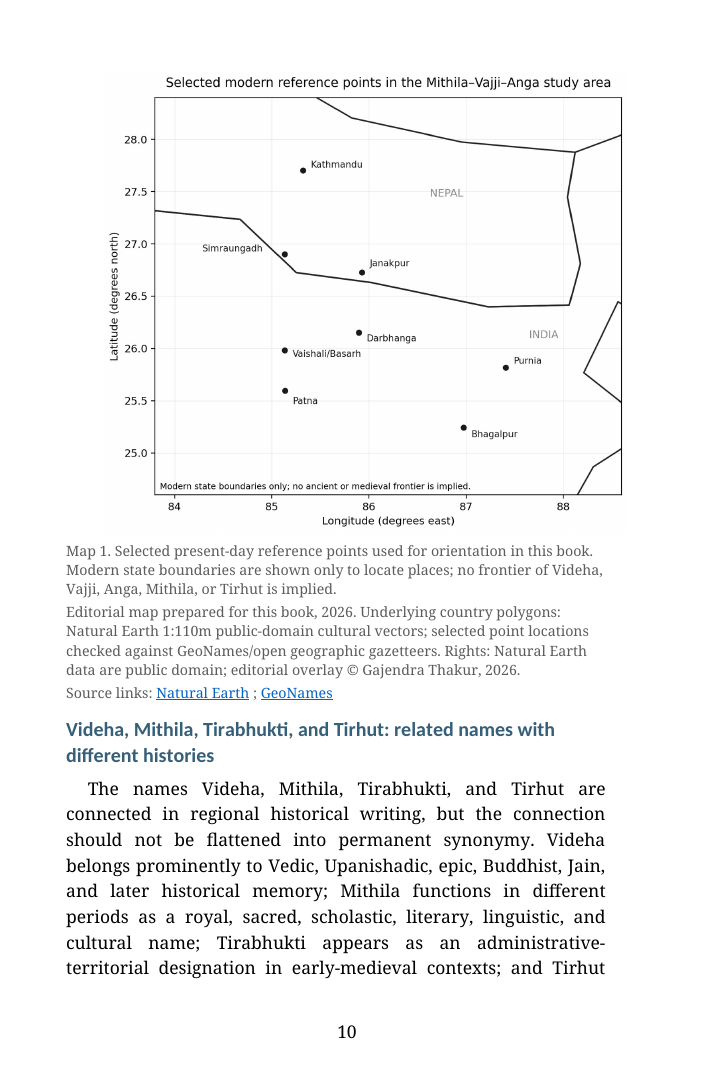
Mithila · Vajji · Anga
Chapter-specific source notes
- Primary chapter witness. Gajendra Thakur, Decoding the Panji of Mithila — Volume VI, formal Chapter 16, PDF pp. 152-161; formal Chapter 16. The HTML transcription is generated from the commit-pinned source PDF and retains the chapter boundary recorded in this edition.
- Internal structure. The repository source-heading inventory records 16 subordinate headings for this chapter: “1. Why Gangesha Requires a Separate Chapter”; “2. The Source Entry: तत्त्वचिंतामणि कारक गंगेश”; “3. What तत्त्वचिंतामणि Means in This Context”; “4. The Phrase पितृ परोक्षे पञ्च वर्ष”; “5. वल्लभा, चर्मकारिणी, and the Female-Line Problem”; “6. Why the Entry Does Not Diminish Gangesha”; “7. The Danger of Weaponizing the Entry”; “8. Why the Entry Cannot Be Hidden”; ….
- Digital editorial method. The page keeps the preserved source text distinct from generated navigational, concordance, visual, and provenance apparatus. The synthetic reconstruction is explanatory only and is not evidence for an individual lineage or a determination of social or marital status.