Decoding the Panji of Mithila · Volume VI · Chapter 17
Anandaa, Vallabha, Medha, Hira, Rahmu, Sohaago: Named Women and Hidden Mothers
Chapter 17
Anandaa, Vallabha, Medha, Hira, Rahmu, Sohaago: Named
              Women and Hidden Mothers

1. Purpose of This Chapter
    The preceding chapter examined the difficult Gangesha
entry and showed how a famous intellectual name can appear
inside a socially uncomfortable genealogical record. Chapter 17
turns from the famous male name to the women through
whom many Dushan records actually move. Its purpose is to
read named women and hidden mothers as historical actors
inside the Panji archive, not as footnotes to male descent.
    The chapter follows the structure of this volume by bringing
together names such as आनन्दा, वल्लभा, मेधा, हीरा, रहमू, and सोहागो.
The title itself requires careful explanation. Some of these are
women named directly. Some are mothers identified through a
son. Some are daughters whose identity becomes visible only
because a later descendant required explanation. One name, रहमू,
appears in the source as यादव रहमू; the relevant female memory in
that case is the daughter-line attached to him. For that reason the
chapter reads रहमू not as a female name but as a marker through
which a hidden daughter enters the record.
   The main argument is simple but important: Dushan Panji
cannot be understood if women are treated only as absence.
The archive often hides women, but when a social boundary is
crossed, when a maternal line becomes uncertain, or when a
daughter-line determines the status of later descendants, the
woman reappears as the decisive figure.

2. Women as Genealogical Evidence, Not
Decoration
    In ordinary patriarchal reading, a genealogy appears to
move from father to son: X son of Y, Y son of Z, village after
village, mool after mool. Dushan Panji disrupts that pattern. It

                      © Gajendra Thakur | 160
                   Decoding the Panji of Mithila, Volume VI

repeatedly shows that a lineage cannot be explained only by
fathers. Mothers, wives, daughters, daughters-in-law, and
women named by community label or relationship label
become necessary to the record.
    This is not accidental. The Panji system existed to determine
relationship, marriage eligibility, and the limits of swajana and
aswajana. A person’s paternal chain was never enough.
Maternal routes, daughter-lines, and wife-lines could alter the
reading of a family. Therefore the Panji archive had to
remember women even when social custom tried to make them
invisible.
   The difficulty is that the archive often remembers women in
damaged language. A woman may appear as माता, पत्नी, सुता, मातृक,
कन्या, पुत्री, दासी, देवदासी, चर्मकारिणी, यवनी, रजकी, अज्ञात, or पथ-पतिता. These
words must not be repeated as modern insults. They must be
decoded as archival labels that reveal how older record-
keepers classified social relation, not how modern readers
should value human beings.

3. The Named Woman as the Point Where the
Record Opens
    Many Dushan entries begin with a community label or a
compressed case number, but the interpretation opens only
when a woman’s name appears. A woman’s name can tell the
reader where the crossing occurred, which generation carried
the mark, whether the route was maternal, marital, or
daughter-line, and how later descendants were placed in the
system.
   The names discussed here therefore do not function like
ornament. They are interpretive keys. आनन्दा, वल्लभा, मेधा, रूद्रमति,
सोहागो, and others mark the points where the formal grammar
of Panji meets the lived complexity of Mithila. Without them,
the table would look like a dry list of mools. With them, it

                          © Gajendra Thakur | 161
                Decoding the Panji of Mithila, Volume VI

becomes a record of marriages, births, memory, forgetting,
stigma, restoration, and survival.
    The chapter does not attempt to invent biographies where
the source gives only a few words. It respects the compression
of the archive. Yet it also refuses to erase the person behind the
label. When the source gives a name, the historian must
preserve that name with care.

4. आनन्दा: From Source Label to Historical
Presence
   आनन्दा appears in the Dushan material as a significant
named woman. The source places her in an entry with a Panji
reference and a chain of names; it also records daughter-linked
memory through expressions such as आनन्दाक-पुत्री. This is
crucial. The record is not merely saying that an unnamed
woman existed. It is remembering that later persons were
connected through her daughter-line.
   The presence of आनन्दाक-पुत्री changes the reading. It shows
that the female route could be stable enough to become a
genealogical identifier. A daughter of आनन्दा becomes a bridge
by which later male names are explained. This is the opposite
of invisibility. It is hidden centrality: the woman is not always
placed at the head of the table, but the table cannot be decoded
without her.
   A later explanatory passage also mentions चर्मकारिणी आनन्दा
and states that descendants were affected or classified through
that line. Whatever one makes of the old social label, the
genealogical fact is that आनन्दा becomes a remembered ancestor-
route. Her name shows the reader that Dushan Panji is not only
a list of prohibitions; it is also a survival record of how
women’s lines entered and remained inside formal memory.

                      © Gajendra Thakur | 162
                 Decoding the Panji of Mithila, Volume VI

5. वल्लभा: The Woman Beside a Great Intellectual
Name
    वल्लभा appeared in the previous chapter because of the
Gangesha material. She must be read again here, not because
she is secondary to Gangesha, but because the record’s
treatment of her reveals the way women are placed in an
intellectual genealogy. In the source entry, the famous name
तत्त्वचिंतामणि कारक गंगेश appears near वल्लभा and a chर्मकारिणी label.

   The historian must resist two temptations. The first is to
erase वल्लभा in order to protect the reputation of a famous
philosopher. The second is to sensationalize her in order to
make the record scandalous. Both responses are ethically
wrong. The right reading is source-grounded: वल्लभा appears
because the archive considered her connection genealogically
relevant.
    वल्लभा therefore teaches the reader how to treat women in
high-status histories. A woman connected to a great intellectual
tradition is not an embarrassment to be deleted. She is part of
the social history through which that intellectual tradition
moved. The record should enlarge our understanding of
Mithila’s scholarship, not narrow it into caste pride or shame.

6. मेधा: The Named Woman inside a Chain of
Restoration
    मेधा appears as a named woman in the Dushan table,
including contexts where the source labels a line as चर्मकारिणी
and later refers to चर्मकारिणी मेधा. The case matters because it
shows a woman not merely as an anonymous marker but as a
name through which an entire relationship-route becomes
legible.

                        © Gajendra Thakur | 163
                Decoding the Panji of Mithila, Volume VI

   The name मेधा also demonstrates how the Dushan system
thinks in chains. A single label may be attached to a woman,
but the consequence is not limited to her. The record asks how
her children, daughters, later marriages, and descendant lines
are to be understood. This is why the entry cannot be read as a
moral story about one person. It is a structural note about how
lineage was classified and later restored.
   Modern readers should be especially careful with such
entries. To repeat the old label without explanation would be
cruel. To remove the name would be dishonest. The proper
method is to preserve the name, explain the route, and separate
archival classification from modern human worth.

7. हीरा: A Name from the Wider Panji Memory

    The structure of this volume includes हीरा among the women
whose names help open this chapter. In the presently available
source material, the clearest visible references to हीरा occur in
wider Panji listing contexts rather than as one of the central
Dushan case entries discussed above. This distinction matters. The
chapter therefore treats हीरा as part of broader Panji memory, not
as a case to be forced into the Dushan table without support.
   Even in that broader setting, the name is useful. It shows
that women’s names could enter the record in compressed
forms such as सुता, daughter, spouse, or relational anchor. The
presence of names like हीरा reminds the reader that the Panji
archive is not merely a male register. It is a system in which
female names surface wherever relationship accuracy required
them.
    For a final scholarly edition, the हीरा references should be
checked again against the original scan images and table positions.
This volume keeps the name in the interpretive frame because the
chapter scope requires it, but it does not overstate the evidence.

                      © Gajendra Thakur | 164
                 Decoding the Panji of Mithila, Volume VI

8. रहमू: A Male Name that Reveals a Hidden
Daughter-Line
   रहमू must be handled carefully because the source gives यादव
रहमू as the visible name, while the female memory appears
through the daughter-line. The later explanatory passage refers
to यादव रहमूक पुत्रीक सन्तान. In other words, Rahmu’s importance for
this chapter is not that he is a named woman, but that his
daughter becomes the genealogical route through which later
descendants are recorded.
   This is one of the most revealing kinds of Panji evidence. A
daughter may be unnamed, yet her line becomes decisive. The
archive remembers her through her father’s name, but the
genealogical route is hers. This is why the phrase hidden
mothers is essential. The female figure may be hidden behind a
male anchor, but the historical function belongs to her body,
her marriage, and her descendants.
   रहमू therefore teaches a method: do not read only the
printed name; read the relationship-route. When the source
says रहमूक पुत्री, the historian must ask what that daughter-line
did in the genealogy. The answer is that it carried memory
across a boundary and required formal registration.

9. सोहागो: Regional Boundary and Woman’s Name

   सोहागो appears in the source in connection with a Kocharaj
or Assam-related royal context. The table records सोहागो with a
Panji reference and later explains that the case involved a
daughter named सोहागो connected with an Assam Koach royal
line. This is not only a family detail; it is evidence that Panji
memory could reach beyond the narrow geography of one
village or mool.

                       © Gajendra Thakur | 165
                 Decoding the Panji of Mithila, Volume VI

   सोहागो brings together gender, region, and status. She is
named, and her name carries a connection to a political and
regional boundary. The case shows that Dushan Panji did not
record only village-level marriage difficulty. It also preserved
memories of relations that crossed region, rank, and
community.
   The ethical rule remains the same. The name सोहागो should
not be used as a mark of shame. It should be read as evidence
of the mobility and contact that formal genealogy often tries to
simplify. Through her, the archive admits that Mithila’s social
history was wider than its orthodox self-description.

10. रूद्रमति, हड़िनी, and the Named Woman behind a
Community Label
   Although not named in the chapter title, रूद्रमति is essential to
this topic. The source gives हड़िणी रुद्रमति and also describes later
connections through रजकक कन्या हड़िनी रूद्रमति. Here the old label
and the personal name appear together. The personal name
prevents the category from becoming an abstraction.
   This pattern is important. A label such as रजक, हड़िणी, or
चर्मकारिणी can flatten a person into a community category. But
when the archive also gives a name, the historian must restore
personhood as far as the evidence allows. रूद्रमति is not just a
category; she is a named person whose daughter-line and
marriage-route affected later genealogical classification.
    The chapter therefore treats such entries as examples of
double memory: the old hierarchy remembered a category, but
the Panji record also preserved a name. Modern scholarship
must keep the name alive while refusing the hierarchy.

                       © Gajendra Thakur | 166
                   Decoding the Panji of Mithila, Volume VI

11. Mothers Who Are Named Only through Sons
    A recurring pattern in Dushan Panji is the phrase माता
followed by a category or a short explanation: अमुकक-माता,
विद्यापतिक-माता, सुरपतिक-माता, रामदत्त-माता, or माता अज्ञात. This language
tells us that a mother can be genealogically decisive even when
she is not socially centered.
    Such entries are painful because they show the partial
nature of the record. The mother’s identity is often reduced to
her child. Yet even that reduction proves her importance. If the
mother did not matter to the structure of descent and marriage
eligibility, she would not appear at all. The record includes her
because the system needed her to explain the line.
   Thus the phrase hidden mothers should be read literally.
Many mothers are hidden behind sons, husbands, fathers,
mools, or categories. The historian’s task is not to invent names
but to notice the hidden labor of the mother-line wherever the
source leaves a trace.

12. Daughter-Line as Historical Argument
   The strongest evidence in this chapter comes from
daughter-line language: पुत्री, सुता, आनन्दाक-पुत्री, रहमूक पुत्री, रूद्रमतिक
पुत्री, and similar expressions. These phrases show that a
daughter could become the decisive bridge between one social
location and another. A daughter’s marriage could carry a
memory into a new mool chain, and her descendants could
remain readable through that route for generations.
    This is why Dushan Panji cannot be read as a simple list of
male lineages. The daughter-line sometimes carries the
interpretive burden of the entire case. The visible male names
may form the sequence, but the hidden event often lies in the
woman’s marriage or maternity.
    The modern reader must therefore ask a different question.
Instead of asking only who was the father, the reader must ask:

                          © Gajendra Thakur | 167
                Decoding the Panji of Mithila, Volume VI

through which woman did the line move, through which
daughter did the boundary cross, and how many generations
later did the mark become historically distant?

13. Named Women and the Problem of Social
Repair
    Dushan records often move from stigma to repair. A line
may be marked because of an old relationship, but later
generations can be read differently. This process is visible only
when the female route is preserved. If the woman is erased, the
logic of repair also disappears.
     The named women in this chapter therefore are not merely
examples of stigma. They are also evidence of continuity. The
very fact that descendants are recorded means the society
found ways to continue. A woman’s line might be marked, but
it also survived, married, produced descendants, and entered
later genealogical calculations.
   The book’s larger argument depends on this point. Dushan
Panji is not only a black book of exclusion. It is also a record of
how exclusion was remembered, limited, reinterpreted, and
sometimes overtaken by time. Named women stand at the
center of that process.

14. How Not to Read These Names
    These names should not be read as scandal. They should not
be used to mock any family, village, mool, community, or
intellectual tradition. They should not be detached from the
original source structure and circulated as insult. Such use
would be a second violence against people who already appear
in the archive under difficult labels.
    Nor should the names be erased in the name of
respectability. Erasure helps only the prestige narrative. It does
not help history. The respectful act is to preserve the names,

                      © Gajendra Thakur | 168
                 Decoding the Panji of Mithila, Volume VI

explain their source context, and remove the moral cruelty
from the reading.
    A responsible reader should always distinguish between
three things: the old source label, the genealogical function of
the entry, and the modern ethical interpretation. The old label
belongs to the source. The genealogical function belongs to the
historian’s analysis. The modern interpretation must belong to
justice.

Conclusion: The Archive Opens through Women
  Chapter 17 has shown that Dushan Panji opens through
women. आनन्दा, वल्लभा, मेधा, सोहागो, रूद्रमति, and the hidden daughter
of रहमू are not marginal to the record. They are the points
through which the record becomes historically readable.
    The Panji archive may have been organized by male scribes
and paternal categories, but it repeatedly depends on female
memory. Mothers, daughters, wives, and named women carry
the most difficult truths of the system. They reveal inter-
community contact, unknown lineage, widowhood, daughter-
line descent, regional crossing, and the possibility of social
repair.
   To decode Dushan Panji, therefore, one must learn to read
women’s names with care. Every name is a fragment of history.
Every hidden mother is a warning against shallow genealogy.
Every daughter-line reminds us that Mithila’s social memory
was never only a chain of fathers.

Chapter 17 Source Notes
1. This chapter follows the structure of Chapter 17: आनन्दा, वल्लभा,
मेधा, हीरा, रहमू, and सोहागो as named women and hidden mothers
inside the Dushan record.
2. Source base includes the Dushan entries for आनन्दा, including
आनन्दा २११/१ and references to आनन्दाक-पुत्री.

                        © Gajendra Thakur | 169
                  Decoding the Panji of Mithila, Volume VI

3. Source base includes the Gangesha-related entry in which
वल्लभा appears near तत्त्वचिंतामणि कारक गंगेश and the चर्मकारिणी source
label.
4. Source base includes the मेधा material, including चर्मकारिणी मेधा
and related daughter-line/restoration contexts.
5. Source base includes the यादव रहमू material, read here through
the daughter-line phrase रहमूक पुत्रीक सन्तान rather than as a
female name.
6. Source base includes the सोहागो material, including सोहागो २०८/१
and the explanatory line referring to an Assam/Koach royal
daughter named सोहागो.

7. Source base also includes the रूद्रमति material, especially हड़िणी
रुद्रमति and रजकक कन्या हड़िनी रूद्रमतिक पुत्री, used to illustrate how a
named woman can stand behind a community label.
8. The हीरा reference is treated cautiously as wider Panji
memory visible in the available source material, not forced into
the central Dushan table without further scan-level verification.
9. Ethical reading rule: every old category is treated as archival
vocabulary. No woman’s name or community label should be
used as a present-day stigma.

                         © Gajendra Thakur | 170
                  Decoding the Panji of Mithila, Volume VI
Source structure and verification apparatus
Editorial source apparatus. This apparatus is descriptive, not interpretive. It records the source-controlled structure used to verify that this page corresponds to formal Chapter 17 of Decoding the Panji of Mithila — Volume VI. The chapter text above is preserved from PDF pp. 161-172; formal Chapter 17 in the commit-pinned authoritative source. It is not merged with a neighboring chapter, appendix, annexure, or independent front/back-matter unit. The internal headings below come from the repository’s source-heading inventory and are retained as navigational and audit evidence; showing them here does not turn those headings into separate publications or add claims that are absent from the source.
Internal source headings
- 2. Women as Genealogical Evidence, Not Decoration
- 3. The Named Woman as the Point Where the Record Opens
- 4. आनन्दा: From Source Label to Historical Presence
- 5. वल्लभा: The Woman Beside a Great Intellectual Name
- 6. मेधा: The Named Woman inside a Chain of Restoration
- 7. हीरा: A Name from the Wider Panji Memory
- 8. रहमू: A Male Name that Reveals a Hidden Daughter-Line
- 9. सोहागो: Regional Boundary and Woman’s Name
- 10. रूद्रमति, हड़िनी, and the Named Woman behind a Community Label
- 11. Mothers Who Are Named Only through Sons
- 12. Daughter-Line as Historical Argument
- 13. Named Women and the Problem of Social Repair
- 14. How Not to Read These Names
- Conclusion: The Archive Opens through Women
- Chapter 17 Source Notes
Source-text concordance
Anandaa · Vallabha · Medha · Hira · Rahmu · Sohaago · Named · Women · Hidden · Mothers · Purpose · preceding · examined · difficult · Gangesha · entry · showed · famous · intellectual · name · appear · inside · socially · uncomfortable · genealogical · record · turns · male · many · Dushan · records · actually · move · read · historical · actors · archive · footnotes · descent · follows · structure · bringing · together · names · title · requires · careful · explanation · directly · identified · daughters · whose · identity · becomes · visible · later · descendant · required · appears · relevant · female · memory · case · daughter-line · attached · reason · reads · marker · daughter · enters · main · argument · simple · important · cannot · understood · treated · absence · often · hides
Boundary verification. In the formal sequence this chapter follows Volume VI Chapter 16, “Gangesha, Tattvachintamani, and the Dushan Record” and precedes Volume VI Chapter 18, “Entry-by-Entry Decoding: Cases 1-25 Purpose of This Chapter”. The chapter extractor begins at the verified formal Chapter 17 marker and stops at the next verified formal chapter marker; for a final chapter it stops before recognized book-level back matter. The concordance above is generated only from distinct terms already present in this chapter’s preserved source text. It is provided for discovery, comparison, and audit, not as an automated judgment about persons, lineages, status, kinship, marriage eligibility, or historical truth.
Illustrated research apparatus
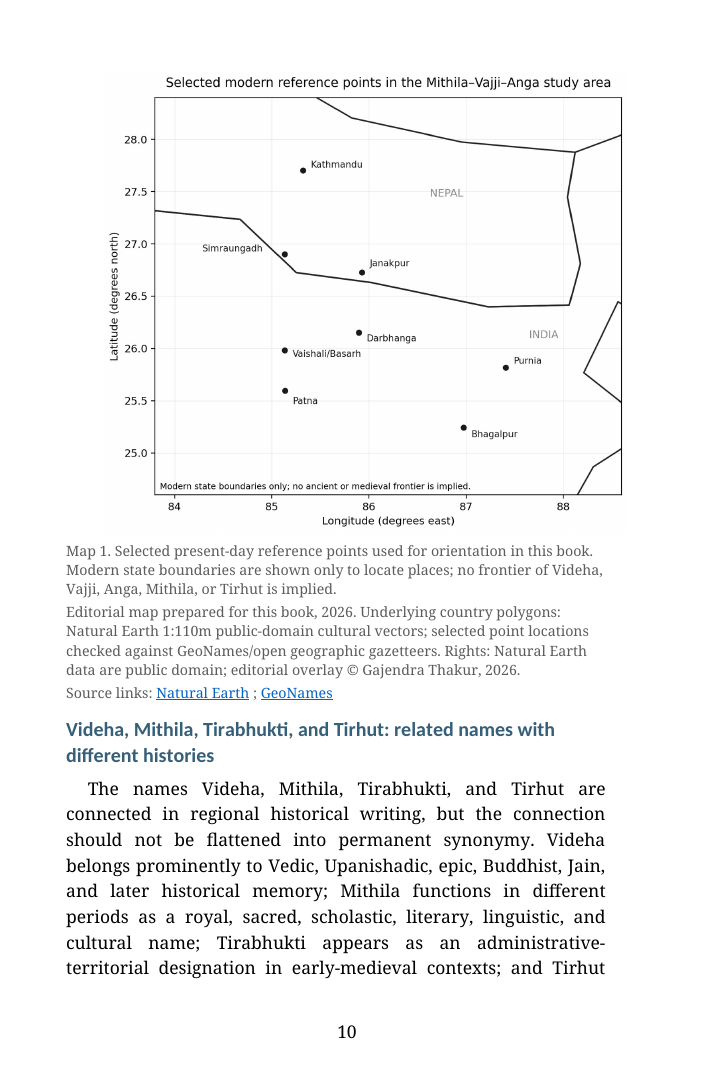
Mithila · Vajji · Anga
Chapter-specific source notes
- Primary chapter witness. Gajendra Thakur, Decoding the Panji of Mithila — Volume VI, formal Chapter 17, PDF pp. 161-172; formal Chapter 17. The HTML transcription is generated from the commit-pinned source PDF and retains the chapter boundary recorded in this edition.
- Internal structure. The repository source-heading inventory records 15 subordinate headings for this chapter: “2. Women as Genealogical Evidence, Not Decoration”; “3. The Named Woman as the Point Where the Record Opens”; “4. आनन्दा: From Source Label to Historical Presence”; “5. वल्लभा: The Woman Beside a Great Intellectual Name”; “6. मेधा: The Named Woman inside a Chain of Restoration”; “7. हीरा: A Name from the Wider Panji Memory”; “8. रहमू: A Male Name that Reveals a Hidden Daughter-Line”; “9. सोहागो: Regional Boundary and Woman’s Name”; ….
- Digital editorial method. The page keeps the preserved source text distinct from generated navigational, concordance, visual, and provenance apparatus. The synthetic reconstruction is explanatory only and is not evidence for an individual lineage or a determination of social or marital status.