Decoding the Panji of Mithila · Volume VI · Chapter 18
Entry-by-Entry Decoding: Cases 1-25 Purpose of This Chapter
Chapter 18

   Entry-by-Entry Decoding: Cases 1-25
Purpose of This Chapter
The preceding chapters built the grammar required for reading
Dushan Panji: गोत्र, मूल, मूलग्राम, मातृक, सुता, अज्ञात, देवदासी, दासी, यवनी,
चर्मकारिणी, रजक, विधवा, and other source terms. Chapter 18 now
begins the detailed decoding of the table itself. It covers cases 1-
25 of the 97-entry Dushan sequence.
The purpose is not to turn compressed Panji notes into scandal.
The purpose is to show how each entry works. Every case must
be read by case number, Panji reference where visible, mool
sequence, named persons, relationship-route, dushan category,
generation movement, and plain-language historical
interpretation. When a term is uncertain, the interpretation
remains cautious. When a person is named, the name is
preserved without turning the old source label into modern
stigma.
Cases 1-25 are especially important because they introduce
almost all the major patterns that recur later: अज्ञात मातृक, inter-
community marriage, daughter-line movement, Devadasi
memory, Yavani connection, Kocharaj connection, western-
origin or आगत entries, and named women such as आनन्दा. They
form the methodological bridge between the interpretive
chapters and the later case blocks.

How the Entries Are Read
Each entry is treated as a compressed record. A mool sequence
may show the genealogical corridor through which memory
travels. A phrase such as मातृक marks the maternal route. A
phrase such as सुता or पुत्री marks the daughter-line. A word such
as अज्ञात does not mean absence of a person; it means absence,

                         © Gajendra Thakur | 171
                  Decoding the Panji of Mithila, Volume VI

uncertainty, or insufficiency of formal lineage knowledge in the
source frame. A label such as अन्तर्जातीय, चर्मकार, यवनी, देवदासी, or
कोचराज पत्नी records the old classificatory language of the
archive, not a judgment that a modern reader should repeat.
Because the source table is terse, the explanations below do not
invent full biographies. They describe what the table allows us
to say: which route is being marked, why that route matters for
Panji logic, and how later generations must be read historically
rather than punitively.

Cases 1-25: Plain-Language Decoding

Case 1: सरिसव १७८/१; वलियास चमरू गंगाधरक मातृक
The first case opens with a dense maternal route. The visible
mool sequence moves through सरिसव, सकराढ़ी, पनिचोभ, दरिहरा, पाली,
and नरवाल, while the table anchors the dushan memory in
वलियास चमरू गंगाधरक मातृक. Names such as भवनाथ, नाथू, गांगू, कान्ह, हेलू,
होराई, चान्द, कमलनयन, किशाई, विशो, गोगे , रूद, and रामक मातृक appear in
the chain.
The plain-language reading is that an inter-community
maternal connection enters the line and then travels through
repeated daughter-line or maternal-line transmission. The issue
is not a single isolated marriage. It is the way a maternal event
became legible across several generations and mools.
This case is the model for reading many later entries. The
relevant fact is the relationship-route. The dushan mark
becomes historically intelligible only when the reader follows
how the maternal connection moves from one branch to
another.

                        © Gajendra Thakur | 172
                     Decoding the Panji of Mithila, Volume VI

Case 2: बुधवाल, पबौली, सतलखा, जगन्नाथक मातृक, and
related अज्ञात notes
The second case records a line involving बुधवाल, पबौली, सतलखा,
जगन्नाथक मातृक, घुसौत, रतनूक मातृक, दरिहरा, पाली, रामक मातृक, and नरवाल.
The personal chain includes जाटू , भीम, रामनाथ, उधोरण, हेलू, होराई, चान्द,
माधव भीमसुता, लक्ष्मी, जगन्नाथ, रतनू, राम, and देवधर.

The repeated use of मातृक shows that the case turns on mother-
line knowledge. The entries marked अज्ञात show that the system
did not always possess a complete formal lineage description.
Rather than erase the line, the Panji records the uncertainty.
The interpretive lesson is that unknownness and maternal
memory can coexist. A name may be present, a mool may be
visible, and yet a crucial maternal origin may still be formally
unclear.

Case 3: माण्डर, सोदरपुर, अलय, and गोढिसुता
This entry presents a mool sequence through माण्डर, सोदरपुर, अलय,
माण्डर, सुरगन, पचही, पकलिया, and सिम्भुनाम. The personal chain
includes रतिपति, चन्द्रपति, देवे , रत्नधर, लगाई, वंशधर, कान्ह, जयपति, दूवे , पाँखू,
भवदत्त, नरसिंह, सुपे , and राम. The crucial source phrase is गोढिसुता with
the parenthetical note निम्नकु ल.

The case must be read through the daughter-line. सुता is not
incidental. It tells the reader that the remembered boundary
crossed through a woman, and that the later chain was
interpreted through that route.
The old phrase निम्नकु ल should be treated as a source category,
not as modern social fact. It records how the Panji classified the
origin in its own period. The historian’s job is to explain the
classification without endorsing it.

                            © Gajendra Thakur | 173
                     Decoding the Panji of Mithila, Volume VI

Case 4: सोदपुर १७७/२; गंगाधरक मातृक and अन्तर्जातीय
Case 4 returns to the गंगाधरक मातृक route and places it in a chain
involving सोदपुर, वलियास, सरिसव, सकराढ़ी, पनिचोभ, दरिहरा, पाली, रामक
मातृक, and नरवाल. The entry explicitly includes the word अन्तर्जातीय.

The case is therefore not merely a repetition of a name. It is a
restatement of an inter-community maternal route as it passes
through a different branch record. The presence of मतिकर, भमरू,
नाथू, गांगू, कान्ह, हेलू, चान्द, and other names shows how the source
follows the link through a structured chain.
The reading principle is that the same dushan memory may
reappear in more than one mool corridor. That recurrence is
not redundancy; it is the archive showing how one origin
affected multiple descendant routes.

Case 5: सरिसव १८६ and राघवक मातृक
The fifth visible block begins with सरिसव १८६ and proceeds
through करमहा, सकराढ़ी, राघवक मातृक, सोदरपुर, अलय, माण्डर, सुरगन, पचही,
पकलिया, and सिम्भुनाम. The person-chain includes नोने , नरहरि, वेनी, देवे ,
रत्नधर, लगाई, वंशीधर, कान्ह, जयपति, दुवे , श्रीनाथ, चक्रपाणि, मति, राघव, पाँखू,
भवदत्त, नरसिंह, सुपे , and राम.

This case teaches that मातृक may appear not only with an
unknown or stigmatized origin but also as a normal technical
device in tracking descent. The marked mother-line tells the
Panjikar where the interpretive pressure lies.
A plain-language reading is that the case asks the reader to
follow a maternal branch through a set of mools and named
descendants. The dushan memory is located in the maternal
connection rather than in the visible paternal sequence alone.

                            © Gajendra Thakur | 174
                   Decoding the Panji of Mithila, Volume VI

Case 6: पवौली भानुदत and के शवसुता १९६/७
Case 6 moves through पवौली, एकहरा, जगति, सोदरपुर, चान्दक मातृक, अलय,
माण्डर, सुरगन, पचही, पकलिया, and सिम्भुनाम. It includes सुधापति, सुरपति,
नोने , पाँखू, रत्नधर, लगाई, वंशीधर, कान्ह, जयपति, दुवे , and then the marked
female expression के शव सुता १९६/७.

The appearance of सुता makes the daughter-line explicit. The
record is not merely saying that Keshav existed; it marks a
daughter as the route by which the case is to be decoded.
The interpretive point is that women’s movement through
marriage can reorganize Panji memory. The dushan category
becomes readable only when the daughter-line is treated as a
central genealogical fact.

Case 7: हरिकरक मातृक and कु मरसुता १८४/२
Case 7 lists सोदरपुर, करमहा, माण्डर, अलय, हरिकरक मातृक, दरिहरा, नीमा
टकवाल, सुईरी, and गदहा पंडोली. Its person-chain includes गदाधर, रामनाथ,
के शव, दिनकर, नरसिंह, दामोदर, परशुराम, अरविन्द, विशो, महेश, जगतू, हरिकर, के शव,
रविशर्म्म, गोरी, and निधि, with कु मरसुता १८४/२ as the marked phrase.

This is a layered entry: one maternal mark appears in हरिकरक
मातृक, while another female-route phrase appears in कु मरसुता. The
table is telling the reader that both mother-line and daughter-
line memory matter.
The case demonstrates that a Dushan entry may not have a
single simple key. Its meaning may lie in the convergence of
several female-route markers across a long chain of mools.

Case 8: हरिअम, उदनपुर, and दामूसुता अन्तर्जातीय
Case 8 moves through हरिअम, उदनपुर, माण्डर, पचही, करही, राउड दरिहरा,
and लहण्डा. The person sequence includes गांगू, दामू, सुरसर, स्थिति,

                          © Gajendra Thakur | 175
                     Decoding the Panji of Mithila, Volume VI

अदितु, शुक्ल विशो, बुधाई, के शव, पागू, हरि, साहब, and साठू . The crucial note
is दामूसुता अन्तर्जातीय.

This is one of the clearest early examples in which a daughter-
line and an inter-community category are joined. The word सुता
marks the route; अन्तर्जातीय marks the old social classification.

The case should not be read as a condemnation of the daughter.
It should be read as evidence that a daughter’s marriage or
maternal route could become a recorded genealogical fact
affecting later eligibility and memory.

Case 9: कोचराज पत्नी and सोहागो २०८/१
Case 9 identifies कोचराज पत्नी and then lists खण्डवला, खौआल, फनन्दह,
वलियास, बहेराढी, and माण्डर. The entry gives सोहागो २०८/१ and later
marks चन्द्रपति सुता कोचराज पत्नी.

The case is important because it extends the Panji horizon
beyond ordinary village genealogy. सोहागो connects a woman’s
name, a royal or regional identity, and a daughter-line route.
The plain-language reading is that the table preserves a cross-
regional and status-marked marriage memory through a
woman. This should be treated as evidence of mobility and
contact, not as a scandal to be repeated.

Case 10: धारूक मातृक and वासुदेवसुता
Case 10 lists पवौली, घुसौत, दरिहरा, धारूक मातृक, वहेराढी, and माण्डर. The
named chain includes शिवदत्त, अमरू, नन्दन, आंगू, सागर, रूपदत २०८/२,
जीवाई, धारू, रूद, स्थिति, and वाशुदेवसुता.

This entry combines मातृक and सुता. The maternal route tied to
धारू and the daughter-line tied to वासुदेव together show why the
entry cannot be reduced to a simple male descent list.

                           © Gajendra Thakur | 176
                    Decoding the Panji of Mithila, Volume VI

The case is a good example of Panji’s layered notation. The
record may place one key in the mool sequence, another in a
mother-line phrase, and another in a daughter-line phrase.

Case 11: यवनी दौलतिजहाँ and डगरक माता
Case 11 lists पवौली, एकहरा, जगति, सोदरपुर, पाली, सतलखा, गंगोली, डगरक माता,
नदाम, and यवनी. The personal chain includes भानुदत्त, सुरपति, नोने , पाँखू,
दुवे , दिवाकर, डगर, यवनी दौलतिजहाँ , धनञ्जय, and दौलतिजहाँ ४३.

The central marker is यवनी दौलतिजहाँ . The entry is not simply
about religious identity; it is about a named woman whose
connection becomes genealogically relevant. The phrase डगरक
माता also reminds the reader that the maternal role is central to
the case.
The ethical interpretation is that दौलतिजहाँ should be read as a
named historical person inside a Panji route. Her presence
shows porous boundaries between communities and the need
for careful documentation in the marriage archive.

Case 12: लाखूक मातृक and a repeated दौलतिजहाँ line
Case 12 continues the यवनी material through कु जौली, खौआल,
महिन्द्रवाड पाली, लाखूक मातृक, गंगोली, डगरक माता, नदाम, and यवनी. It names
गोपाल २१६/१, गोविन्द, लाखू यशोधर, दौलतिजहाँ , डगर, दौलति जहाँ , धनञ्जय,
वंशवर्द्धन, विशो, गंगाधर, and वलभद्रसुता.

The repetition of दौलतिजहाँ is significant. It shows that the source
is not merely inserting a label once; it is tracking the line
through a structured route. The presence of मातृक again
emphasizes that mother-line knowledge is the key to the entry.
The case helps confirm that यवनी entries are genealogical
records, not loose social rumors. They belong to a formal table
and should be read with the same care given to any other Panji
route.

                            © Gajendra Thakur | 177
                      Decoding the Panji of Mithila, Volume VI

Case 13: धारे श्वरक माता and अज्ञात
Case 13 moves through खण्डवला, माण्डर, पाली, दरिहरा, बहेराढी, जमुनी,
माण्डर, and धारे श्वरक माता. The named sequence includes चान्द or
चन्द्रपति, काशी, नोने , गुणे , राम, धारे श्वर, महेश, भीम, बाटू , अनन्दू, अफे ल, गोनू, माधव,
and माने .

The important source signal is धारे श्वरक माता followed by an अज्ञात
note. Here the mother is visible as a genealogical necessity but
not fully identifiable in the formal lineage frame.
The case shows why अज्ञात must be read carefully. It does not
erase the mother. It records that her formal lineage was
unknown, uncertain, or outside the available Panji apparatus.

Case 14: गोढिक, तनया २१६/२, and रघुपाणिसुता
Case 14 begins with गोढिक and lists सरिसव, घुसौत, गंगोर, वलहा, and
मधुकर. The person-chain gives सागर, गांगू, रतिकांत, हारू, सुधाकर, संतति,
and then तनया २१६/२. It also records रघुपाणिसुता with the note
गोढिमाता.

The entry is built around daughter-language. तनया and सुता are
both female-route terms. The table is saying that a daughter or
female descendant becomes the way to understand the
genealogical question.
The case confirms that the Dushan table cannot be decoded
without gendered vocabulary. A reader who ignores daughter-
line words will miss the whole structure of the entry.

Case 15: रतिक माता and यशुसुता
Case 15 lists दरिहरा, सोदरपुर, दरिहरा, घुसौत, तेरहुता, नरवाल, and रतिक माता.
The sequence then moves through भोला, शंकर, खाटू , दामोदर, लाखू,
नोनाई, मनसुख, गंगाधर, नरपति, हरि, रति, and यशुसुता.

                               © Gajendra Thakur | 178
                     Decoding the Panji of Mithila, Volume VI

This case again combines mother-line and daughter-line
markers. रतिक माता identifies the maternal route; यशुसुता marks a
daughter-route within the same compressed case.
The plain-language interpretation is that the case preserves a
layered female route. Mother and daughter both become
necessary for explaining how the dushan memory moves.

Case 16: देवदासी memory; हरिहरक-माता and विदूक-माता
Case 16 lists सोदरपुर, खौआल, सोदरपुर, दरिहरा, पनिचोभ, चान्दो, तिलय, खौआल,
and सोदरपुर. It names राघव, पूरखू, नागू, धारू, रतन, कामेश्वर, श्रीपति, नोने , हरिदत्त,
रत्नपति २१५/१, हरिहरक-माता (देवदासी), विदूक-माता, देवदास, and यदुनाथ.

The important category is देवदासी, but the entry should be read
through मातृत्व. The table does not merely say Devadasi in the
abstract. It identifies mothers: हरिहरक-माता and विदूक-माता.

This case shows that women connected with Devadasi memory
were not outside the genealogical system. They were recorded
precisely because their motherhood mattered for lineage
interpretation.

Case 17: जानिक देवदास and विद्यापतिक-माता
Case 17 begins with जानिक देवदास and moves through बुधवाल,
खौआल, जलीवाल, माण्डर, कु रहनि, तिलय श्रीपति, खौआल, and सोदरपुर. The
entry gives चान्द २१५/२ and includes गीरू, जीवे , देवादित्य, गुणेश्वर,
विद्यापतिक-माता (देवदासी), नोने , हरिदत्त, भानू, हरखू, थेग, नाथू, ढोढे , and सुधापति.

Again the key is not the old label alone. The key is the mother.
विद्यापतिक-माता is the phrase that explains why the record exists in
this form.
A responsible reading must separate the historical person from
the source category. The case is evidence that a mother’s
identity was genealogically decisive even when she was
marked through a difficult social label.

                             © Gajendra Thakur | 179
                    Decoding the Panji of Mithila, Volume VI

Case 18: जानिक देवदास, जीवेक-माता, लाखूक-माता, and
चतुर्भूजसुता
Case 18 continues the Devadasi cluster through जानिक देवदास,
सोदरपुर, पाली, सुरगन, दरिहरा, जीवेक-माता, तिलय-श्रीपति, खौआल, and सोदरपुर.
The record names लाखन, ज्ञान, रवि, जीवे , देवदासी, लाखूक-माता, ढोढे , हरदत्त,
जनार्दन २१४/१, वाटू , वाचस्पति, अमरू, and चतुर्भूजसुता १०२/०१.

This entry contains multiple female-route markers: जीवेक-माता,
लाखूक-माता, देवदासी, and चतुर्भूजसुता. The archive is not dealing with a
single woman but with a chain in which several female
positions become interpretively relevant.
The case teaches the reader to slow down. In a compressed
Panji entry, every मातृ and सुता phrase may carry a separate
genealogical function.

Case 19: जानिक देवदास and पहकर जागेक माता
Case 19 lists जानिक देवदास with सोदरपुर, माण्डर, हरिअम, माण्डर, करमहा,
खौआल, and सोदरपुर. It names पशुपति, यशोधर, सोनी, नन्दन, पहकर जागेक माता
(देवदास), ढोढे , हरदत्त, श्रीहरि २१४/२, दामू, देवनाथ, रघु, हारूक-माता, हरिनाथ, and an
अज्ञात note.

The case again places a mother at the center. पहकर जागेक माता and
हारूक-माता indicate that the line cannot be understood by father-
names alone.
The अज्ञात note adds another layer: a mother may be visible in
function while her complete formal identity remains uncertain.
This is a recurring Dushan pattern.

                            © Gajendra Thakur | 180
                     Decoding the Panji of Mithila, Volume VI

Case 20: जानिक; देवदास २१३/१; two named mother-
routes
Case 20 begins with जानिक and lists पवौली, बुधवाल, वलियास, वभनियाम,
मताउन, रकवाल, and तिलय-श्रीपति. It gives देवदास २१३/१ and names
सभापति, पराण, धारू, होरे , धर्मू, कामदेव, विद्यापतिक-माता (देवदासी), गोप, नारायण,
श्रीरामक-माता (देवदासी), मनसुख, हरिपति, उधे , and रतिपति.

The striking feature is the presence of two mother-routes
marked as देवदासी: विद्यापतिक-माता and श्रीरामक-माता. The table is not
speaking in generalities; it preserves named descendant
positions through mothers.
This case confirms that Devadasi-linked memory was not
incidental. It entered the formal logic of lineage and had to be
recorded for later genealogical decision-making.

Case 21: जानिक; देवदास २१३/२; विद्यापति and Haridev
references
Case 21 continues with जानिक and moves through दरिहरा, पवौली,
बुधवाल, खौआल, जलिवाल, माण्डर, कु रहनि, and तिलय-श्रीपति. The entry
includes देवदास २१३/२, रामनाथ, विद्यानाथ, मानू, गीरू, जीवे , देवादित्य, गुणीश्वर,
विद्यापतिक-माता (देवदासी), रघुनी, गुणपति, सुधापति, हरखू, थेघ, नाथू, विद्यापति, and
हरिदेव ४७/३.

This case is close to Case 17 but belongs to a different visible
sequence and reference. The repetition helps the reader see
that the same type of maternal memory could appear across
multiple linked records.
The entry also shows why later decoding must preserve case
numbers. Similar terms do not mean identical cases. Each case
has its own mool corridor and person-chain.

                            © Gajendra Thakur | 181
                     Decoding the Panji of Mithila, Volume VI

Case 22: पश्चिम देश सँ आगत २१२/१ and मधुसुदन-सुता
अज्ञातकु ल
Case 22 is marked by पश्चिम देश सँ आगत and lists माण्डर, करमहा, खौआल,
सोदरपुर, वभनियाम, सकराढ़ी, दरिहरा, यमुगाम, and पुरहदी. It gives आगत २१२/१
and names लटाउँ , रघु, मित्रकर, शक्तू, गहेश्वर, टूनी, लक्ष्मीनाथ, कीर्तिवास, मतिश्वर,
होराई, शिव, जीवे , उधोरण, होरे , धृतिकर, and मधुसुदन-सुता (अज्ञातकु ल).

The case combines migration and unknown lineage. पश्चिम देश सँ
आगत marks origin from the west or outside the immediate local
frame. मधुसुदन-सुता (अज्ञातकु ल) shows that the daughter-line is tied
to a formally unknown lineage category.
The plain-language reading is that the archive records both
movement and uncertainty. Migration did not erase the line; it
created the need for formal notation.

Case 23: पश्चिम देश सँ आगत २१२/२ and मतिकर माता अज्ञात
Case 23 also begins with पश्चिम देश सँ and lists माण्डर, खण्डवला, दरिहरा,
बहेराढी, खौआल, and जालय. It gives आगत, चन्द्रपति, दीनू, भवे , वराह, हरिहर,
रतिधर, २१२/२, गोढि, गुणाकर, मेधू, नोने , रति, and मतिकर (माता अज्ञात).

This entry parallels Case 22 but has its own structure. It
connects western-origin or आगत memory with a mother whose
formal identity is unknown.
The case reinforces an important rule: आगत should not be read
as mere geography and अज्ञात should not be read as nothingness.
Together they record how movement and incomplete maternal
knowledge shaped Panji classification.

Case 24: चर्मकार, बैजूक-माता, and आनन्दा २११/१
Case 24 explicitly gives चर्मकार and lists तल्हनपुर, टकवाल, दरिहरा,
पञ्चोभ, मेरन्दी, ब्रह्मपुर, and बैजूक-माता. It then gives आनन्दा २११/१ and

                            © Gajendra Thakur | 182
                   Decoding the Panji of Mithila, Volume VI

names गढवय, जीवधर, पाठक, जगन्नाथ, परभू, बैजू, आनन्दा, रवि, गहाय, हरि,
दिवाकर, मितूसुता २५३/६, and हरिहर.

This is one of the most important early named-woman cases.
आनन्दा is not anonymous. Her name appears twice, and the entry
also includes बैजूक-माता and मितूसुता. The old label चर्मकार must be
treated as a source category, while आनन्दा must be preserved as
a named historical presence.
The case shows how a woman’s name can transform a category
into a recoverable human and genealogical story. The table
records a boundary, but it also records a person.

Case 25: आनन्दाक-पुत्री and the daughter-line of
memory
Case 25 lists सोदरपुर, माण्डर, फनदह, and नदाम. It names अफे ल, धारू, हारू,
कान्हा, दिवाकर, विश्वनाथक-माता आनन्दाक-पुत्री, सोन, जयकरक-माता आनन्दाक-पुत्री,
and रघु २११/११.

This case is a direct continuation of the आनन्दा theme. The key
phrase is आनन्दाक-पुत्री, repeated for the mothers of विश्वनाथ and
जयकर. The record thus remembers later persons through the
daughter of आनन्दा.

The case proves that daughter-line memory was not marginal.
It could become the formal key by which later male names
were explained. This is why the Dushan table must be read
through mothers and daughters as carefully as through fathers
and sons.

Patterns Emerging from Cases 1-25
The first twenty-five cases show that Dushan Panji is not a
random list. It is a structured archive of relationship-routes.
Several patterns dominate the group: maternal memory,
daughter-line transmission, inter-community marriage,

                          © Gajendra Thakur | 183
                   Decoding the Panji of Mithila, Volume VI

unknown lineage, regional arrival, Devadasi-linked
motherhood, Yavani connection, and named women whose
presence prevents the record from becoming merely abstract.
The most common decoding mistake is to read these cases as a
list of “defects” without following the chain. The table is not
built for gossip. It is built for genealogical calculation. A word
such as चर्मकार, यवनी, देवदासी, कोचराज पत्नी, अज्ञातकु ल, or अन्तर्जातीय only
becomes meaningful when placed inside the mool sequence
and person-chain that the table gives.
A second mistake is to treat male names as the only real
genealogy. Cases 1-25 repeatedly show that mothers and
daughters carry the decisive information. मातृक, माता, सुता, तनया,
and पुत्री are not marginal terms. They are keys.

Ethical Reading of These Twenty-Five Cases
The first case block also establishes the ethical rule for the rest
of the book. Old source categories must remain visible because
hiding them would falsify the archive. But they must never be
repeated as present-day stigma. The reader must distinguish
between archival vocabulary, genealogical function, and
human dignity.
The persons named in these entries belonged to historical
circumstances very different from the modern world. A
modern reader has no right to convert the source into
accusation. The proper work is to decode the structure,
preserve the names, understand the social system, and prevent
the archive from being misused against living families or
communities.

Conclusion: The First Case Block as a Reading
School
Cases 1-25 teach the reader how to read the rest of Dushan
Panji. They show that the table is compressed but not chaotic. It

                          © Gajendra Thakur | 184
                    Decoding the Panji of Mithila, Volume VI

is filled with routes, markers, names, and categories that can be
decoded when the grammar of Panji is respected.
The next chapters will continue the entry-by-entry work. Cases
26-50 will deepen the same method, especially through
additional अज्ञात, inter-community, named-woman, and
intellectual-lineage material. The reader should now be
prepared to follow the table not as a blacklist but as Mithila’s
difficult social memory.

Chapter 18 Source Notes
1. This chapter follows the structure of Chapter 18: entry-by-entry
decoding of cases 1-25, including original case number, names,
mool sequence, relationship chain, dushan category, and plain-
language interpretation.
2. Source base for Cases 1-2 includes the opening Dushan table
entries beginning with सरिसव १७८/१ and बुधवाल-पबौली-सतलखा,
including गंगाधरक मातृक, रामक मातृक, and अज्ञात notes.

3. Source base for Cases 3-15 includes the table sequence
containing गोढिसुता, गंगाधरक मातृक, अन्तर्जातीय, राघवक मातृक, के शवसुता,
कु मरसुता, दामूसुता, सोहागो, धारूक मातृक, यवनी दौलतिजहाँ , धारे श्वरक माता, तनया,
रघुपाणिसुता, रतिक माता, and यशुसुता.

4. Source base for Cases 16-21 includes the Devadasi cluster:
हरिहरक-माता, विदूक-माता, विद्यापतिक-माता, लाखूक-माता, पहकर जागेक माता,
श्रीरामक-माता, and related देवदास references.

5. Source base for Cases 22-23 includes the पश्चिम देश सँ आगत
entries, especially मधुसुदन-सुता (अज्ञातकु ल) and मतिकर (माता अज्ञात).

6. Source base for Cases 24-25 includes चर्मकार, बैजूक-माता, आनन्दा
२११/१, मितूसुता, and the repeated आनन्दाक-पुत्री phrases in the
mothers of विश्वनाथ and जयकर.

                           © Gajendra Thakur | 185
               Decoding the Panji of Mithila, Volume VI

7. All community terms and status terms in this chapter are
treated as archival categories and relationship-route markers,
not as modern insults or judgments.

                     © Gajendra Thakur | 186
                 Decoding the Panji of Mithila, Volume VI
Source structure and verification apparatus
Editorial source apparatus. This apparatus is descriptive, not interpretive. It records the source-controlled structure used to verify that this page corresponds to formal Chapter 18 of Decoding the Panji of Mithila — Volume VI. The chapter text above is preserved from PDF pp. 172-188; formal Chapter 18 in the commit-pinned authoritative source. It is not merged with a neighboring chapter, appendix, annexure, or independent front/back-matter unit. The internal headings below come from the repository’s source-heading inventory and are retained as navigational and audit evidence; showing them here does not turn those headings into separate publications or add claims that are absent from the source.
Internal source headings
- Purpose of This Chapter
- How the Entries Are Read
- Cases 1-25: Plain-Language Decoding
- Case 1: सरिसव १७८/१; वलियास चमरू गंगाधरक मातृक
- Case 2: बुधवाल, पबौली, सतलखा, जगन्नाथक मातृक, and related अज्ञात notes
- Case 3: माण्डर, सोदरपुर, अलय, and गोढिसुता
- Case 4: सोदपुर १७७/२; गंगाधरक मातृक and अन्तर्जातीय
- Case 5: सरिसव १८६ and राघवक मातृक
- Case 6: पवौली भानुदत and केशवसुता १९६/७
- Case 7: हरिकरक मातृक and कुमरसुता १८४/२
- Case 8: हरिअम, उदनपुर, and दामूसुता अन्तर्जातीय
- Case 9: कोचराज पत्नी and सोहागो २०८/१
- Case 10: धारूक मातृक and वासुदेवसुता
- Case 11: यवनी दौलतिजहाँ and डगरक माता
- Case 12: लाखूक मातृक and a repeated दौलतिजहाँ line
- Case 13: धारेश्वरक माता and अज्ञात
- Case 14: गोढिक, तनया २१६/२, and रघुपाणिसुता
- Case 15: रतिक माता and यशुसुता
- Case 16: देवदासी memory; हरिहरक-माता and विदूक-माता
- Case 17: जानिक देवदास and विद्यापतिक-माता
- Case 18: जानिक देवदास, जीवेक-माता, लाखूक-माता, and चतुर्भूजसुता
- Case 19: जानिक देवदास and पहकर जागेक माता
- Case 20: जानिक; देवदास २१३/१; two named mother-routes
- Case 21: जानिक; देवदास २१३/२; विद्यापति and Haridev references
- Case 22: पश्चिम देश सँ आगत २१२/१ and मधुसुदन-सुता अज्ञातकुल
- Case 23: पश्चिम देश सँ आगत २१२/२ and मतिकर माता अज्ञात
- Case 24: चर्मकार, बैजूक-माता, and आनन्दा २११/१
- Case 25: आनन्दाक-पुत्री and the daughter-line of memory
- Patterns Emerging from Cases 1-25
- Ethical Reading of These Twenty-Five Cases
- Conclusion: The First Case Block as a Reading School
- Chapter 18 Source Notes
Source-text concordance
Entry-by-Entry · Decoding · Cases · 1-25 · Purpose · preceding · chapters · built · grammar · required · reading · Dushan · terms · begins · detailed · table · covers · 97-entry · sequence · turn · compressed · notes · scandal · show · entry · works · Every · case · must · read · number · reference · visible · mool · named · persons · relationship-route · category · generation · movement · plain-language · historical · interpretation · term · uncertain · remains · cautious · person · name · preserved · without · turning · label · modern · stigma · especially · important · introduce · almost · major · patterns · recur · later · inter · community · marriage · daughter-line · Devadasi · memory · Yavani · connection · Kocharaj · western · origin · entries · women · form · methodological · bridge · interpretive
Boundary verification. In the formal sequence this chapter follows Volume VI Chapter 17, “Anandaa, Vallabha, Medha, Hira, Rahmu, Sohaago: Named Women and Hidden Mothers” and precedes Volume VI Chapter 19, “Entry-by-Entry Decoding: Cases 26-50”. The chapter extractor begins at the verified formal Chapter 18 marker and stops at the next verified formal chapter marker; for a final chapter it stops before recognized book-level back matter. The concordance above is generated only from distinct terms already present in this chapter’s preserved source text. It is provided for discovery, comparison, and audit, not as an automated judgment about persons, lineages, status, kinship, marriage eligibility, or historical truth.
Illustrated research apparatus
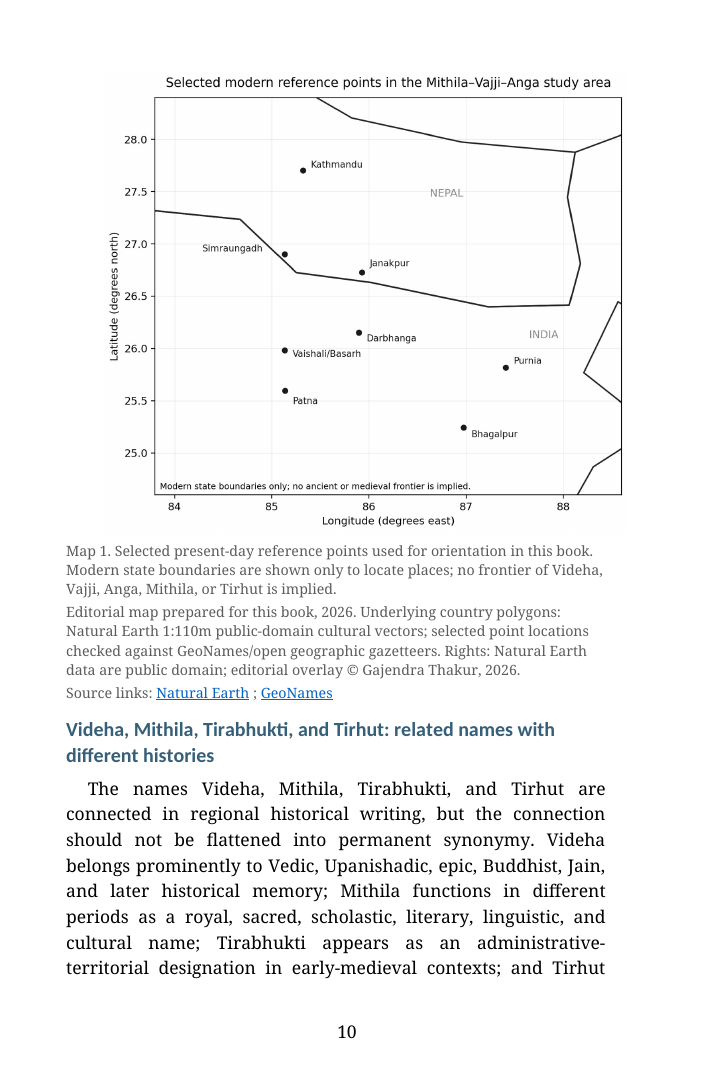
Mithila · Vajji · Anga
Chapter-specific source notes
- Primary chapter witness. Gajendra Thakur, Decoding the Panji of Mithila — Volume VI, formal Chapter 18, PDF pp. 172-188; formal Chapter 18. The HTML transcription is generated from the commit-pinned source PDF and retains the chapter boundary recorded in this edition.
- Internal structure. The repository source-heading inventory records 32 subordinate headings for this chapter: “Purpose of This Chapter”; “How the Entries Are Read”; “Cases 1-25: Plain-Language Decoding”; “Case 1: सरिसव १७८/१; वलियास चमरू गंगाधरक मातृक”; “Case 2: बुधवाल, पबौली, सतलखा, जगन्नाथक मातृक, and related अज्ञात notes”; “Case 3: माण्डर, सोदरपुर, अलय, and गोढिसुता”; “Case 4: सोदपुर १७७/२; गंगाधरक मातृक and अन्तर्जातीय”; “Case 5: सरिसव १८६ and राघवक मातृक”; ….
- Digital editorial method. The page keeps the preserved source text distinct from generated navigational, concordance, visual, and provenance apparatus. The synthetic reconstruction is explanatory only and is not evidence for an individual lineage or a determination of social or marital status.