Decoding the Panji of Mithila · Volume VI · Chapter 19
Entry-by-Entry Decoding: Cases 26-50
Chapter 19 — Entry-by-Entry Decoding:
Cases 26-50
1. How This Chapter Reads Cases 26-50
Chapter 18 began the entry-by-entry method with cases 1-25.
Chapter 19 continues the same discipline. Each case is read
through five questions: What is the case number and Panji
reference? Which mool or moolgram names appear? Which
named persons are linked? What kind of difficulty is recorded?
What does the entry mean when translated into plain
language?
The entries in this block are especially important because they
reveal repetition. Unknown mothers appear again and again.
Rajak/Rajaki markers appear as maternal routes. The phrase
निषिद्धकु ल appears in a cluster. Several cases repeat the old case-1
chain in new form. The block ends with two major
Charmakarini cases: one tied to the
Gangesha/Tattvachintamani record and another tied to Medha.
The method remains ethical. The source vocabulary is
preserved as archival evidence, but the interpretation avoids
turning old labels into present-day blame. Every entry is
treated as a historical record of how the Panji system handled
descent, marriage, maternal memory, and social boundary.
2. Cases 26-28: Unknown Lineage and
Widowhood
Case 26 begins with the reference २०९/१ and an explicit notation:
गोविन्द रघुनन्दनसुता- अज्ञात कु ल. The line then includes names such as
पशुपति, हरिहर, गणपति, चान्द, and a marriage notation involving कान्ह
and वसाउन अज्ञात. The case is not simply about an unknown
person; it records unknownness inside a marriage and
descendant route.
© Gajendra Thakur | 187
Decoding the Panji of Mithila, Volume VI
Case 27 continues the unknown-mother problem through a
sequence including करमहा, सोदरपुर, माण्डर, गाउल करमहा, वलियास, मोनारी,
पाली, कु रिसमा, and के उटराम पण्डोली. The entry contains जगन्नाथ, बामन,
and the notation माता अज्ञात. Here the hidden mother becomes
the decisive fact, even though the surrounding male names are
preserved more fully.
Case 28 is explicitly marked विधवा. It connects widowhood with a
broad mool sequence and with names such as वेणी, जगन्नाथ, मेघ,
वामन, शंकर, गणपति, दिनपति, रुद, समटू , वंशी, श्रीकर, रवि, and चान्द. This entry
belongs to the social history of widowhood: the older record
classified the condition as a Dushan issue, while the modern
reader must see a woman’s life and descendant memory
behind the label.
3. Cases 29-30: Rajak and Rajaki Memory
Cases 29 and 30 introduce one of the clearest Rajak/Rajaki
clusters in the table. Case 29 uses the phrase रजक धरम and
includes माता-रजकी भवानीनाथ. It is a maternal route: the record is
concerned with how a Rajaki connection enters the genealogy
and how later names are to be read through that maternal
memory.
Case 30 continues the same theme with रजक धरम मानिकी, गोविन्दक-
माता रजकी, and विभू-मात्रिक रजक परम्परा. The repetition is important. It
proves that Rajak/Rajaki was not a stray word in the table but a
recognizable category of Dushan memory.
The plain reading is that the Panji system encountered lines in
which Rajak/Rajaki connection affected eligibility, identity, or
later interpretation. These cases should not be used to
stigmatize living descendants. They show how the old system
recorded social boundary crossings and maternal-line links.
© Gajendra Thakur | 188
Decoding the Panji of Mithila, Volume VI
4. Cases 31-34: Unknown Mother as Repeated
Structure
Cases 31 to 34 form a compact series around unknown
maternity. Case 31 includes रामक-माता अज्ञात. Case 32 includes
सभापति-माता अज्ञात and also returns to रामक माता. Case 33 includes
गंगाधर-मातृक अज्ञात, जूड़ाउन-माता अज्ञात, and पराउँ -माता अज्ञात. Case 34
records वागेक-माता (अज्ञात).
These entries show that अज्ञात is not a rare accident. It is a
repeated archival category. The source preserves the male
chain in many places, but it often compresses or obscures the
mother’s identity. When the mother becomes genealogically
important, the record uses the language of अज्ञात rather than
silence.
The ethical reading is that unknown mother does not mean
unimportant mother. It means the opposite. The mother is so
important that the absence of her name becomes the central
fact of the entry. The Dushan table repeatedly marks the
missing woman because descent cannot be decoded without
her.
5. Cases 35-40: The निषिद्धकु ल Cluster
Cases 35 to 40 form a second cluster, this time around निषिद्धकु ल.
Case 35 places निधि inside a forbidden or blocked-line notation.
Case 36 names अरविन्द with निषिद्धकु ल. Case 37 again includes
हरिकरक-माता अज्ञात and अरविन्द निधि (निषिद्धकु ल). Cases 38, 39, and 40
continue the same pattern through अरविन्द, अफे लक-माता, गांगे -माता,
मणीषक मातृक (अज्ञात), हरिकरक माता, and निधि.
The repeated word निषिद्धकु ल tells the reader that these entries
concern formal prohibition, not merely social discomfort. The
Panji system marks a line as blocked or forbidden for marriage
reasoning. The category belongs to eligibility logic: who may
© Gajendra Thakur | 189
Decoding the Panji of Mithila, Volume VI
marry whom, which route is too close, which route is socially
marked, and how far the mark travels.
In plain language, these cases are about genealogical caution.
They are not independent scandals. They are a cluster of
records warning future readers that a line must be examined
through a prohibited or problematic route. The modern
interpreter should decode the route, not repeat the stigma.
6. Cases 41-44: Inter-Jati and Repeated Maternal
Flags
Case 41 is marked अंतर्जातिय. It belongs to the social-crossing
category already seen in earlier chapters. The mool sequence
includes Harhi/Harim, Udanpur, Mandar, Pachahi, Karhi,
Raudh, Lahanda, and Shudi, followed by a male chain and the
boundary-crossing marker.
Case 42 returns to maternal warning with हरिकरक-माता and an
अज्ञात notation. Case 43 records चान्दक-माता and an अज्ञात entry
related to Keshav. Case 44 contains राघवक-माता. The sequence
shows how the table moves between explicit inter-jati status
and maternal uncertainty without treating them as unrelated
issues.
The plain reading is that the Panji record placed marriage
crossing, mother-line uncertainty, and descendant eligibility in
the same analytical field. The entries are compressed, but their
logic is consistent: a relationship route enters memory, and the
record marks it for future decision-making.
7. Cases 45-47: Nawranga, Repetition, and
Return to Case 1
Case 45 includes नवरं गा (अंतर्जातिय), along with शिवक-माता and an
अज्ञात notation. Case 46 continues with नवरं गा, दहिभत, जोरक-माता,
गुदहरिक-माता, and multiple अज्ञात markers. These entries combine
named maternal routes with inter-jati status and uncertainty.
© Gajendra Thakur | 190
Decoding the Panji of Mithila, Volume VI
Case 47 is especially important because it returns to the earlier
chain associated with case 1: सोदरपुर, वलियास, सरिसव, सकराढ़ी, पनचोभ,
दरिहरा, and पाली. It includes गंगाधरक-माता, रामक-माता, and two अज्ञात
markers. The repetition shows that the Dushan table often re-
enters the same social problem from different points in the
genealogy.
The plain-language meaning is that Dushan was not always a
single event attached to one person. A route could reappear
through later marriages and maternal lines. The table is
therefore cumulative: one difficult relationship could produce
several later entries because later marriages had to be checked
against it.
8. Case 48: Tanti and Artisan Connection
Case 48 is headed ताँतनी and includes the phrase श्रीनाथसुता ताँती
जाति मे विवाह. The mool route includes सोदरपुर, सकराढ़ी, जालय, खण्डवला,
भराठी, जालय again, खण्डवला again, and भदुआल पागू. The entry also
contains कल्याणक-माता (अज्ञात), विभाकरक-माता, and other names.
This case belongs to the artisan-connection material discussed
in Chapter 13. The word ताँती is not incidental. It identifies a jati
route through marriage. For Panji, this affected how the
descendant line should be read. For modern history, it shows
how artisan communities were part of the social field that the
Brahmin genealogy system tried to police and remember.
The correct decoding is not to treat Tanti as a slur. It is a
recorded social marker. The entry shows inter-community
connection through marriage and maternal route, and it also
shows how such a connection was preserved in the archive
rather than erased.
© Gajendra Thakur | 191
Decoding the Panji of Mithila, Volume VI
9. Case 49: Gangesha and the Tattvachintamani
Record
Case 49 is one of the most consequential entries in the entire
Dushan table. It is headed चर्मकारिणी and includes the reference
१८८/२. It names तत्त्वचिंतामणि कारक गंगेश, छादनगंगेशक, नाँई, रत्नाकरक-मातृक
(अज्ञात), गंगेश, and वल्लभा.
This entry must be handled with scholarly restraint. Its
importance does not lie in gossip about a great scholar. It lies in
the fact that the Panji record places intellectual history,
maternal memory, and social boundary in the same line.
Gangesha is remembered not only through philosophical
achievement but also through a difficult genealogical route.
The plain-language interpretation is that the table preserves a
source claim linking the Gangesha/Tattvachintamani line with
a Charmakarini-related maternal or marital route. The
historian must preserve the wording, explain the archival
claim, and avoid turning the record into present-day
accusation.
10. Case 50: Medha and the Charmakarini
Continuation
Case 50 is also headed चर्मकारिणी. It moves through सोदरपुर, अलय,
माण्डर, नरउन, पनिचोभ, खण्डवला, डीह दरिहरा, ब्रह्मपुर, and कोरई. It names मेधा,
शंकर, गादू, अफे ल, मुशे , विद्यापति, रत्नाकर, मतिकर, मांगु, and माण्डर. It also
includes the reference १८९/१ and the notation सुरपतिक-माता
(चर्मकारिणी), followed by गांगू-मेधा.
This entry continues the same social field as case 49 but shifts
the focus to Medha and maternal marking. The record is not
merely naming a woman; it is placing her in a descendant
route. Her name becomes the key by which later lineage
movement is understood.
© Gajendra Thakur | 192
Decoding the Panji of Mithila, Volume VI
Case 50 therefore closes this block by returning the reader to
the central lesson of Chapters 11-17: women’s names and
women’s hidden status are not secondary. They determine how
the record reads descent. मेधा is not a marginal figure in this
case; she is the interpretive hinge.
11. Compact Case Table: Cases 26-50
Case Source markers Relationship Plain-language
route decoding
26 २०९/१; गोविन्द सतलखा, बुधवाल, Unknown lineage
appears inside a
रघुनन्दनसुता- अज्ञात मुथे , सोदरपुर, marriage route; the
कु ल; कान्ह-विवाह टकवाल, नदाम, entry marks both
descent
वसाउन अज्ञात सतलखा uncertainty and
future eligibility
concern.
27 करमहा etc.; २०९/११; करमहा, सोदरपुर, A repeated
unknown-mother
जगन्नाथ, बामन माण्डर, गाउल case, showing that
(माता) अज्ञात करमहा, वलियास, maternal absence
could become the
मोनारी, पाली, main genealogical
fact.
कु रिसमा, के उटराम
पण्डोली
28 विधवा; मेघ वामन- सोदरपुर, माण्डर, Widowhood enters
the table as a
माता अज्ञात गाउल, वलियास, descent problem,
मोनारी, पाली, not as a personal
fault.
कु रिसमा, के उटराम,
पण्डोली
29 २०७/१; रजक धरम; खण्डवला, बुधवाल, Rajaki maternal
memory is
माता-रजकी बुधवाल, माण्डर, explicitly recorded
भवानीनाथ टकवाल, वलियास, as a genealogical
route.
ब्रह्मपुरा, मेरन्दी,
कोर्थुआ
© Gajendra Thakur | 193
Decoding the Panji of Mithila, Volume VI
Case Source markers Relationship Plain-language
route decoding
30 २०७/११; रजक धरम हरिअम, वलियास, The Rajak/Rajaki
theme continues as
मानिकी; गोविन्दक- नरवाल, सतलखा, a recognizable
माता रजकी; विभू- सुरगन, त्रिलाढी, डीह category, not an
isolated note.
मात्रिक रजक दरिहरा
परम्परा
31 १७९/१; रामक-माता सोदरपुर, दरिहरा, Unknown
maternity affects
अज्ञात पाली, नरवाल the reading of the
Ram line and its
descendants.
32 १७९/II; सभापति- करमहा, सोदरपुर, Another unknown-
mother case tied to
माता अज्ञात; रामक दरिहरा, घुसौत, a compact mool
माता दरिहरा, पाली chain.
33 १८०/I; गंगाधर-मातृक सोदरपुर, टकवाल, The entry shows
multiple maternal
अज्ञात; जूड़ाउन-माता यमुगाम, टकवाल, uncertainties
अज्ञात; पराउँ -माता सुइरी, गदहा पण्डोली inside one line.
अज्ञात
34 १८०/II; वागेक-माता सोदरपुर, माण्डर, The mother’s
unknown status
(अज्ञात) बेलउँ च, खौआल, remains the key to
घोसियाम, गदहा decoding the case.
पण्डोली
35 १८१/I; निधि सोदरपुर, सतलखा, This begins the
cluster where a
(निषिद्धकु ल) वभनियाम, माण्डर, line is flagged
यमुगाम, सकराढ़ी, through निषिद्धकु ल.
पाली, गदहापण्डोली
36 १८१/२; अरविन्द बुधवाल, दरिहरा, Forbidden-line
notation combines
(निषिद्धकु ल); शीरूक- पचही, कोरड़ा, with mother-line
माता गदहापण्डोली memory.
© Gajendra Thakur | 194
Decoding the Panji of Mithila, Volume VI
Case Source markers Relationship Plain-language
route decoding
37 १८२/१; हरिकरक- सरिसव, करमहा, Unknown mother
and निषिद्धकु ल
माता अज्ञात; सकराढ़ी, पनिचोभ,
appear together.
अरविन्द निधि माण्डर, यमुगाम,
(निषिद्धकु ल) नीमा, मुसरी,
गदहापण्डोली
38 १८२/२; अरविन्द सोदरपुर, माण्डर, The same blocked-
line pattern is
(निषिद्धकु ल); रघुक- हरिअम, माण्डर, carried into
माता; अज्ञात बुधवाल, मताउन, another route.
गदहापण्डोली
39 १८३/१; अफे लक- सोदरपुर, पाली, Named maternal
points and
माता; गांगे -माता; माण्डर, पचही, unknown points
निधि (निषिद्धकु ल); माण्डर, गदहापण्डोली coexist within the
prohibited-line
अज्ञात cluster.
40 १८३/२; मणीषक हरिअम, दरिहरा, The entry
preserves both a
मातृक (अज्ञात); बुधवाल, सकराढ़ी, named mother-line
हरिकरक माता; निधि पनिचोभ, माण्डर, and an unknown
maternal route.
(निषिद्धकु ल) यमुगाम, नीमा
टकवाल,
गदहापण्डोली
41 १८४/१; अंतर्जातिय हरिअम, उदनपुर, A direct inter-jati
marker; the issue is
माण्डर, पचही, करही, crossing of social
राउढ़, लहन्दा, शुदी boundary.
42 १८४/२; हरिकरक- सोदरपुर, करमहा, The table returns to
maternal marking
माता; निधि माण्डर, अलय, and prohibited-line
(निषिद्धकु ल); अज्ञात दरिहरा, नीमा, सदूरी, memory.
गदहापण्डोली
© Gajendra Thakur | 195
Decoding the Panji of Mithila, Volume VI
Case Source markers Relationship Plain-language
route decoding
43 १८६/१; चान्दक-माता; पवौली, एकहरा, A mother-line entry
where the marked
के शव (अज्ञात) जगति, सोदरपुर, mother affects later
अलय, माण्डर, decoding.
सुरगन, पचही,
पकलिया, सिम्भुनाम
44 १८६/२; राघवक-माता सरिसव, करमहा, The entry is read
through the
सकराढ़ी, सोदरपुर, maternal route
अलय, माण्डर, attached to Raghav.
सुरगन, पचही,
पकलिया, सिम्भुनाम-
करमहा
45 १८७/१; नवरं गा सोदरपुर, पाली, Inter-jati marker
joined with
(अंतर्जातिय); शिवक- सोदरपुर, खौआल, unknown maternal
माता; अज्ञात पवौली, वलियाम, memory.
गंगोली, नवरं गा
46 १८७/२; नवरं गा; सोदरपुर, हरिअम, Several maternal
routes are named
जोरक-माता; माण्डर, खण्डवला, or marked
गुदहरिक-माता; वलियास, गंगोली, unknown in a
Nawranga-linked
अज्ञात नवरं गा, दहिभत case.
47 १७७/१; गंगाधरक- सोदरपुर, वलियास, A return to the
earlier case-1
माता; रामक-माता; सरिसव, सकराढ़ी, route, showing
अज्ञात पनचोभ, दरिहरा, cumulative Dushan
memory.
सुण्डिपार पाली
48 १८८/१; ताँतनी; सोदरपुर, सकराढ़ी, Tanti/artisan
marriage route
श्रीनाथसुता ताँती जालय, खण्डवला, enters the
जाति मे विवाह; भराठी, जालय, genealogy and is
preserved as a
कल्याणक-माता खण्डवला, भदुआल social marker.
अज्ञात पागू
© Gajendra Thakur | 196
Decoding the Panji of Mithila, Volume VI
Case Source markers Relationship Plain-language
route decoding
49 १८८/२; चर्मकारिणी; माण्डर, वभनियाम, A Gangesha-related
record where
तत्त्वचिंतामणि छादन intellectual history
कारक गंगेश; and
maternal/social
रत्नाकरक-मातृक boundary meet.
अज्ञात; वल्लभा
50 १८९/१; चर्मकारिणी; सोदरपुर, अलय, Medha becomes
the interpretive
मेधा; सुरपतिक-माता माण्डर, नरउन, hinge for a
(चर्मकारिणी); गांगू- पनिचोभ, खण्डवला, Charmakarini-
linked descendant
मेधा डीह दरिहरा, ब्रह्मपुर, route.
कोरई
12. Patterns Emerging from Cases 26-50
The first pattern is repetition of unknown maternity. Cases 26-
34 show that अज्ञात कु ल and माता अज्ञात are not marginal words.
They are the very mechanism through which the record marks
a difficult descent route.
The second pattern is the Rajak/Rajaki cluster. Cases 29 and 30
preserve Rajak and Rajaki not merely as social names but as
maternal-memory categories. This belongs to the larger Dushan
grammar of community crossing.
The third pattern is the निषिद्धकु ल cluster. Cases 35-40 show that
some lines were not simply unknown or inter-community; they
were treated as formally blocked or prohibited for future
marriage reasoning.
The fourth pattern is the late arrival of highly charged cases.
Cases 48-50 bring Tanti, Charmakarini, Gangesha, Vallabha,
and Medha into the same interpretive zone. The block therefore
moves from ordinary unknownness to some of the most
historically significant entries in the whole table.
© Gajendra Thakur | 197
Decoding the Panji of Mithila, Volume VI
13. Ethical Reading of the Block
The reader must resist the temptation to rank these cases by
sensational value. Case 49 may attract attention because of
Gangesha, but the unknown mothers of cases 31-34 are equally
important for understanding how Panji worked. Case 48 may
look smaller than the Gangesha case, but it is essential for
understanding artisan connection. Case 28 may be only one
word, विधवा, but it opens a whole social history of women.
The central ethical rule is unchanged: the entry is evidence, not
accusation. The names are historical data. The categories are
archival categories. The modern interpretation must explain
them, not weaponize them.
This block prepares the next chapter, cases 51-75, where the
same themes continue with Hadi/Hadini, Rajak tradition,
Yavani, Chamar/Charmakarini, Yadav, Mahapatra, and
additional inter-community and maternal-line entries.
Conclusion: From Unknown Mother to Named
Women
Cases 26-50 show the transition from hidden women to named
women. The block begins with अज्ञात कु ल, माता अज्ञात, विधवा, and
Rajaki memory. It ends with Vallabha, Medha, and the
Gangesha-related Charmakarini record. This progression is not
accidental. It reveals the deep structure of Dushan Panji: the
archive repeatedly returns to women because descent
repeatedly depends on women.
The older record often marked these women harshly or
incompletely. The modern historian must do the opposite: read
them carefully, place them in context, and show that the history
of Panji cannot be written only through fathers, mools, and
gotras.
Chapter 19 therefore completes the second block of the Dushan
table by showing how unknownness, widowhood, Rajak/Rajaki
connection, prohibited line, artisan connection, Charmakarini
© Gajendra Thakur | 198
Decoding the Panji of Mithila, Volume VI
memory, and intellectual history are bound together inside
cases 26-50.
Chapter 19 Source Notes
1. This chapter follows the structure of Chapter 19: full explanation
of Dushan entries 26-50, including Rajak/Rajaki, widow, unknown
mother, Chamar/Charmakarini, Gangesha-related entries, and
other social links.
2. Case 26 begins with reference २०९/१ and includes गोविन्द
रघुनन्दनसुता- अज्ञात कु ल and कान्ह-विवाह वसाउन अज्ञात.
3. Case 28 is the explicitly marked विधवा entry and is read as a
widowhood and descent-memory case, not as moral accusation.
4. Cases 29 and 30 preserve Rajak/Rajaki markers, including
माता-रजकी भवानीनाथ, गोविन्दक-माता रजकी, and विभू-मात्रिक रजक परम्परा.
5. Cases 31-34 contain repeated unknown-mother markers,
including रामक-माता अज्ञात, सभापति-माता अज्ञात, गंगाधर-मातृक अज्ञात, जूड़ाउन-
माता अज्ञात, पराउँ -माता अज्ञात, and वागेक-माता (अज्ञात).
6. Cases 35-40 form a निषिद्धकु ल cluster centered around Aravind
and Nidhi-related line marking.
7. Case 48 includes ताँतनी and श्रीनाथसुता ताँती जाति मे विवाह. It is
treated as an artisan/community-connection entry.
8. Case 49 includes चर्मकारिणी, तत्त्वचिंतामणि कारक गंगेश, रत्नाकरक-मातृक
(अज्ञात), गंगेश, and वल्लभा.
9. Case 50 includes चर्मकारिणी, मेधा, सुरपतिक-माता (चर्मकारिणी), and गांगू-
मेधा.
10. The ethical note for this chapter is the same as for the
earlier entry-by-entry chapter: preserve the source vocabulary,
explain its genealogical function, and never convert archival
stigma into present-day blame.
© Gajendra Thakur | 199
Decoding the Panji of Mithila, Volume VISource structure and verification apparatus
Editorial source apparatus. This apparatus is descriptive, not interpretive. It records the source-controlled structure used to verify that this page corresponds to formal Chapter 19 of Decoding the Panji of Mithila — Volume VI. The chapter text above is preserved from PDF pp. 188-201; formal Chapter 19 in the commit-pinned authoritative source. It is not merged with a neighboring chapter, appendix, annexure, or independent front/back-matter unit. The internal headings below come from the repository’s source-heading inventory and are retained as navigational and audit evidence; showing them here does not turn those headings into separate publications or add claims that are absent from the source.
Internal source headings
- 1. How This Chapter Reads Cases 26-50
- 2. Cases 26-28: Unknown Lineage and Widowhood
- 3. Cases 29-30: Rajak and Rajaki Memory
- 4. Cases 31-34: Unknown Mother as Repeated Structure
- 5. Cases 35-40: The निषिद्धकुल Cluster
- 6. Cases 41-44: Inter-Jati and Repeated Maternal Flags
- 7. Cases 45-47: Nawranga, Repetition, and Return to Case 1
- 8. Case 48: Tanti and Artisan Connection
- 9. Case 49: Gangesha and the Tattvachintamani Record
- 10. Case 50: Medha and the Charmakarini Continuation
- 11. Compact Case Table: Cases 26-50
- 12. Patterns Emerging from Cases 26-50
- 13. Ethical Reading of the Block
- Conclusion: From Unknown Mother to Named Women
- Chapter 19 Source Notes
Source-text concordance
Entry-by-Entry · Decoding · Cases · 26-50 · Reads · began · method · 1-25 · continues · discipline · case · read · five · questions · number · reference · mool · moolgram · names · appear · named · persons · linked · kind · difficulty · recorded · entry · mean · translated · plain · language · entries · block · especially · important · reveal · repetition · Unknown · mothers · Rajak · Rajaki · markers · maternal · routes · phrase · appears · cluster · Several · repeat · case-1 · chain · form · ends · major · Charmakarini · tied · Gangesha · Tattvachintamani · record · another · Medha · remains · ethical · vocabulary · preserved · archival · evidence · interpretation · avoids · turning · labels · present-day · blame · Every · treated · historical · system · handled · descent · marriage
Boundary verification. In the formal sequence this chapter follows Volume VI Chapter 18, “Entry-by-Entry Decoding: Cases 1-25 Purpose of This Chapter” and precedes Volume VI Chapter 20, “Entry-by-Entry Decoding: Cases 51-75”. The chapter extractor begins at the verified formal Chapter 19 marker and stops at the next verified formal chapter marker; for a final chapter it stops before recognized book-level back matter. The concordance above is generated only from distinct terms already present in this chapter’s preserved source text. It is provided for discovery, comparison, and audit, not as an automated judgment about persons, lineages, status, kinship, marriage eligibility, or historical truth.
Illustrated research apparatus
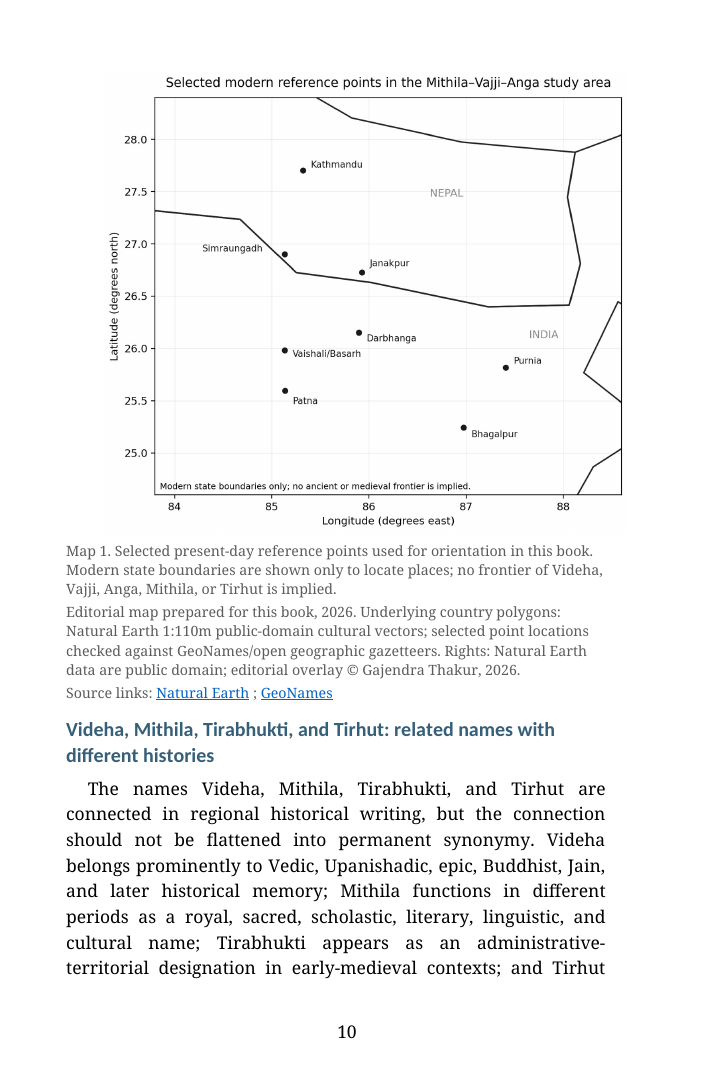
Mithila · Vajji · Anga
Chapter-specific source notes
- Primary chapter witness. Gajendra Thakur, Decoding the Panji of Mithila — Volume VI, formal Chapter 19, PDF pp. 188-201; formal Chapter 19. The HTML transcription is generated from the commit-pinned source PDF and retains the chapter boundary recorded in this edition.
- Internal structure. The repository source-heading inventory records 15 subordinate headings for this chapter: “1. How This Chapter Reads Cases 26-50”; “2. Cases 26-28: Unknown Lineage and Widowhood”; “3. Cases 29-30: Rajak and Rajaki Memory”; “4. Cases 31-34: Unknown Mother as Repeated Structure”; “5. Cases 35-40: The निषिद्धकुल Cluster”; “6. Cases 41-44: Inter-Jati and Repeated Maternal Flags”; “7. Cases 45-47: Nawranga, Repetition, and Return to Case 1”; “8. Case 48: Tanti and Artisan Connection”; ….
- Digital editorial method. The page keeps the preserved source text distinct from generated navigational, concordance, visual, and provenance apparatus. The synthetic reconstruction is explanatory only and is not evidence for an individual lineage or a determination of social or marital status.