Decoding the Panji of Mithila · Volume VI · Chapter 20
Entry-by-Entry Decoding: Cases 51-75
Chapter 20 — Entry-by-Entry Decoding:
Cases 51-75
1. How This Chapter Reads Cases 51-75
Chapter 19 ended with cases 49 and 50, where the record
turned sharply toward Charmakarini, Gangesha, Vallabha, and
Medha. Chapter 20 continues from case 51. The entries are still
brief, but their pattern is no longer hidden. A mool sequence is
given, names are placed in relation, and then the Dushan
marker appears: अज्ञात, रजक परम्परा, हड़िणी, गोपपुत्री विवाह, चर्मकार हिरुआ,
तैलिक देवाई, महापात्र, चाम्पो यवनी, यादव जयसिंह, यादव रहमू, and related
terms.
The case-by-case reading below follows the same discipline
used in Chapters 18 and 19: first the case number and source
reference, then the names and mool route, then the category,
and finally the plain-language interpretation. The goal is not to
enlarge shame. The goal is to restore structure to a damaged
archive.
One textual caution is necessary. The structure of this volume
for this chapter names Gurupatni among the themes to be
watched. In the source sequence, the Gurupatni item appears in
the following case block rather than within cases 51-75. This
chapter therefore flags the theme but does not misplace it. Case 62
supplies the Mahapatra/Param-Brahman field within the present
block; the Gurupatni entry belongs to the next chapter’s 76-97
sequence.
2. Cases 51-53: Medha, Hadi/Hadini, and
Rudramati
Case 51 continues the Medha field. It follows case 50 by
placing सोदरपुर, पाली, माण्डर, सकौना, सकराढी, खण्डवला, डीह दरिहरा, and
ब्रह्मपुरा in relation with names such as महाई, माँगू, बाढन, रत्नाकर, and
सुरपति-माता अज्ञात. The important point is that Medha is no longer
© Gajendra Thakur | 200
Decoding the Panji of Mithila, Volume VI
only a name from case 50; it becomes a continuing genealogical
marker.
Case 52 introduces one of the clearest Hadi/Hadini-related
entries in this block: हड़िणी रुद्रमति. The mool route includes सोदरपुर,
माण्डर, कु जौली, तिसूरी, खण्डवला, पाली, and घोसियाम. The entry also
records गूदी-माता अज्ञात हाड़ी, शुभदत्त-माता अज्ञात, and जगन्नाथ-रुद्रमति विवाह.
The record therefore holds three layers together: an identified
woman, an unknown mother, and an explicitly marked
marriage route.
Case 53 continues the same Rudramati line with नरउन, माण्डर,
जमूनी, तिसूरी, डीह खण्डवला, नवहथ पाली, and धोसियाम. It repeats शुभदत्त-माता
अज्ञात and जगन्नाथ-रुद्रमति. The plain reading is that the table is
tracking recurrence. A relationship already marked once is not
dropped; it is carried forward because descendants and later
marriage eligibility depended on remembering the route.
3. Cases 54-56: Rajak, Inter-Jati Marriage, and
Gop Daughter
Case 54 places a Rajak connection inside a broad route
beginning with खौआल, वहेराढ़ी, माण्डर, सकौना, दिघोइ, and पाली. The key
phrase is रजेश्वर सुता रजक, followed by names such as साधुकर, श्रीकर,
विभाकरसुता, गोंगू, ढोढ़े , विभू, भानूकर, गोपाल, गौरीपति, माधव, and जगाई. The
entry also marks रतेश्वर विवाह अन्तर्जातीय. It is therefore both a
daughter-line and an inter-jati case.
Case 55 continues the Rajak-Rudramati pattern. It includes
सुरे श्वर-रजकक कन्या and रजकक विवाह हड़िनी रुद्रमतिक पुत्रीसँ . This is not a
loose community label. It is a relationship sentence: a Rajak
daughter, a marriage, and a daughter of Rudramati are all part
of the genealogical route.
Case 56 moves from Rajak to Gop. It begins with सोदरपुर,
करमहा, एकहरा, खौआल, बेलउँ च, माण्डर, कु रहनि, and पकलिया, and later
© Gajendra Thakur | 201
Decoding the Panji of Mithila, Volume VI
records गोपपुत्री विवाह. The phrase matters because it marks a
daughter-line connection, not merely a male descent. In plain
language, the Panji entry says that a Gop daughter’s marriage
entered the record and affected the memory of the line.
4. Cases 57-59: Unknown Mothers in Ordinary-
Looking Lines
Case 57 includes कृ ष्णा-माता अज्ञात. The surrounding names—
काशी, गुणी, शंकर, देवनाथ, गोविन्द, होरे , राम, महाई, यशाई, नारायण, हरिशर्म्म, देशू,
कु लपति, and रातू—make the entry look genealogically ordinary
until the maternal uncertainty appears. That is exactly why the
case matters. Unknown motherhood is embedded inside
normal lineage structure.
Case 58 similarly records लान्हि-माता अज्ञात. It moves through
हरिअम, दरिहरा, बुधवाल, सकराढी, वहेराढ़ी, दरिहरा, बुधवाल, माण्डर, and गोरहिनी.
The plain interpretation is that maternal uncertainty can
remain a small phrase in a long chain, but it is still the reason
the case was preserved in this part of the table.
Case 59 is less explicit in its social marker, yet it belongs to
the same field because it continues the Gोरहिनी-linked sequence
and places a long line of names—मणिधर, राम, कृ ष्णदेव, रतनू, भवाई,
जीबधर, कल्याण, जीवे , राम, वंशीधर, शीरू, सुरसर, आँगनि, हरदत्त, परिसरा, कु लपति,
and रातू—inside the Dushan block. In such entries the label may
be muted, but the placement inside the table tells the reader
that the route was not neutral for marriage memory.
5. Cases 60-63: Charmakar Hirua, Telik Dewai,
and Mahapatra
Case 60 is headed चर्मकार हिरुआ. It follows सोदरपुर, माण्डर, फनन्दह,
पकलिया, अलई, and बेलमोहन, and includes विद्यानाथ (माता) अज्ञात, सोने -
(माता) अज्ञात, सुता-अन्तर्जातीय, and गिरु-चर्मकार हिरुआक पुत्रीसँ . This case
© Gajendra Thakur | 202
Decoding the Panji of Mithila, Volume VI
combines four fields: Charmakar connection, unknown
mothers, inter-jati daughter-line marking, and a specific
daughter of Hirua.
Case 61 is headed तैलिक देवाई. The route includes खण्डवला, तिसौँत,
पण्डोल, खजूरी, and सकराढ़ी. The key phrases are जीवेश्वर-माता अज्ञात and
तैलिक देवाई अन्तर्जातीय. This is the clearest Teli/Tailik case in the
block. It should be read in the same way as Rajak or
Charmakar: as a recorded social route, not as a present-day
insult.
Case 62 brings the Mahapatra/Param-Brahman field into the
case block. It includes के शवसुता महापात्रसँ विवाह amid a route
involving करमौलि, हरिअम्ब, दरिहरा, फनन्दह, करमौली, गंगोली, पाण्डे , पाली, चान्दो,
फनन्दह, and पाण्डोलि. The plain reading is that the record did not
only mark artisan or Dalit connections. It also marked high-
status or ritual-office connections when they created a
genealogical issue.
Case 63 returns to चर्मकार हिरुआ, now through बुधवाल, सकराढ़ी,
पाली, माण्डर, पुनन्दह, पकलिया, अलय, and बेलमोहन. It includes गीरू-चर्मकार
हिरुआ. The repetition of Hirua across cases 60 and 63 shows that
this was not a single isolated note. It became a recognizable
route in the Dushan memory.
6. Cases 64-67: Rajak/Rajaki, Chāmpo Yavani,
and Maternal Tradition
Case 64 is headed हड़िनी रुद्रमति and रजक परम्परा. It lists दरिहरा,
करमहा, पवौली, बुधवाल, माण्डर, and दिघोय, then records सुरे श्वर-रजकक कन्या-
विवाह हड़िनी रुद्रमतिक कला अन्तर्जातीय. This is one of the most
concentrated entries in the block because Rajak,
Hadini/Rudramati, and inter-jati marriage all appear together.
Case 65 continues रजक परम्परा. It includes रामदत्त-माता अज्ञात and
सुरे श्वर-रजकक कन्या-रजकक विवाह रुद्रमति कन्या. The repeated structure
© Gajendra Thakur | 203
Decoding the Panji of Mithila, Volume VI
proves that Rajak memory is not a side note. It is one of the
recurrent female-line and marriage-line concerns of the
Dushan table.
Case 66 is headed चाम्पो यवनी. It lists a route including माण्डर,
पचही, पवौली, पकलिया, तिरलाठी, करनैठा, and कोइयार, and contains the key
phrase शक्ति-पत्नी चाम्पो यवनी. Here the table records Yavani not as
an abstract category but as a named woman connected through
wifehood. The case belongs with Chapter 14 but now appears
inside the entry-by-entry sequence.
Case 67 returns to रजकक परम्परा and records पाँखू-माता रजकक
परम्परा. This formulation is crucial. It is not merely saying that a
Rajak connection existed; it says the mother-line of Pankhu
belonged to that remembered Rajak tradition. The Panji’s
compressed syntax again makes the mother-line decisive.
7. Cases 68-73: The Middle Cluster of Unknown
Mothers
Case 68 includes जगन्नाथक माता and सूपे -माता in a route through
बुधवाल, पवौली, सतलखा, घुसौत, तेरहोत, कोइयार, and भदुआल. The entry is
softer in label than some earlier cases, but it still focuses on
maternal identification. In the Dushan context, such mother-
line signals matter because they determine how a descent chain
is to be read.
Case 69 explicitly records जगतू-माता अज्ञात. The route includes
सोदरपुर, करमहा, माण्डर, पंचोभ, महुआ, and भदुआल. The case shows the
same lesson in a very direct form: an otherwise ordinary line is
converted into a Dushan entry by the unknown status of a
mother.
Case 70 records चाँड़ो-माता अज्ञात. The surrounding line includes
गदाधर, ध्रुवानन्द, हरिके श, काशी, रामचन्द्र, सुरपति, माने , विष्णुकान्त, दामू, रघुपति,
उमापति, हल्लेश्वर, सोम, होरे , and हरिके श. The case is important because
© Gajendra Thakur | 204
Decoding the Panji of Mithila, Volume VI
it shows how a single unknown mother can sit inside a
prestigious or complex male-name chain without being erased.
Case 71 records दशरथ-माता अज्ञात within a route involving
वलियास, गंगोली, विठु आल, खौआल, तिरलाठी, and भदवाल. Case 72 records
रुचि-माता अज्ञात in a route through सोदरपुर, बुधवाल, जगति, नरउन, and
भदवाल. Cases 71 and 72 therefore function as a paired lesson:
unknown mothers appear repeatedly across different mools
and villages, not only inside one family cluster.
Case 73 is a dense maternal-unknown case. It records रघुनाथ-
माता अज्ञात, रति-माता अज्ञात, and नरसिंह चान्द-माता अज्ञात. Here the
unknown-mother marker appears three times in one entry.
This makes case 73 one of the clearest examples of how the
Dushan table can preserve a whole cluster of maternal
uncertainty inside a single genealogical block.
8. Cases 74-75: Yadav Jayasingh and Yadav
Rahmu
Case 74 is marked नरबंगा शाखा and यादव जयसिंह. The route
includes माण्डर, पाली, खौआल, पवौलि, वलियास, गंगोली, नरबंगा, and दहिभत. It
includes names such as शिवपति, यज्ञपति, अफे ल, मुरारी, पाँखू, रघुपति, दूबे ,
सुपन, देवदत्त, शक्ति, वरदत्त, सोमदत्त, नोहरि, and श्रीपति-अज्ञात कु ल. The plain
interpretation is that a Yadav-linked branch and an unknown-
kul notation entered the genealogical record together.
Case 75 is headed यादव रहमू. It moves through खण्डवला, दरिहरा,
बुधवाल, सोदरपुर, दरिहरा, फनन्दह, कु जौली, पकलिया, अलय, and पंचोभ. It
includes the striking phrase हृषिके श पत्नी यादव and later ठकरु-माता
अज्ञात. This case shows the double logic of the table: a named
Yadav connection is preserved, and an unknown mother
remains separately marked.
Together, cases 74 and 75 show why the Dushan table
cannot be reduced to a single caste boundary. It records
© Gajendra Thakur | 205
Decoding the Panji of Mithila, Volume VI
different kinds of crossings: daughter-line, wife-line, mother-
line, unknown-kul, branch-line, and named community
connection. These entries are not only about exclusion. They
are also about remembering how families actually became
connected.
9. Compact Case Table: Cases 51-75
Case Source markers Dushan category Plain-language
decoding
51 १८९/११; सुरपति- Medha / unknown Continuation of the
mother Medha-
माता अज्ञात; मेधा Charmakarini field;
the entry shows a
named woman and
an unknown
mother inside a
formal mool route.
52 हड़िणी रुद्रमति; गूदी- Hadini / Hadi / A named
unknown mother Hadini/Rudramati
माता अज्ञात हाड़ी; line is joined with
जगन्नाथ-रुद्रमति unknown maternal
identity and a
विवाह recorded marriage
route.
53 शुभदत्त-माता अज्ञात; Rudramati Repeats the
continuation Rudramati
जगन्नाथ-रुद्रमति marriage memory
and keeps the
unknown mother
marker in the
descendant line.
54 रजेश्वर सुता रजक; Rajak / inter-jati A Rajak daughter-
line and inter-jati
रतेश्वर विवाह marriage are
अन्तर्जातीय preserved together
as a relationship
route.
55 सुरे श्वर-रजकक Rajak + Rudramati Shows how a Rajak
daughter and
कन्या; रजकक Rudramati’s
विवाह हड़िनी daughter entered
the marriage-
रुद्रमतिक पुत्रीसँ memory chain.
© Gajendra Thakur | 206
Decoding the Panji of Mithila, Volume VI
Case Source markers Dushan category Plain-language
decoding
56 गोपपुत्री विवाह Gop daughter-line Records a Gop
daughter’s
marriage as
genealogically
significant.
57 कृ ष्णा-माता अज्ञात Unknown mother Unknown
maternity appears
inside an otherwise
ordinary male
descent chain.
58 लान्हि-माता अज्ञात Unknown mother Maternal
unknownness is
preserved as the
entry’s critical
marker.
59 गोरहिनी-linked Dushan The placement
placement / muted inside the table
route; long descent
marker marks the route as
sequence
one requiring
genealogical
caution even
where the label is
less explicit.
60 चर्मकार हिरुआ; Charmakar / A highly layered
unknown mother / case combining
विद्यानाथ माता inter-jati community
अज्ञात; सोने माता connection,
unknown mothers,
अज्ञात; गिरु-चर्मकार daughter-line, and
inter-jati marking.
हिरुआक पुत्रीसँ
61 तैलिक देवाई; Teli/Tailik / inter- The clearest Tailik
jati case in this block; it
जीवेश्वर-माता अज्ञात; links unknown
तैलिक देवाई mother and inter-
jati marriage.
अन्तर्जातीय
62 के शवसुता महापात्रसँ Mahapatra / ritual- Shows that high-
status link status or ritual-
विवाह office links could
also be recorded as
Dushan-relevant
routes.
© Gajendra Thakur | 207
Decoding the Panji of Mithila, Volume VI
Case Source markers Dushan category Plain-language
decoding
63 चर्मकार हिरुआ; Charmakar Returns to Hirua,
continuation proving that this
गीरू-चर्मकार हिरुआ connection recurs
across the table.
64 हड़िनी रुद्रमति; रजक Hadini + Rajak + A concentrated
inter-jati case joining
परम्परा; सुरे श्वर- Rudramati, Rajak
रजकक कन्या- tradition, and
inter-jati marriage.
विवाह...
65 रजक परम्परा; Rajak / unknown Continues the
mother Rajak-Rudramati
रामदत्त-माता अज्ञात; pattern and adds
रजकक विवाह unknown
maternity.
रुद्रमति कन्या
66 चाम्पो यवनी; शक्ति- Yavani wife-line A named Yavani
woman appears
पत्नी चाम्पो यवनी through wifehood,
not merely as an
abstract label.
67 रजकक परम्परा; Rajak maternal The entry makes
tradition mother-line
पाँखू-माता रजकक memory explicit
परम्परा through Rajak
tradition.
68 जगन्नाथक माता; Maternal markers Focuses on mother-
line identification
सूपे -माता inside a broader
route.
69 जगतू-माता अज्ञात Unknown mother A single unknown
mother converts
the line into a
Dushan entry.
70 चाँड़ो-माता अज्ञात Unknown mother Shows unknown
maternity inside a
long and complex
male-name chain.
© Gajendra Thakur | 208
Decoding the Panji of Mithila, Volume VI
Case Source markers Dushan category Plain-language
decoding
71 दशरथ-माता अज्ञात Unknown mother Another distinct
mool route
preserving
maternal
uncertainty.
72 रुचि-माता अज्ञात Unknown mother Repeats the same
structural concern
through a different
route.
73 रघुनाथ-माता अज्ञात; Multiple unknown A dense cluster
mothers showing repeated
रति-माता अज्ञात; maternal
नरसिंह चान्द-माता unknownness in
one case.
अज्ञात
74 नरबंगा शाखा; यादव Yadav / unknown Yadav-linked
kul branch memory is
जयसिंह; श्रीपति- joined with an
अज्ञात कु ल unknown-kul
marker.
75 यादव रहमू; हृषिके श Yadav wife-line / Records both
unknown mother named Yadav
पत्नी यादव; ठकरु- connection and
माता अज्ञात separate unknown
maternal marking.
10. Patterns Emerging from Cases 51-75
The first pattern is the expansion of community categories.
Earlier blocks had already introduced Rajak, Yavani, Devadasi,
Charmakarini, and unknown mothers. Cases 51-75 add
Hadi/Hadini, Gop, Charmakar Hirua, Tailik Dewai, Mahapatra,
and Yadav with greater density.
The second pattern is the recurrence of named women.
Rudramati, Cham(po) Yavani, Medha, and Yadav-linked
wife/daughter lines are not ornamental. They are the hinges of
the record. Without them, the male descent chain cannot be
decoded.
© Gajendra Thakur | 209
Decoding the Panji of Mithila, Volume VI
The third pattern is the persistence of अज्ञात. Unknown
mothers appear in cases 51, 52, 53, 57, 58, 60, 61, 65, 69, 70, 71,
72, 73, and 75. The repeated marker proves that the Dushan
table is one of Mithila’s richest sources for hidden maternal
history.
The fourth pattern is mixed-line descent. Some entries work
through mother, some through daughter, some through wife,
some through a branch, and some through a named community
link. Dushan Panji therefore preserves the social reality that
genealogical purity was never simply patrilineal. It had to be
defended, questioned, repaired, and remembered through
many relational paths.
11. Ethical Reading of the Block
Cases 51-75 are among the most difficult to read because
they contain many community names that later society could
misuse. The ethical rule must remain strict: no old category
should be carried into the present as stigma. The table records
what the Panji system considered genealogically relevant at
that time. It does not authorize modern contempt.
This block also shows why concealment is not scholarship.
To hide these entries would erase Rudramati, Medha, Cham(po)
Yavani, the Gop daughter, the Rajak daughters, the unknown
mothers, the Tailik woman, the Yadav wife, and many others.
The humane task is not to pretend the record is gentle. It is to
read the record without reproducing its cruelty.
The next chapter will decode cases 76-97. That final block
contains Gurupatni, Mahapatra/Param-Brahman continuation,
Chāmpo Yavani continuation, widowhood, Dhivar Dasi, Gop-
Vivah-Dasi, and the later explanatory summary that connects
many of the earlier entries.
Conclusion: The Third Block as Social Map
Cases 51-75 transform the Dushan table into a wider social
map. The first block taught the reading method. The second
© Gajendra Thakur | 210
Decoding the Panji of Mithila, Volume VI
block deepened unknownness, Rajak/Rajaki, Tanti,
Charmakarini, Gangesha, and Medha. The third block shows
how many social routes could enter the Panji memory at once.
The most important lesson is that Dushan Panji is not
merely a list of forbidden relationships. It is a record of how
society remembered difficulty. The difficulty may be unknown
mother, named woman, artisan link, Yavani wife, Tailik
connection, Mahapatra marriage, Yadav branch, or a mixed
daughter-line. The archive preserves all of them because
marriage eligibility and lineage memory depended on
remembering them.
A modern reader should therefore approach these cases
with precision and humility. Precision prevents distortion.
Humility prevents cruelty. Together they allow the Dushan
record to become what it should be: not a weapon, but a
difficult source for Mithila’s social history.
Chapter 20 Source Notes
1. This chapter follows the structure of Chapter 20: entry-by-entry
decoding of cases 51-75, including Hadi/Hadini, Charmakarini, Teli,
Yadav, Mahapatra/Param-Brahman references, and mixed-line
descent.
2. Case 51 continues the Medha field and includes सुरपति-माता
अज्ञात and मेधा in the source sequence.
3. Cases 52-53 include हड़िणी रुद्रमति, गूदी-माता अज्ञात हाड़ी, शुभदत्त-माता
अज्ञात, and जगन्नाथ-रुद्रमति विवाह.
4. Cases 54-55 preserve Rajak and Rudramati links, including
रजेश्वर सुता रजक, रतेश्वर विवाह अन्तर्जातीय, सुरे श्वर-रजकक कन्या, and रजकक
विवाह हड़िनी रुद्रमतिक पुत्रीसँ .
5. Case 56 includes गोपपुत्री विवाह. Cases 57-59 continue the
unknown-mother and lineage-caution field.
© Gajendra Thakur | 211
Decoding the Panji of Mithila, Volume VI
6. Cases 60 and 63 preserve चर्मकार हिरुआ and related daughter-
line and unknown-mother markers. Case 61 preserves तैलिक देवाई
and तैलिक देवाई अन्तर्जातीय.
7. Case 62 includes के शवसुता महापात्रसँ विवाह and is therefore the
principal Mahapatra/ritual-office case within this block.
8. Cases 64-67 include हड़िनी रुद्रमति, रजक परम्परा, चाम्पो यवनी, शक्ति-पत्नी
चाम्पो यवनी, and पाँखू-माता रजकक परम्परा.
9. Cases 68-73 contain a repeated unknown-mother cluster:
जगन्नाथक माता, सूपे -माता, जगतू-माता अज्ञात, चाँड़ो-माता अज्ञात, दशरथ-माता अज्ञात,
रुचि-माता अज्ञात, रघुनाथ-माता अज्ञात, रति-माता अज्ञात, and नरसिंह चान्द-माता
अज्ञात.
10. Cases 74-75 preserve यादव जयसिंह, श्रीपति-अज्ञात कु ल, यादव रहमू,
हृषिके श पत्नी यादव, and ठकरु-माता अज्ञात.
11. The Gurupatni reference named in the plan is treated as a
transition note because the actual source entry appears in the
following case block rather than in cases 51-75.
12. All readings preserve old source terms as archival
categories only. No term is used as present-day social judgment.Source structure and verification apparatus
Editorial source apparatus. This apparatus is descriptive, not interpretive. It records the source-controlled structure used to verify that this page corresponds to formal Chapter 20 of Decoding the Panji of Mithila — Volume VI. The chapter text above is preserved from PDF pp. 201-213; formal Chapter 20 in the commit-pinned authoritative source. It is not merged with a neighboring chapter, appendix, annexure, or independent front/back-matter unit. The internal headings below come from the repository’s source-heading inventory and are retained as navigational and audit evidence; showing them here does not turn those headings into separate publications or add claims that are absent from the source.
Internal source headings
- 1. How This Chapter Reads Cases 51-75
- 2. Cases 51-53: Medha, Hadi/Hadini, and Rudramati
- 3. Cases 54-56: Rajak, Inter-Jati Marriage, and Gop Daughter
- 4. Cases 57-59: Unknown Mothers in Ordinary-Looking Lines
- 5. Cases 60-63: Charmakar Hirua, Telik Dewai, and Mahapatra
- 6. Cases 64-67: Rajak/Rajaki, Chāmpo Yavani, and Maternal Tradition
- 7. Cases 68-73: The Middle Cluster of Unknown Mothers
- 8. Cases 74-75: Yadav Jayasingh and Yadav Rahmu
- 9. Compact Case Table: Cases 51-75
- 10. Patterns Emerging from Cases 51-75
- 11. Ethical Reading of the Block
- Conclusion: The Third Block as Social Map
- Chapter 20 Source Notes
Source-text concordance
Entry-by-Entry · Decoding · Cases · 51-75 · Reads · ended · record · turned · sharply · toward · Charmakarini · Gangesha · Vallabha · Medha · continues · case · entries · still · brief · pattern · longer · hidden · mool · sequence · given · names · placed · relation · Dushan · marker · appears · related · terms · case-by-case · reading · follows · discipline · used · Chapters · first · number · reference · route · category · finally · plain-language · interpretation · goal · enlarge · shame · restore · structure · damaged · archive · textual · caution · necessary · Gurupatni · themes · watched · item · following · block · rather · within · therefore · flags · theme · misplace · supplies · Mahapatra · Param-Brahman · field · present · entry · belongs · next · chapter’s · 76-97 · 51-53
Boundary verification. In the formal sequence this chapter follows Volume VI Chapter 19, “Entry-by-Entry Decoding: Cases 26-50” and precedes Volume VI Chapter 21, “Entry-by-Entry Decoding: Cases 76–97”. The chapter extractor begins at the verified formal Chapter 20 marker and stops at the next verified formal chapter marker; for a final chapter it stops before recognized book-level back matter. The concordance above is generated only from distinct terms already present in this chapter’s preserved source text. It is provided for discovery, comparison, and audit, not as an automated judgment about persons, lineages, status, kinship, marriage eligibility, or historical truth.
Illustrated research apparatus
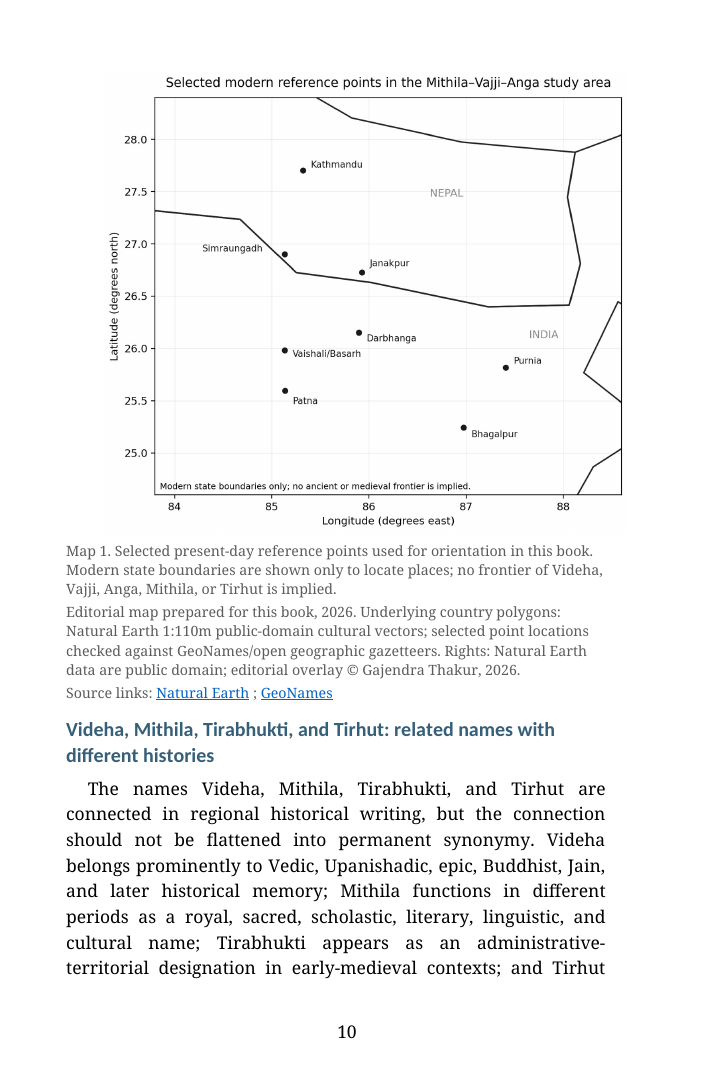
Mithila · Vajji · Anga
Chapter-specific source notes
- Primary chapter witness. Gajendra Thakur, Decoding the Panji of Mithila — Volume VI, formal Chapter 20, PDF pp. 201-213; formal Chapter 20. The HTML transcription is generated from the commit-pinned source PDF and retains the chapter boundary recorded in this edition.
- Internal structure. The repository source-heading inventory records 13 subordinate headings for this chapter: “1. How This Chapter Reads Cases 51-75”; “2. Cases 51-53: Medha, Hadi/Hadini, and Rudramati”; “3. Cases 54-56: Rajak, Inter-Jati Marriage, and Gop Daughter”; “4. Cases 57-59: Unknown Mothers in Ordinary-Looking Lines”; “5. Cases 60-63: Charmakar Hirua, Telik Dewai, and Mahapatra”; “6. Cases 64-67: Rajak/Rajaki, Chāmpo Yavani, and Maternal Tradition”; “7. Cases 68-73: The Middle Cluster of Unknown Mothers”; “8. Cases 74-75: Yadav Jayasingh and Yadav Rahmu”; ….
- Digital editorial method. The page keeps the preserved source text distinct from generated navigational, concordance, visual, and provenance apparatus. The synthetic reconstruction is explanatory only and is not evidence for an individual lineage or a determination of social or marital status.