Decoding the Panji of Mithila · Volume VI · Chapter 21
Entry-by-Entry Decoding: Cases 76–97
Chapter 21 — Entry-by-Entry Decoding:
Cases 76–97
The final Dushan block, Cases 76–97, completes the table by
moving from mixed-line marriage records into a dense cluster
of unknown maternal lines, western-origin arrivals, Parm
Brahman/Mahapatra references, Gurupatni, Yavani, path-
patita, widow, Dhivar Dasi, and Dasi marriage entries. The final
cases are especially important because they show that Dushan
© Gajendra Thakur | 212
Decoding the Panji of Mithila, Volume VI
Panji is not a single-category register. It is a layered record of
boundary crossing, social memory, and eventual absorption.
The method remains the same as in Chapters 18–20: first
identify the case number and record marker, then read the
mool and place sequence, then identify the relational route,
then state the Dushan category in plain language without
turning it into a present-day accusation.
Cases 76–97: Working Decoding Table
Case Source Marker Plain-Language Reading
76 २०२/I; An unknown mother is
attached to Bootan, within
Panuwa/Harhiam/Mandar
a long mool-route chain.
sequence
The case continues the
late-table pattern in which
मातृक अज्ञात is a
genealogical problem, not
merely a moral label.
77 २०२/II; The route belongs to the
same late cluster of
Sodarpur/Karmaha/Mand
Mandar-Alay-Jalay-
ar/Alay route
Singhashram movements.
It should be read as
branch memory and
migration, not as an
isolated allegation.
78 २०३/II; Giru-vivah Hirua This is a Charmakar-
linked marriage entry.
Charmakarin
The key fact is that the
table records both the
inter-community route
and the descendants who
were later carried
forward in Panji memory.
79 २०३/I; Param Brahman / The entry records a
Mahapatra/Param
Mahapatra
Brahman line. It shows
that Dushan categories
also touched ritual status
and rank, not only caste
labels.
© Gajendra Thakur | 213
Decoding the Panji of Mithila, Volume VI
Case Source Marker Plain-Language Reading
80 २०४/I; Hore-Param A repeated Param
Brahman connection
Brahman
appears through the
mother-line and marriage
route. The entry is best
read together with Cases
79, 81, 83, and 84.
81 २०४/II; Batuk-mata agyat, Unknown mother markers
appear beside a Param
Hore-Param Brahman
Brahman relation. This is
a mixed record of
maternal uncertainty and
ritual-status linkage.
82 २०५/I; Gurupatni Bhatt Bhushan is recorded
with marriage to a गुरु-
पत्नी. The issue here is not
caste but a prohibited
relationship category
within the moral
grammar of the source.
83 २०५/II; Hore-Param This is another Parm
Brahman entry with
Brahman
unknown maternal
markers. The repetition
suggests a lineage cluster
rather than an isolated
event.
84 २०६/I; Gangoli Parm A direct Gangoli Parm
Brahman connection
Brahman
appears. The table records
this as a descent-and-
marriage route through
several named men.
85 २०६/II; Path-patita kanya The entry records Hore’s
marriage to a woman
described as path-patita. It
belongs with the
widow/path-patita
discussion of Chapter 15.
© Gajendra Thakur | 214
Decoding the Panji of Mithila, Volume VI
Case Source Marker Plain-Language Reading
86 २१६/I; Yavani Daulat This Yavani-linked
daughter-line entry
Jahan putri
continues the
Muslim/Yavani cluster.
The key phrase is Afel’s
marriage with a Yavani
daughter.
87 Jamuni/Mandar/ This case records a
Chakrahad/Gondi route Gondi/Gond line and a
daughter route. It is
another example of
Dushan Panji preserving
regional and community
contact.
88 २२७; Mahishi Budhwal The entry is a long
memory chain through
and long descendant
Mahishi/Budhwal and
chain
related mools. It is less
about a single label and
more about preserving a
complex route.
89 २२६/II; This case records a wide
branch route with
Naroun/Pali/Darihara/Kar
multiple named
maha route
descendants. It is a late-
table example of dense
genealogical continuity.
90 २१८/I; Paschim desh se Western-origin arrival is
the marker. The case
agat charo
records outside arrival
and its later placement
inside Panji structure.
91 २१८/II; This continues the post-
arrival line with mool
Soiderpur/Pali/Darihara/K
routes and names. The
handwala cluster
main issue is branch
absorption after
migration.
92 २१९/I; Kerwal branch The Kerwal branch is
explicitly named. It
records a branch identity
and unknown mother
marker within regional
memory.
© Gajendra Thakur | 215
Decoding the Panji of Mithila, Volume VI
Case Source Marker Plain-Language Reading
93 २१९/II; Path-patita kanya Hore’s marriage to a
Gangoli path-patita
woman is recorded. This
connects women’s hidden
social history with lineage
continuity.
94 २२०/I; Vartini widow The entry records a
widow line and a child of
widow descent. It is one of
the strongest examples
that the record preserves
both restriction and lived
continuation.
95 २२०/II; A dense named chain
follows the widow-related
Harhiam/Sodarpur/Karma
cluster. It shows how lines
ha route
continued even around
difficult social categories.
96 २२१/I; Dhivar Dasi The entry records Dhivar
Dasi and Mandan’s wife as
Dhivar Dasi. It is a direct
Dasi/community-link
record.
97 २२१/II; Gop-vivah Dasi The final case records
Jeeve’s unknown mother
and Madhav’s Gop
marriage with Dasi. It
closes the table by
returning to the core
themes of unknown
mother, Dasi, and inter-
community union.
Reading the Final Block as a Whole
Cases 76–97 show that the Dushan table grows denser as it
moves toward the end. The early cases teach the reader how to
read मातृक, अज्ञात, देवदासी, यवनी, and चर्मकारिणी. The last cases
combine these categories with migration, branch formation,
Param Brahman or Mahapatra status, Gurupatni, path-patita
women, widow descent, Dhivar Dasi, and Dasi marriage. The
© Gajendra Thakur | 216
Decoding the Panji of Mithila, Volume VI
table therefore ends not with a single verdict but with a model
of society in motion.
This final block also demonstrates why Dushan Panji cannot be
read as a simple blacklist. The same record that marks a line
also preserves its later names, mools, branches, descendants,
and marriage routes. The archive remembers difficulty, but it
also remembers continuation.
Source Note
Based on Chapter 21 plan and the Dushan Panji source table,
Cases 76–97, including the entries for Giru-Hirua Charmakarin,
Param Brahman/Mahapatra, Gurupatni, Yavani Daulat Jahan,
western-origin arrival, Vartini widow, Dhivar Dasi, and Gop-
vivah Dasi.Source structure and verification apparatus
Editorial source apparatus. This apparatus is descriptive, not interpretive. It records the source-controlled structure used to verify that this page corresponds to formal Chapter 21 of Decoding the Panji of Mithila — Volume VI. The chapter text above is preserved from PDF pp. 213-218; formal Chapter 21 in the commit-pinned authoritative source. It is not merged with a neighboring chapter, appendix, annexure, or independent front/back-matter unit. The internal headings below come from the repository’s source-heading inventory and are retained as navigational and audit evidence; showing them here does not turn those headings into separate publications or add claims that are absent from the source.
Internal source headings
- Cases 76–97: Working Decoding Table
- Reading the Final Block as a Whole
- Source Note
Source-text concordance
Entry-by-Entry · Decoding · Cases · final · Dushan · block · completes · table · moving · mixed-line · marriage · records · dense · cluster · unknown · maternal · lines · western-origin · arrivals · Parm · Brahman · Mahapatra · references · Gurupatni · Yavani · path · patita · widow · Dhivar · Dasi · entries · especially · important · show · Gajendra · Thakur · single-category · register · layered · record · boundary · crossing · social · memory · eventual · absorption · method · remains · Chapters · first · identify · case · number · marker · read · mool · place · sequence · relational · route · state · category · plain · language · without · turning · present-day · accusation · Working · Plain-Language · Reading · mother · attached · Bootan · within · Panuwa · Harhiam · Mandar · long · mool-route
Boundary verification. In the formal sequence this chapter follows Volume VI Chapter 20, “Entry-by-Entry Decoding: Cases 51-75” and precedes Volume VI Chapter 22, “The “Sixth Generation””. The chapter extractor begins at the verified formal Chapter 21 marker and stops at the next verified formal chapter marker; for a final chapter it stops before recognized book-level back matter. The concordance above is generated only from distinct terms already present in this chapter’s preserved source text. It is provided for discovery, comparison, and audit, not as an automated judgment about persons, lineages, status, kinship, marriage eligibility, or historical truth.
Illustrated research apparatus
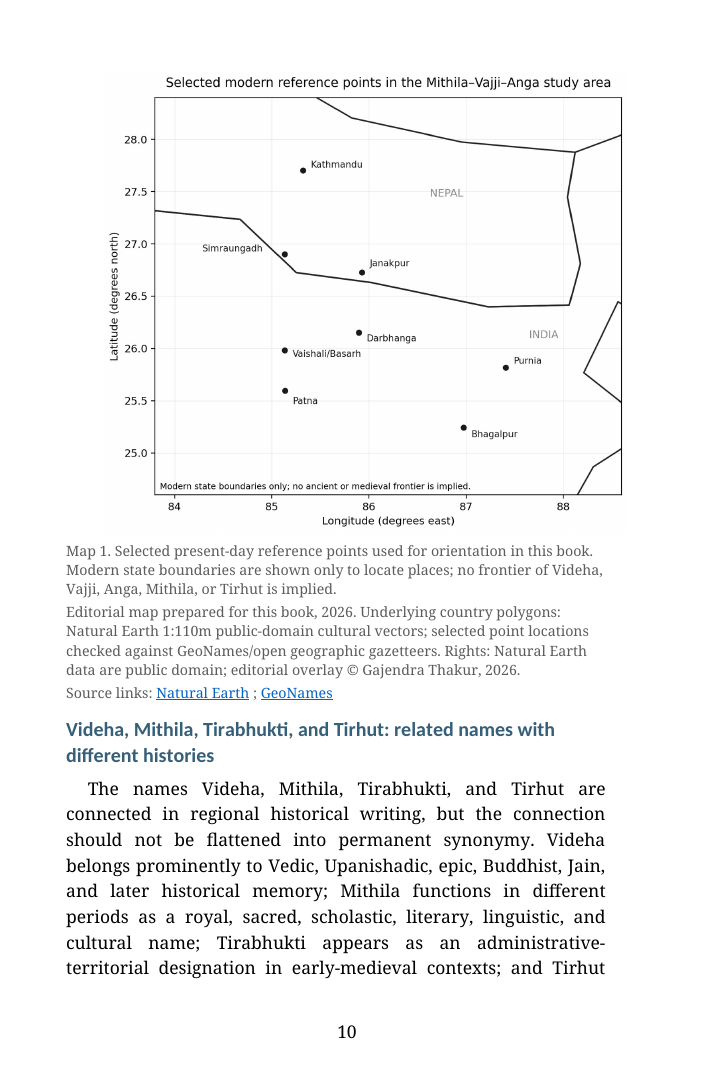
Mithila · Vajji · Anga
Chapter-specific source notes
- Primary chapter witness. Gajendra Thakur, Decoding the Panji of Mithila — Volume VI, formal Chapter 21, PDF pp. 213-218; formal Chapter 21. The HTML transcription is generated from the commit-pinned source PDF and retains the chapter boundary recorded in this edition.
- Internal structure. The repository source-heading inventory records 3 subordinate headings for this chapter: “Cases 76–97: Working Decoding Table”; “Reading the Final Block as a Whole”; “Source Note”.
- Digital editorial method. The page keeps the preserved source text distinct from generated navigational, concordance, visual, and provenance apparatus. The synthetic reconstruction is explanatory only and is not evidence for an individual lineage or a determination of social or marital status.