Decoding the Panji of Mithila · Volume VI · Chapter 22
The “Sixth Generation”
Chapter 22 — The “Sixth Generation”
Question: When Does Dushan Fade?
One of the most important interpretive clues in the Dushan
record is the statement that a descendant could become “fully
pure” by the sixth generation. This is not a marginal remark. It
gives the ethical and social logic by which Dushan could fade
over time.
Dushan as Memory, Not Eternal Condemnation
If Dushan were meant to be an eternal sentence, the source
would have no need to discuss generational distance. Yet the
explanation of the first table example describes a line moving
through a chain of daughter marriages and maternal links until
the descendant Devadhar is described as fully purified in the
sixth generation. The record therefore carries a mechanism of
time, not only a mark of origin.
© Gajendra Thakur | 217
Decoding the Panji of Mithila, Volume VI
The Genealogical Logic of Fading
The fading of Dushan depends on several linked ideas: distance
from the original event, intervening marriage routes,
recognition by society, and continued record within the Panji
system. The Panji does not simply erase the past. It records the
route by which the past loses its force.
First, the original difficult union or maternal uncertainty is
recorded.
Second, the descendants are traced through daughter-lines,
son-lines, and marital routes.
Third, the line becomes socially legible within known mools
and branches.
Fourth, by generational distance, the earlier Dushan no
longer controls the present status of the descendants.
Social Forgetting and Historical Justice
Social forgetting is often treated as carelessness. In Dushan
Panji, however, forgetting can also be a form of rehabilitation.
The source itself notes that some facts had rightly been
forgotten by later society. The implication is that historical
truth should be preserved for learning, but not weaponized
against descendants.
The Sixth Generation as Ethical Boundary
For modern readers, the sixth-generation principle is an ethical
warning. To decode Dushan Panji today is not to revive an old
stigma. It is to understand how Mithila’s society absorbed lines
that had once crossed forbidden boundaries. The archive’s
difficult truth is therefore double: it records exclusion, and it
records the path by which exclusion ended.
Source Note
Based on Chapter 22 plan and the Dushan Panji explanation of
the first table example, where the line from an inter-
community union is traced through multiple generations and
© Gajendra Thakur | 218
Decoding the Panji of Mithila, Volume VI
the descendant Devadhar is described as fully purified in the
sixth generation.Source structure and verification apparatus
Editorial source apparatus. This apparatus is descriptive, not interpretive. It records the source-controlled structure used to verify that this page corresponds to formal Chapter 22 of Decoding the Panji of Mithila — Volume VI. The chapter text above is preserved from PDF pp. 218-220; formal Chapter 22 in the commit-pinned authoritative source. It is not merged with a neighboring chapter, appendix, annexure, or independent front/back-matter unit. The internal headings below come from the repository’s source-heading inventory and are retained as navigational and audit evidence; showing them here does not turn those headings into separate publications or add claims that are absent from the source.
Internal source headings
- Dushan as Memory, Not Eternal Condemnation
- The Genealogical Logic of Fading
- Social Forgetting and Historical Justice
- The Sixth Generation as Ethical Boundary
- Source Note
Source-text concordance
Sixth · Generation · Question · Dushan · Fade · important · interpretive · clues · record · statement · descendant · become · fully · pure · marginal · remark · gives · ethical · social · logic · time · Memory · Eternal · Condemnation · meant · sentence · need · discuss · generational · distance · explanation · first · table · example · describes · line · moving · chain · daughter · marriages · maternal · links · Devadhar · described · purified · therefore · carries · mechanism · mark · origin · Gajendra · Thakur · Decoding · Genealogical · Fading · depends · several · linked · ideas · original · event · intervening · marriage · routes · recognition · society · continued · within · system · simply · erase · past · records · route · loses · force · difficult · union · uncertainty · recorded
Boundary verification. In the formal sequence this chapter follows Volume VI Chapter 21, “Entry-by-Entry Decoding: Cases 76–97” and precedes Volume VI Chapter 23, “Panji Vocabulary: Offices, Titles, Scholars, and Social Rank”. The chapter extractor begins at the verified formal Chapter 22 marker and stops at the next verified formal chapter marker; for a final chapter it stops before recognized book-level back matter. The concordance above is generated only from distinct terms already present in this chapter’s preserved source text. It is provided for discovery, comparison, and audit, not as an automated judgment about persons, lineages, status, kinship, marriage eligibility, or historical truth.
Illustrated research apparatus
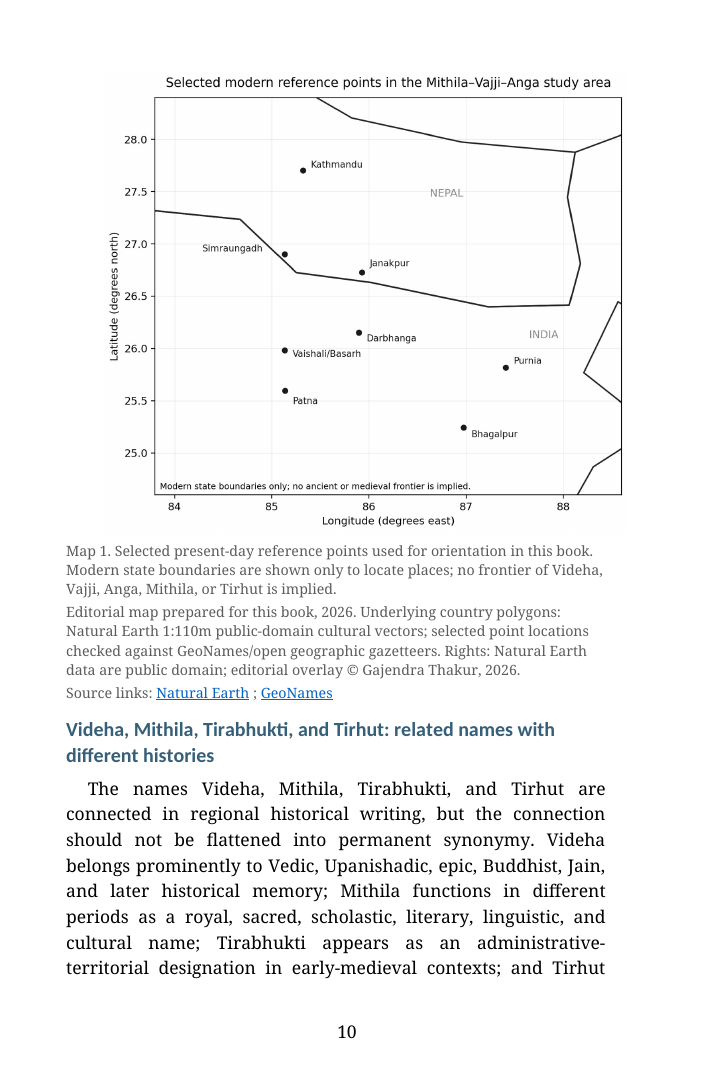
Mithila · Vajji · Anga
Chapter-specific source notes
- Primary chapter witness. Gajendra Thakur, Decoding the Panji of Mithila — Volume VI, formal Chapter 22, PDF pp. 218-220; formal Chapter 22. The HTML transcription is generated from the commit-pinned source PDF and retains the chapter boundary recorded in this edition.
- Internal structure. The repository source-heading inventory records 5 subordinate headings for this chapter: “Dushan as Memory, Not Eternal Condemnation”; “The Genealogical Logic of Fading”; “Social Forgetting and Historical Justice”; “The Sixth Generation as Ethical Boundary”; “Source Note”.
- Digital editorial method. The page keeps the preserved source text distinct from generated navigational, concordance, visual, and provenance apparatus. The synthetic reconstruction is explanatory only and is not evidence for an individual lineage or a determination of social or marital status.