Decoding the Panji of Mithila · Volume VI · Chapter 23
Panji Vocabulary: Offices, Titles, Scholars, and Social Rank
Chapter 23 — Panji Vocabulary: Offices,
Titles, Scholars, and Social Rank
Panji is not only a genealogical archive. It is also a vocabulary
archive. It preserves the words by which Mithila remembered
offices, scholarly titles, social rank, learned authority, royal
administration, and professional accomplishment.

Why Vocabulary Matters
A Panji entry is compressed. One small title can carry several
meanings: scholarly qualification, court service, ritual
authority, administrative office, or social prestige. Without
decoding such terms, a reader will misunderstand both the
person and the social world that produced the entry.

Representative Vocabulary Table
Term                         Category                    Reading

महामहोपाध्याय / म.म.         Great scholarly title       Marks advanced
                                                         recognition in learning,
                                                         often associated with
                                                         major scholars.

सदुपाध्याय / सदु उ.          Scholarly title             Indicates a learned
                                                         Upadhyaya line or
                                                         recognized scholar.

वैयाकरण / वैया.              Grammarian                  Marks expertise in
                                                         Paninian grammar and
                                                         Sanskrit learning.

ज्योतिर्विद / ज्यो.          Astronomer-astrologer       Indicates expertise in
                                                         Jyotisha.

आगमाचार्य                    Tantric/Agamic specialist   A learned ritual title in
                                                         Agama or Tantra.

                            © Gajendra Thakur | 219
                      Decoding the Panji of Mithila, Volume VI

Term                         Category                    Reading

तर्क पंचानन                  Logician                    Signals mastery of
                                                         Tarkashastra and related
                                                         debate traditions.

शान्ति-विग्रहिक              State office                An administrative office
                                                         concerned with peace and
                                                         conflict/settlement.

पार्णागारिक                  State/storage office        A royal or administrative
                                                         term preserved in the
                                                         Panji vocabulary.

भाण्डागारिक                  Treasury/store officer      A state office related to
                                                         treasury or stores.

स्थानान्तरिक                 Administrative term         A state-office term
                                                         pointing to movement,
                                                         placement, or
                                                         appointment.

राजवल्लभ                     Royal favor/status          Marks closeness to royal
                                                         authority or favor.

धर्माध्यक्षक                 Religious-legal authority   A role in dharma
                                                         adjudication or learned
                                                         religious administration.

धर्माधिकरणिक                 Religious-legal office      Connected to dharma
                                                         authority and institutional
                                                         judgment.

प्रतिहस्त / मुद्राहस्तक      Documentary/royal hand      Terms associated with
                                                         signatures, seal, or record-
                                                         office authority.

कवि / कविशेखर                Poet/scholar                Marks literary reputation
                                                         and learned identity.

नैयायिक / मीमांसक / वैदिक Scholarly schools              Identify specialists of
                                                         Nyaya, Mimamsa, and
                                                         Vedic study.

Titles as Social Evidence
These terms show that Panji was also an archive of learning
and office. It preserves the social worlds around marriage:
courts, temples, fiscal offices, teachers, grammarians, logicians,
ritual experts, and poets. A person in Panji is not merely a

                            © Gajendra Thakur | 220
                   Decoding the Panji of Mithila, Volume VI

name in a descent chain; he may also be a scholar, officer,
patron, priest, royal favorite, or office-holder.

Vocabulary and Rank
The same vocabulary also reveals the formation of social rank.
A title can raise a lineage’s prestige; a Dushan marker can
complicate it; a branch-name can locate it; a mool can anchor
it. The combined grammar of title, mool, relationship, and
office is what makes Panji a social archive rather than a bare
list of ancestors.

Source Note
Based on Chapter 23 plan and the source note listing scholarly
abbreviations such as म.म., सदु उ., वैया., ज्यो., as well as state and
social    terms     including      शान्ति-विग्रहिक,   पार्णागारिक,   भाण्डागारिक,
स्थानान्तरिक, राजवल्लभ, धर्माध्यक्षक, and धर्माधिकरणिक.
Source structure and verification apparatus
Editorial source apparatus. This apparatus is descriptive, not interpretive. It records the source-controlled structure used to verify that this page corresponds to formal Chapter 23 of Decoding the Panji of Mithila — Volume VI. The chapter text above is preserved from PDF pp. 220-222; formal Chapter 23 in the commit-pinned authoritative source. It is not merged with a neighboring chapter, appendix, annexure, or independent front/back-matter unit. The internal headings below come from the repository’s source-heading inventory and are retained as navigational and audit evidence; showing them here does not turn those headings into separate publications or add claims that are absent from the source.
Internal source headings
- Why Vocabulary Matters
- Representative Vocabulary Table
- Titles as Social Evidence
- Vocabulary and Rank
- Source Note
Source-text concordance
Vocabulary · Offices · Titles · Scholars · Social · Rank · genealogical · archive · preserves · words · remembered · scholarly · learned · authority · royal · administration · professional · accomplishment · Matters · entry · compressed · small · title · carry · several · meanings · qualification · court · service · ritual · administrative · office · prestige · Without · decoding · terms · reader · misunderstand · person · world · produced · Representative · Table · Term · Category · Reading · Great · Marks · advanced · recognition · learning · often · associated · major · Indicates · Upadhyaya · line · recognized · scholar · Grammarian · expertise · Paninian · grammar · Sanskrit · Astronomer-astrologer · Jyotisha · Tantric · Agamic · specialist · Agama · Tantra · Gajendra · Thakur · Logician · Signals · mastery · Tarkashastra · related · debate · traditions
Boundary verification. In the formal sequence this chapter follows Volume VI Chapter 22, “The “Sixth Generation”” and precedes Volume VI Chapter 24, “Biji Purush and the Vamshavali Logic The Panji system is built around memory anchors. Among”. The chapter extractor begins at the verified formal Chapter 23 marker and stops at the next verified formal chapter marker; for a final chapter it stops before recognized book-level back matter. The concordance above is generated only from distinct terms already present in this chapter’s preserved source text. It is provided for discovery, comparison, and audit, not as an automated judgment about persons, lineages, status, kinship, marriage eligibility, or historical truth.
Illustrated research apparatus
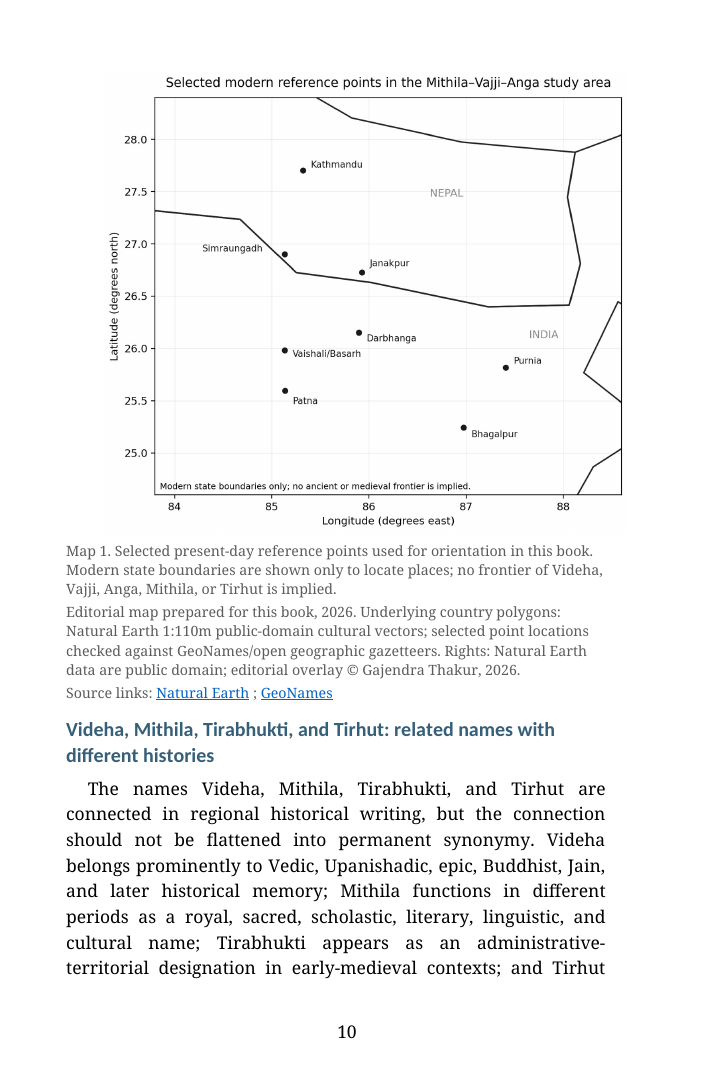
Mithila · Vajji · Anga
Chapter-specific source notes
- Primary chapter witness. Gajendra Thakur, Decoding the Panji of Mithila — Volume VI, formal Chapter 23, PDF pp. 220-222; formal Chapter 23. The HTML transcription is generated from the commit-pinned source PDF and retains the chapter boundary recorded in this edition.
- Internal structure. The repository source-heading inventory records 5 subordinate headings for this chapter: “Why Vocabulary Matters”; “Representative Vocabulary Table”; “Titles as Social Evidence”; “Vocabulary and Rank”; “Source Note”.
- Digital editorial method. The page keeps the preserved source text distinct from generated navigational, concordance, visual, and provenance apparatus. The synthetic reconstruction is explanatory only and is not evidence for an individual lineage or a determination of social or marital status.