Decoding the Panji of Mithila · Volume VI · Chapter 24
Biji Purush and the Vamshavali Logic
Chapter 24 — Biji Purush and the
Vamshavali Logic
The Panji system is built around memory anchors. Among
these, बीजी पुरुष is one of the most important. It identifies the
earliest known founding ancestor of a lineage, while mool and
moolgram organize the place-memory around that ancestor.
What Is Biji Purush?
A बीजी पुरुष is the known seed-person of a lineage. He is not
always the biological first man in an absolute sense; he is the
earliest remembered and recordable ancestor from whom a
branch can be organized. The term therefore belongs to
archival memory, not mythology.
© Gajendra Thakur | 221
Decoding the Panji of Mithila, Volume VI
How Biji Purush Connects with Mool and
Moolgram
A mool records an ancestral root; a moolgram records the
village or settlement memory attached to that root; a Biji
Purush gives the human anchor. Together, these form the logic
of Vamshavali. The system can connect multiple later villages to
a single older mool if the source recognizes a common descent
frame.
Patra Number, Branch, and Descendant Cluster
The Panji entry often compresses several coordinates: patra
number, mool, branch, person, spouse or daughter-line
relation, and descendants. A modern reader should not treat
these as separate facts. They are coordinates in one memory
system.
Mool identifies the root-place or root-line.
Moolgram identifies the village memory or later settlement
frame.
Biji Purush identifies the founding remembered ancestor.
Patra number anchors the written record.
Branch and descendant clusters show how the root spread
across villages and social routes.
Vamshavali as Map of Memory
Vamshavali is not merely ancestry. It is a map of remembering:
who was recognized, where the line was anchored, which later
village carried it, and how descendants were grouped. Dushan
entries become intelligible only when this Vamshavali logic is
understood.
Source Note
Based on Chapter 24 plan and the source explanation that Panji
collection treated Biji Purush and moolgram as central anchors
for organizing kualik identity and lineage memory.
© Gajendra Thakur | 222
Decoding the Panji of Mithila, Volume VISource structure and verification apparatus
Editorial source apparatus. This apparatus is descriptive, not interpretive. It records the source-controlled structure used to verify that this page corresponds to formal Chapter 24 of Decoding the Panji of Mithila — Volume VI. The chapter text above is preserved from PDF pp. 222-224; formal Chapter 24 in the commit-pinned authoritative source. It is not merged with a neighboring chapter, appendix, annexure, or independent front/back-matter unit. The internal headings below come from the repository’s source-heading inventory and are retained as navigational and audit evidence; showing them here does not turn those headings into separate publications or add claims that are absent from the source.
Internal source headings
- What Is Biji Purush?
- How Biji Purush Connects with Mool and Moolgram
- Patra Number, Branch, and Descendant Cluster
- Vamshavali as Map of Memory
- Source Note
Source-text concordance
Biji · Purush · Vamshavali · Logic · system · built · around · memory · anchors · important · identifies · earliest · known · founding · ancestor · lineage · mool · moolgram · organize · place-memory · seed-person · always · biological · first · absolute · sense · remembered · recordable · branch · organized · term · therefore · belongs · archival · mythology · Gajendra · Thakur · Decoding · Connects · records · ancestral · root · village · settlement · attached · gives · human · anchor · Together · form · connect · multiple · later · villages · single · older · recognizes · common · descent · frame · Patra · Number · Descendant · Cluster · entry · often · compresses · several · coordinates · person · spouse · daughter-line · relation · descendants · modern · reader · treat · separate · facts · root-place
Boundary verification. In the formal sequence this chapter follows Volume VI Chapter 23, “Panji Vocabulary: Offices, Titles, Scholars, and Social Rank” and precedes Volume VI Chapter 25, “Up-Tip and Nagaram: Regional Branching and the Pachhwari Par System”. The chapter extractor begins at the verified formal Chapter 24 marker and stops at the next verified formal chapter marker; for a final chapter it stops before recognized book-level back matter. The concordance above is generated only from distinct terms already present in this chapter’s preserved source text. It is provided for discovery, comparison, and audit, not as an automated judgment about persons, lineages, status, kinship, marriage eligibility, or historical truth.
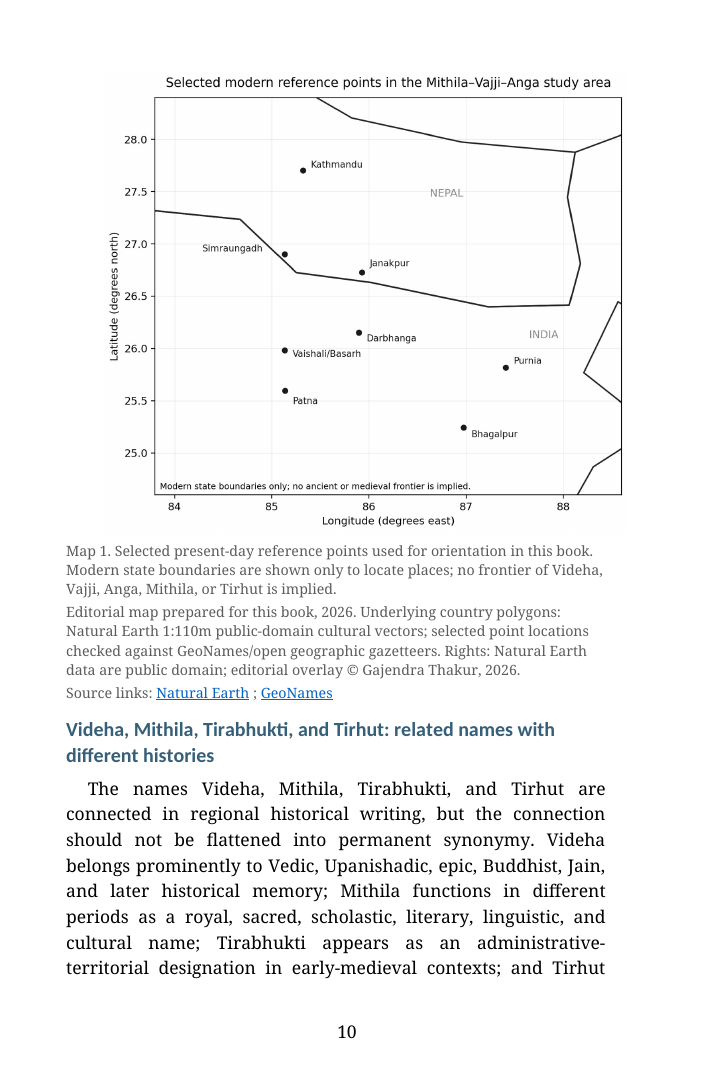
Illustrated research apparatus
Mithila · Vajji · Anga
Chapter-specific source notes
- Primary chapter witness. Gajendra Thakur, Decoding the Panji of Mithila — Volume VI, formal Chapter 24, PDF pp. 222-224; formal Chapter 24. The HTML transcription is generated from the commit-pinned source PDF and retains the chapter boundary recorded in this edition.
- Internal structure. The repository source-heading inventory records 5 subordinate headings for this chapter: “What Is Biji Purush?”; “How Biji Purush Connects with Mool and Moolgram”; “Patra Number, Branch, and Descendant Cluster”; “Vamshavali as Map of Memory”; “Source Note”.
- Digital editorial method. The page keeps the preserved source text distinct from generated navigational, concordance, visual, and provenance apparatus. The synthetic reconstruction is explanatory only and is not evidence for an individual lineage or a determination of social or marital status.