Decoding the Panji of Mithila · Volume VI · Chapter 25
Up-Tip and Nagaram: Regional Branching and the Pachhwari Par System
Chapter 25 — Up-Tip and Nagaram:
Regional Branching and the Pachhwari
Par System
The Panji system was not a single flat register. It consisted of
several related books and functional registers. Up-Tip and
Nagaram show how regional branching and social division
entered the archival system.

The Seven Kinds of Panji and the Branching
Problem
The source distinguishes multiple Panji forms: मूल, शाखा, गोत्र, पत्र,
दूषण, उतेढ़, and अस्वाजन्यपत्र. This already shows that Panji was a
network, not one book. Each form served a particular function:
origin, branch, gotra, offspring, Dushan, sapinda clearance, or
aswajana reference.

Up-Tip / Sotipura
Up-Tip, also called Sotipura in the source description, belongs
to the branch-making phase after Madhav Singh’s order. It
helped separate certain social or regional lines for functional
use. It should be read as a record-management category, not
simply as a caste label.

Nagaram / Pachhwari Par
Nagaram, associated with the Pachhwari Par frame, records
another mode of regional organization. Its presence beside Up-
Tip, gotra Panji, and patra Panji shows that the archive had to
manage geography, marriage eligibility, and social status at the
same time.

                       © Gajendra Thakur | 223
               Decoding the Panji of Mithila, Volume VI

Why Regional Books Matter
Regional books matter because people moved. Branches
formed across villages; status labels changed; marriage
eligibility had to be checked across both paternal and maternal
lines. A single universal list could not handle all of this. The
Panji system therefore developed as a layered administrative
network.

Source Note
Based on Chapter 25 plan and the source statements that
earlier mool Panji were common, later branch books were
made, and that Up-Tip/Sotipura, Nagaram/Pachhwari Par, gotra
Panji, and patra Panji were recorded in Mithilakshar.
Source structure and verification apparatus
Editorial source apparatus. This apparatus is descriptive, not interpretive. It records the source-controlled structure used to verify that this page corresponds to formal Chapter 25 of Decoding the Panji of Mithila — Volume VI. The chapter text above is preserved from PDF pp. 224-225; formal Chapter 25 in the commit-pinned authoritative source. It is not merged with a neighboring chapter, appendix, annexure, or independent front/back-matter unit. The internal headings below come from the repository’s source-heading inventory and are retained as navigational and audit evidence; showing them here does not turn those headings into separate publications or add claims that are absent from the source.
Internal source headings
- The Seven Kinds of Panji and the Branching Problem
- Up-Tip / Sotipura
- Nagaram / Pachhwari Par
- Why Regional Books Matter
- Source Note
Source-text concordance
Up-Tip · Nagaram · Regional · Branching · Pachhwari · System · single · flat · register · consisted · several · related · books · functional · registers · show · social · division · entered · archival · Seven · Kinds · Problem · distinguishes · multiple · forms · already · shows · network · book · form · served · particular · function · origin · branch · gotra · offspring · Dushan · sapinda · clearance · aswajana · reference · Sotipura · called · description · belongs · branch-making · phase · Madhav · Singh’s · order · helped · separate · certain · lines · read · record-management · category · simply · caste · label · associated · frame · records · another · mode · organization · presence · beside · patra · archive · manage · geography · marriage · eligibility · status · time · Gajendra · Thakur
Boundary verification. In the formal sequence this chapter follows Volume VI Chapter 24, “Biji Purush and the Vamshavali Logic” and precedes Volume VI Chapter 26, “Panji, Hierarchy, and Social Damage”. The chapter extractor begins at the verified formal Chapter 25 marker and stops at the next verified formal chapter marker; for a final chapter it stops before recognized book-level back matter. The concordance above is generated only from distinct terms already present in this chapter’s preserved source text. It is provided for discovery, comparison, and audit, not as an automated judgment about persons, lineages, status, kinship, marriage eligibility, or historical truth.
Illustrated research apparatus
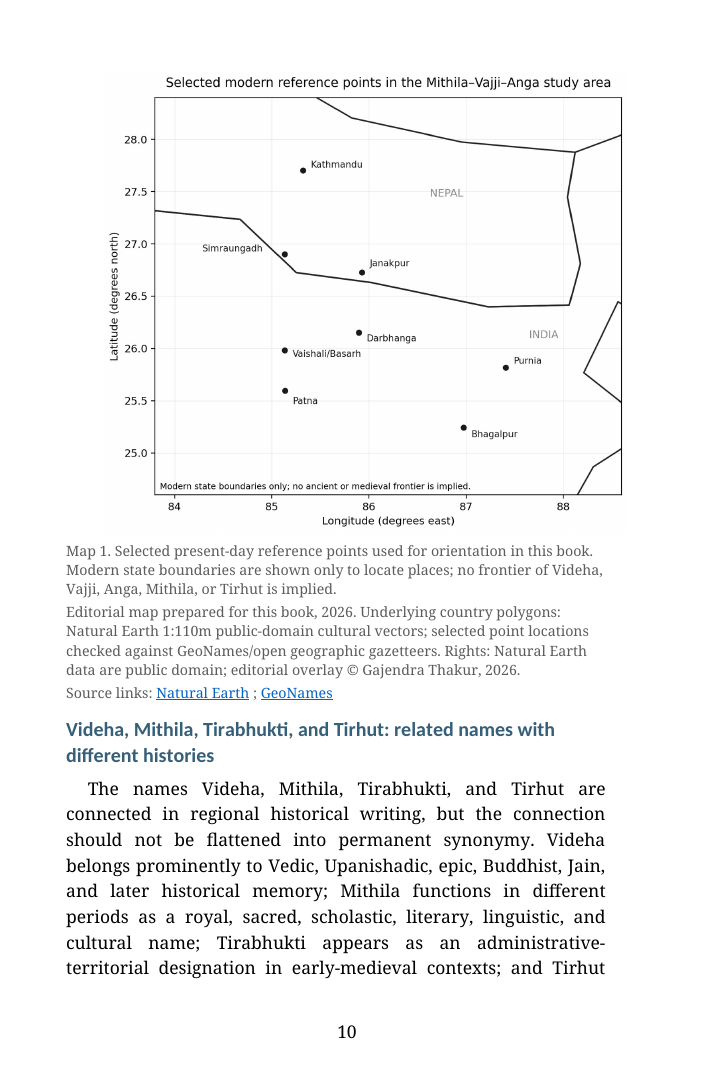
Mithila · Vajji · Anga
Chapter-specific source notes
- Primary chapter witness. Gajendra Thakur, Decoding the Panji of Mithila — Volume VI, formal Chapter 25, PDF pp. 224-225; formal Chapter 25. The HTML transcription is generated from the commit-pinned source PDF and retains the chapter boundary recorded in this edition.
- Internal structure. The repository source-heading inventory records 5 subordinate headings for this chapter: “The Seven Kinds of Panji and the Branching Problem”; “Up-Tip / Sotipura”; “Nagaram / Pachhwari Par”; “Why Regional Books Matter”; “Source Note”.
- Digital editorial method. The page keeps the preserved source text distinct from generated navigational, concordance, visual, and provenance apparatus. The synthetic reconstruction is explanatory only and is not evidence for an individual lineage or a determination of social or marital status.