Decoding the Panji of Mithila · Volume VI · Chapter 26
Panji, Hierarchy, and Social Damage
Chapter 26 — Panji, Hierarchy, and
Social Damage
Every archive has a cost. Panji preserved memory, regulated
marriage, protected lines from confusion, and gave Mithila an
extraordinary genealogical discipline. But the same system also
helped produce hierarchy, internal stratification, and social
damage.

From Order to Hierarchy
A system created to organize descent can become a system of
ranking. The source itself criticizes the later development of
internal stratification among Brahmin and Kayastha
communities. Once records become instruments of status, the
record-keeper’s ethical role becomes fragile.

Panjikar Decline and the Bikaua Problem
The source laments the decline of Panjikar selflessness,
truthfulness, and trustworthiness, and links this decline to the

                     © Gajendra Thakur | 224
                Decoding the Panji of Mithila, Volume VI

rise of a Bikaua class. This is a major internal critique: the
problem    is   not   only    outside  attack    or    modern
misunderstanding, but corruption inside the custodianship of
memory.

Child Marriage and Widowhood
The same critique connects Panji-based hierarchy to child
marriage and a sharp growth in widowhood. This is essential
for reading Chapters 15 and 21. Widowhood in Dushan Panji is
not an isolated women’s issue; it is tied to the larger machinery
of marriage control and status preservation.

The Absence of Reform Movements
The source also notes the absence of strong reform movements
in favor of widow remarriage and against child marriage in
Mithila. This admission must remain in the book because it
turns the study of Panji from antiquarian curiosity into social
history.

Archive and Damage
The difficult conclusion is that Panji preserved history and also
preserved the evidence of harm. The ethical task today is not to
destroy the archive, nor to romanticize it. The task is to read it
honestly: as memory, as discipline, as hierarchy, and as a
witness to suffering.

Source Note
Based on Chapter 26 plan and the source critique that Panji’s
purpose was inverted into internal stratification, Panjikar
decline, Bikaua formation, child marriage, increased
widowhood, and lack of reform movements.

                      © Gajendra Thakur | 225
               Decoding the Panji of Mithila, Volume VI
Source structure and verification apparatus
Editorial source apparatus. This apparatus is descriptive, not interpretive. It records the source-controlled structure used to verify that this page corresponds to formal Chapter 26 of Decoding the Panji of Mithila — Volume VI. The chapter text above is preserved from PDF pp. 225-227; formal Chapter 26 in the commit-pinned authoritative source. It is not merged with a neighboring chapter, appendix, annexure, or independent front/back-matter unit. The internal headings below come from the repository’s source-heading inventory and are retained as navigational and audit evidence; showing them here does not turn those headings into separate publications or add claims that are absent from the source.
Internal source headings
- From Order to Hierarchy
- Panjikar Decline and the Bikaua Problem
- Child Marriage and Widowhood
- The Absence of Reform Movements
- Archive and Damage
- Source Note
Source-text concordance
Hierarchy · Social · Damage · Every · archive · cost · preserved · memory · regulated · marriage · protected · lines · confusion · gave · extraordinary · genealogical · discipline · system · helped · produce · internal · stratification · Order · created · organize · descent · become · ranking · criticizes · later · development · Brahmin · Kayastha · communities · records · instruments · status · record-keeper’s · ethical · role · becomes · fragile · Panjikar · Decline · Bikaua · Problem · laments · selflessness · truthfulness · trustworthiness · links · Gajendra · Thakur · Decoding · rise · class · major · critique · outside · attack · modern · misunderstanding · corruption · inside · custodianship · Child · Widowhood · connects · Panji-based · sharp · growth · essential · reading · Chapters · Dushan · isolated · women’s · issue · tied · larger
Boundary verification. In the formal sequence this chapter follows Volume VI Chapter 25, “Up-Tip and Nagaram: Regional Branching and the Pachhwari Par System” and precedes Volume VI Chapter 27, “Plagiarism, Ownership, and the Struggle over Panji Knowledge”. The chapter extractor begins at the verified formal Chapter 26 marker and stops at the next verified formal chapter marker; for a final chapter it stops before recognized book-level back matter. The concordance above is generated only from distinct terms already present in this chapter’s preserved source text. It is provided for discovery, comparison, and audit, not as an automated judgment about persons, lineages, status, kinship, marriage eligibility, or historical truth.
Illustrated research apparatus
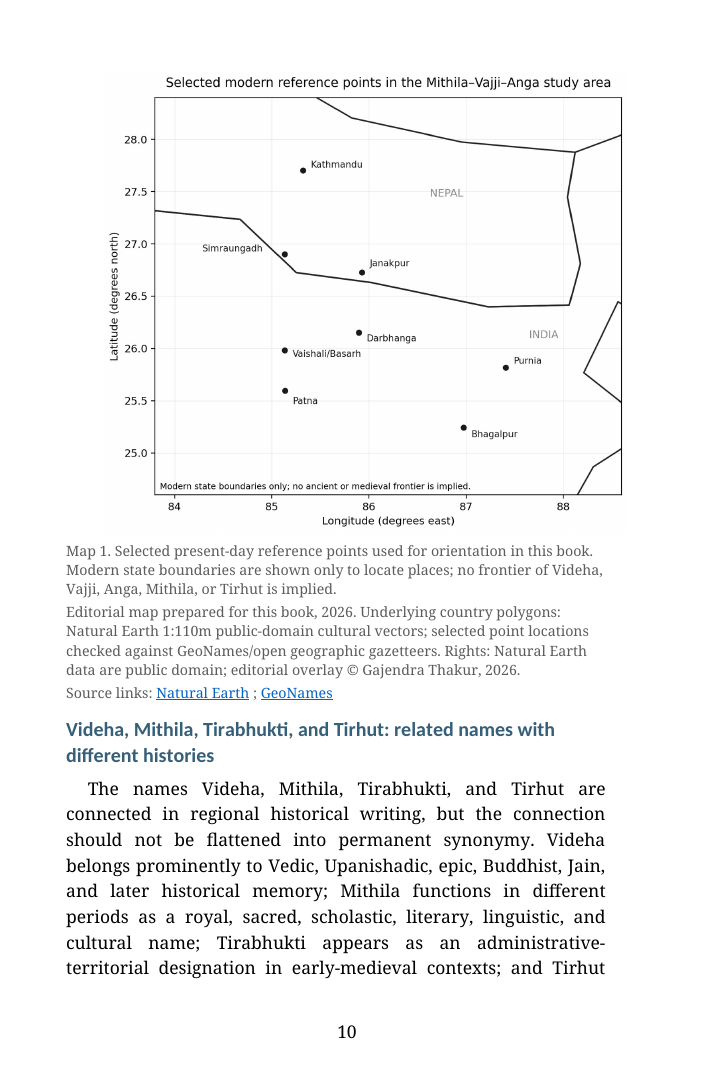
Mithila · Vajji · Anga
Chapter-specific source notes
- Primary chapter witness. Gajendra Thakur, Decoding the Panji of Mithila — Volume VI, formal Chapter 26, PDF pp. 225-227; formal Chapter 26. The HTML transcription is generated from the commit-pinned source PDF and retains the chapter boundary recorded in this edition.
- Internal structure. The repository source-heading inventory records 6 subordinate headings for this chapter: “From Order to Hierarchy”; “Panjikar Decline and the Bikaua Problem”; “Child Marriage and Widowhood”; “The Absence of Reform Movements”; “Archive and Damage”; “Source Note”.
- Digital editorial method. The page keeps the preserved source text distinct from generated navigational, concordance, visual, and provenance apparatus. The synthetic reconstruction is explanatory only and is not evidence for an individual lineage or a determination of social or marital status.